The best equipment in DARK is not a conventional sword-and-gun loadout. Eric Bane’s top-tier setup is the crossbow for silent ranged kills, Shadow Leap for instant repositioning, Vampire Vision for route planning, and a disciplined investment in stealth and blood-management skills. DARK has no traditional loot ladder, so this tier list ranks the game’s usable weapons, vampire powers, and upgrades by reliability, ammunition efficiency, and how well they preserve stealth.
That distinction matters. The 2013 stealth-action game from Realmforge Studios and Kalypso Media presents itself like a vampire RPG, but it doesn’t shower you with swords, armor sets, or randomly rolled equipment. Your real progression comes from experience points, skill upgrades, consumables, and the tools found within each mission. If you approach DARK like a cover shooter, its combat feels clumsy. If you build around silence, line-of-sight control, and carefully chained powers, Eric becomes dramatically more dangerous.
DARK weapon tier list at a glance
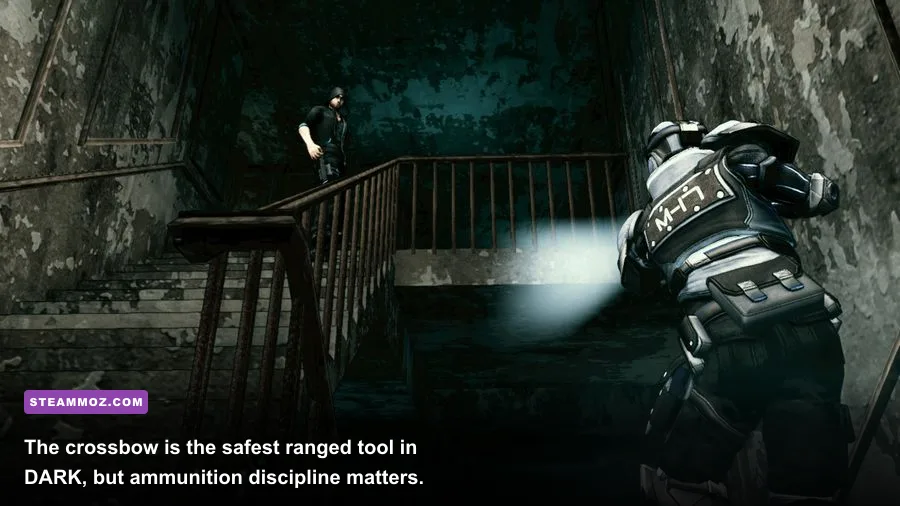
The short version is simple: the crossbow is the best actual weapon, while Shadow Leap is the best overall ability. Throwing knives are excellent for isolated targets, but their limited supply makes them a situational tool rather than a complete build foundation. Firearms can rescue a failed stealth attempt, yet they rank low because noise attracts attention and their ammunition is too valuable to waste on ordinary guards.
| Rank | Weapon or ability | Why it ranks here | Best use |
|---|---|---|---|
| S-Tier | Crossbow | Silent, accurate, and effective at picking off exposed enemies | Opening an encounter without triggering alarms |
| S-Tier | Shadow Leap | Exceptional mobility and escape potential | Crossing gaps, reaching cover, and resetting detection |
| S-Tier | Vampire Vision | Reveals patrols, routes, and interactive objectives | Planning every room before moving |
| A-Tier | Domination | Can remove a dangerous target from the fight without a loud exchange | Controlling isolated guards or creating openings |
| A-Tier | Throwing knives | Fast silent kills with no reload animation | Close and mid-range isolated enemies |
| B-Tier | Blood Rage | Strong emergency damage but encourages risky exposure | Finishing a fight after stealth has already failed |
| B-Tier | Firearms | Useful damage, but noise and limited ammunition reduce value | Emergency defense and heavily armed encounters |
| C-Tier | Basic melee attacks | Reliable at point-blank range but vulnerable against groups | Single stunned targets and last-resort finishes |
There’s an important caveat with this ranking: the best option changes depending on whether you’re still undetected. A crossbow bolt fired from concealment is S-Tier. The same crossbow becomes much less impressive when three armed enemies are already searching the room. DARK rewards the first decision in an encounter more than the last one.

🎮 DARK
Looking to experience this game? Grab your digital key directly on our store for $2.99.
View on Steammoz Store →S-Tier equipment and powers you should prioritize
Crossbow
The crossbow is the closest thing DARK has to a universally dependable weapon. It gives Eric a quiet way to remove a guard before entering a room, and that first silent kill often determines whether the entire area becomes manageable. Use it against enemies standing alone, especially those positioned near patrol routes or alarm-sensitive spaces.
Don’t treat every visible target as a crossbow target. A corpse in an obvious location can still compromise the route if another guard discovers it. Before firing, activate Vampire Vision, study the patrol cycle, and identify where the body will land. The strongest crossbow shot is one that removes a target and leaves no witness with a reason to investigate.
The weapon also works best when you think in terms of angles rather than distance. DARK’s stealth spaces are built around corners, balconies, crates, and narrow sightlines. Fire from a position that offers an immediate retreat. If the shot fails to kill or the target survives long enough to react, you’ll want Shadow Leap or a nearby hiding place ready.
Shadow Leap
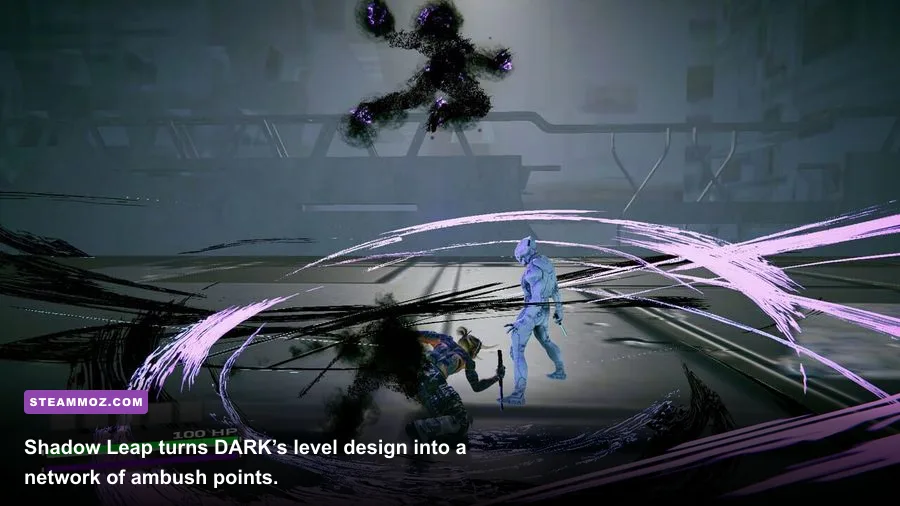
Shadow Leap is the best upgrade for players who value consistency. It lets Eric move rapidly through darkness and reach positions that would otherwise require a long, exposed walk. More importantly, it provides a way out when a patrol turns at the wrong moment. Many failed stealth attempts become recoverable once you stop thinking of Shadow Leap as an attack and start treating it as a movement reset.
Use it before you need it. Waiting until guards are already firing gives you fewer safe destinations and makes the ability feel unreliable. Mark the next patch of darkness first, then move. The ideal sequence is Vampire Vision to identify the route, Shadow Leap to cross the dangerous section, and a silent takedown once you’ve reached the new angle.
Vampire Vision
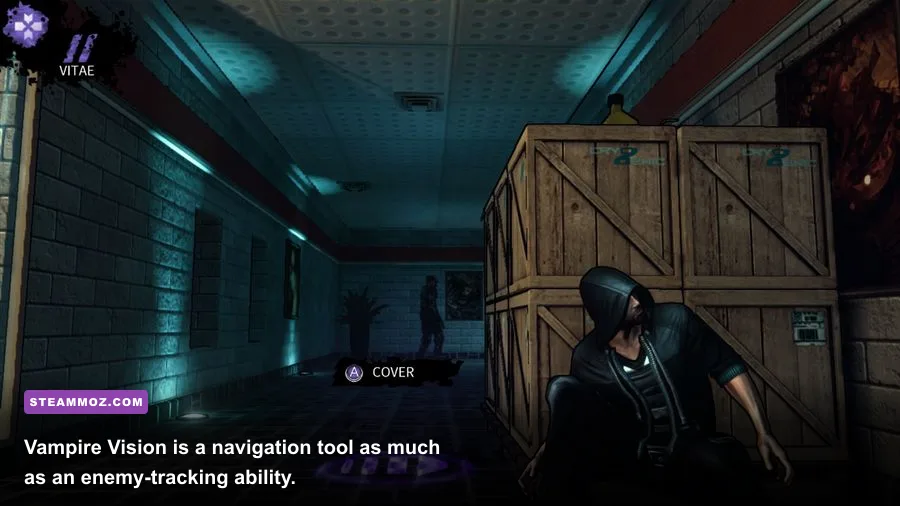
Vampire Vision doesn’t deal damage, but it arguably saves more attempts than any weapon. It helps you read the room, recognize hostile positions, and locate the route that the normal lighting hides. Turn it on before opening doors or stepping into a new corridor. The information advantage is especially valuable in the game’s larger areas, where a single careless movement can pull several guards into the same search.
Its real strength is planning. You can identify which enemy is isolated, which patrol overlaps another, and which corner provides a safe recovery position. Don’t sprint through a room simply because the nearest guard is looking away. Check the next sightline first. DARK often places a second observer beyond the target you initially notice.
A-Tier tools that complete a stealth build
Domination
Domination is one of the most useful powers for breaking a room’s defensive rhythm. It can turn an isolated human enemy into a temporary asset or remove a threat without forcing Eric into a loud exchange. Its value depends heavily on target selection. Use it on the guard whose position blocks your route, not necessarily the guard closest to you.
The best Domination setup begins with reconnaissance. Scan the room with Vampire Vision, wait for the patrol to separate, then use the controlled target to create an opening or thin the opposition. Don’t activate it in the middle of a crowded firefight and expect a miracle. The power is strongest when the room is still calm.
Throwing knives
Throwing knives deserve an A rather than S because they are limited, but they’re excellent in the situations they’re designed for. They’re quick, quiet, and useful when a crossbow shot would expose your position or when an enemy moves too close for a clean ranged attack. They’re particularly good for finishing an isolated guard near a corner.
Save knives for targets that cannot be reached safely. If you can approach from behind and perform a silent takedown without creating a body-discovery problem, keep the knife. Ammunition conservation matters more than speed during the early missions, when your options for recovering from mistakes are thinner.
Stealth upgrades
Stealth upgrades don’t appear on a weapon rack, but they belong in any best-equipment discussion because they improve every other tool. Reduced detection risk gives you more time to line up crossbow shots, reach melee range, and reposition with Shadow Leap. A stealth-first character also spends fewer resources on healing and emergency combat.
| Upgrade priority | Recommended investment | Practical payoff | Who benefits most |
|---|---|---|---|
| 1 | Stealth and movement improvements | Longer safe windows and easier repositioning | Players pursuing clean mission clears |
| 2 | Shadow Leap improvements | More reliable movement between cover points | Players who use vertical routes |
| 3 | Domination improvements | Better control over isolated threats | Players who manipulate patrols |
| 4 | Ranged weapon improvements | More dependable silent openings | Players who plan encounters from distance |
| 5 | Direct combat improvements | Higher survival odds after detection | Players who accept occasional firefights |
This is also where the game differs from a conventional action RPG. You aren’t chasing a higher item level. You’re buying better decision-making tools. A movement upgrade that helps you avoid one firefight can be worth more than a damage improvement that only matters after stealth has failed.
B-Tier weapons and why firearms stay situational
Blood Rage
Blood Rage is satisfying because it gives Eric a burst of aggression when a careful plan collapses. It can help finish enemies at close range and turn a dangerous exchange in your favor. The problem is that it encourages exactly the behavior DARK usually punishes: standing in the open and trading damage.
Use Blood Rage as a bridge to safety, not as your default opener. Trigger it to eliminate the enemy currently blocking your retreat, then break line of sight. If you activate it simply because a target is nearby, you may win the exchange and still lose the room when the noise draws reinforcements.
Firearms
Guns are useful, but they’re deliberately awkward within a stealth-focused game. Their damage can save you against armed enemies, yet the noise changes the encounter immediately. Ammunition is another reason to keep them in B-Tier. Burning rounds on a single guard can leave you underprepared for a later section where stealth is difficult or an elite enemy forces a direct confrontation.
Keep firearms for emergencies, clustered threats, and situations where the alarm has already been raised. Once stealth is gone, stop pretending the room is still a stealth puzzle. Find cover, prioritize the enemy with the clearest line of fire, and move between safe positions instead of standing still to absorb damage.
Basic melee attacks
Eric’s melee options are functional but not a replacement for stealth. They work against a single vulnerable opponent, especially after you’ve used darkness or a power to close the distance. They become dangerous against groups because recovery time and positioning matter more than raw damage. If two enemies can reach you at once, the supposedly easy takedown can become a health-draining brawl.
Use melee as a controlled finish. Approach from behind, confirm that no second patrol is entering the area, and keep a retreat route open. You can find more general stealth-action positioning advice in Steamoz’s Daymare 1998 starting-build guide, even though DARK’s supernatural tools make its encounters distinct.
The best DARK loadout for a first playthrough
For most players, the safest loadout is crossbow, throwing knives, Shadow Leap, Vampire Vision, and Domination. This combination covers silent ranged damage, close-range elimination, scouting, mobility, and crowd manipulation. It also leaves room to recover from a mistake without immediately resorting to gunfire.
| Slot or role | Best choice | How to use it | Common mistake |
|---|---|---|---|
| Primary weapon | Crossbow | Remove isolated guards before entering a room | Firing before checking the body’s visibility |
| Silent backup | Throwing knives | Finish close targets or solve awkward angles | Spending them on easy melee takedowns |
| Mobility | Shadow Leap | Cross exposed areas and escape searches | Waiting until every exit is covered |
| Information | Vampire Vision | Map patrols before committing to movement | Turning it off before checking the next sightline |
| Control | Domination | Separate or neutralize the most disruptive enemy | Using it in a crowded firefight |
| Emergency option | Firearm or Blood Rage | Finish a failed stealth encounter and retreat | Opening every battle with loud damage |
On a first run, prioritize upgrades that make this loadout more forgiving rather than chasing maximum damage. DARK’s missions contain enough blind corners and overlapping patrols that a mobility or stealth improvement can prevent multiple reloads. If you prefer a louder approach, the Death Howl weapon ranking offers a useful comparison for thinking about weapon roles, but don’t copy a conventional damage-first philosophy into DARK.
How to use the tier list during real encounters
Before entering a room
Activate Vampire Vision, identify every visible patrol, and locate darkness on both sides of the entrance. You want an opening position and a recovery position. If you can’t see a safe retreat, don’t start the fight yet. Wait for the patrol cycle to change or find another route.
During a clean stealth run
Use the crossbow for the target that creates the biggest route problem, not simply the nearest target. Then move the body out of obvious sight if the game gives you enough time. Shadow Leap is best saved for the next dangerous crossing, while Domination can disrupt a second patrol when the room’s timing is awkward.
After detection
Don’t panic-fire. Break sight immediately, use Shadow Leap to reach darkness, and wait for the search to lose momentum. If enemies already have your position, switch to Blood Rage or a firearm only long enough to eliminate the nearest threat. The objective is to regain control, not to prove that Eric can win a fair gunfight.
That mindset is the difference between DARK’s strongest and weakest equipment. A tool is valuable because it preserves your options. The crossbow preserves silence, Vampire Vision preserves information, Shadow Leap preserves mobility, and Domination preserves control. Firearms and melee mostly preserve your life after those options have already been spent.
Final ranking and upgrade verdict
If you only remember one ranking, make it this: Shadow Leap and the crossbow are S-Tier priorities, Vampire Vision is essential utility, Domination and throwing knives are A-Tier specialists, and firearms, Blood Rage, and basic melee belong in the emergency category. Build around stealth first, then add enough direct-combat power to survive the occasional mistake.
DARK becomes much less frustrating when you stop searching for a mythical best sword or perfect armor set. Its equipment game is about sequencing abilities through a level: scout with Vampire Vision, remove the right target with the crossbow, cross the danger zone with Shadow Leap, and use Domination or knives when the patrol pattern refuses to cooperate.
For more weapon-focused RPG rankings, see Steamoz’s Cossacks 3 weapon tier list and Disciples: Liberation equipment guide. For DARK itself, the official Steam page, Kalypso Media’s official site, and the game’s Steam Community hub remain the best places to check platform details and current community fixes.
One final practical warning: save before experimenting with a loud approach. DARK is at its best when you feel clever, not overpowered. The right tier list won’t turn every encounter into a damage test; it will help you choose the tool that keeps the next ten seconds under your control.