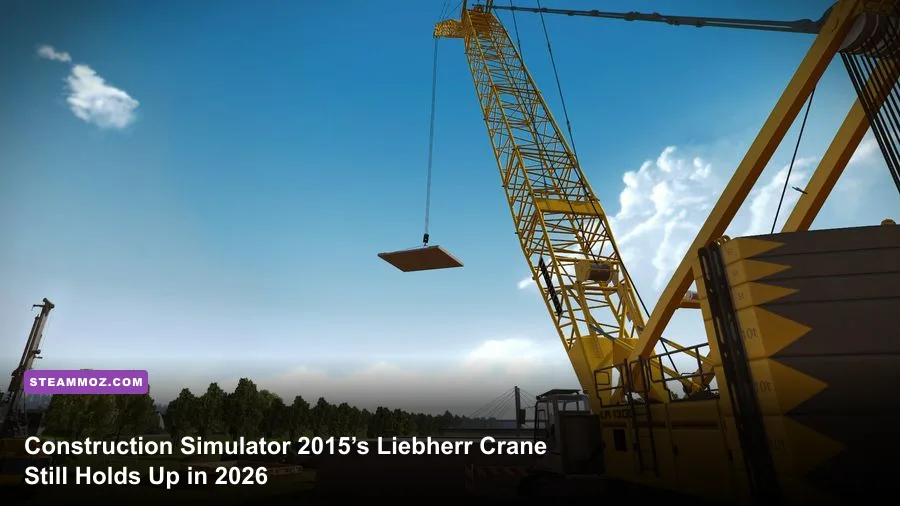
Yes, Construction Simulator 2015 is still worth playing in 2026 if you specifically enjoy methodical vehicle simulation—and the Liebherr LTM 1300-6.2 is one of its best reasons to return. This is not a modern, deeply simulated crane package with a live service roadmap. It is an older PC construction game with simple physics, dated presentation, and wonderfully satisfying machinery routines. The Liebherr DLC works because it turns a huge six-axle mobile crane into a practical problem-solving tool rather than a decorative vehicle.
The important distinction is what you expect from it. If you want realistic load charts, fully modeled road regulations, multiplayer activity, and modern controller support, this package will feel limited. If you want to drive a serious crane across a compact map, deploy outriggers, position a boom, attach a load, and complete a lift without the game burying you in spreadsheets, it remains surprisingly playable. In 2026, I would recommend it on a deep discount, especially for players who already own the base game.
What the Liebherr LTM 1300-6.2 Adds
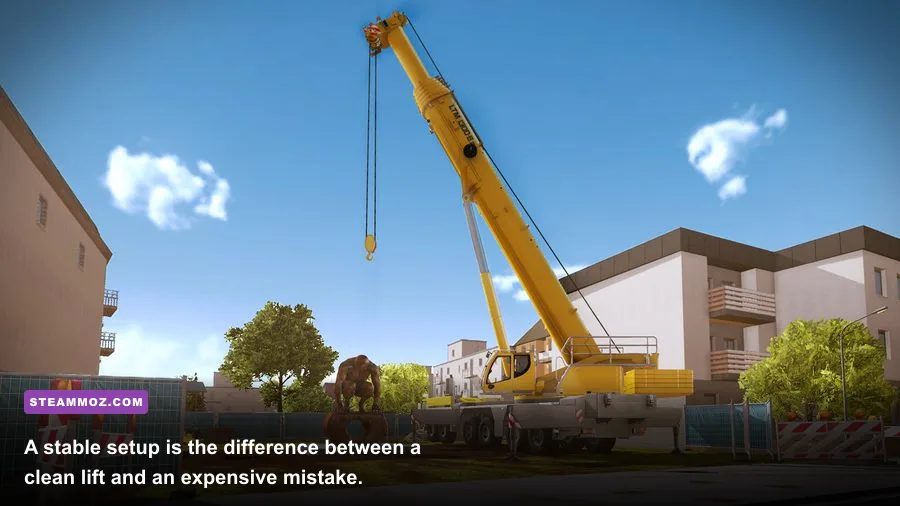
The Liebherr LTM 1300-6.2 is the headline attraction here: a six-axle all-terrain mobile crane based on Liebherr’s real LTM 1300-6.2. In the real world, that machine belongs to the 300-ton class and is designed to travel between sites before handling heavy lifts with its telescopic boom and supporting equipment. Construction Simulator 2015 compresses that complexity into a manageable vehicle, but it keeps the crucial rhythm intact.
You drive the crane to a worksite, select the vehicle, deploy the stabilizers, extend the boom, connect the hook, and move the assigned load into position. The game does not ask you to calculate a full engineering lift plan. That is a feature, not a failure. The LTM feels powerful without becoming a technical certification exam.
Its value also comes from role clarity. A wheel loader is about scooping, a dump truck is about transport, and a crawler excavator is about excavation. The LTM 1300-6.2 is about access and placement. It lets you reach over obstacles and put a load where ordinary vehicles cannot. The missions built around that idea are noticeably more interesting than simply driving materials from point A to point B.
It is worth checking the official Steam page for Construction Simulator 2015 before buying, because the crane’s availability and bundle pricing can vary by edition. Also verify that you are purchasing the Liebherr content rather than only the base game.
🎮 Construction Simulator 2015: Liebherr LTM 1300 6.2
Looking to experience this game? Grab your digital key directly on our store for $1.19.
View on Steammoz Store →How the Crane Actually Plays
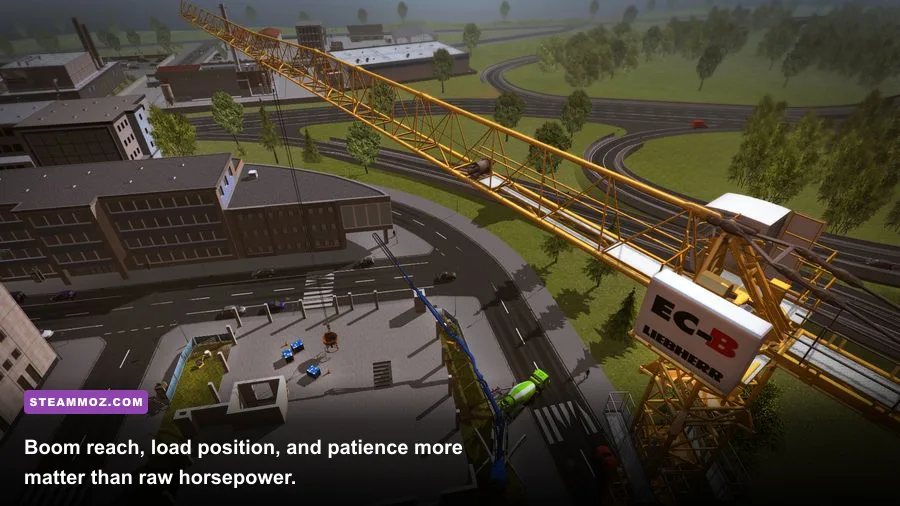
The LTM 1300-6.2’s best moments happen during setup. You cannot treat it like a normal truck, pull alongside a building, and immediately start swinging a load. The stabilizers need space, the chassis needs a sensible orientation, and the boom needs a clear path. The game’s simplified physics let you recover from some bad positioning, but careless setup still creates awkward angles and failed objectives.
Step 1: Scout the work area
Before accepting the crane controls, look at the pickup point and the destination. Check where the load begins, where it must end, and whether nearby buildings, trees, road furniture, or construction equipment will block the swing. The compact map makes these obstacles easy to underestimate. A crane that technically reaches the target may still be unable to rotate cleanly.
Step 2: Build a stable footprint
Deploy the outriggers on level ground whenever the mission allows it. The game does not expose a detailed ground-pressure model, but stability still affects how confidently you can work. Parking with one side against a curb or wedged beside another vehicle is asking for trouble. Give yourself room to extend the boom and keep the vehicle’s long body away from traffic lanes.
Step 3: Use the boom for reach, not decoration
Extending the telescopic boom too early can make the lift harder to control. Start with the shortest practical reach, position the crane, and extend only when the target requires it. A shorter boom makes the hook easier to align and reduces the amount of swinging you need to correct. The LTM is strongest when you plan the approach instead of trying to rescue a bad angle with frantic control inputs.
Step 4: Lift slowly, then rotate
Get the hook directly over the load before raising it. Once the object clears the ground, pause and let the movement settle. Rotate in controlled increments, especially when the load is near a building or another machine. The game’s cargo behavior is forgiving, but sudden direction changes create the familiar pendulum effect. Lower the load only after the placement marker is genuinely aligned.
| Crane Task | Main Risk | Reliable Counter | Best Practice |
|---|---|---|---|
| Parking | Blocked outriggers or poor angle | Scout the worksite first | Leave clearance on both sides |
| Boom extension | Overreaching the target | Use the shortest useful length | Extend after chassis positioning |
| Load pickup | Hook offset from cargo | Center the hook before lifting | Raise slowly and pause |
| Slewing | Load swing and collisions | Use small directional inputs | Rotate only after the load clears |
| Placement | Dropping outside the marker | Lower in short corrections | Prioritize alignment over speed |
This loop is straightforward, but it has tactile weight. You are not just selecting a crane from a menu; you are managing a sequence. That sequence is why the machine feels more rewarding than many of the base-game vehicles.
Where the LTM DLC Sits in the Vehicle Roster
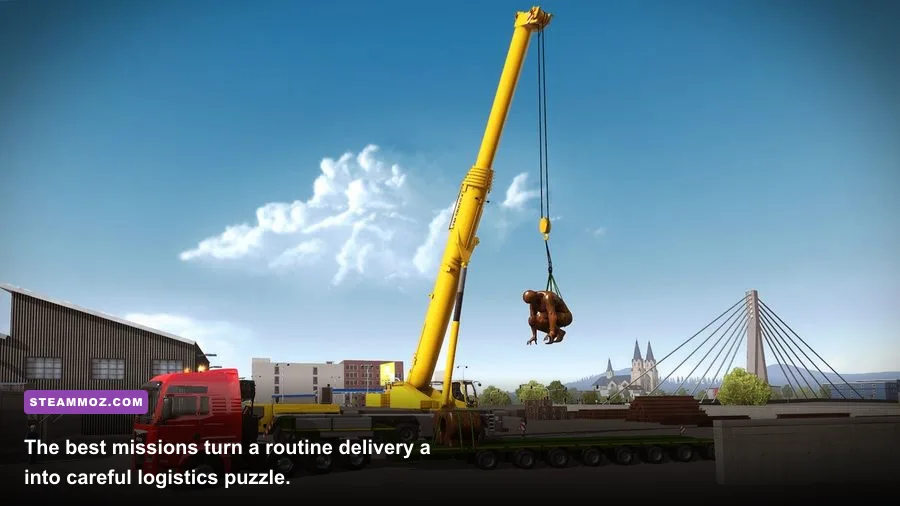
The LTM 1300-6.2 is not automatically the best vehicle for every contract. It is expensive in opportunity cost because it is designed for specialized lifts. Sending it to a basic earthmoving task is inefficient, while bringing a smaller machine to a high-reach placement job can turn a clean contract into a wrestling match.
| Vehicle Role | Strength | Weakness | When It Wins |
|---|---|---|---|
| Liebherr LTM 1300-6.2 | Reach and heavy placement | Setup time and limited versatility | High, distant, or obstructed lifts |
| Mobile construction crane | Fast access to ordinary jobs | Less reach and lifting authority | Small-to-medium site placements |
| Wheel loader | Fast bulk material handling | Cannot perform elevated lifts | Loose aggregate and short hauls |
| Excavator | Digging and trench work | Slow outside excavation tasks | Soil removal and foundation preparation |
| Dump truck | Efficient material transport | No active site manipulation | Repeated delivery routes |
That comparison explains the crane’s appeal. It is not a replacement for the rest of the fleet; it is a specialist that unlocks a different kind of job. The strongest campaign rhythm alternates between preparation, transportation, excavation, and heavy lifting. The LTM gives the latter category a clear identity.
Its weakness is that Construction Simulator 2015 does not build a genuinely detailed economy around crane ownership. You will not be balancing fuel costs, transport permits, rigging crews, or subcontractor rates in the way a dedicated management sim might. The crane is a gameplay tool first and a business asset second. Players wanting a hard financial simulation should temper their expectations.
Progression, Missions, and the 2026 Problem
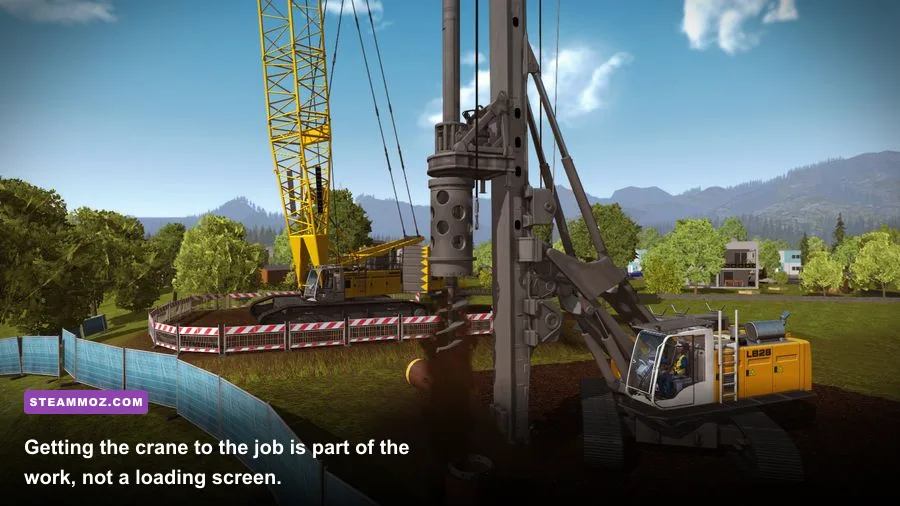
Construction Simulator 2015 still has a pleasant progression curve. Early tasks teach basic driving and loading, while later contracts gradually ask you to coordinate multiple vehicle types. The game’s two maps give the campaign enough room to establish routines, although the objectives eventually repeat their structure. A crane mission may feel fresh because of its location and load, but the underlying actions remain familiar.
That repetition is where the game’s age shows most clearly. Modern simulators are better at giving every vehicle a distinct operational workflow. Construction Simulator 2015 sometimes turns a complex job into a short list of interaction prompts. The LTM DLC improves the illusion, but it cannot completely escape the older game’s mission design.
Still, the crane creates useful self-imposed goals. Try completing a lift without repositioning after the outriggers are down. Plan the shortest driving route between the depot and the site. Use a loader or truck to prepare the worksite before the crane arrives. These small challenges turn a simple contract into a satisfying logistics exercise.
For a more modern comparison point, Steamoz’s PC troubleshooting coverage is useful when an older game’s technical quirks become part of the buying decision. The LTM package itself is not graphically demanding, but compatibility matters more than raw power on current systems.
Multiplayer can add another layer, especially when one player handles transport and another operates the crane. However, do not buy this DLC expecting a huge active community in 2026. Its strongest audience is solo players, small friend groups, and simulator fans who enjoy making their own structure inside a relatively relaxed campaign.
Graphics, Controls, and Performance on Modern PCs
Construction Simulator 2015 is easy to run by 2026 standards, but its visuals are unmistakably from the mid-2010s. The vehicle models hold up better than the environments. The Liebherr’s proportions, wheels, boom, and stabilizers communicate its purpose well, while textures, traffic behavior, lighting, and distant scenery look basic beside newer entries in the genre.
The good news is that the age helps performance. A modern mainstream PC should have no trouble exceeding the original target experience at 1080p. The biggest variables are resolution, anti-aliasing, shadow quality, view distance, and background applications. Because the crane often occupies a large portion of the screen, stable frame pacing matters more than chasing an unnecessarily high frame-rate number.
| Setting or Hardware Target | Recommended Value | Performance Effect | Visual Result |
|---|---|---|---|
| Resolution | 1080p | Low on modern GPUs | Sharp enough for crane controls and markers |
| Anti-aliasing | High, then reduce if needed | Moderate at higher resolutions | Smoother boom and vehicle edges |
| Shadows | High | Moderate in busy sites | Better contact with roads and buildings |
| View distance | High on 16GB systems | Can affect crowded scenes | Earlier visibility of worksite details |
| Texture quality | Maximum available | Usually low impact | Cleaner machinery surfaces |
| System memory | 8GB minimum target, 16GB preferred | Helps background stability | Less hitching while switching vehicles |
Input is more complicated than performance. Keyboard controls work, but crane operation feels more natural with a controller. Analog movement makes boom adjustments and rotation less abrupt, while a mouse can be useful for menus and camera control. If you encounter crashes, odd resolution behavior, or poor frame pacing, start with the Steam community hub and support links rather than immediately blaming the DLC.
Do not expect modern accessibility features, extensive camera customization, or a polished UI designed around ultrawide displays. The game is playable, but some menus and prompts feel like they were built for a 2015 monitor and controller setup. That is tolerable for a focused weekend, less so for a long-term daily sim.
What Still Works—and What Has Aged Badly
The central pleasure still works: arriving at a site with a machine that looks capable of doing something enormous, then making that machine behave through careful inputs. The LTM 1300-6.2 has presence. Driving it under power lines, lining up the chassis, extending the supports, and moving a load over a building creates a sense of scale that smaller vehicles cannot match.
The game also deserves credit for keeping failure low-stakes. You can experiment without losing an entire evening to a single incorrect lift calculation. That makes it approachable for players who like the fantasy of crane operation but do not want the uncompromising complexity of specialist simulators. The accessible design is precisely why the DLC remains easy to recommend to newcomers.
What has aged badly is the world around the crane. Traffic and pedestrians can feel artificial, missions sometimes repeat too quickly, and physics interactions lack the convincing weight found in newer construction games. The campaign also does not always explain why a particular vehicle is required, so first-time players may spend time searching menus instead of understanding the contract’s logistics.
There is also a presentational gap. The real Liebherr LTM 1300-6.2 is a highly specialized piece of engineering, but the game only models a selection of its operational ideas. If you are buying because you want real-world crane procedure, load charts, rigging details, or engineering limits, look toward a dedicated crane simulator instead. This is construction-themed gameplay, not professional training software.
Players who enjoy discovering hidden content in older games may also like Steamoz’s guides to secret locations and rewards or Everspace 2 exploration. The genres are completely different, but the same appeal applies: finding a better route and squeezing more satisfaction out of familiar systems.
Verdict: Buy It on Sale, Not Blindly
Construction Simulator 2015: Liebherr LTM 1300 6.2 is worth playing in 2026, but only for the right kind of player. It remains a strong specialist vehicle in an accessible construction sandbox, and its setup-to-placement loop is more absorbing than the game’s age might suggest. The crane gives the campaign a useful sense of scale and offers some of the most memorable worksite tasks in the package.
It is not worth paying a premium for. The dated visuals, repetitive objectives, basic physics, and uncertain multiplayer population prevent it from competing directly with newer construction simulators. Treat it as an inexpensive, focused crane experience rather than a complete modern simulation platform.
| Player Type | Recommendation | Why |
|---|---|---|
| Existing Construction Simulator 2015 owner | Strong buy on sale | Adds a distinct heavy-lift role to the fleet |
| Crane enthusiast | Conditional buy | Good accessible workflow, limited technical depth |
| Dedicated simulation veteran | Wait for a deep discount | Physics and systems may feel too simplified |
| Casual co-op group | Recommended | Easy-to-understand jobs work well with friends |
| Graphics-focused player | Skip unless curious | Vehicle models age better than the world |
My final score is 7/10 as a DLC vehicle and 6/10 as a 2026 construction simulation. The Liebherr LTM 1300-6.2 earns those points through scale, clarity, and satisfying setup. It loses them through age, repetition, and a lack of deeper crane management. Buy it alongside the base game during a sale, approach each lift deliberately, and it can still deliver a surprisingly good afternoon of virtual heavy lifting.
For more PC buying advice, Steamoz’s older-PC performance coverage offers a useful reminder: low system requirements do not automatically mean a flawless modern experience. Construction Simulator 2015 is inexpensive, approachable, and still charming—but its best case is a focused return trip, not a replacement for the latest entry in the series.