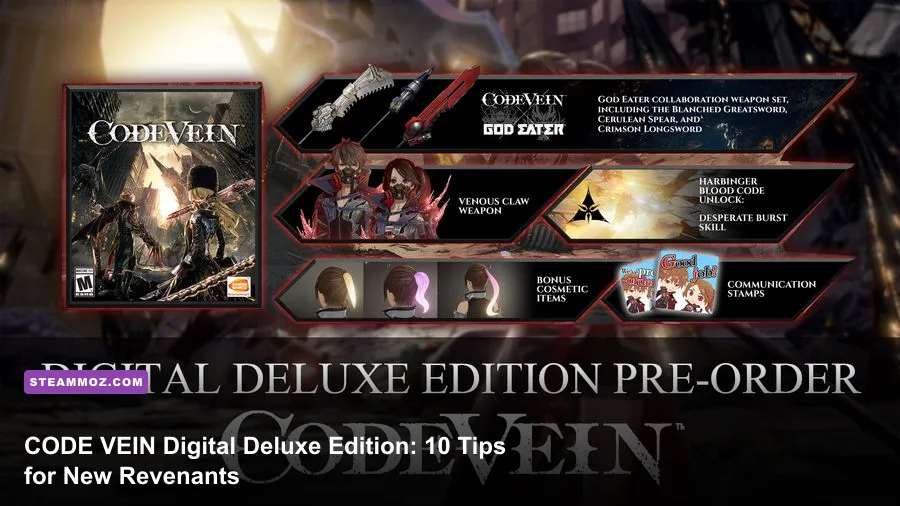
CODE VEIN Digital Deluxe Edition becomes far less punishing once you understand Blood Codes, Gift mastery, weapon scaling, and the value of patience. Start with a flexible melee build, keep a companion nearby, activate every Mistle, and treat each boss as a pattern test rather than a damage race. The Deluxe Edition also includes the base game and Season Pass content, so these habits will carry you through the main story and the three additional boss-focused DLC areas.
CODE VEIN looks like a stylish anime spin on the Souls formula, but it has its own rules. You can change your class at almost any time, Gifts are more important than raw level, and the partner AI can completely change how a fight unfolds. These are the 10 tips I wish every new Revenant knew before entering the ruined streets of the City of Falling Flame.

🎮 Get CODE VEIN Digital Deluxe Edition
Ready to dive in? Grab your copy today for just $11.99.
Check Offer1. Learn Blood Codes before chasing levels
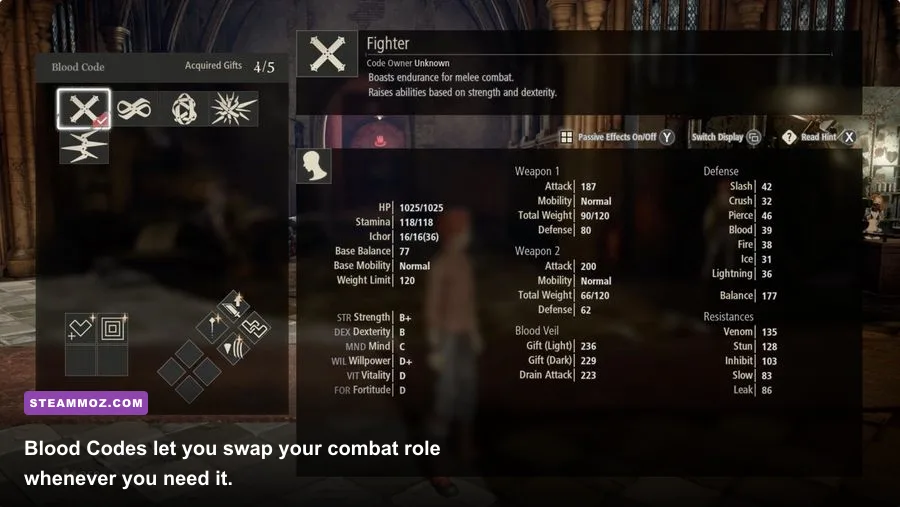
Your Blood Code is effectively your class, and CODE VEIN expects you to experiment. Fighter gives you a straightforward early melee setup, Ranger adds ranged utility, Caster favors offensive Ichor Gifts, and Prometheus rewards aggressive swordplay. Later options such as Atlas, Queenslayer, Darkseeker, and Isis specialize much more sharply.
At a Mistle, open the Blood Code menu and inspect the stat spread, weight limit, Ichor capacity, and available Gifts. The important detail is that you can equip a Blood Code you have already unlocked without permanently committing to it. This means you can use Fighter while learning the Ruined City Center, switch to Caster for a safer ranged approach, then return to Prometheus when you want better melee pressure.
Don’t assume your current level makes a Blood Code irrelevant. You can inherit Gifts from other Blood Codes by spending Haze and meeting the required conditions. Once a Gift is mastered, you can often equip it on another Blood Code, creating hybrid builds that are much stronger than the starter classes.
| Blood Code | Best New-Player Use | Key Strength | Watch Out For |
|---|---|---|---|
| Fighter | Early melee learning | Simple Strength and weapon Gifts | Limited Ichor and ranged options |
| Ranger | Safe exploration | Ranged tools and mobility | Lower durability in close combat |
| Prometheus | Fast sword builds | Dexterity, stamina, and parry tools | Light armor punishes mistakes |
| Atlas | Heavy weapons | High weight allowance and Strength | Slow dodges if weight exceeds 100% |
| Caster | Gift-focused ranged damage | High Willpower and offensive Ichor Gifts | Fragile when enemies reach you |
The official CODE VEIN Steam page is useful for checking included edition content, but the best classroom is the game’s training area. Test attack speed, dodge distance, and Gift costs there before burning valuable upgrade materials.
🎮 CODE VEIN Digital Deluxe Edition
Looking to experience this game? Grab your digital key directly on our store for $11.99.
View on Steammoz Store →2. Activate every Mistle and fully restore the map

Mistles are more than bonfires. They reveal nearby map information, unlock fast travel, restore your health and Ichor, let you change Blood Codes, and provide access to weapon and Gift management. Touch every one you find, even if the route ahead looks safe. CODE VEIN’s zones contain dead ends, hidden ladders, one-way drops, and side rooms that are easy to forget after a death.
Use the map aggressively. A partially completed map is a warning that you missed a corridor or side route. Exploration pays off through Vestiges, upgrade materials, Regeneration upgrades, and NPC quest progress. In areas such as the Cathedral of the Sacred Blood, the map is deliberately confusing: white corridors overlap visually, and a staircase can return you to a familiar-looking platform from a completely different direction.
When you reach a new zone, establish a loop. Move from the nearest Mistle, clear a manageable group, identify the next shortcut, and return before your Haze becomes uncomfortable to carry. Unlocking a door back to an earlier Mistle is often more valuable than reaching the next enemy pack. It gives you a safe recovery route and turns a long runback into a short one.
Mark mentally where you found locked doors, NPCs, and suspicious gaps. CODE VEIN rewards revisiting old locations after receiving new Blood Codes or key items. The Dried-Up Trenches and Ridge of Frozen Souls especially benefit from careful backtracking rather than a straight sprint to the boss.
3. Build around weight, scaling, and one main weapon

Weapon damage isn’t the only number that matters. Your weapon’s scaling letters, the Blood Code’s Strength, Dexterity, Willpower, and Mind values, and the weapon’s weight all interact. Most importantly, watch your mobility category. Staying at or below 50% weight gives you a normal dodge. Between 50% and 100%, you get a slower step. Above 100%, you are overloaded and lose the reliable movement that keeps you alive.
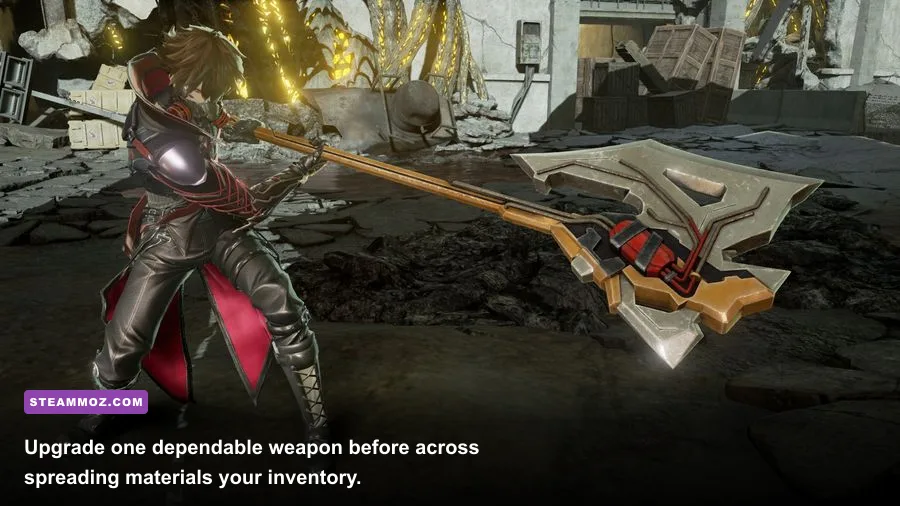
For a first run, choose one primary weapon family and upgrade it consistently. The Queenslayer Blade is an excellent balanced sword, while the Zweihander offers powerful physical hits and a useful guard-focused style. The Bardiche gives you reach without committing to the heaviest hammer animations, and the Sunset Hammer is a comfortable early option for Strength-oriented players.
Don’t upgrade five weapons simply because the materials are available. Weapon reinforcement consumes Queen’s Iron, Queen’s Steel, Queen’s Titanium, and later Queen’s Tungsten. A +3 weapon used confidently will outperform a collection of underdeveloped alternatives. Transformations also matter: Fortification improves raw damage, while Devour can help an Ichor-heavy setup. The correct choice depends on your scaling and Gift rotation, not on the largest number in the shop.
| Weapon Choice | Ideal Profile | Why It Works | Beginner Warning |
|---|---|---|---|
| Queenslayer Blade | Balanced melee | Fast attacks and flexible scaling | Short reach requires positioning |
| Zweihander | Strength and guard | Large damage with excellent blocking potential | Heavy weight and slow recovery |
| Bardiche | Reach-focused hybrid | Good spacing and useful halberd moveset | Whiffed attacks are easy to punish |
| Sunset Hammer | Early heavy melee | Reliable stagger and simple timing | Consumes weight budget quickly |
| Bayonet | Ranged hybrid | Gunfire supplements melee and Gift damage | Low durability if enemies close the gap |
Armor works the same way. Veils such as Night Claw, Ivory Grace, and Night Thorn alter your physical and elemental defenses while also affecting weight and drain attack performance. A Blood Veil is not just fashion; its drain attack can replenish Ichor and its defense profile can decide whether a boss combo kills you.
For technical tuning, CODE VEIN is not a modern performance showcase, but stable frame pacing still helps with dodge timing. On PC, start with a locked 60 fps if your system can hold it. Lower shadows and effects before reducing texture quality, and disable motion blur if visual smearing makes telegraphs harder to read. Our PC crash and FPS fixes cover the same basic troubleshooting habits that help with older Unreal Engine games.
4. Master Gifts instead of button-mashing attacks
Gifts are CODE VEIN’s real combat engine. Active Gifts spend Ichor, passive Gifts modify your stats, and weapon Gifts change how you approach a target. You regain Ichor through normal attacks, drain attacks, parries, back attacks, and certain equipment effects. If you only swing your weapon, you’re leaving a huge part of your build unused.
Start with a small rotation you can execute under pressure. A melee character might use Adrenaline for temporary attack power, Overdrive for a damage boost that ends when you take a hit, and Iron Will to reduce incoming physical damage. Add Bridge to Glory later if your Mind stat supports it. For a Caster, use a ranged projectile to open, recover Ichor with a drain attack when safe, then follow with a heavier elemental Gift after the enemy commits to an animation.
Gift icons show whether an ability is active, passive, or weapon-based, but the description matters more than the flashy effect. Some buffs stack; others overwrite or conflict. Gifts with long animations can get you killed if you activate them in an enemy’s face. Cast buffs before opening a room, not after you’ve already been surrounded.
Parry and back attacks are also Ichor tools. A parry requires reading the enemy’s wind-up and pressing the drain button during the brief window, while a back attack demands that you circle behind a vulnerable target. Practice on Lost enemies near a Mistle. The payoff is substantial: a successful drain attack restores Ichor and launches a powerful animation that can interrupt weaker foes.
Once you unlock a Gift, check whether its mastery bar can be filled through combat or Haze. Mastered Gifts can be separated from their original Blood Code, which is how a Prometheus melee setup can borrow a defensive tool from Fighter or a utility skill from Ranger. This flexibility is the reason CODE VEIN’s build system feels much deeper after the first few hours.
5. Bring the right companion and use co-op intelligently
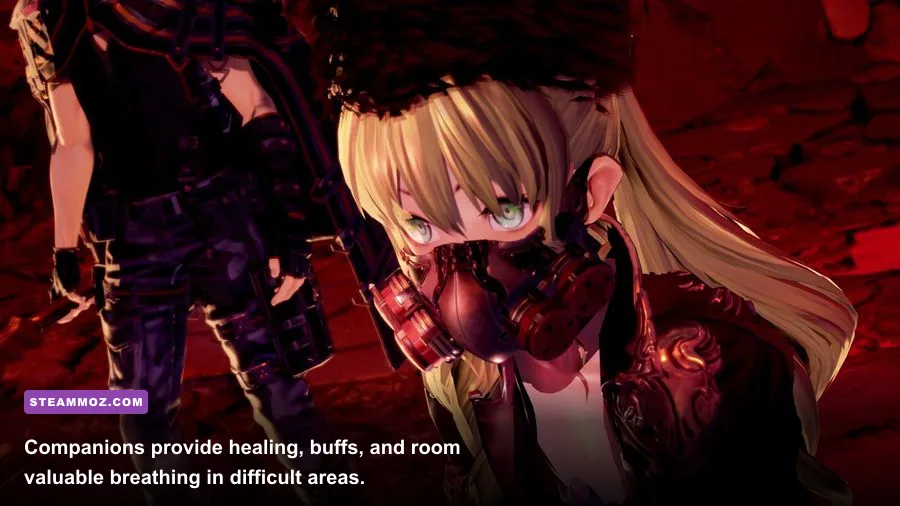
Companions are not decorative party members. They revive you, draw aggro, apply damage, and sometimes provide buffs that make a difficult zone manageable. Louis is an excellent early partner because his sword attacks are quick and his Blood Veil gives him useful Gift support. Yakumo Shinonome is the safer choice when you need a durable frontline fighter, while Mia Karnstein provides ranged pressure with her bayonet.
Companion selection should match your weakness. If you keep dying while healing, take a partner who can hold enemies away from you. If your build already has strong melee control, Mia’s ranged attacks can add pressure without competing for the same space. Io is especially valuable later because of her powerful support and healing options.
The AI is helpful, not magical. Companions can revive you, but the revival animation leaves them vulnerable and doesn’t replace good positioning. Don’t hide behind a partner and assume every boss will stay focused on them. Aggro can switch suddenly after a back attack, a stagger, or a companion’s death.
Online co-op is best used as a learning tool rather than a panic button. Send a distress signal from the menu when a boss pattern is blocking progress, but watch what the visitor does. A strong host still marks shortcuts, manages healing, and avoids pulling three rooms at once. If you prefer solo play, the official Bandai Namco CODE VEIN page remains a useful source for game information and updates.
6. Read boss telegraphs before spending your healing
Most CODE VEIN bosses punish panic more than low damage. Learn the sound and motion that comes before an attack, then dodge toward a safe angle rather than automatically rolling backward. Many bosses have tracking that catches a retreating player but misses someone who moves through the swing at the correct moment.
Tip 7: Keep your healing economy under control
Your Regeneration is limited, but you can improve it. Find the Survivor Vestiges and speak with Coco to increase the number of Regeneration uses, while Regeneration Shards improve the amount restored. The base heal is not enough to cover reckless trades, so treat every use as a resource that must buy meaningful progress.
Heal after a boss finishes a long animation, not immediately when your health dips. A half-health bar is survivable; healing in front of a charging Lost is not. If a companion is down and you have a safe window, revive them before healing yourself only when the extra aggro relief is worth the risk.
Tip 8: Use elemental buffs for the correct fight
Fire, ice, lightning, and blood damage are not interchangeable. Flaming Weapon helps against targets vulnerable to fire, while Frost Weapon, Lightning Weapon, and Venom-focused tools can make specific encounters dramatically shorter. However, elemental buffs usually add a temporary damage type rather than turning every attack into a universal weakness. Test the effect, watch the damage numbers, and don’t waste Ichor repeatedly against a resistant target.
Tip 9: Treat the Digital Deluxe DLC as endgame content
The Digital Deluxe Edition’s Season Pass includes Hellfire Knight, Frozen Empress, and Lord of Thunder. These are not beginner tutorial zones. Their bosses are built to test optimized Gifts, elemental resistance, and consistent dodge timing. Finish the main campaign first, collect your Vestiges, and bring a properly upgraded weapon rather than rushing into the DLC because it appears on the title screen.
The DLC also rewards experimentation. Hellfire Knight encourages fire-resistant preparation, Frozen Empress tests cold defense and spacing, and Lord of Thunder makes lightning awareness essential. Check your Blood Veil’s defense profile before each challenge, and carry elemental resistance Gifts when the arena’s attacks are clearly telegraphed by color or effect. The Deluxe Edition’s extra content is best viewed as a build laboratory after you understand the core system.
Tip 10: Restore Vestiges and don’t skip the story threads
Vestiges unlock missing memories and restore Gifts tied to characters such as Louis, Mia, Yakumo, Eva Roux, and Io. More importantly, restoring the right Vestiges before their associated successor boss can change the ending outcome. Explore carefully, return Vestiges to the correct attendant, and speak with companions in Home Base whenever new memories become available.
That preparation affects more than lore. Successor bosses connect directly to the characters and Blood Codes you meet, and their memories explain why certain Gifts exist. If you want the best ending path, don’t blindly destroy every Successor’s relic. Restore the relevant Vestiges, watch the memory sequence, and interact with the successor afterward. Missing this step can lock you out of the ending you intended to see on that playthrough.
| Situation | Best Immediate Action | Reason | Common Mistake |
|---|---|---|---|
| New zone reached | Activate the Mistle and inspect the map | Creates a recovery and fast-travel point | Running past it to chase enemies |
| Boss health below half | Save Ichor for defense and one emergency heal | Second phases often add tracking or area attacks | Spending every Gift immediately |
| Weapon feels weak | Check scaling, transformation, and Blood Code stats | Raw reinforcement is only part of damage | Replacing it without testing the build |
| Repeated deaths | Change companion, Veil, or defensive Gifts | Build adaptation is central to CODE VEIN | Grinding levels without changing tactics |
| Successor memory found | Restore the complete Vestige sequence | Protects ending choices and unlocks Gifts | Entering the boss immediately |
Finally, don’t compare CODE VEIN’s progression to a pure level-grinding RPG. A few levels can help, but they won’t fix an overloaded build, an unmastered Gift setup, or a weapon that scales badly with your Blood Code. If you enjoy methodical exploration, our guides to secret locations and hidden rewards and careful map exploration cover the same useful habit: investigate every suspicious path before moving on.
For a first playthrough, stick with a medium-weight sword or halberd, use Louis or Yakumo, master defensive Gifts early, and keep one backup Blood Code for ranged damage. Touch every Mistle, upgrade one main weapon, learn each boss’s first two attacks, and spend the Digital Deluxe Edition’s DLC after the main game has taught you its language. Once those fundamentals click, CODE VEIN stops feeling unfair and starts feeling wonderfully deliberate.
For official product details, consult the Steam store listing, the publisher’s CODE VEIN page, and Bandai Namco support for platform-specific issues. If performance problems interrupt your run, Steamoz’s crash and low-FPS troubleshooting guide offers additional PC-side checks.