
Children of Silentown has no traditional character build, weapon tree, or stat screen. The best beginner setup is a methodical investigation build: inspect every hotspot, collect every harmless-looking item, save crafted tools for obvious blockers, and prioritize Lucy’s songs and memory puzzles whenever they appear. That approach gives you the smoothest route through Silentown, prevents missed clues, and makes the game’s later story decisions far less stressful.
That distinction matters because Children of Silentown looks, at first glance, like it might have survival-horror progression. It has a grim forest, threatening creatures, a young protagonist, crafting, and plenty of ominous sound design. But Lucy is not leveling Strength or equipping a stronger blade. You are building knowledge. Your real resources are time, attention, inventory space, discovered clues, and the confidence to revisit places after the story changes.
This guide treats the game like the narrative puzzle adventure it actually is. There are no fake damage numbers to chase and no secret overpowered loadout. Instead, you’ll get a practical starting build for beginners, a chapter-by-chapter progression plan, a crafting priority list, and a clean way to handle songs, memories, exploration, and choices without turning the experience into a walkthrough.
The Best Starting Build Is the Investigator Build

Think of Lucy’s beginner build as four habits working together: observation, collection, experimentation, and restraint. Observation means clicking on environmental details before speaking to everyone. Collection means picking up objects even when their purpose is not immediately clear. Experimentation means combining reasonable items and testing them on the world. Restraint means refusing to spend a consumable just because the game lets you.
The first habit is the most important. Children of Silentown hides progress in ordinary details: a damaged object, a suspicious sound, a visual change in a familiar location, or a conversation that only becomes useful after you have examined something else. If an area feels small, assume the developers expect you to inspect it more than once.
Lucy’s inventory is not a junk drawer. Every item tends to have a narrative, puzzle, or crafting purpose, so avoid discarding anything unless the game explicitly allows it and you are certain it has served its role. When you find a new object, ask three questions: what does it resemble, what could it interact with, and which character or location has recently mentioned something related to it?
| Build Element | Beginner Priority | How to Use It | Common Mistake |
|---|---|---|---|
| Observation | S-Tier | Inspect every hotspot before leaving an area | Rushing to the next dialogue scene |
| Inventory control | S-Tier | Keep unusual objects and track their possible uses | Assuming an item is useless after one failed attempt |
| Crafting | A-Tier | Craft only when a puzzle clearly suggests the result | Using materials randomly on every object |
| Songs and memories | S-Tier | Complete them whenever the game presents a safe opportunity | Treating them as optional decoration |
| Story choices | A-Tier | Choose consistently with Lucy’s personality | Reloading every decision to chase a perfect route |
There is no punishment for playing slowly. In fact, the game’s atmosphere works better when you let a room breathe. Listen to background audio, inspect objects before exhausting every conversation, and make a mental note of locations that feel like they have unresolved business.

🎮 Children of Silentown
Looking to experience this game? Grab your digital key directly on our store for $5.99.
View on Steammoz Store →What to Prioritize During the Opening Chapters
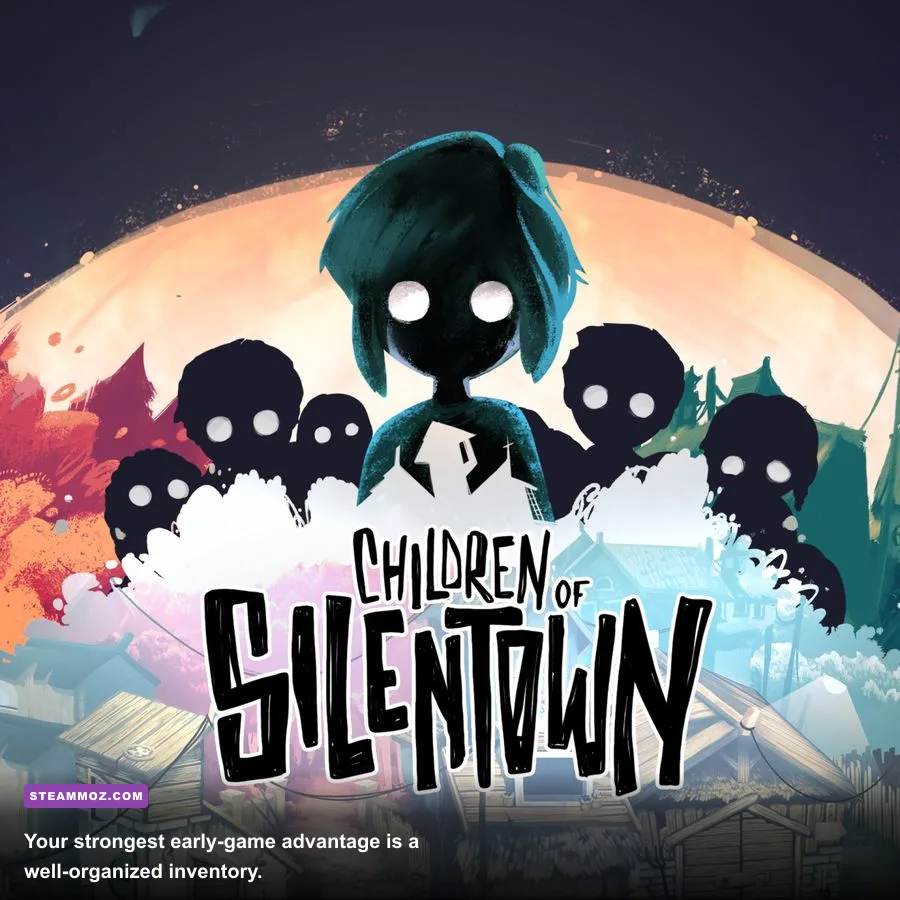
During the opening stretch, your goal is not to solve the entire mystery. Your goal is to learn how Silentown changes. Lucy’s home, the village streets, and the nearby forest establish the game’s central rhythm: investigate a familiar place, notice something wrong, talk to a resident, then return with a new item or piece of information.
Start by sweeping each available screen from left to right. This sounds basic, but it prevents the classic adventure-game problem of forgetting an object sitting at the edge of the screen. Click on doors, paths, work areas, trees, signs, tools, and anything that looks visually distinct. Some interactions only provide flavor, but flavor is often the game’s way of teaching you which details matter later.
Speak to characters more than once when new dialogue becomes available. The residents of Silentown are not quest-board dispensers. Their reactions reveal relationships, fears, and contradictions, and those details help you interpret later puzzles. Pay particular attention to Lucy’s conversations with her family and the people connected to the disappearances. The story’s mystery is solved through context as much as through item combinations.
When you reach the forest, resist the urge to click every ominous object in a panic. First establish what is safe to examine and what appears to trigger a progression beat. If the game gives you a chance to return to the village, take it. Many players create unnecessary confusion by moving forward before checking whether a new dialogue line or interaction has appeared behind them.
| Early-Game Action | Priority | Why It Matters | Best Timing |
|---|---|---|---|
| Inspect Lucy’s home | High | Teaches the visual language of useful objects | Before leaving for the village |
| Talk to every available resident | High | Builds the clue web for later puzzles | After each major discovery |
| Explore the village edges | High | Adventure-game hotspots are often placed away from the main path | Before entering a new story area |
| Enter the forest | Required | Advances the central investigation | Only after clearing nearby interactions |
| Revisit solved locations | Medium | Story flags can change available dialogue | After a song, memory, or major reveal |
The game does not expect you to memorize every line. It does expect you to notice patterns. If someone mentions a missing object, a forbidden place, or a repeated sound, treat that information as a puzzle clue even if no quest marker appears.
Crafting Priorities and Inventory Discipline
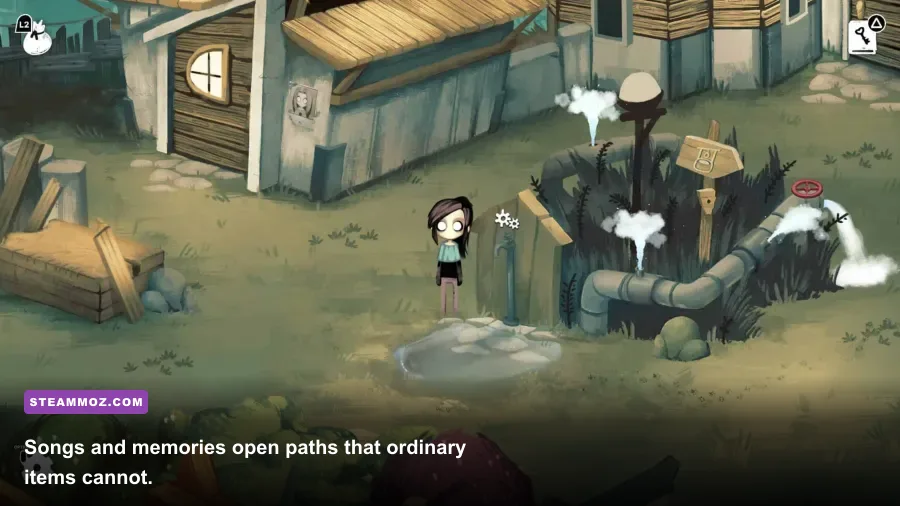
Crafting in Children of Silentown is closer to classic point-and-click problem solving than to a survival game. You are not manufacturing a combat loadout. You are combining or preparing objects to answer a specific environmental problem. That means the best crafting strategy is conservative: do not burn a component until you understand what the crafted result is supposed to accomplish.
Look for visual and verbal links. If an item is described as sharp, flexible, sticky, brittle, noisy, or absorbent, those adjectives are often more useful than the item’s name. A tool that appears useless in the village may become essential in the forest, while a material found in a dark location may be designed for a light-related interaction. The game’s puzzles generally give you enough contextual information to make a sensible guess.
Keep a short note outside the game for objects that have resisted your attempts. Write down the location, the item, and the clue that made you suspect a connection. Do not record only the failed action. Record why you tried it. When Lucy gains a new memory or hears a new song, that note can turn an apparently unrelated object into an obvious solution.
There is also a useful distinction between progression items and information items. A progression item physically opens a route or completes an interaction. An information item teaches you how to interpret a character, location, or event. Beginners often undervalue the second category because it does not immediately change the map. In this game, information is frequently the key that makes a later item combination understandable.
| Resource Type | Recommended Treatment | Use First On | Do Not Do This |
|---|---|---|---|
| Basic materials | Hold until a clear interaction appears | Obvious blocked paths or damaged tools | Testing every material on every hotspot |
| Unique objects | Keep permanently until the game consumes them | Characters or locations that reference them | Assuming one failed use makes them worthless |
| Crafted tools | Use when the environment strongly signals a solution | Objects matching the tool’s physical properties | Crafting duplicates without a reason |
| Clues and memories | Review mentally after major story beats | Dialogue contradictions and recurring symbols | Ignoring them because they do not enter inventory |
If you get stuck, do not immediately brute-force every item. Re-read descriptions, revisit the last location where the story changed, and speak to the character most closely connected to the current problem. Adventure games often lock the intended solution behind a conversation or inspection flag rather than a hidden mechanical trick.
Songs and Memories Are Your Real Skill Tree

Children of Silentown’s songs and memory sequences are the closest thing the game has to abilities. They are not combat skills with cooldowns, but they expand Lucy’s understanding of the world and frequently connect the emotional story to the practical puzzle design. Treat every song-related opportunity as high priority, even when it seems like a side activity.
The safest approach is to play these sequences carefully rather than quickly. Watch for repeated patterns, audio cues, and visual prompts. If a sequence asks you to reproduce an order, focus on rhythm and grouping instead of trying to memorize the entire input string at once. Break it into short phrases. If you fail, use the attempt as information; the game is usually teaching you the structure of the answer rather than demanding reflexes.
Memories also deserve a second look after major discoveries. Their meaning can shift as Lucy learns more about the missing people and the forest. A scene that initially feels like background may become emotionally or thematically important later. You do not need to force a definitive interpretation immediately, but you should remember its symbols and recurring sounds.
Do not skip optional-looking interactions just because they do not produce a conventional reward. Children of Silentown uses optional investigation to enrich its characters and themes, and those moments can make later choices feel grounded instead of arbitrary. The strongest beginner run is not the one with the fastest completion time; it is the one where Lucy understands why she is making a decision.
How to Handle Choices Without Chasing a Perfect Route
There is no universal best morality build for Lucy. The game’s decisions work better when you treat them as an investigation into her character, not as a morality meter. Choose whether Lucy is cautious, compassionate, confrontational, curious, or protective, then let that approach shape your decisions. A consistent roleplay run is easier to follow and usually more satisfying than randomly selecting whichever option appears safest.
Before an important decision, inspect the surrounding area and finish any available conversations. Story choices can feel abrupt if you have ignored the clues that frame them. If the choice concerns another resident, talk to that person first. If it concerns the forest, search the immediate area for environmental context. The game wants you to make an informed emotional decision, not solve a spreadsheet.
Manual saving is worth using before major transitions if your platform and version provide a convenient save option. Still, do not reload after every imperfect outcome. Some consequences are deliberately uncomfortable, and the game’s horror depends on uncertainty. A first playthrough built around constant correction can flatten the tension that makes Silentown effective.
For beginners, the most reliable decision rule is simple: choose the option that matches what Lucy has actually learned. If she has evidence, use it. If she does not, acknowledge the uncertainty. If a character is frightened, consider whether pushing harder will reveal the truth or simply damage trust. This is not a game where an aggressive answer automatically produces the strongest result.
A Practical Progression Loop for Every Chapter
Use the following loop whenever the story opens a new section of Silentown. First, clear Lucy’s current safe area. Second, speak with every character who has new dialogue. Third, inspect every newly accessible hotspot. Fourth, review your inventory and notes. Fifth, attempt the most contextually obvious puzzle. Only then should you push into the next threatening location.
This rhythm keeps the game’s clues organized and reduces backtracking. It also protects you from a common soft-stall: carrying the right item but missing the conversation or inspection that activates its use. If an object seems perfect for a puzzle and nothing happens, the issue is often not the object. You may need to trigger a scene, learn a song, or examine the target first.
| Progression Stage | Lucy’s Main Job | Player Checklist | Expected Result |
|---|---|---|---|
| New village area | Gather context | Inspect hotspots and talk to residents | Several connected clues |
| New forest route | Read environmental signals | Identify safe interactions and suspicious sounds | A clearer route forward |
| Crafting obstacle | Translate descriptions into action | Compare item properties with the obstacle | A targeted combination or tool use |
| Song or memory scene | Learn rather than rush | Follow audio and visual patterns | New context or access to progress |
| Major choice | Commit to Lucy’s perspective | Finish nearby dialogue and inspect the scene | A meaningful story consequence |
If you are completely stuck, follow a strict reset routine. Return to the last hub, speak to everyone again, inspect the inventory descriptions, then revisit the newest location. Avoid random item spam until you have done those four steps. The game’s logic is occasionally dreamlike, but its best puzzles still reward thematic connections over pixel-hunting.
Difficulty, Performance, and the Best First-Playthrough Setup
Because Children of Silentown is a hand-drawn narrative adventure rather than a reflex-heavy action game, performance tuning is mostly about comfort and atmosphere. A stable frame rate matters less than clear audio and an interface you can read, especially during songs and memory sequences. Headphones are strongly recommended: sound is not just decoration here, and the forest’s audio cues carry genuine narrative weight.
On PC, start with the default graphics profile, then lower resolution scaling or effects only if your system struggles. Avoid muting ambient audio while keeping music on; that can remove clues and make the soundscape feel strangely flat. If you use a controller, confirm that cursor movement and interaction prompts feel comfortable before committing to a long session. Mouse control is often faster for systematic hotspot inspection, while a controller makes slow exploration feel more natural.
For the cleanest first run, disable distractions, play in a dark room if you enjoy horror, and keep a small notebook nearby. Do not look up puzzle answers unless you have exhausted the investigation loop. Children of Silentown is short enough that a solution guide can accidentally erase a large part of its intended experience.
You can find the game on the official Steam page, while the official Children of Silentown website provides the game’s broader presentation and updates. For developer information, check Elf Games and the publisher’s Daedalic game page.
Final Verdict on the Best Beginner Build
The best starting build in Children of Silentown is the patient detective: inspect everything, preserve materials, revisit changed areas, learn every song and memory sequence, and make choices from evidence rather than fear of a bad ending. There are no stats to optimize and no weapon tier list hiding behind the forest. Your advantage comes from understanding how the game communicates.
Play Lucy as observant rather than omniscient. Let clues accumulate. When a puzzle seems strange, look for a relationship between its imagery, its wording, and the people involved. When the story offers a choice, trust the character you have developed instead of hunting for a perfect answer. That mindset turns Children of Silentown from a sequence of obscure adventure-game obstacles into a tense, coherent investigation—and it is the closest thing this unsettling little town has to an overpowered build.