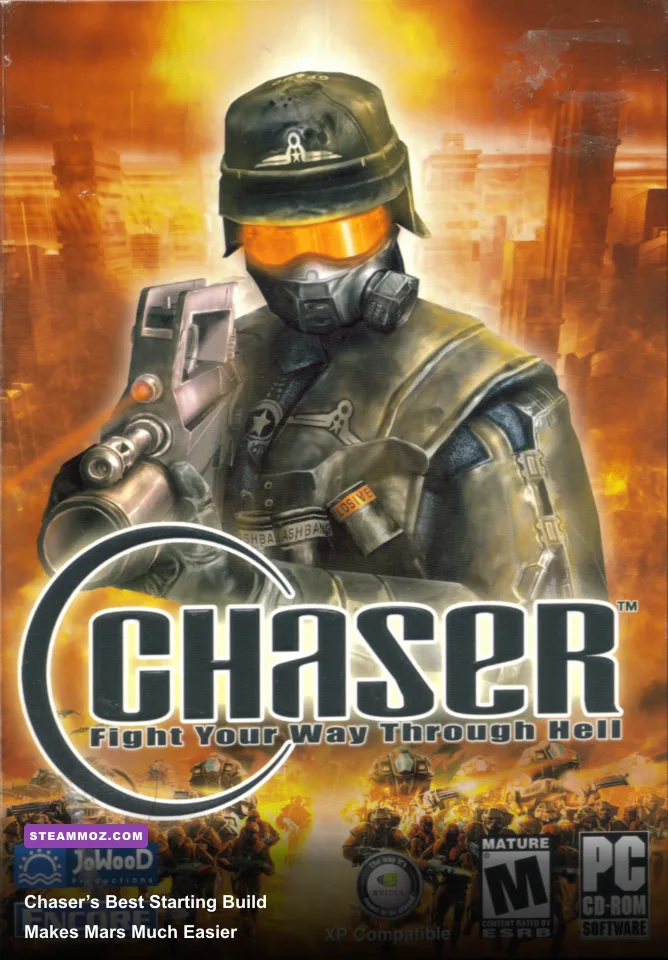
The best beginner build in Chaser is a balanced three-weapon setup: keep the Falcon pistol for precision, pair it with an assault rifle for general combat, and carry the shotgun for sudden close-range fights. Chaser has no RPG-style skill tree, character stats, or permanent class selection, so your “build” is really about weapon roles, ammunition discipline, control settings, and the order in which you approach each encounter. Play that setup patiently and the opening Mars missions become far less punishing.
That distinction matters. Chaser is a story-driven 2003 first-person shooter from Cauldron, not a modern live-service game with perk pages and damage spreadsheets. John Chaser’s abilities don’t improve because you invested points into Strength or Accuracy. Your survival comes from picking the right gun, reading enemy positions, leaning on cover, and refusing to waste rare ammunition. If you’re coming from a modern shooter, the campaign’s slower rhythm can feel harsh at first. Give it a few fights, though, and its rules become refreshingly clear.
Before changing anything, check the current Chaser Steam page for the supported release and community updates. Older PC shooters can behave differently depending on your display resolution, mouse polling rate, and compatibility settings.
What the Chaser beginner build actually prioritizes
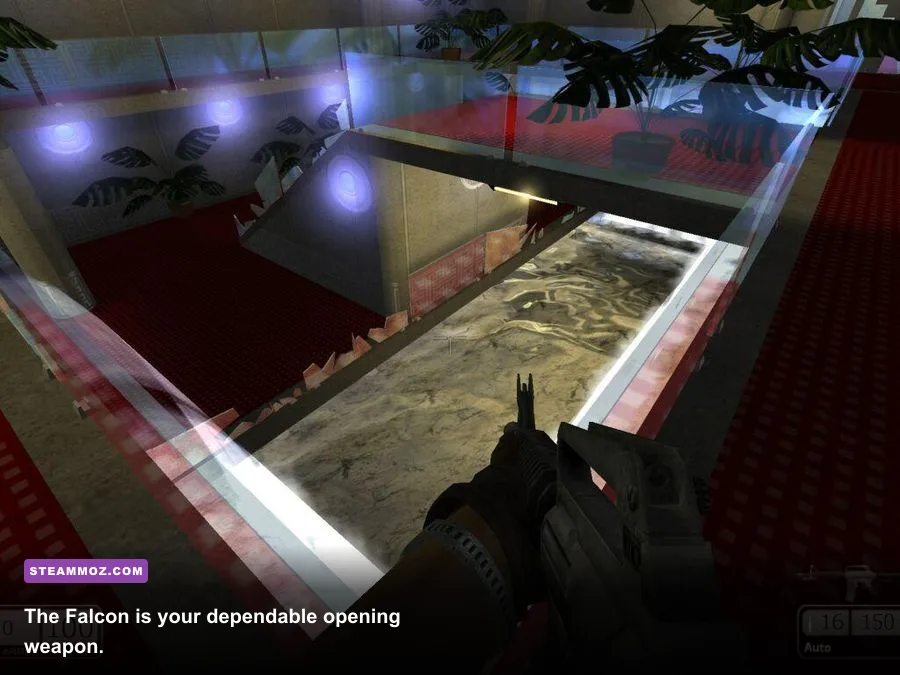
Your first priority is not maximum damage. It’s flexible ammunition use. Chaser regularly moves you between open industrial spaces, indoor corridors, stairwells, and defended bases. A weapon that dominates one environment can become awkward in the next, especially when enemies appear in groups or from elevated positions.
The Falcon pistol handles single targets, wounded enemies, and moments when you need to conserve rifle rounds. Your primary automatic weapon handles medium-range soldiers and most routine encounters. The shotgun exists for panic control: doors, corners, ladders, and enemies who push into your personal space. That gives you a simple combat loop without relying on a weapon you may not have ammunition for.
| Role | Recommended weapon | Use it for | Why beginners need it |
|---|---|---|---|
| Precision backup | Falcon pistol | Isolated enemies, wounded targets, ammo saving | Accurate, dependable, and usually easier to feed |
| General-purpose primary | Assault rifle | Medium-range soldiers and mixed encounters | Best balance of reach, damage, and flexibility |
| Close-range control | Shotgun | Corridors, doorways, ambushes, armored rushes | Stops dangerous pushes before they reach you |
| Long-range option | Sniper rifle | Watchtowers, windows, distant sentries | Lets you remove threats before a firefight starts |
| Emergency explosive | Grenades or launcher | Groups behind cover and blocked routes | Powerful, but too expensive for ordinary enemies |
Don’t treat that table like a rigid loadout screen. Chaser’s campaign gives you different weapons at different points, and the exact inventory available can depend on the mission. The important habit is to maintain one weapon for each distance instead of carrying three guns that all do the same job.

🎮 Chaser
Looking to experience this game? Grab your digital key directly on our store for $1.24.
View on Steammoz Store →Spend the opening missions mastering the Falcon
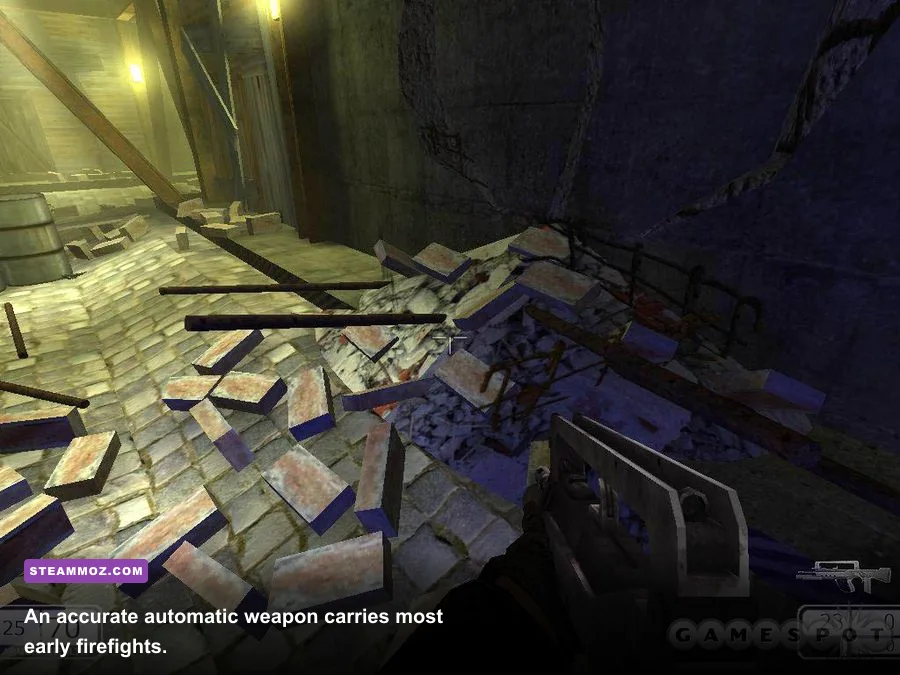
The Falcon is the weapon that teaches Chaser’s fundamentals. It rewards deliberate head-level aiming and punishes frantic spraying less than a slow, accurate weapon would. Use short clicks rather than holding the trigger continuously. The goal is to land clean shots while exposing as little of John Chaser’s body as possible.
At the beginning of an encounter, keep the pistol equipped while you identify the room. Listen for movement, locate cover, and look for the nearest retreat route. If one enemy is visible at a distance, the Falcon is often the correct choice even when an automatic weapon is available. Rifle ammunition is more valuable when several enemies arrive together.
There’s also a practical reload rule: reload behind cover, not after every target. Chaser’s old-school encounters can punish an empty magazine at exactly the moment a second enemy rounds a corner. Fire until the immediate threat is down, move behind a wall or crate, then reload. That small rhythm is more reliable than trying to perform a perfect reload in the open.
How to aim without wasting shots
Keep your crosshair at likely head height as you move through a facility. Most beginners aim at the floor while walking and then drag the mouse upward when an enemy appears. That costs reaction time and produces panic fire. Pre-aim at doorways, windows, and the top of staircases instead.
Use the Falcon against lone guards, stationary targets, and enemies who haven’t detected you. Switch immediately when a group pushes forward. The pistol is a precision tool, not an invitation to duel an entire squad while standing in the doorway.
Choose the assault rifle as your default primary
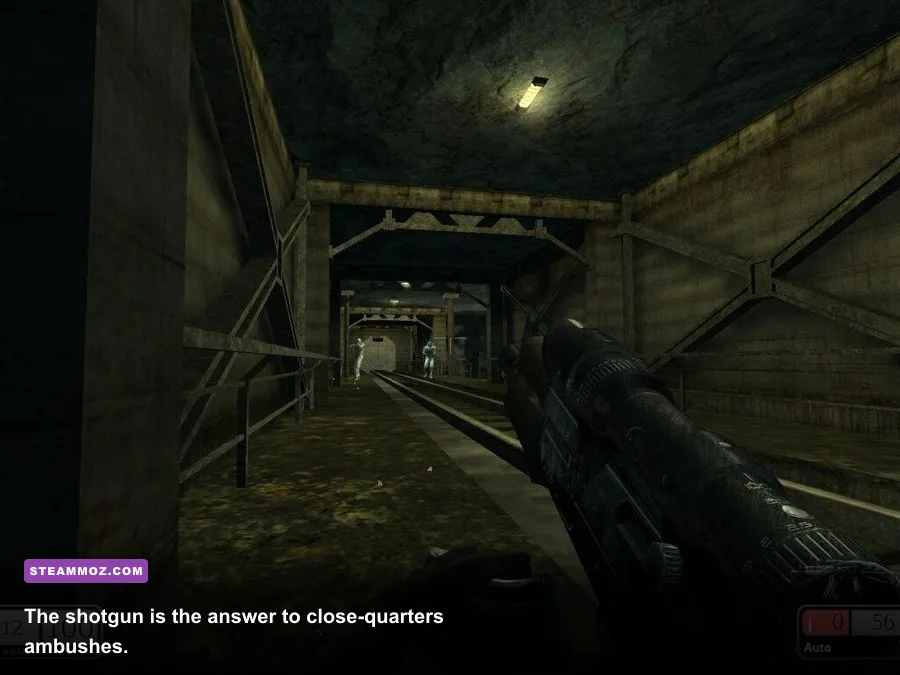
Once an assault rifle enters your inventory, it should become your default weapon for unfamiliar rooms. Automatic fire gives you the control needed when two or three enemies appear at different distances, but you still need to manage the trigger. Short bursts are better than emptying the magazine at the first silhouette.
At medium range, fire in controlled bursts and reset your aim between groups. At close range, hold the trigger only long enough to stop the push. At long range, swap to the Falcon or sniper rifle rather than trying to win a spread-heavy automatic duel. Chaser’s weapon handling feels dated by current standards, and sustained automatic fire can make misses expensive.
When you find a new automatic weapon, compare its role rather than instantly abandoning the old one. A higher-capacity weapon may be better against a crowd, while a more accurate rifle can save ammunition across an entire chapter. Keep the weapon that complements your available reserve ammo. A theoretically stronger gun is useless when its ammunition appears only once every few rooms.
| Encounter distance | First choice | Firing pattern | Beginner mistake to avoid |
|---|---|---|---|
| Long range | Sniper rifle or Falcon | Single accurate shots | Spraying an assault rifle at tiny targets |
| Medium range | Assault rifle | Short controlled bursts | Holding the trigger until the magazine is empty |
| Short range | Shotgun or assault rifle | One decisive blast or tight burst | Backing into an unknown room while reloading |
| Enemy group | Assault rifle or explosives | Focus the closest threat first | Chasing a distant target while being flanked |
For more general classic-FPS performance habits, Steamoz’s weapon ranking guide for Far Cry 3: Blood Dragon is useful for thinking in terms of weapon roles rather than raw damage. Chaser rewards that same mindset, even though its campaign is much more linear.
Keep the shotgun ready for Chaser’s worst surprises
The shotgun is not just a damage option; it’s your mistake-recovery button. Chaser frequently funnels you through narrow corridors, doorways, staircases, and industrial rooms where an enemy can appear at close distance with almost no warning. In those spaces, switching early is safer than trying to react after the enemy is already within arm’s reach.
Fire when the target is clearly inside effective range, then move sideways or retreat while the weapon cycles. Don’t stand still to admire the impact. If the first shot doesn’t finish the target, create space before firing again. Backpedaling in a straight line can trap you against geometry, so use corners and doorframes to break line of sight.
Against a group, the shotgun’s job is to remove the closest threat, not to replace the assault rifle. Blast the enemy who can reach you first, switch back to the rifle, and clean up the remaining targets from cover. Save shells when the room is open and enemies are far away; you’ll be glad you did when the level turns into a corridor fight.
Doorways are combat tools
Before crossing a doorway, stop and listen. If enemies are close, enter with the shotgun ready. Fire once, retreat behind the frame, and force the surviving opponents to approach through the same narrow opening. This turns a messy room into a controlled queue.
Never reload in the center of a room simply because the shotgun has fired one shell. If the immediate danger is gone, top up behind cover. If danger is still present, switch to the assault rifle and keep moving. Weapon management is faster than gambling on a reload animation.
Use the sniper rifle and explosives as problem solvers
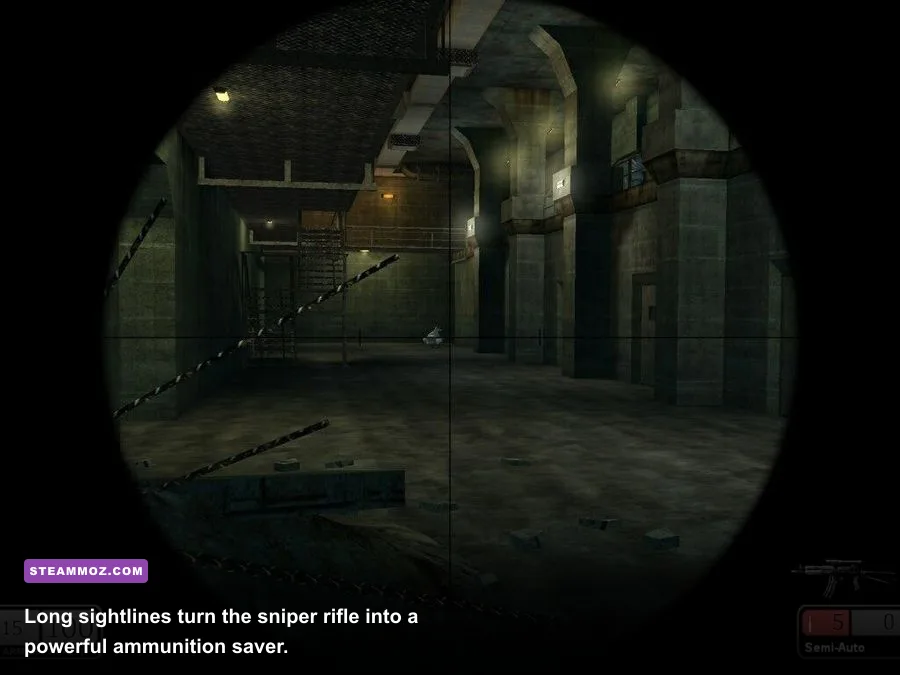
The sniper rifle is strongest when you treat it as an encounter opener. Use it to remove a sentry, a rooftop shooter, or an enemy controlling a long sightline before the main firefight begins. Don’t waste every round on targets you can safely defeat with the Falcon. Sniper ammunition tends to be most valuable when the game gives you distance and time to line up a shot.
Find cover before zooming. The scope narrows your awareness, and Chaser can place threats at the edges of an arena or behind your position. Take the shot, immediately lower the scope, and scan for movement. If the target survives, don’t stay exposed trying to force a second hit. Relocate, then re-engage from a different angle.
Grenades are best used against enemies hiding behind cover or clustered around a doorway. Bounce them into a room rather than throwing blindly across open ground. Explosives can also force enemies out of strong positions, but they’re a poor substitute for ordinary marksmanship. Save them for groups that would otherwise cost you a magazine and a chunk of health.
Chaser’s environments make positioning more important than flashy weapon swaps. Mars facilities often give you crates, machinery, railings, and doorframes that can divide an enemy group. Use those objects to create one-on-one fights. A grenade thrown after enemies bunch up is far more effective than one tossed at the first target you see.
Build your controls and graphics for reliable aim
A good starting build falls apart if the game’s controls feel slippery. Use a moderate mouse sensitivity and disable any operating-system acceleration that makes slow and fast movements behave differently. You want a consistent turn: the same physical mouse movement should produce the same rotation every time.
Run Chaser at a stable frame rate rather than chasing a resolution your system cannot sustain. The game is old enough that most modern PCs can run it comfortably, but compatibility layers, widescreen patches, and forced high refresh rates may introduce problems. Test a short mission after every major change, especially if you’re using community fixes.
| Setting or habit | Recommended beginner value | Gameplay impact | Adjustment note |
|---|---|---|---|
| Resolution | Native monitor resolution if stable | Sharper targets and cleaner sightlines | Lower it if scaling or performance glitches appear |
| Mouse sensitivity | Moderate, then fine-tune | More consistent head-level aim | Change gradually; large jumps ruin muscle memory |
| Field of view | Default or conservative widescreen value | Preserves target scale and avoids distortion | Use community patches carefully |
| Frame rate | Stable output over maximum refresh | Improves tracking and reduces visual judder | Cap or use compatibility settings if needed |
| Quick weapon access | Bind pistol, rifle, and shotgun nearby | Faster response to changing distances | Avoid relying only on cycling through inventory |
If you run into crashes or strange frame pacing, Steamoz’s PC crash and FPS troubleshooting guide covers the same broad compatibility checks that help with older Windows games. For a second perspective on keeping legacy shooters playable, see the Far Cry 2 PC requirements breakdown.
A practical progression plan for the first chapters
Don’t measure progression by how quickly you collect every weapon. Measure it by whether each new gun gives you a new answer. Early on, establish the Falcon as your quiet precision option. When the assault rifle becomes available, reserve it for mixed encounters and larger patrols. Add the shotgun whenever the campaign starts compressing fights into rooms and corridors.
After every firefight, check your ammunition before moving through the next door. If rifle rounds are low, shift more work to the pistol. If shells are plentiful, let the shotgun handle close-range targets instead of spending automatic ammunition. This simple inventory check prevents the classic FPS problem of reaching a difficult set piece with the wrong reserve.
Save before entering unfamiliar areas when the game allows it, but don’t use quick saves as an excuse to repeat the same reckless push. If you die in a room, identify the actual cause: missed shots, poor cover, an unseen flank, or a reload in the open. Then change one thing on the next attempt. Chaser’s combat becomes much easier when each failure gives you a concrete correction.
The five-step room-clear routine
- Pause at the entrance. Listen for footsteps, gunfire, and movement above or behind the door.
- Choose the weapon by distance. Use the shotgun for a cramped entry, the rifle for a mixed room, and the pistol or sniper rifle for a clear sightline.
- Identify the closest threat. Remove the enemy who can force you out of cover first.
- Retreat after the first exchange. Let the doorway or machinery split the group instead of fighting everyone at once.
- Reload only when safe. Top up behind cover, collect ammunition, and scan the room before advancing.
That routine sounds cautious because it is. Chaser’s AI and level layouts often reward the player who makes enemies come through predictable lanes. Sprinting into every room may work in a modern shooter with regenerating health and generous checkpoints, but it burns ammunition and leaves you vulnerable in Chaser.
Common beginner mistakes that ruin the build
The biggest mistake is treating every weapon as interchangeable. They aren’t. The pistol is not a weak assault rifle, the shotgun is not a short-range machine gun, and the sniper rifle is not a weapon for hurried room clearing. Each one is built around a different distance and tempo.
The second mistake is standing in doorways. A doorway feels like cover because it blocks part of the room, but it also makes your position predictable and can expose you to enemies on both sides. Peek, fire, and retreat behind the wall. If you need to advance, do it after the first group has been thinned.
Finally, don’t sprint everywhere. Running is useful for crossing exposed ground and repositioning, but it makes careful target identification harder. Walk into a new area with your crosshair raised, keep an exit in mind, and use the environment. Chaser is at its best when you play it like a tactical classic FPS rather than a speedrun through enemy bullets.
For players who enjoy digging into older games and hidden systems, Steamoz’s Everspace weapon guide offers another useful lesson: the best purchase or pickup is the one that fills a tactical gap. Chaser doesn’t have a shop-driven build system, but the same principle applies every time you decide which gun stays equipped.
The final beginner loadout to remember
Keep the Falcon ready when you’re scouting, the assault rifle equipped for the average fight, and the shotgun one quick switch away whenever the environment narrows. Use the sniper rifle to start long-range encounters on your terms, and spend explosives only when they solve a genuine group problem. That’s the most dependable starting build for Chaser because it covers every combat distance without demanding perfect aim or a huge ammunition reserve.
Most importantly, build your habits around cover and information. Listen before entering, pre-aim at head height, shoot in controlled bursts, and move after every exchange. Chaser’s Mars campaign can feel unforgiving during the first hour, but it rarely asks for mysterious tactics. It asks you to respect distance, conserve ammunition, and let the level’s geometry work for you.
For the official release details, consult the official Steam listing and the Cauldron developer website. Once your controls are stable and your three core weapons have clear jobs, John Chaser’s opening missions stop feeling like a scramble and start feeling like a series of fights you can actually control.