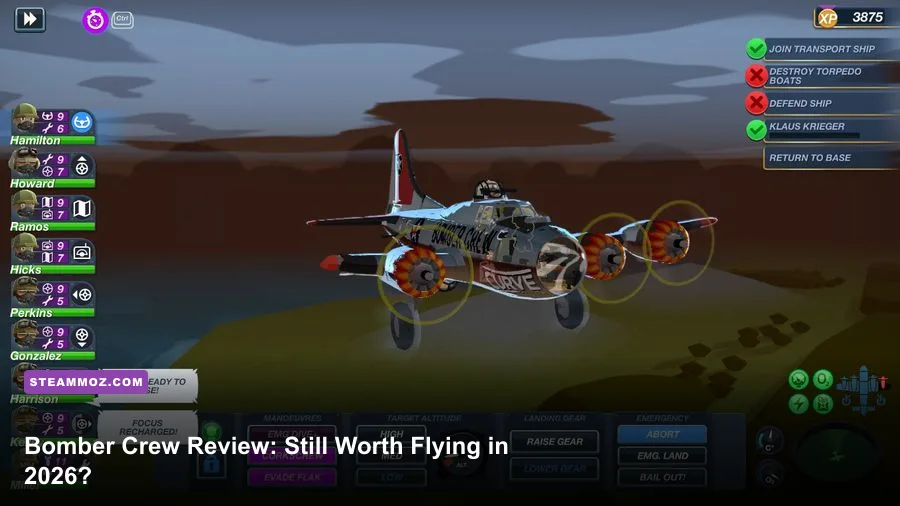
Yes, Bomber Crew is still worth playing in 2026—especially if you like compact strategy games that turn multitasking into a genuine survival test. Its colorful presentation has aged better than expected, the crew-management loop remains wonderfully tense, and a single mission can still produce a story you'll remember. The catch is that the campaign's repetition, occasional interface friction, and permanently dead crew members feel much less forgiving today than they did at launch.
Runner Duck's 2017 bomber simulator isn't a historically exhaustive flight sim. You don't manually fly a Lancaster through every turn, and you won't find a detailed cockpit modeled down to individual gauges. Instead, Bomber Crew treats the aircraft as a moving workplace. You assign eight crew members to stations, manage fuel and temperature, mark targets, dodge fighters, repair systems, and bring everyone home before the plane becomes a flaming collection of spare parts. That focused design still works beautifully on Steam Deck, modest laptops, and modern gaming PCs.
What makes Bomber Crew so addictive
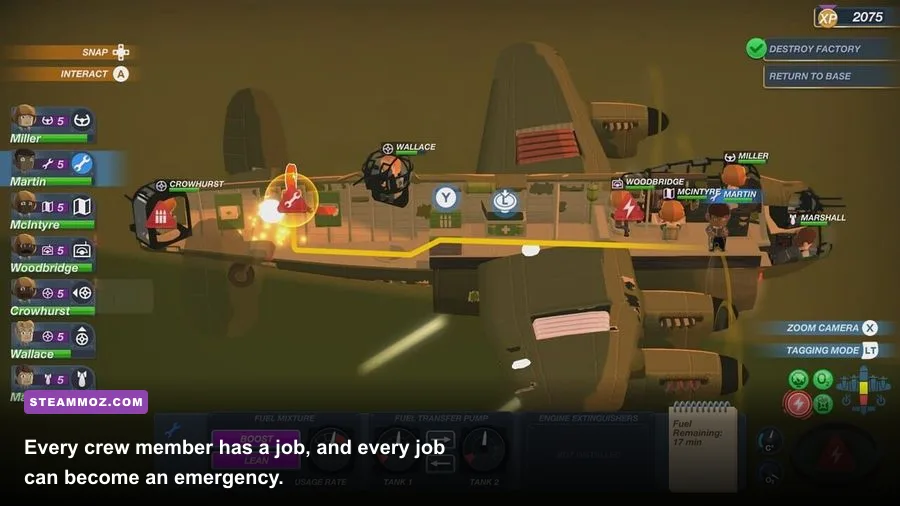
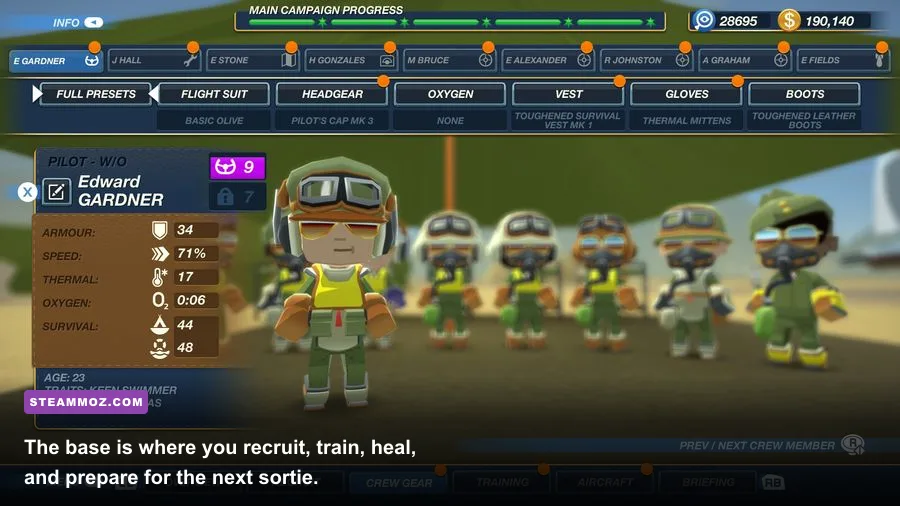
The core loop is an elegant chain of small decisions. At the base, you choose a mission, outfit the aircraft, hire or promote crew, and decide whether your current roster is ready. In the air, you zoom around the bomber's interior and select crew members individually. A navigator plots the route. The pilot manages altitude and speed. Engineers watch fuel and engine temperature. Gunners occupy turret positions. A radio operator handles communications and can help with incoming threats.
The game never lets those jobs remain isolated for long. A gunner may need to leave the turret to extinguish a fire. Your engineer might be the only crew member close enough to repair a damaged engine. The pilot can be knocked unconscious, forcing another crew member to take the controls. If the aircraft loses cabin pressure, everyone needs oxygen masks; if fuel tanks are hit, a desperate engineer has to patch the leak before the engines sputter out.
That creates the game's best emotional trick: your crew starts as a row of tiny portraits, then gradually becomes a team you recognize by name, nationality, class, and traits. A veteran with high-level skills is faster and more useful, but losing them permanently changes the next sortie. Permadeath isn't a decorative option here. It's the reason a damaged aircraft feels terrifying even when the mission objective is technically complete.
| Role | Primary Responsibility | Best Emergency Assignment |
|---|---|---|
| Pilot | Altitude, speed, and aircraft control | Maintain flight while another crew member repairs the cockpit |
| Engineer | Engine efficiency, repairs, and fire control | Fix engines, extinguish fires, and manage overheating |
| Navigator | Route plotting and navigation support | Keep the mission on course while the pilot handles danger |
| Radio Operator | Communication and support actions | Respond to threats and assist with mission information |
| Gunner | Operate defensive .303 machine-gun turrets | Suppress enemy fighters approaching from a turret's arc |
For another strategy game built around stressful decisions rather than twitch combat, our For the King II settings guide is a useful comparison. Bomber Crew is less expansive, but its pressure arrives faster and its missions are much easier to restart.

🎮 Bomber Crew
Looking to experience this game? Grab your digital key directly on our store for $2.39.
View on Steammoz Store →The campaign loop still has real teeth
Bomber Crew's campaign is divided into missions that gradually introduce longer routes, tougher objectives, and more dangerous opposition. Early sorties teach the basic rhythm: launch, navigate, photograph or bomb the target, and return to base. Later missions ask you to manage multiple points of interest while fighters, flak, fires, fuel loss, and damaged systems compete for your attention.
The important detail is that mission success isn't the same as a clean run. You can complete an objective while losing a turret, burning through spare fuel, or bringing home a wounded veteran who can't be deployed next time. The real score is measured in aircraft condition, crew survival, collected intel, and whether your economy can fund repairs and upgrades before the next mandatory mission.
That progression curve is strongest during the middle of the campaign. At that point, you have enough upgrades to feel capable but not enough armor, fuel, or ammunition to ignore mistakes. The opening can feel tutorial-heavy, while the late game occasionally becomes a checklist of familiar hazards. Still, the central tension holds because every upgrade solves one problem while leaving another exposed.
| Progression Stage | What You Can Handle | Main Risk | Recommended Priority |
|---|---|---|---|
| Early campaign | Short routes and basic target runs | Untrained crew and weak survivability | Recruit a full eight-person roster and improve essential stations |
| Mid campaign | Longer flights with repeated combat events | Fuel loss, fires, and wounded specialists | Balance armor, fuel capacity, repair speed, and turret coverage |
| Late campaign | Multi-objective sorties and heavy opposition | Stacked damage and permanent crew losses | Use veterans carefully and avoid unnecessary optional encounters |
| Post-campaign | Extra missions and Secret Weapons content | Repetition without major new systems | Play for challenge, completion, and higher-risk loadouts |
Don't confuse Bomber Crew with a relaxed management game. The cute art direction makes it approachable, but the campaign can punish greed. Optional objectives are tempting because they provide extra rewards, yet detouring toward them costs fuel and exposes the aircraft to more encounters. If the plane is already damaged, heading straight home is often the strategically correct move—not cowardice.
Aircraft upgrades and crew skills worth buying
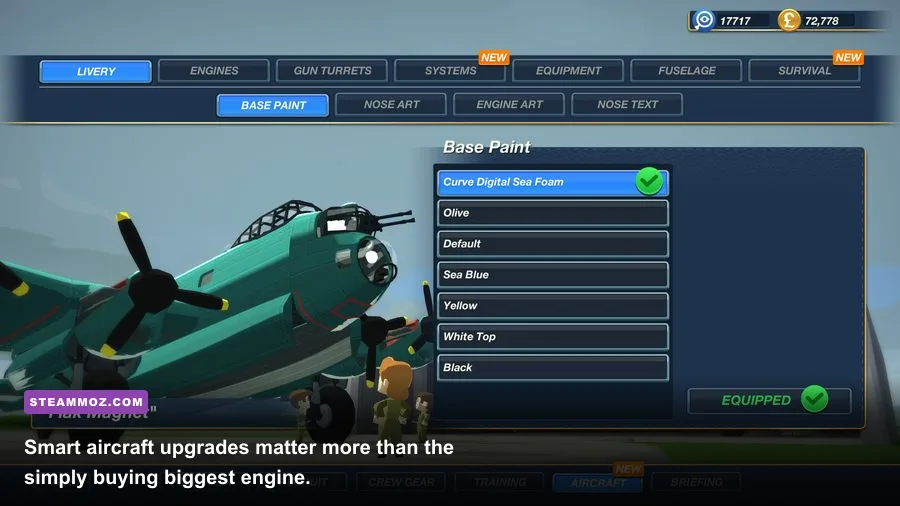
Upgrade choices are where Bomber Crew becomes more interesting than its cartoon style suggests. The aircraft has limited slots and competing needs. Better engines improve speed and fuel performance, armor makes critical compartments more resilient, turret improvements increase your defensive response, and fuel tanks extend the margin for long missions. You can't simply max every category immediately, so your loadout should reflect the missions currently available.
Early on, prioritize the upgrades that prevent cascading failures. Extra fuel gives you time to make a safe return. Engine improvements reduce the chance that one damaged powerplant turns into a forced landing. Fire extinguishers and repair-related equipment are valuable because fires spread quickly and can make multiple nearby stations unusable. Defensive weapons matter, but a stronger turret won't save a bomber that runs dry over enemy territory.
Crew skill choices follow the same logic. A gunner who can reload quickly is more valuable during repeated fighter waves, while a navigator with stronger route performance helps on long-distance missions. Engineers should become your most dependable emergency workers because they can move between engines, fuel tanks, fires, and damaged equipment. The exact perfect build doesn't exist; what matters is reducing the time between an alarm appearing and somebody reaching it.
| Upgrade Focus | Why It Matters | When to Prioritize | Common Mistake |
|---|---|---|---|
| Fuel capacity and efficiency | Creates a larger safety margin for detours and damaged engines | Before longer objectives and multi-stop routes | Ignoring fuel because the first missions are short |
| Engine performance | Improves travel pace and helps recover from power loss | When routes begin taking multiple flight segments | Adding speed without planning for overheating and repairs |
| Armor and survivability | Reduces the impact of flak and fighter damage | When returning crews regularly arrive wounded | Stacking armor while neglecting fuel and repair tools |
| Turret weapons | Improves your response to enemy fighters | When combat waves become frequent | Expecting turrets to solve threats outside their firing arcs |
| Repair and fire equipment | Shortens the time systems remain disabled | As soon as fires and component failures become common | Sending an untrained crew member to repair a critical system |
The strongest practical habit is assigning a dedicated engineer before takeoff and keeping that character near the bomber's most vulnerable systems. Don't scatter every crew member across the aircraft at the start. A compact formation lets you respond to an unexpected fire quickly, then return specialists to their normal stations once the emergency is contained.
If you enjoy games where equipment decisions matter more than reflexes, Steamoz's Gas Station Simulator equipment rankings cover a similarly satisfying upgrade mindset, though Bomber Crew makes every purchase feel more dangerous.
Combat is about timing, not dogfighting skill
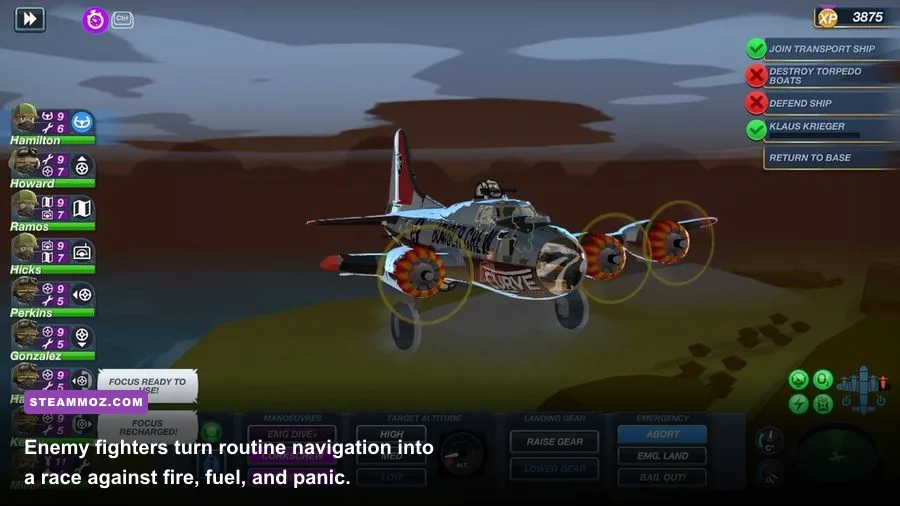
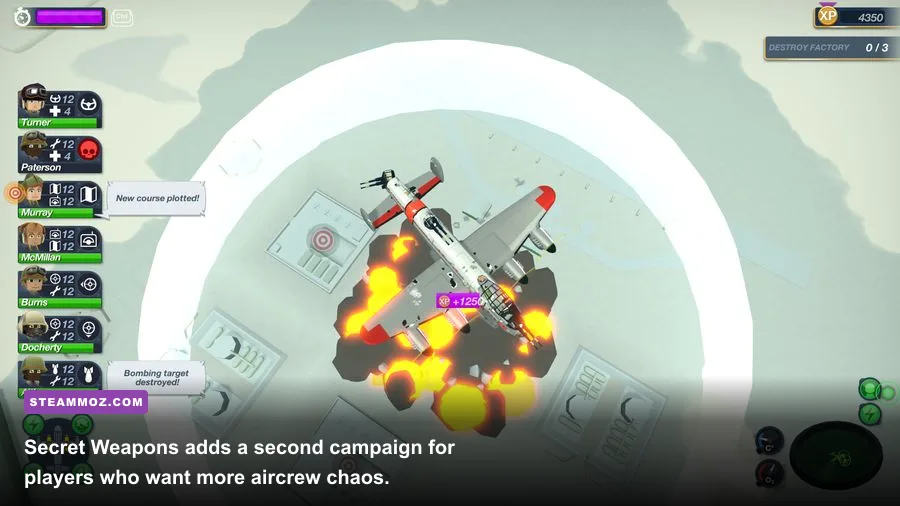
Bomber Crew's aerial combat is indirect. You don't aim a fighter plane with a mouse or fly evasive maneuvers manually. Instead, you choose altitude, monitor enemy approaches, assign gunners, and manage the bomber's condition while the aircraft follows its route. That sounds simple until multiple fighters attack from different sides and a damaged turret becomes unavailable.
Watch the warning indicators rather than staring at one gunner. Enemy fighters telegraph their arrival through approach markers, giving you a brief window to select the correct turret or reposition a crew member. Keep gunners assigned to usable weapons and avoid pulling both of them away for minor repairs. If a fighter is outside a turret's arc, moving the gunner won't magically create a shot; you may need to adjust the aircraft's position or wait for the target to cross into range.
Altitude is another tactical lever. Higher flight can reduce certain threats and improve route safety, but it also creates oxygen and temperature complications. Lower altitude can be useful when the bomber is struggling with damaged engines, yet it may expose you to more flak and hostile encounters. There isn't a universal “best” altitude. The correct choice depends on the bomber's current damage, remaining fuel, and the objective's location.
| Threat | Warning Sign | Immediate Response | Long-Term Fix |
|---|---|---|---|
| Enemy fighter | Approach indicator near a turret arc | Assign a gunner and keep the weapon operational | Improve turret coverage, armor, and gunner efficiency |
| Engine fire | Fire alert and falling aircraft performance | Send an engineer with firefighting equipment immediately | Upgrade engines and keep repair routes unobstructed |
| Fuel leak | Rapid fuel loss or damaged tank alert | Dispatch an engineer before taking optional detours | Improve tank protection and carry more fuel |
| Cabin pressure loss | Pressure warning affecting the crew | Equip oxygen masks and reach the damaged compartment | Protect vulnerable systems and shorten repair response time |
| Flak damage | Ground-fire warnings during exposed travel | Maintain course and avoid unnecessary route extensions | Increase armor and improve fuel margin for safer routing |
Most failed missions aren't caused by one massive hit. They're caused by three small problems arriving together: a damaged engine, a fire, and a gunner pulled away from a turret. Pause frequently, zoom out, and scan the whole aircraft before reacting. The game rewards calm triage more than frantic clicking.
Graphics, performance, and Steam Deck reality
On modern hardware, Bomber Crew is extremely easy to run. The official Steam listing asks for Windows 7 or newer, a 2.0 GHz processor, 2 GB of RAM, a graphics card with 512 MB of video memory, and 1 GB of available storage. Those requirements are tiny by 2026 standards, and the game's stylized 3D art remains clean at high resolutions.
There are no meaningful ray-tracing or advanced-upscaling decisions here. The useful settings are resolution, fullscreen or windowed mode, texture quality, shadows, anti-aliasing, and effects. A modern desktop should comfortably hold 60 frames per second, while Steam Deck performance is generally smooth with sensible power limits. The bigger issue on handheld play is readability: the bomber's small compartments and icons can feel cramped at native controls.
| Profile | Recommended Settings | Expected Result | Best For |
|---|---|---|---|
| Modern desktop | Native resolution, high quality, fullscreen, enabled anti-aliasing | Stable 60 FPS with crisp interface | 1080p, 1440p, and high-refresh displays |
| Older laptop | 720p or 900p, medium shadows, reduced effects | Consistent performance with minor visual cuts | Integrated graphics and low-power CPUs |
| Steam Deck battery profile | 1280×800, capped 60 FPS, moderate brightness | Smooth play with lower power draw | Long campaign sessions away from a charger |
| Maximum readability | Fullscreen, native resolution, brighter display, larger UI where available | Clearer crew selection and emergency alerts | Players who struggle with tiny station icons |
The lack of modern graphics features is actually a strength. Loading is quick, input latency is negligible, and you can focus on the tactical interface instead of troubleshooting stutters. For a more demanding comparison, see our Ghost Recon Breakpoint performance guide; Bomber Crew requires almost no technical tuning by comparison.
Should you buy Bomber Crew in 2026?
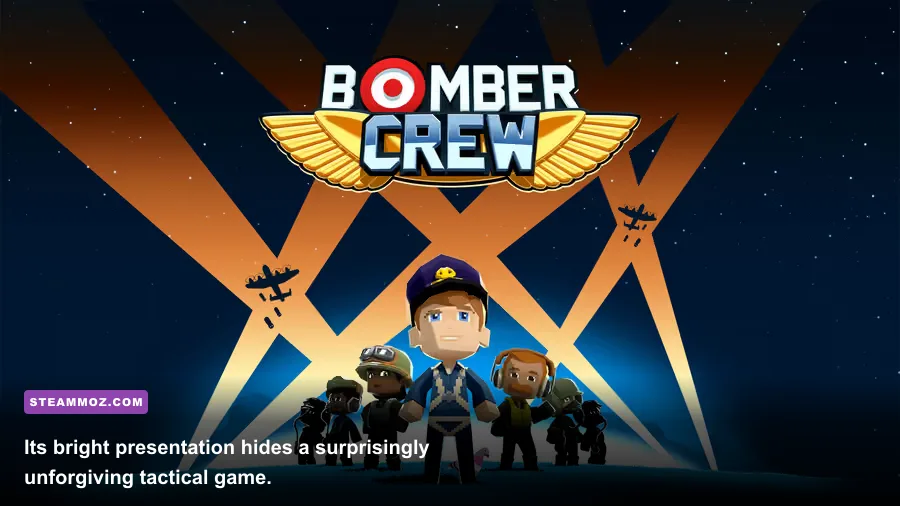
Bomber Crew is worth buying if you want a focused strategy game with short, high-pressure missions, meaningful crew attachment, and a progression system that runs well on practically anything. It remains particularly good for players who like FTL: Faster Than Light-style crisis management but want a more tactile interface. Every click has a physical location inside the aircraft, and that makes emergencies easy to understand even when they're hard to solve.
It isn't the right choice if you're looking for a realistic World War II simulation, deep historical campaign structure, or endless variety after the main story. The cartoon visuals are deliberate, not a substitute for realism, and repeated mission types eventually reveal the limits of the system. The campaign also expects you to accept losses. If permanent deaths and occasional bad-luck spirals sound exhausting, the game's strongest feature may feel like its harshest flaw.
The Secret Weapons expansion is the better purchase once you've finished the original campaign and want more missions. It adds a separate campaign with new objectives and experimental technology themes, while preserving the same crew-management fundamentals. New players should start with the base game rather than buying DLC immediately; learning how to handle fuel, fires, turret coverage, and crew injuries is already plenty.
| Player Type | Verdict | Why |
|---|---|---|
| Strategy newcomer | Highly recommended | Readable systems and escalating missions teach multitasking naturally |
| FTL or management veteran | Recommended | Excellent crisis triage, though the campaign is more linear |
| Historical simulation fan | Conditional | Enjoyable bomber theme, but the mechanics are intentionally abstracted |
| Completionist | Recommended with DLC | Secret Weapons supplies a worthwhile second campaign |
| Casual short-session player | Recommended | Missions are bite-sized, but permadeath can create tense setbacks |
For the current PC version, check the official Bomber Crew Steam page for platform details, controller support, and current pricing. The Runner Duck Games website has developer information, while Curve Games' Bomber Crew page covers the publisher's version and related releases.
My final verdict is an enthusiastic 8/10. Bomber Crew isn't a limitless sandbox, and its late campaign can show its age, but the essential design remains sharp. Assigning a crew member to a burning engine, watching fighters close in, and realizing your best navigator is bleeding in the rear compartment still creates exactly the kind of controlled panic that strategy games chase. In 2026, that's more than nostalgia. It's a compact, smart, and highly replayable mission loop that still earns a place in your hangar.
If you want another older game that holds up through strong systems rather than cutting-edge presentation, Steamoz's God Eater 2: Rage Burst review makes a similar case for revisiting overlooked PC releases.