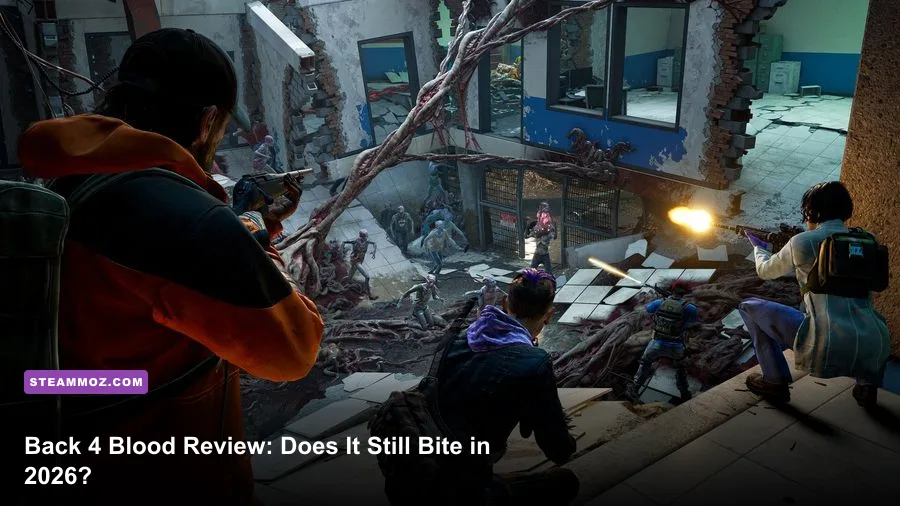
Yes, Back 4 Blood is worth playing in 2026—but mainly as a four-player co-op shooter, not as a replacement for Left 4 Dead 2. Its gunplay remains excellent, crossplay makes finding friends easier, and the card system gives repeat runs real build variety. The catch is just as important: Turtle Rock Studios stopped releasing new content after the River of Blood expansion, the solo experience is weaker than the co-op game, and its campaign occasionally mistakes chaos for challenge.
That makes this a conditional recommendation. If you have two or three teammates and enjoy learning enemy patterns, refining decks, and replaying missions on Nightmare or No Hope, Back 4 Blood still has teeth. If you're looking for a constantly updated live-service game or a relaxed solo zombie adventure, your money and time are better spent elsewhere.

What Back 4 Blood still does brilliantly

Back 4 Blood's strongest feature is the feel of its weapons. The Ridden react convincingly to hits, weak-point shots feel chunky, and every encounter can collapse within seconds when a Tallboy, Stinger, and Reeker attack from different angles. Assault rifles such as the M4 Carbine and SCAR feel dependable at medium range, while the AA12 and Super 90 turn close quarters into a loud, wonderfully irresponsible mess.
The four-player structure is built around complementary roles rather than rigid classes. Walker rewards accurate headshots with precision bonuses, Holly restores stamina when she kills an enemy, Doc can heal teammates without consuming an item once per level, and Hoffman creates ammo when he kills Ridden. These aren't cosmetic differences. A team with Doc and Hoffman can sustain a long run, while Holly or Evangelo gives the group more mobility when a mission starts throwing hordes at narrow chokepoints.
There are 10 playable Cleaners in the complete game, including the original eight—Evangelo, Walker, Holly, Mom, Hoffman, Jim, Karlee, and Doc—plus Sharice and Heng from the expansions. Dan, added with River of Blood, brings a more volatile support style by triggering random benefits when rescuing incapacitated teammates. That roster isn't as instantly iconic as Left 4 Dead's survivors, but each character has enough mechanical identity to influence how you play.
| Cleaner | Signature Advantage | Best Team Function |
|---|---|---|
| Doc | Free healing ability once per level | Sustain and trauma recovery |
| Hoffman | Chance to spawn ammo on Ridden kills | Ammo economy |
| Jim | Damage increases after accurate precision hits | Special Ridden elimination |
| Holly | Stamina restored on kill | Melee pressure and mobility |
| Karlee | Detects hazards and quick-use item support | Scouting and utility |
It also helps that the campaign has more personality than its opening hours suggest. Acts move from abandoned highways and church interiors to farms, construction sites, and the enormous finale set pieces. The official Steam listing confirms the full co-op focus, while the official Back 4 Blood site remains the best place to check the game's current edition and DLC availability.
🎮 Back 4 Blood
Looking to experience this game? Grab your digital key directly on our store for $5.99.
View on Steammoz Store →The card system is deeper than its launch reputation
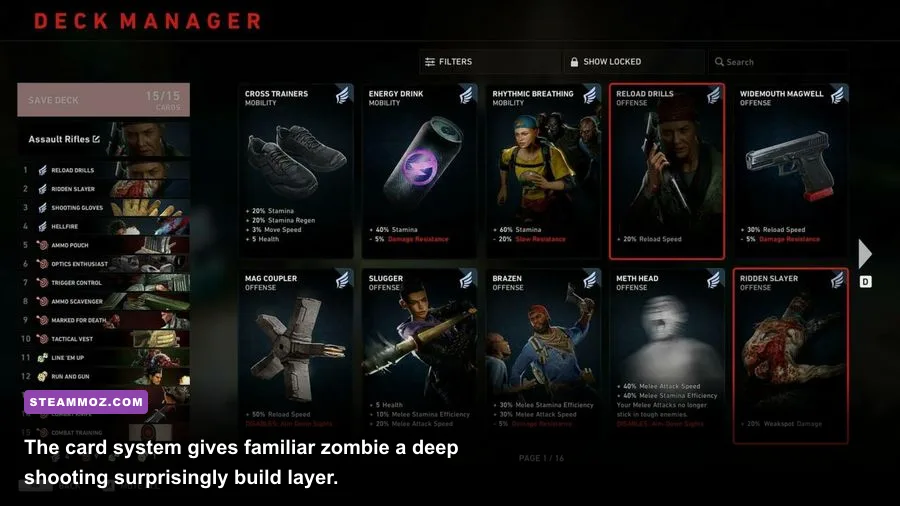
At launch, Back 4 Blood's card system could feel like a menu you had to fight before fighting zombies. The modern campaign is much cleaner. You build a 15-card deck, draw cards during a run, and choose from the available selections at the start of each level. That structure lets you shape a character around melee, shotguns, weak-point damage, healing, speed, or ammunition rather than simply hoping the Director hands you a good weapon.
A strong beginner deck should solve one problem instead of trying to do everything. For a rifle Cleaner, cards such as Glass Cannon increase damage at the cost of survivability, Ammo Pouch improves ammunition capacity, and Ammo For All benefits the whole squad. Add Confident Killer for damage scaling after killing mutations and a reload-speed card if your weapon's downtime keeps getting you pinned. The exact order matters because early cards define the first few missions, when weak attachments and limited copper make mistakes expensive.
Melee builds are still extremely effective when built deliberately. Holly paired with Battle Lust, Vanguard, and Face Your Fears can generate healing and temporary health while cutting through commons. But melee is not a license to sprint into every horde. Retch acid, Stinger projectiles, and Tallboy swings punish tunnel vision, and Nightmare's corruption cards can turn a comfortable health engine into a disaster.
| Build Focus | Core Cards | Primary Weapon | Main Weakness |
|---|---|---|---|
| Rifle damage | Glass Cannon, Confident Killer, Ammo For All | M4 Carbine or SCAR | Lower survivability |
| Shotgun burst | Shell Carrier, Shredder, Buckshot Bruiser | AA12 or Super 90 | Range and ammo use |
| Melee sustain | Battle Lust, Vanguard, Face Your Fears | Combat Knife or machete | Ranged mutations |
| Support healing | Medical Professional, Group Therapy, Needs of the Many | SMG or rifle | Lower personal damage |
The important lesson is not to copy a tier list blindly. Check the deck's economy, healing, damage, and movement together. A glass-cannon Jim build is excellent when teammates protect him, but miserable when everyone plays selfishly. For broader build-focused reading, Steamoz's starting-build guide shows the same useful principle: specialize early, then patch the weakness your actual runs expose.
Difficulty is where the campaign finally clicks
Recruit is a forgiving introduction, but it can hide the game's best ideas. Veteran introduces more punishing damage and resource pressure, Nightmare demands reliable decks and team communication, and No Hope removes much of the comfort that lets casual squads improvise. You don't simply shoot more accurately at higher levels; you need to understand corruption cards, alarm mechanics, healing efficiency, and when to abandon a bad position.
The Game Director constantly changes the texture of a level. A door may be alarmed, birds may turn a quiet street into a horde, and a scripted objective can combine with a random mutation spawn to create a genuine emergency. Sound cues are vital. A Tallboy's roar gives you a moment to locate its glowing shoulder weak point, while a Stinger's attack should trigger immediate lateral movement rather than a panicked backpedal. Reekers telegraph their vomit and explosion, but their body-blocking potential is often more dangerous than the damage itself.
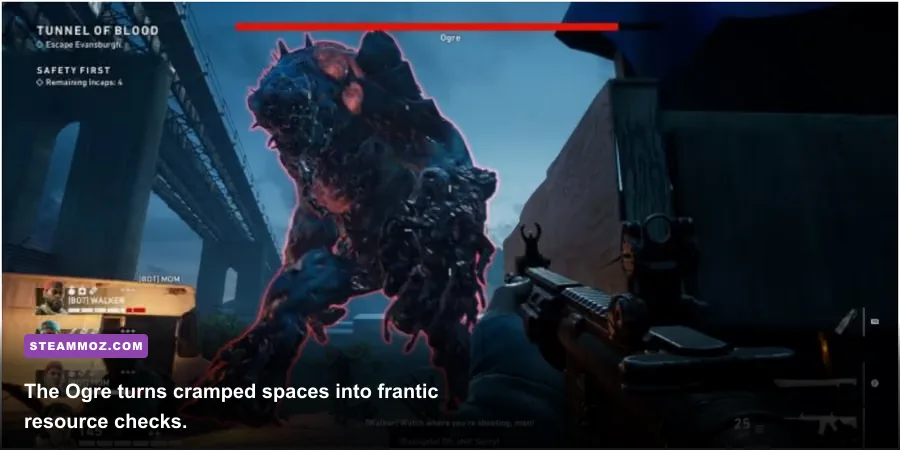
The Ogre is the clearest example of the game's boss philosophy. Its appearance is often less about killing it immediately than surviving the arena it controls. In the early tunnel encounter, focus fire on the glowing weak points, keep moving around cover, and avoid wasting every magazine while the team is still exposed. Later encounters can be handled more aggressively when the squad has a strong damage deck, but saving a toolkit, pipe bomb, or pain medication for the objective that follows is frequently smarter than chasing a flashy boss kill.
| Threat | Telegraph | Best Counter | Common Mistake |
|---|---|---|---|
| Tallboy | Loud roar and raised mutated arm | Circle wide and hit shoulder weak point | Backing into teammates |
| Stinger | Ranged screech and projectile stance | Strafe hard and prioritize immediately | Standing still to aim |
| Reeker | Vomiting animation and swelling body | Keep distance; finish away from the team | Letting the explosion split the group |
| Ogre | Boss music and arena lockdown | Use cover, weak points, and controlled bursts | Burning all resources too early |
Veteran also teaches the value of copper. Buy team upgrades at safe rooms whenever possible, but don't empty your wallet for a low-quality attachment if the squad needs defibrillators or a medkit. The best runs feel like small economic puzzles: spend enough to survive the next level, then preserve enough to recover from the level after that.
Where Back 4 Blood falls short in 2026

The biggest problem is structure. Back 4 Blood borrows the rhythm of Left 4 Dead but adds systems that can make a bad run feel predetermined. A poor card draw, weak shop inventory, corruption cards that stack the wrong way, and an unlucky Special Ridden combination can overwhelm a team before individual skill has much room to matter. Experienced players learn to manage those risks, but new players may read the result as unfair rather than strategic.
Its campaign storytelling is also serviceable rather than memorable. The Cleaners have personality, and the voice work keeps safe-room chatter lively, yet the plot never matches the scale of the apocalypse it describes. Missions such as The Abomination finale deliver spectacle, but the boss design can become a long damage check instead of a clever tactical climax.
Solo play is the more serious warning. Bots can shoot, revive, and follow objectives, but they don't provide the flexible decision-making of a human squad. They won't consistently manage copper, protect a vulnerable teammate, or understand that an alarmed door is a terrible place to start a fight. The offline campaign is playable, and solo progression is no longer the headache it was at release, but the game still clearly wants four human players.
Versus mode is another weak point if you're buying specifically for competitive play. Swarm offers a different take on the formula, with players controlling Ridden against Cleaners, but it never became the long-term centerpiece that keeps a competitive community alive. Treat it as a bonus, not the reason to purchase.
For comparison, Steamoz's Desperados III review and Dungeon Siege review both make a useful distinction between a game that remains mechanically strong and one that remains fully supported. Back 4 Blood belongs in the first category: its core loop holds up, but its content roadmap is finished.
PC performance and the settings worth changing
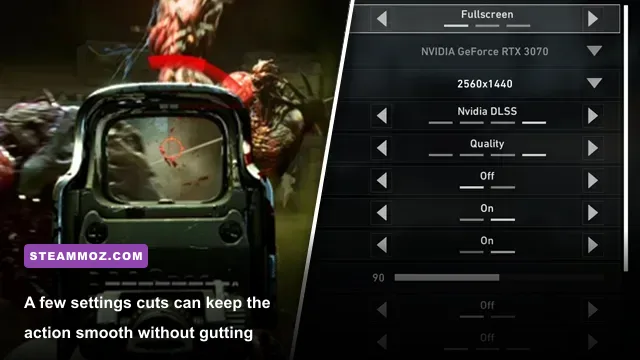
On PC, Back 4 Blood scales well across modern hardware. Its Unreal Engine 4 presentation looks best with volumetric effects, shadows, and post-processing intact, but dense hordes can expose CPU limits even when the GPU has headroom. A stable 60 frames per second matters more than ultra textures in this game because aiming through a Ridden wave is already visually busy.
| Setting | Recommended Value | FPS Impact | Visual Trade-Off |
|---|---|---|---|
| Resolution | Native 1080p or 1440p | High | Use resolution scaling before destroying texture quality |
| Texture Quality | High | Low to medium | Needs sufficient VRAM |
| Shadow Quality | Medium | Medium | Small loss in contact-shadow detail |
| Post Processing | Medium | Medium | Cleaner image and fewer distracting effects |
| Effects Quality | Medium | Medium to high in hordes | Less smoke and particle density |
| Motion Blur | Off | Minimal | Sharper target tracking |
Enable a frame-rate cap that your system can sustain rather than chasing unstable highs. If your 1440p rig drops below 60 during Ogre fights, reduce Effects and Shadows first. Keep textures high if VRAM allows it; lowering them makes the world look muddy without solving the CPU spikes caused by large Ridden groups. Players troubleshooting other PC releases may also find Steamoz's PC fixes guide useful for the broader habit of changing one performance variable at a time.
Should you play Back 4 Blood in 2026?
Play it if you have friends, enjoy replayable FPS campaigns, and like the idea of building a deck around a weapon or team role. The shooting is satisfying, the Ridden encounters remain genuinely tense, and the campaign has enough Acts, difficulty levels, DLC missions, and card combinations to justify dozens of hours. Crossplay across supported platforms is a major advantage for a game whose best content requires a full squad.
Skip it if you want a rich solo story, a permanent stream of seasonal content, or a competitive multiplayer ecosystem. The lack of new expansions is not a deal-breaker for a finished co-op game, but it does mean you should buy it for what exists now—not for what it might become. Check the current official news archive before purchasing a bundle so you know which DLC chapters and Cleaners are included.
My final verdict is 7.5/10. Back 4 Blood never escapes Left 4 Dead 2's shadow, and its card-driven difficulty can produce some rough edges. Still, once a team understands its economy and stops treating every mutation as a target to rush, the game becomes a sharp, replayable co-op shooter with more buildcraft than its reputation suggests. In 2026, it's worth playing at the right price—and much more worth playing with the right people.