
Yes, Anno 1800 Complete Edition is still worth playing in 2026, and its mix of city building, production logistics, diplomacy, and naval trade remains unusually deep. The catch is that this isn't a relaxing sandbox you casually finish over a weekend. Its late game can become a spreadsheet with ships, workforce tiers, commuter piers, and supply chains stretched across several regions. If you enjoy methodical strategy and can accept a slow opening, the Complete Edition is arguably the best version of Anno 1800. If you want fast victories or constant tactical action, the same richness may feel like homework.
That verdict comes after a full retrospective rather than a nostalgia pass. Ubisoft's post-launch support has ended, but the finished game now includes a huge amount of polished content. You can check the current package details on the official Steam page, while Ubisoft's Anno 1800 site still documents the core experience.

What the Complete Edition actually gives you
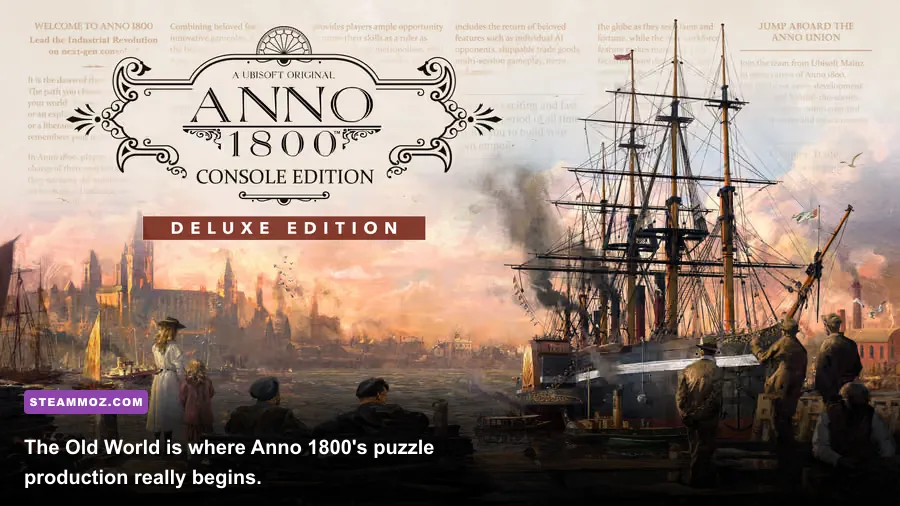
The Complete Edition's value comes from how naturally its expansions plug into the original campaign. The base game already contains the Old World, Cape Trelawney, the New World, Arctic Passage, and Enbesa-style exploration through later content. The complete bundle adds the four major Season Pass collections, typically covering the key gameplay expansions and their associated cosmetic material. Store naming can vary by platform and sale, so verify the exact package list before buying, especially if you already own the base game or individual passes.
The important content is substantial. Sunken Treasures adds Cape Trelawney and its enormous Crown Falls island, a perfect space for a capital city. The Passage introduces the Arctic, airship logistics, and gas production. Land of Lions adds Enbesa, irrigation-based agriculture, research, and a memorable story campaign. Docklands changes trade by letting you exchange one surplus good for another through a modular export harbor.
Season 2's Bright Harvest makes tractors and fuel a serious agricultural upgrade, while The High Life adds skyscrapers and late-game building density. Season 3's Seeds of Change, Empire of the Skies, and New World Rising deepen the New World with haciendas, airships, and a larger progression arc. Cosmetic packs aren't the reason to buy, but the gameplay DLC is far more than filler.
| Content | What It Adds | Best For |
|---|---|---|
| Base Game | Old World, New World, campaign, diplomacy, naval trade | Learning the core economy |
| Sunken Treasures | Cape Trelawney and Crown Falls | Building a giant capital |
| The Passage | Arctic region, airships, gas | Advanced logistics |
| Land of Lions | Enbesa, research, irrigation | Story and complex production |
| Docklands | Specialized export-import harbor | Solving awkward shortages |
| Bright Harvest and The High Life | Tractors, fuel, skyscrapers | Late-game optimization |
🎮 Anno 1800
Looking to experience this game? Grab your digital key directly on our store for $59.99.
View on Steammoz Store →Why the production system still feels exceptional

Anno 1800's central trick is turning every upgrade into a logistical problem. Farmers need schnapps, workers need soap and bread, artisans need canned food and sewing machines, engineers need telephones and spectacles, and investors eventually demand advanced goods such as steam carriages and gramophones. Each population tier unlocks more money and workforce, but also creates another dependency. A city can look prosperous while one missing input quietly blocks thousands of residents from upgrading.
The workforce model is the game's smartest pressure valve. A factory doesn't simply require money; it needs a local workforce category. A cannery uses artisans, while a bicycle factory needs engineers and artisans. Commuter Piers let you share workers between islands, but they don't erase production costs or shipping problems. They turn the archipelago into a network rather than a collection of isolated towns.
That network is where Anno 1800 remains unmatched. A New World island may grow cotton and sugar cane, but the finished textiles and rum are consumed in the Old World. Cape Trelawney may hold your skyscraper district, while the Arctic supplies gas and Enbesa produces research materials. A shortage isn't just a red warning icon; it's a question about ships, harbor storage, production ratios, workforce, and route timing.
The progression curve is deliberate, not slow by accident
The early game asks you to stabilize basic needs before chasing luxury. Build farmer residences, connect marketplaces, establish fishery and work-clothes production, then add schnapps and pub coverage. Once workers arrive, bread and soap become priorities. Don't rush every upgrade. Promoting too many farmers at once can remove the workforce needed to operate farms and fisheries, creating the classic Anno spiral: upgrade citizens, lose workers, lose supplies, then watch happiness collapse.
By artisans, you should be thinking in production chains rather than individual buildings. A bakery needs flour, flour needs grain, and grain needs farms with enough fertility. Production statistics are more useful than visual guesswork, so pause often and inspect the statistics screen. This measured pace is a strength for strategy fans, though players expecting the immediate action of a traditional RTS may bounce off it. For another management-heavy experience, our Empires of the Undergrowth progression guide shows a much faster rhythm.
Where the DLC succeeds—and where it overcomplicates things
The Complete Edition is at its best when each expansion creates a new strategic layer. Land of Lions is the clear highlight. Enbesa's irrigation channels make terrain and water management matter, while the research institute turns expedition materials and specialist items into a long-term project. Its story is also more focused than Anno 1800's sometimes scattered campaign, giving the region a genuine sense of place.
Sunken Treasures is less mechanically surprising but hugely valuable. Crown Falls is a massive, fertile canvas that lets you build an impressive capital without demolishing your original settlement. Docklands is powerful enough to change how you play: exporting fish, soap, or even high-volume agricultural goods can solve a shortage of steel, brass, or other bottleneck resources. Used carefully, it smooths the economy. Used too early, it can hide weak production planning.
The weaker additions are mostly about late-game density. The High Life looks spectacular, but skyscraper tiers require demanding supply chains and can encourage repetitive optimization. The Arctic remains visually distinctive, yet its harsh layout and long shipping distances make it a region many players postpone indefinitely. Airships are useful, especially for remote routes, but they don't completely replace a well-designed cargo fleet.
| Expansion | Value in 2026 | Main Strength | Main Drawback |
|---|---|---|---|
| Land of Lions | S-Tier | Best story, research, irrigation | Arrives late in a campaign |
| Sunken Treasures | A-Tier | Crown Falls and huge city space | Less new production variety |
| Docklands | A-Tier | Flexible global trade | Can trivialize shortages |
| The Passage | B-Tier | Arctic and gas logistics | Harsh terrain and slow setup |
| The High Life | B-Tier | Skyscraper city endgame | Heavy late-game micromanagement |
Performance, graphics, and the late-game CPU problem
Anno 1800 is still demanding in 2026, but not for the reason many players expect. A modern graphics card handles the visual load comfortably at 1080p or 1440p; the real enemy is simulation complexity. As population, ships, factories, and active trade routes multiply, the main thread becomes the limiting factor. A powerful GPU won't guarantee a locked 60 fps over a city with tens of thousands of residents.
The official PC requirements remain a useful baseline, although newer drivers and CPUs can improve the experience. The minimum target listed for the game is roughly an Intel Core i5-4460 or AMD Ryzen 3 1200, 8 GB of RAM, and a GTX 960 or Radeon R9 270X. Recommended specifications move toward an i5-4690, 8 GB of RAM, and a GTX 970 or Radeon R9 285. In 2026, 16 GB of RAM and a six-core modern CPU are the sensible target for a large DLC-heavy save.
| Setting or Component | Recommended Value | Performance Impact | Visual Note |
|---|---|---|---|
| Resolution | 1440p on a modern mid-range GPU | Moderate GPU load | Excellent readability for dense cities |
| Texture Quality | High | Low to moderate | Keep high if VRAM allows |
| Volumetric Clouds | Medium | Moderate GPU load | Small visual sacrifice |
| Shadows | High or Medium | Moderate | Medium helps older cards |
| Object and Terrain Detail | High | CPU and GPU load | Lower only on weak systems |
| Simulation-heavy late game | Six-core modern CPU, 16 GB RAM | Largest frame-time factor | Zoom out and scrolling benefit most |
For a smoother campaign, limit background applications, use an SSD, and avoid placing every production building on one island if your CPU is older. Save before major DLC transitions, especially when activating multiple story regions. Our PC graphics settings coverage explains the same general performance principle: reduce expensive visual settings first, but remember that simulation-heavy games often need CPU-side compromises instead.
Who should buy it in 2026?
Buy Anno 1800 Complete Edition if you like watching a messy settlement become an elegant machine. The best moments are quiet ones: a new railway fixes a congested harbor, a commuter pier stabilizes an island, or a carefully timed cargo route prevents a city-wide shortage. The game rewards planning more than reflexes, and its sandbox can absorb dozens of hours without running out of meaningful problems.
It also remains a great choice for players who want a historical setting without a strict military focus. Combat exists through frigates, ships of the line, monitors, battlecruisers, and defensive harbor guns, but war is only one part of the system. Diplomacy with characters such as Bente Jorgensen, Princess Qing, and Alonso del Campo matters, while pirates can be bribed, fought, or managed depending on your reputation and economy.
Don't buy it expecting a compact campaign or effortless city decoration. The interface takes time to learn, the opening hours can feel tutorial-heavy, and the late game can bury you under production statistics. New players should begin with the campaign on a relaxed difficulty, keep pirates enabled only if they want naval pressure, and resist installing every expansion at once. Add regions gradually so the economy remains understandable.
Anno 1800 Complete Edition is less a game you beat than a system you inhabit. In 2026, its visuals still hold up, its economic design remains superb, and the Complete Edition finally delivers the content breadth the original launch version lacked. Its age shows in UI friction and CPU-heavy mega-cities, but no newer city builder has completely replaced its combination of atmosphere, logistics, and satisfying industrial escalation. At a substantial discount, this is an easy recommendation. At full price, buy it only if you genuinely want a long-term strategy project—not just another game to sample for two evenings.
For broader PC troubleshooting ideas, Steamoz's crash and FPS fixes are useful reference material, while the PC specs guide format can help you compare an older system against Anno 1800's real-world demands.