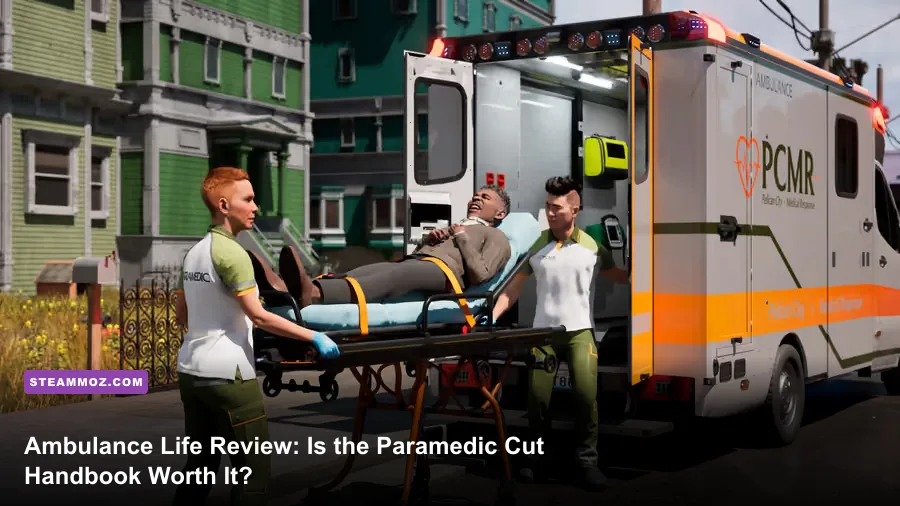
Ambulance Life: A Paramedic Simulator is worth playing in 2026 only if you want a patient, systems-heavy emergency sim rather than a polished action game. Its best moments are genuinely tense: you rush into San Pelicano, identify what is wrong, stabilize a patient, and decide whether your diagnosis is good enough to justify transport. Its weakest moments are equally obvious, with repetitive calls, awkward driving, rough animation, and an interface that sometimes makes basic medical work feel harder than it should.
The “Paramedic Handbook” and “Dev’s Cut” wording deserves a quick clarification. The officially listed game is Ambulance Life: A Paramedic Simulator from Aesir Interactive and NACON; there is not a major, separately recognized “Dev’s Cut” edition that radically changes the simulation. So this review treats that phrase as the handbook-style, developer-focused version of the game: the base experience, its career structure, and what remains worthwhile for players in 2026.
What Ambulance Life Gets Surprisingly Right

Ambulance Life understands that paramedic work is mostly about uncertainty. You rarely arrive with a neat objective marker saying “heal the broken arm.” Instead, a patient gives you clues, symptoms point in several directions, and the correct sequence of checks matters. You inspect the patient, ask questions, look for visible injuries, check vital signs, and use the available diagnostic tools before choosing treatment.
That process gives the game its strongest identity. A successful call isn't about clicking through a single obvious interaction. It is about building a plausible diagnosis from incomplete information. A patient who looks merely shaken may have a more serious condition, while a dramatic-looking injury can sometimes be stabilized with a straightforward intervention. The game wants you to slow down, read the symptoms, and resist the instinct to rush every person into the ambulance.
The feedback loop is simple but effective. You reach the incident, secure the scene, assess the patient, perform treatment, move them to the ambulance, and drive to the hospital when the case demands it. Every stage can go wrong. Arriving late can worsen the situation. Missing a symptom can lead to the wrong treatment. Transporting someone who should have been handled on-site wastes time and reduces the quality of the call.
That doesn't make Ambulance Life a hardcore medical simulator. It simplifies real-world emergency medicine into readable game systems, and the available actions are designed for accessibility. Still, the game succeeds at creating the mindset of a first responder: prioritize, gather information, stabilize, and don't panic when the scene becomes messy.
The city of San Pelicano is also more useful than it first appears. It is not a living open world in the exploration-game sense, but the districts provide enough variety to keep routes and calls from feeling completely interchangeable. Traffic, narrow streets, roadside collisions, industrial areas, and residential incidents all change how you approach the job.
🎮 Ambulance Life - Paramedic Handbook Devs cut
Looking to experience this game? Grab your digital key directly on our store for $3.49.
View on Steammoz Store →Career Mode Is the Real Test of Patience
Career mode is where the game either clicks or falls apart for you. It introduces the tools and call types gradually, then expands the map and adds more complicated situations as you gain experience. Early shifts are deliberately modest. You learn how to examine patients, operate the ambulance equipment, and recognize the rhythm of a standard call before the game starts layering complications on top.
The progression is not built around a flashy skill tree with dozens of permanent bonuses. Instead, new responsibilities, districts, equipment, and scenario types provide the sense of advancement. That design fits the subject better than a conventional RPG progression system. You are not becoming a superhero paramedic; you are becoming more comfortable with the workflow.
The problem is that the career loop can become predictable before the game has exhausted its best ideas. The first time you work through a complicated multi-patient incident, the pressure feels excellent. By the tenth similar call, the driving and patient-transfer steps can feel like chores between the interesting decisions. Ambulance Life needs you to enjoy repetition because repetition is part of the fantasy.
| Career Stage | Main Focus | What Improves | Potential Weakness |
|---|---|---|---|
| Initial Training | Basic examination and treatment | Learn the patient workflow without heavy pressure | Can feel slow for experienced simulation players |
| Early San Pelicano Calls | Single-patient incidents and ambulance driving | Builds confidence with tools and route planning | Call structures start repeating quickly |
| Expanded Districts | More varied scenes and longer responses | Introduces better prioritization and time management | Traffic and navigation can become frustrating |
| Advanced Emergencies | Multiple patients and difficult diagnoses | Produces the game's best pressure moments | Small interface mistakes can feel overly punishing |
The best way to approach progression is to treat every call as practice rather than a score chase. Read the incident description before moving. Memorize where the examination tools sit in the interface. When multiple patients are present, identify the most urgent case first instead of bouncing between everyone in the order the game presents them.
That habit matters because the game rewards composure more than speed. A fast response is useful, but a rushed diagnosis can undo the entire call. If you enjoy structured progression, this is closer to learning a demanding job than unlocking overpowered equipment. If you need constant rewards, mission variety, and narrative momentum, the career can feel thin.
Patient Diagnosis Has More Depth Than the Presentation
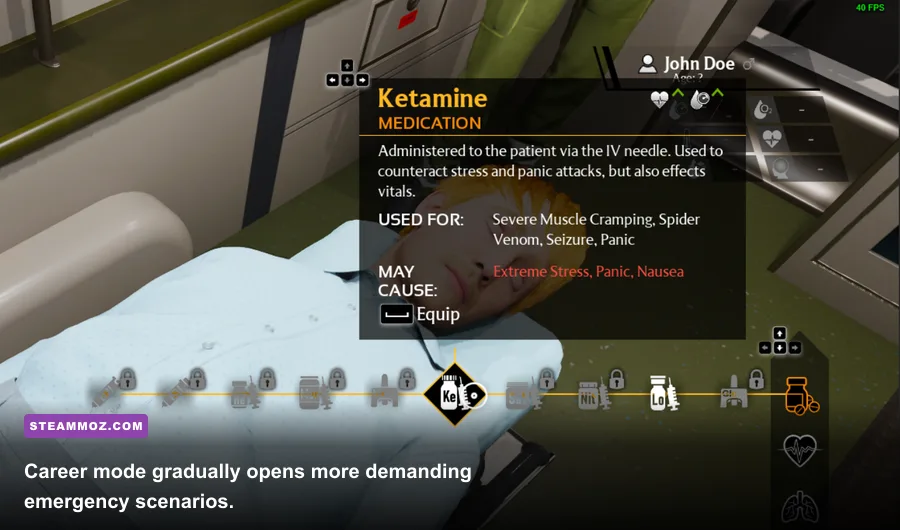
The examination system is the reason to play Ambulance Life, and it is also where the rough edges are easiest to forgive. The game gives you a toolbox of checks and treatments rather than a single universal healing button. Visible injuries, questions, vital signs, and medical equipment each contribute different information. You need to connect those clues instead of assuming the loudest symptom is the whole diagnosis.
Good calls usually follow a repeatable routine. Start with a visual scan and basic conversation. Check the patient's condition before applying a treatment. If the game reveals a vital sign or symptom that changes the situation, stop and reassess instead of continuing down your first plan. Once the patient is stable, decide whether the correct outcome is on-site treatment or hospital transport.
There is a satisfying risk-reward tension in that final choice. Transporting every patient feels safe, but it is not always the most efficient answer. Leaving someone at the scene can be the correct call when their condition is manageable, while a serious patient demands a hospital even if the drive is inconvenient. The game makes those choices feel consequential without turning every error into an instant failure.
Multi-patient incidents are the closest Ambulance Life comes to a dramatic set piece. They test whether you can triage instead of simply following prompts. The interface doesn't always communicate urgency elegantly, so you have to learn to read the scene, identify who is deteriorating, and avoid spending too long perfecting one patient's treatment while another waits.
That is also why the game is better with a controller or a carefully configured keyboard-and-mouse layout than with default controls blindly accepted. You want quick access to examination tools, movement, and interaction without repeatedly searching menus. The controls are functional, but not so intuitive that you should skip the tutorial or early training calls.
| Call Situation | Primary Risk | Best Response | Common Mistake |
|---|---|---|---|
| Single injured patient | Misreading visible trauma | Complete the examination before treating | Applying the first obvious treatment immediately |
| Unclear symptoms | Building the wrong diagnosis | Use questions and vital checks to confirm clues | Assuming one symptom explains everything |
| Multiple patients | Spending too long with one person | Triage urgency, then stabilize in priority order | Treating patients in menu order |
| Stable patient after treatment | Unnecessary transport | Review condition before choosing the destination | Driving everyone to hospital by default |
Do not expect real clinical accuracy. The game is an accessible interpretation of emergency response, not a replacement for medical training. That distinction is important, but it doesn't erase the value of the simulation. It teaches observation, prioritization, and procedure rather than textbook medicine.
Driving and Presentation Are the Biggest Friction Points
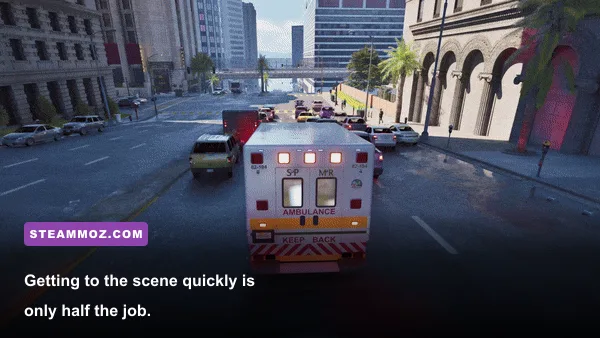
Getting to the emergency is often less enjoyable than handling it. The ambulance has weight and presence, but the driving model can feel floaty, especially when you are trying to thread through traffic with the siren active. The roads are serviceable, yet collisions, awkward turns, and navigation quirks regularly break the fantasy.
The siren helps create urgency, but it doesn't turn the city into a convincing traffic simulation. Other vehicles sometimes react inconsistently, and the quickest route is not always the one the navigation system suggests. Learn the broad shape of each district instead of trusting the GPS completely. A route that looks shorter on the map can be slower once you account for intersections and cramped side streets.
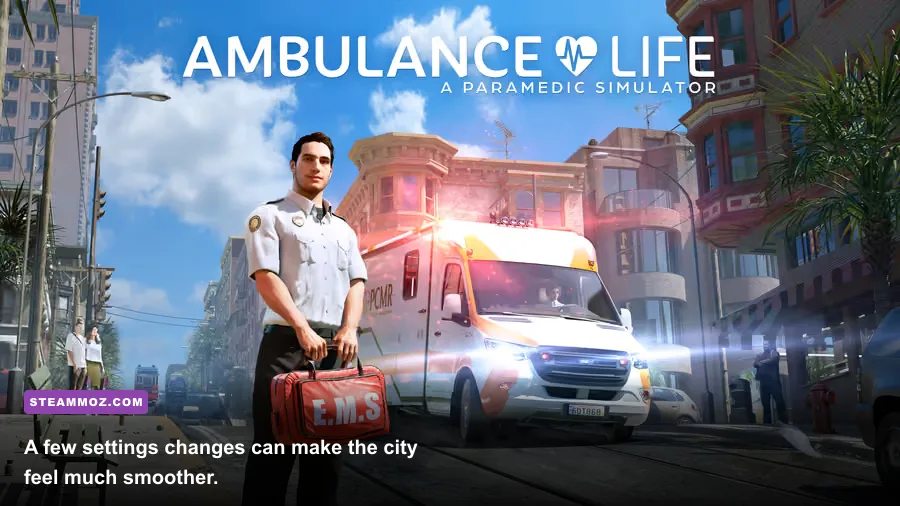
On PC, the game also shows its ambition and its limitations. The city lighting and ambulance interiors can look good, particularly during rain or nighttime calls, but character animation and environmental detail are uneven. Expect a simulation that benefits from a stable frame rate more than maximum visual quality. Smooth steering and quick interaction are worth more than a few extra reflections.
| Setting | Recommended Value | Performance Impact | Visual Trade-Off |
|---|---|---|---|
| Resolution Scale | 100% | High if increased | Keep native resolution before raising expensive effects |
| Shadows | Medium | Medium to high | Reduces distant shadow quality with a useful FPS gain |
| Post-Processing | Medium | Medium | Preserves the city's mood without excessive blur |
| Effects Quality | Medium | Medium | Maintains emergency lighting while reducing clutter |
| View Distance | High | Medium | Helps navigation and keeps the city from popping in |
| Motion Blur | Off | Minimal | Improves visual clarity during fast driving |
These are practical starting points, not guaranteed benchmark numbers. Performance depends heavily on your CPU, GPU, and patch version. The published Steam system requirements are the sensible baseline to check before buying, and players dealing with crashes or inconsistent frame pacing can also compare our broader PC performance troubleshooting advice.
On a mid-range gaming PC, a locked 60 FPS target with medium shadows is generally a better goal than chasing ultra settings. The game is not a competitive shooter, but frame-time spikes are noticeable when driving and during crowded emergencies. A stable image makes the controls feel more predictable, which directly improves the simulation.
Is the Handbook-Style Experience Worth Playing in 2026?
In 2026, Ambulance Life occupies a strange but appealing niche. It is not the most polished driving game, not the deepest medical simulator, and not a story-heavy emergency drama. What it does offer is a focused fantasy of working through calls, interpreting symptoms, and making practical decisions under pressure. Few games deliver that exact loop, and the lack of direct competition helps its strengths stand out.
The “handbook” appeal comes from learning the workflow. You gradually understand which clues deserve attention, when to stop treating and reassess, and how to manage the clock without turning every call into a frantic speedrun. Players who enjoy methodical progression systems will likely appreciate that rhythm. Those looking for constant spectacle will probably bounce off it.
There is also a useful contrast with more chaotic simulation games. Ambulance Life isn't asking you to build a huge operation or manage an entire hospital. You are on the ground, one incident at a time. That narrow scope makes the best scenarios feel personal, even when the surrounding city and NPC behavior remind you that the production budget had limits.
Buy it if you like emergency-response games, realistic procedures simplified into game mechanics, or career modes where improvement comes from player knowledge. Wait for a discount if repetitive missions, awkward vehicle handling, or uneven animation tend to ruin your immersion. Skip it if you want a cinematic campaign, deep character relationships, or medically rigorous simulation.
| Player Type | Verdict | Why |
|---|---|---|
| Simulation fans | Recommended | The assessment and triage loop creates unusual, satisfying pressure |
| Emergency-service enthusiasts | Recommended at a discount | The fantasy is strong, but presentation and repetition hold it back |
| Action-focused players | Probably skip | Most of the game is observation, menus, driving, and procedure |
| Completionists | Mixed | Career progression is clear, but late-game variety can thin out |
| Low-end PC owners | Check first | Stable frame pacing matters more than the nominal minimum specs |
For a second opinion on how Steamoz approaches PC-focused reviews and fixes, see our coverage of EscapeVR performance problems and PC specification breakdowns. Ambulance Life deserves the same practical treatment: judge it by whether its core loop works for you, not by whether every animation matches a premium simulator.
Final Verdict
Ambulance Life: A Paramedic Simulator is a flawed but unusually focused game. The diagnosis and triage work can produce real tension, especially during multi-patient incidents, and the career structure gives you enough time to learn the job's rhythm. But the driving model, repeated call patterns, interface friction, and uneven visual polish keep it from becoming an essential simulation.
Our 2026 verdict: 7/10. It is worth playing for patient players who want a grounded emergency-response experience, especially at a sale price. The official NACON game page and Aesir Interactive's developer site are the best places to check current editions and updates. Just don't buy it expecting an action blockbuster. Ambulance Life is at its best when the siren stops, the scene goes quiet, and you have to decide what to do next.