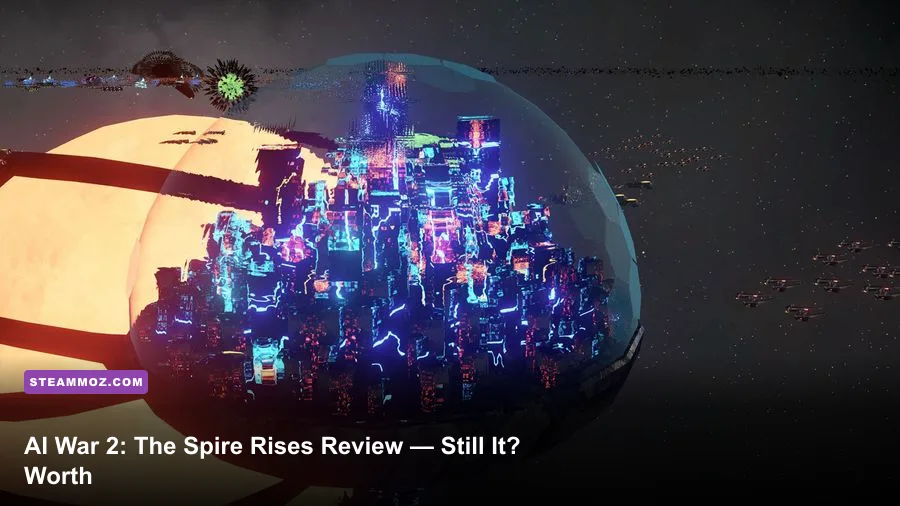
Yes, AI War 2: The Spire Rises is worth playing in 2026—but only if you want a hostile, systems-heavy RTS that expects you to lose intelligently. The expansion does not turn Arcen Games' cult classic into a conventional space battle simulator. Instead, it deepens the asymmetric war, adds another layer of strategic panic, and makes every attack feel like a calculated theft from an enemy that is already stronger than you.
That distinction matters. If you want a campaign that hands you a growing army, a tidy tech tree, and a satisfying march toward total map control, this is still the wrong game. If you enjoy stealth, timing, scouting, disposable fleets, and making the AI react to your mistakes, The Spire Rises remains one of the most unusual RTS expansions on PC.
What The Spire Rises actually changes

The expansion's defining idea is the Spire: a powerful, mobile strategic presence that changes how you read the galaxy. AI War 2 already asks you to fight an enemy with superior numbers and production. The Spire layer makes that advantage feel less abstract. You are not simply clearing red systems from a map; you are deciding which threats can be tolerated, which worlds can be raided, and when a supposedly safe route has become strategically poisoned.
That fits AI War 2's central design perfectly. The AI has an aggression economy, escalation systems, special worlds, and defensive networks that punish noisy play. The familiar five-level AI difficulty scale is only the beginning. The real question is how much attention you attract while trying to build enough power to survive. Destroying a valuable structure can win a local fight and still push the campaign toward a losing endgame.
The Spire is at its best when it forces a change in priorities. You cannot treat every hostile contact as a target. Sometimes the correct move is to take an adjacent planet, disable a dangerous connection, steal a strategic asset, and leave before the enemy's response fleet arrives. That is a very different rhythm from more conventional swarm-focused RTS design.
The campaign loop rewards restraint
A normal RTS teaches expansion. AI War 2 teaches controlled trespassing. You begin with a command station, a limited fleet, and an incomplete understanding of the AI's network. Early objectives usually involve scouting nearby systems, identifying dangerous defenses, and finding a route toward an AI-controlled world without triggering a chain reaction.
The best campaigns have a deliciously lopsided feeling. You may destroy a fortress, capture a planet, and celebrate for thirty seconds before realizing that the move exposed your flank. The Spire Rises sharpens that tension because the map's strategic threats are harder to classify as permanent or temporary. A location that was harmless during your first raid can become a lethal crossroads after the AI expands its response pattern.
| Campaign decision | Short-term benefit | Long-term danger | Best approach |
|---|---|---|---|
| Capture an AI world | More territory and production | Raises attention and opens retaliation routes | Secure the exits before committing |
| Destroy a major defense | Safer access through the system | Can accelerate AI escalation | Strike only when the route matters |
| Ignore a hostile system | Preserves fleet strength | Leaves a future threat behind you | Mark it and monitor its connections |
| Use a disposable raiding group | Reveals defenses cheaply | Losses can weaken your next attack | Spend ships for information, not pride |

🎮 AI War 2: The Spire Rises
Looking to experience this game? Grab your digital key directly on our store for $3.19.
View on Steammoz Store →How the Spire changes the way you play

The most important adjustment is psychological: stop measuring success by territory alone. A tiny, well-positioned fleet can be more valuable than a large force parked on a captured world. The Spire encourages you to think in terms of information, mobility, and threat timing.
For example, a fast scouting group can reveal whether a system contains a vulnerable command structure, a heavily defended planet, or a route that should remain untouched. That information determines your next move. You might send a Hacker-type support group to interfere with a dangerous defense, use stealth-capable ships to slip past a screen, or split your fleet so the AI cannot answer every threat at once. None of those moves looks impressive in a post-battle screenshot. They are often what keeps the campaign alive.
AI War 2 also makes fleet composition more meaningful than raw unit count. Screens absorb attention and protect fragile specialists. Long-range ships punish static defenses. Cloaked or stealth-oriented units create openings, but they are not magic; detection, area effects, and bad positioning still erase them. The Spire's pressure means you should build fleets around a job rather than collect every ship that looks powerful.
A practical fleet structure
Use one main force for taking objectives, one small reaction force for emergencies, and at least one scouting group. The main fleet should contain enough direct damage to remove the system's key defense, but not so many expensive ships that losing it ends the campaign. Your reaction group exists to intercept raiders, protect a vulnerable route, or buy time while the main fleet retreats.
Do not rush to upgrade every ship. AI War 2's strongest tools are often situational. A ship that looks weak in a straight engagement can be outstanding when it disables a specific defense or creates an escape window. The right question is not “What is the highest damage fleet?” It is “What prevents this system from turning into a campaign-ending fight?”
| Fleet role | Recommended composition | Primary job | Common mistake |
|---|---|---|---|
| Scout group | Fast, inexpensive ships | Reveal routes, defenses, and escape paths | Entering combat before reporting information |
| Objective fleet | Damage dealers, screens, and support | Destroy the target structure and withdraw | Chasing every surviving enemy |
| Reaction fleet | Mobile ships with reliable damage | Defend exposed planets and buy time | Parking it permanently in one safe system |
| Specialist fleet | Stealth, hacking, or disruption tools | Open a route through a specific defense | Using it as a substitute for a main army |
Combat is clever, but the interface remains demanding
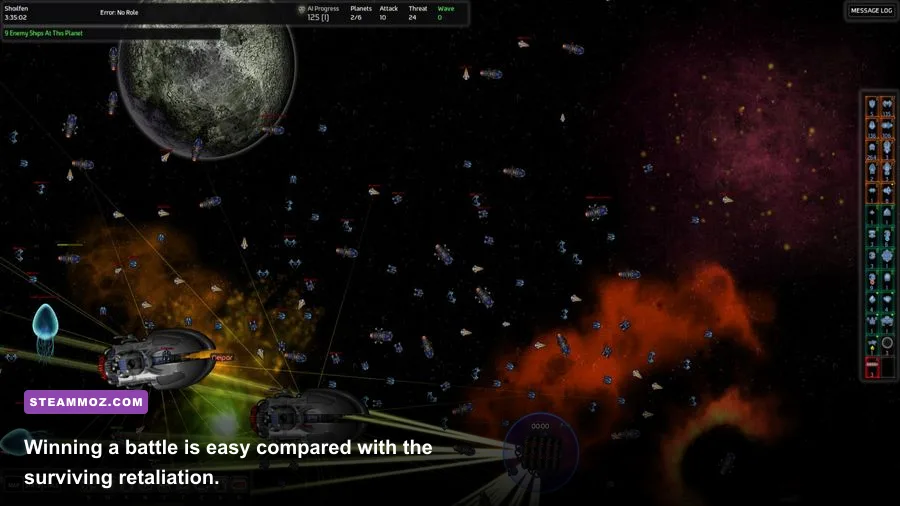
Combat is not difficult because units have complicated ability rotations. It is difficult because the game gives you more information than you can comfortably process during a crisis. Threat ranges overlap. Objectives matter more than kills. A retreat can be correct even when your fleet is winning. Meanwhile, the AI is happy to exploit the one undefended connection you forgot existed.
The interface has improved over the years, but it still feels designed for players who enjoy learning a dense toolset. Tooltips, selection filters, strategic zoom, pause controls, and command queues are essential rather than optional conveniences. Use pause aggressively while learning. This is not cheating or a concession to weakness; the game is built around planning and lets you think through complex encounters.
There is also a crucial difference between winning a fight and winning the operation. Before attacking, identify the actual objective. If the goal is to destroy a defense, stop once it is gone. If the goal is to capture a world, prepare the garrison and the retreat route before the first shot. Chasing a damaged enemy ship into an unknown cluster is how a clean victory becomes a disaster.
What makes The Spire Rises satisfying
The expansion creates stories rather than scripted set pieces. One campaign may involve a desperate crawl through the outer systems. Another may let you establish a safe pocket, build a surgical raiding fleet, and dismantle the AI's network piece by piece. Because the AI reacts to your choices, the same opening can develop into very different wars.
That unpredictability is also why the game can feel unfair. The AI is not pretending to be an equal opponent. It has stronger infrastructure, broader production, and defensive advantages. Your compensation is asymmetry: stealth, ambushes, hacking, mobility, strategic commanders, and the ability to choose where the war happens. Once you accept that, losses become useful data rather than a personal insult.
Performance, visuals, and accessibility in 2026
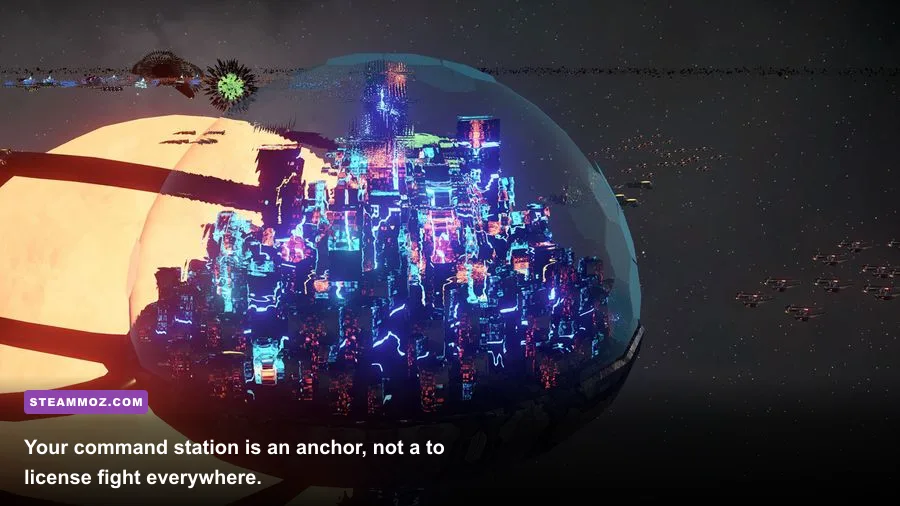
AI War 2 is not a demanding modern 3D showcase. Its 2D presentation scales cleanly on modest hardware, and a stable frame rate is generally easy to achieve. The real performance test is a late campaign with multiple fleets, projectile effects, explosions, and hundreds of units interacting in one system. Large engagements can become CPU-heavy even when your graphics card is barely working.
For most players, 60 frames per second is a sensible target. If a late-game battle slows down, reduce effects and particle density before lowering the display resolution. The visual cost is small, while the improvement in readability can be significant. A clean zoom level also matters: too far out and you miss combat cues; too close and you lose the strategic picture.
| Setting or habit | Recommended value | Performance impact | Visual result |
|---|---|---|---|
| Display resolution | Native monitor resolution | Low on most systems | Sharper strategic text and icons |
| Particle and explosion effects | Medium during huge battles | Moderate CPU/GPU relief | Less visual clutter around objectives |
| Background detail | Medium or High | Usually low | Preserves the atmosphere of star systems |
| Game speed | Normal while learning | No hardware cost | Gives more time to read threats |
| Pause and tactical planning | Use frequently | Improves decision quality | Makes dense battles manageable |
For broader PC troubleshooting advice, Steamoz's stutter and low-FPS checklist is useful, although AI War 2's biggest slowdowns are usually simulation-related rather than texture-related.
Is The Spire Rises good for new players?
Not immediately. AI War 2 has one of the steepest learning curves in the modern RTS space because it teaches strategy by withholding comfort. The game does provide tutorials and campaign tools, but you still need to understand escalation, scouting, command limits, strategic objectives, and retreat timing before the larger war makes sense.
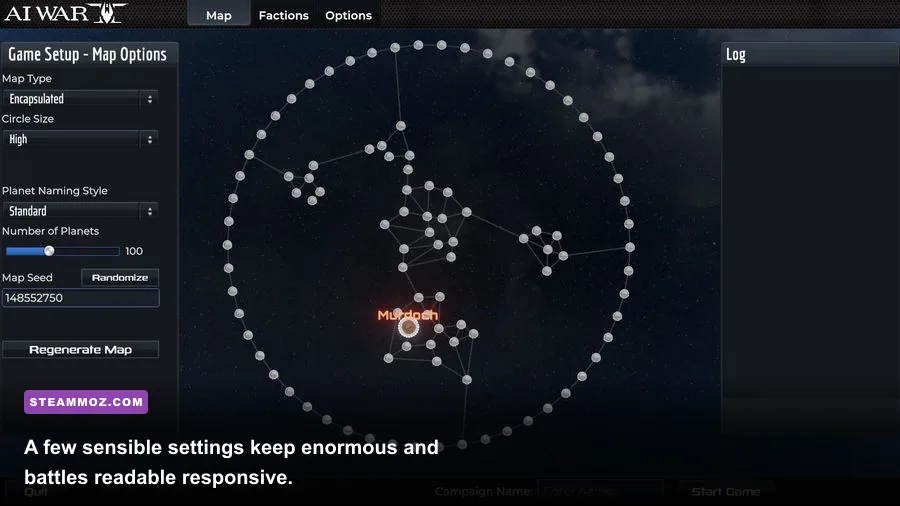
Start on an easier AI setting and use a smaller galaxy. Do not add every optional faction, difficulty modifier, or unusual commander on your first run. The point of an introductory campaign is to learn what the AI considers a loud action and how quickly it can punish a gap in your defenses. If you lose, study the campaign map rather than only the final battle. Usually the decisive mistake happened several systems earlier.
Newcomers should also resist the urge to copy a build order. AI War 2 is too reactive for one universal opening. A strong first move depends on the nearby map, the available routes, your commander, and the defenses surrounding the first useful target. Guides such as Steamoz's run-strengthening strategy advice can help with general decision-making, but this game rewards adaptation more than memorization.
Who should skip it?
Skip The Spire Rises if you want a relaxed power fantasy, a short campaign, or a competitive ladder with neatly balanced factions. You may also bounce off it if losing a six-hour run feels unacceptable. The expansion amplifies the game's strongest qualities, including its opacity and its willingness to let you make a doomed decision without announcing it.
Players who enjoy evaluating tools by situation rather than raw power will have a much better time. So will anyone who likes pausing an RTS, zooming across a star map, and realizing that the best move is to abandon a prize they spent twenty minutes preparing to capture.
Final verdict: worth playing in 2026?
AI War 2: The Spire Rises is worth playing in 2026, especially as part of the complete AI War 2 experience. It is not a flashy expansion, and it does not solve every interface problem. What it does is reinforce the game's rarest strength: making you feel like a clever survivor operating inside an enemy's machine.
The Spire Rises earns its place by changing decisions, not merely adding content. It makes map knowledge more valuable, turns fleet composition into a strategic language, and gives cautious players more reasons to think several moves ahead. The cost is a demanding opening, a steep learning curve, and a campaign structure that can punish enthusiasm harder than most modern strategy games dare to.
My recommendation is straightforward: buy it if you already enjoy AI War 2 or want an RTS where asymmetric warfare matters more than production speed. Play the base game first if you are completely new, then add the expansion once you understand why a “victory” can still damage your campaign. In 2026, that uncompromising design feels less outdated than refreshingly honest.
For the official details, check the AI War 2 Steam page, the The Spire Rises store listing, and Arcen Games' official site for current compatibility and update information.