Yes, Age of Empires IV is still worth playing in 2026—especially if you want an RTS with meaningful civilization differences, excellent competitive fundamentals, and a campaign that teaches rather than merely entertains. It isn't flawless: late-game performance can dip, some matchups are intimidating for newcomers, and the best multiplayer experience demands deliberate practice. But its readable combat, landmark-based progression, seasonal support, and strong solo content give it more staying power than most modern strategy releases.
The more useful answer depends on what you expect. If you want a relaxed historical sandbox with dozens of sprawling cities, Age of Empires II: Definitive Edition still offers broader legacy content. If you want a sharp, contemporary RTS where a single villager scout, early raid, or technology choice can reshape the entire match, Age of Empires IV is the better modern starting point. After revisiting its campaigns, custom matches, and ranked structure, I think it has settled into a very good place—less revolutionary than its launch promised, but considerably deeper and more polished than its early reputation suggests.
What Makes Age of Empires IV Hold Up?
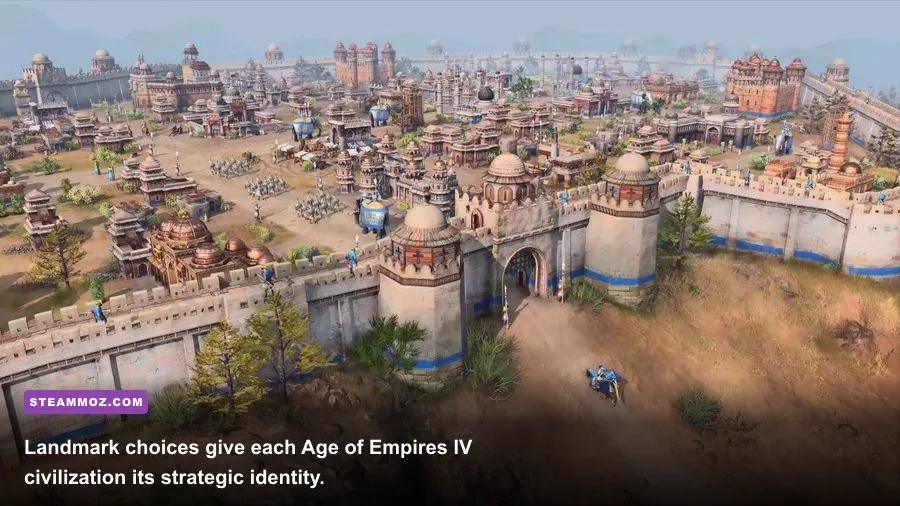
Age of Empires IV works because it preserves the series' central rhythm: gather resources, advance through historical Ages, establish a production advantage, and turn that advantage into map control. The basic economy remains familiar—Food, Wood, Gold, and Stone—but the game constantly asks you to spend those resources under pressure. Do you build a second Town Center for long-term growth, or spend that 400 Wood and 350 Stone on defenses? Do you rush a technology, add cavalry, or keep villagers mining Gold for the next Age?
That tension is the game's strongest design feature. Advancing from the Dark Age to the Feudal Age costs 400 Food and 200 Gold for most civilizations, while later transitions require increasingly serious investment. The landmark system makes the decision more interesting than a simple technology button. The English Council Hall, for example, acts as an Archery Range and supports an aggressive longbow opening. The Abbey of the Trinity boosts religious play for the English in the Castle Age. For the French, the School of Cavalry functions as a Stable and accelerates production, pushing the civilization naturally toward early Royal Knight pressure.
Every faction has a recognizable game plan without becoming a one-button gimmick. The Abbasid Dynasty uses the House of Wisdom and Golden Age tiers to reward efficient expansion. The Delhi Sultanate researches technologies for free but must protect Scholars and manage Sacred Sites. The Mongols can pack up buildings and move their economy, while Ovoos amplify production around strategically placed Stone deposits. The Rus are rewarded for hunting, scouting, and building a strong early economy. These aren't cosmetic bonuses; they change what a good first five minutes actually looks like.
| Core System | Why It Still Works | Where It Can Frustrate |
|---|---|---|
| Landmarks | Creates meaningful Age-up choices and faction identity | Some choices are clearly more practical on specific maps |
| Resource economy | Simple to understand, difficult to optimize | Villager losses snowball quickly after early raids |
| Combat counters | Spearmen, archers, cavalry, and siege have readable roles | Mixed armies and siege positioning punish beginners hard |
| Asymmetric civilizations | Each faction changes build orders and priorities | Learning the full roster takes significant time |
The result is a game that feels approachable for the first few matches but keeps revealing new layers. A beginner can understand that spearmen counter cavalry. An experienced player understands when to make them, where to place them, which blacksmith upgrade to delay, and how many villagers can safely leave Food before the next timing attack.

🎮 Age of Empires IV
Looking to experience this game? Grab your digital key directly on our store for $39.99.
View on Steammoz Store →Is the Multiplayer Still Good in 2026?
This is where Age of Empires IV earns its recommendation. The multiplayer is still the reason to keep returning. Matches are generally more readable than in older entries because units have clear silhouettes, combat animations are easy to follow, and the interface communicates important information without drowning the screen in clutter. You can usually identify the problem: exposed Gold, insufficient anti-cavalry units, a missed Scout, or a delayed upgrade.
That clarity doesn't make the game easy. Ranked play is a demanding loop built around small advantages. A French player who reaches Feudal with 400 Food and 200 Gold can threaten Royal Knights almost immediately, forcing the opponent to place Outposts, train Spearmen, or wall vulnerable resources. An English player may combine longbows with network-of-castles bonuses, while a Delhi player can contest Sacred Sites and use Scholars to accelerate research. The strongest players aren't simply clicking faster; they're forcing you to answer questions before your economy is ready.
Team games are more forgiving and often more entertaining for casual groups. A defensive Abbasid player can boom while a Mongol ally creates early map pressure. The trade system gives certain civilizations a late-game economic angle, and Wonder victories create a real clock rather than an abstract end condition. Still, team matchmaking can produce uneven games, and a teammate losing every villager to a first-minute raid can make a 40-minute match feel decided before it has properly started.
For solo competitors, the ranked ladder has enough strategic depth to support hundreds of hours. The important caveat is emotional: you need to enjoy reviewing mistakes. Losing a game because you floated 800 resources, forgot to add production buildings, or failed to scout a second Town Center feels rough, but those errors are teachable. The official Age of Empires IV site and the official news hub remain useful places to track balance changes, seasonal updates, and civilization adjustments.
| Mode | Best For | 2026 Verdict | Main Warning |
|---|---|---|---|
| Ranked 1v1 | Players who enjoy learning builds and reviewing losses | Excellent | Early mistakes are punished immediately |
| Quick Match | Shorter sessions without ladder pressure | Very Good | Match quality can vary by experience level |
| Team Games | Friends and coordinated strategies | Good | Uneven teammates can decide games early |
| Skirmish and Custom | Relaxed play, AI practice, and experimentation | Excellent | AI habits don't perfectly prepare you for humans |
Which Civilizations Are Best for New Players?
The English are still the safest recommendation. Their economy is forgiving, farms are reliable, and defensive structures project a useful attack-speed aura through the Network of Castles. Their early longbows are cheap enough to mass, and English Keeps can protect key areas while improving nearby military buildings. A straightforward opening is to gather Food and Gold for the Council Hall, add longbows and spearmen, then pressure exposed resources rather than blindly attacking the Town Center.
The French are another excellent entry point if you prefer aggression. The School of Cavalry gives you a fast Stable and accelerated Stable production, while Royal Knights have enough durability to threaten villagers and escape many bad fights. Don't throw them into spearmen. Use them to deny Gold, force defensive Outposts, and return later. French economic technologies and Villager production bonuses reward players who maintain constant Town Center production.
For players who want a more unusual economy, the Abbasid Dynasty is a strong long-term choice. The House of Wisdom's wings let you specialize through technologies such as Economic, Culture, Trade, and Military Wings. The civilization becomes powerful when you keep villagers working, establish a second Town Center, and reach the Golden Age by placing buildings efficiently. The tradeoff is that Abbasid armies can feel less immediately explosive than French cavalry or English longbows.
Japan, Malians, Ottomans, Byzantines, and the other expansion civilizations are worth learning after you understand the fundamentals. Japan's Daimyo Manors and Bannermen create a compact, upgrade-focused economy. Malians use Pit Mines and influence mechanics to generate Gold while fielding distinctive units such as Musofadi Warriors. Ottomans build Imperial Officials and military schools for a different production curve. These factions are rewarding, but their economies ask more specific questions than the English or French.
| Civilization | Learning Curve | Signature Strength | Best Beginner Goal |
|---|---|---|---|
| English | Low | Longbows, farms, defensive Network of Castles | Control space with ranged units and Outposts |
| French | Low-Medium | Royal Knights and faster Villager production | Raid resources without losing cavalry |
| Abbasid Dynasty | Medium | House of Wisdom wings and economic scaling | Reach a strong second Town Center timing |
| Delhi Sultanate | Medium-High | Free technology and Sacred Site pressure | Protect Scholars while contesting objectives |
| Mongols | High | Mobile buildings, Ovoo influence, aggressive tempo | Use mobility without neglecting the economy |
My practical advice is to play one civilization for at least 15 matches instead of changing after every defeat. Learn its first landmark, one defensive response, one expansion plan, and one late-game composition. The official Steam community hub is also useful for discovering build discussions, patch reactions, and custom-game ideas.
How Good Are the Campaigns and Solo Modes?
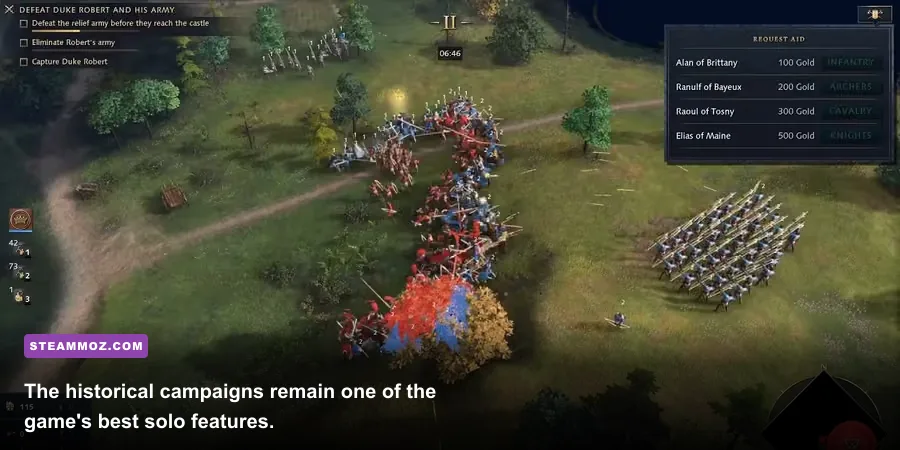
The campaigns are a major reason Age of Empires IV remains worth buying for players who don't care about ranked multiplayer. The Norman campaign follows William the Conqueror and his successors, while other campaigns cover the Hundred Years War, the rise of the Mongol Empire, and the Moscow-to-Rus historical arc. Missions combine battles with documentary-style historical narration, illustrated timelines, and short explanations of units, technologies, and locations.
These aren't disposable tutorials. Missions introduce mechanics in context, then ask you to use them under pressure. A siege scenario may teach you to escort trebuchets and protect their slow setup time. A defensive mission can make the value of walls, Keeps, and chokepoints immediately obvious. The campaigns also provide a useful bridge into skirmish play because they teach scouting, resource priorities, and objective management without throwing you directly into a ranked build-order race.
Challenge missions and Art of War exercises are particularly valuable. Art of War scenarios focus on fundamentals such as early economy, booming, defending raids, and executing an attack. They won't turn you into a ladder specialist, but they expose the exact habits that separate a functional opening from a dead one. The AI is suitable for learning hotkeys and unit counters, though it can be predictable and occasionally exploitable compared with human opponents.
For a deeper historical overview, the official game page outlines the major civilizations and campaign structure. If you're coming from another PC strategy title, Steamoz's guides to Empires of the Undergrowth progression and PC performance troubleshooting are useful in a broader sense, although their systems don't map directly onto AoE4.
Performance, Graphics, and PC Requirements in 2026
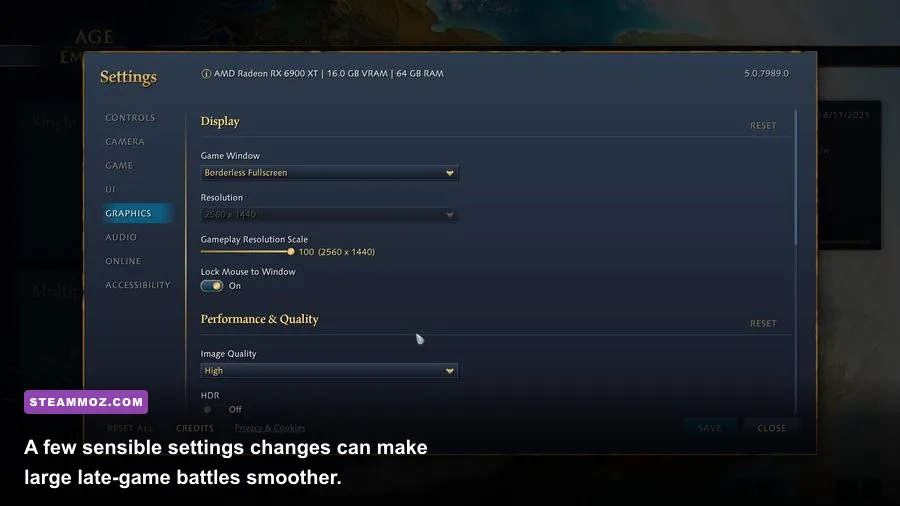
Age of Empires IV is not an especially demanding game during a small early fight, but late-game armies and dense bases can stress both the CPU and GPU. Simulation workload matters as much as visual quality. If your frame rate collapses when 150 units collide, lowering texture quality alone won't solve the problem. Unit count, effects, shadows, and object detail are usually more relevant, while the CPU becomes the limiting factor during huge battles.
The official PC requirements have aged reasonably well. The listed minimum target includes an Intel Core i5-6300U or AMD Ryzen 5 2400G, 8GB of RAM, and a GeForce GTX 970 or Radeon RX 570-class graphics card. The recommended target is substantially stronger, including a modern six-core-class processor, 16GB of RAM, and a GTX 1070 or RX Vega 56-class GPU. In 2026, an SSD and 16GB of memory are sensible rather than luxurious, especially if you use high-resolution textures or multitask with voice chat and browser tabs.
| Setting | Recommended Value | Performance Impact | Visual Difference |
|---|---|---|---|
| Resolution | Native 1080p or 1440p | High | Largest GPU cost; use upscaling if available |
| Texture Quality | High with 6GB-plus VRAM | Low-Medium | Improves terrain, buildings, and unit detail |
| Shadow Quality | Medium | Medium-High | Lower values soften shadows with limited gameplay loss |
| Effects | Medium-High | Medium | Controls spell, fire, dust, and combat effects |
| Geometry/Object Detail | Medium on older CPUs | High in large battles | Reduces scene complexity and late-game CPU load |
| V-Sync | Off with VRR display | Variable | Reduces input latency; may introduce tearing |
For a stable competitive profile, target a consistent 60 frames per second rather than chasing a peak number in the opening minutes. Cap your frame rate if temperatures or frame pacing become erratic, close unnecessary overlays, and keep graphics drivers current. If you're troubleshooting stutter, Steamoz's FPS settings guide offers useful general PC optimization habits, while the crash and low-FPS checklist covers common Windows-side problems.
What Has Aged Poorly?
Age of Empires IV's biggest weakness is that its onboarding stops just before the point where most players need the most help. The campaigns explain the broad ideas, but ranked play requires build orders, scouting patterns, hotkey discipline, and matchup knowledge that the game doesn't fully teach. You can understand why a Knight beats a Villager and still lose because your opponent created pressure 45 seconds earlier than you expected.
The balance experience can also feel cyclical. Patches adjust unit costs, landmark effects, technology timings, and civilization bonuses, so a build learned from an old video may be inefficient or outright wrong. That's healthy for a competitive game, but it creates friction for returning players. Check the current patch before copying a build, and treat popular strategies as frameworks rather than sacred scripts.
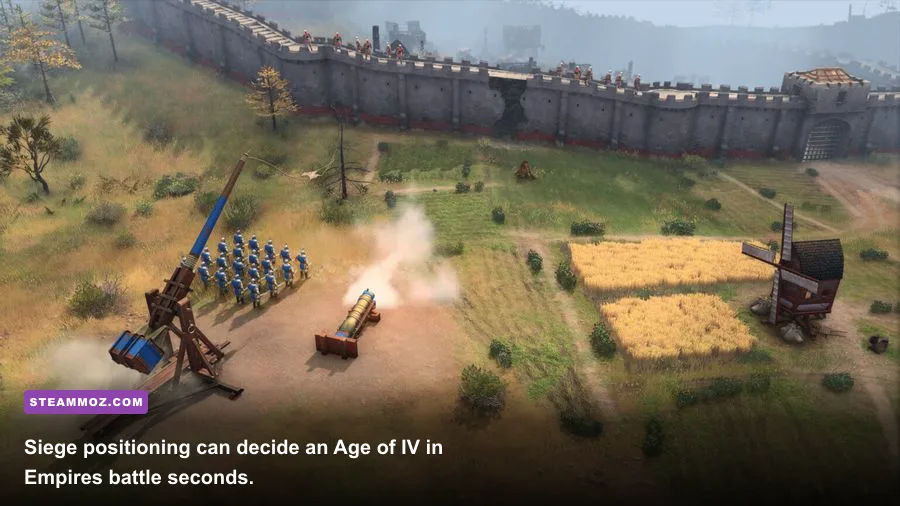
Late-game stalemates are another sore spot. Cannon emplacements, Keeps, walls, and mass siege can turn a decisive-looking map into a slow trench war. Bombards and Culverins demand careful positioning, while Mangonels punish dense infantry formations but are vulnerable to cavalry and ranged focus fire. The counter system is logical, yet battles can become visually chaotic when multiple armies, landmarks, and siege lines overlap.
Finally, the game is less relaxing than its medieval presentation suggests. Even a casual match rewards constant villager production, resource balancing, scouting, and army movement. That pressure is exactly why the multiplayer is satisfying, but it can make the game a poor choice if you want a low-attention city builder. For that audience, a pause-friendly grand strategy game may be a better fit.
Should You Buy Age of Empires IV in 2026?
Buy it if you want a modern RTS with a strong competitive core, distinct civilizations, meaningful economic decisions, and excellent historical campaigns. It is especially good for players who enjoy improving through repetition: scouting one more time, fixing one resource mistake, or learning why a supposedly safe attack failed. The game has enough solo content to justify the purchase even before you touch ranked play, and multiplayer gives it the long tail that campaign-only strategy games often lack.
Wait for a sale if you're unsure about the genre, dislike losing while learning, or mainly want a huge catalog of civilizations and scenarios. The subscription version is a sensible way to test the campaigns and skirmish mode before committing. You should also compare it with Age of Empires II: Definitive Edition if you value decades of maps and a gigantic mod ecosystem more than modern presentation and streamlined combat.
| Player Type | Recommendation | Reason |
|---|---|---|
| New RTS player | Yes, start with English | Clear counters, forgiving economy, strong tutorials |
| Competitive RTS veteran | Strong yes | Deep matchups, tight timings, and active ranked play |
| History-focused solo player | Yes, preferably on sale | Campaigns and documentary presentation are excellent |
| Relaxed builder | Maybe | Skirmish works, but the core game remains time-sensitive |
| Low-end PC owner | Check performance first | Large battles can expose CPU and memory limitations |
My final verdict is an 8.5 out of 10 for 2026. Age of Empires IV hasn't replaced every reason to play its predecessors, and its competitive learning curve remains steep. But it has earned its place as one of the strongest modern real-time strategy games. The landmark system gives familiar Age mechanics a useful twist, the civilizations feel genuinely different, the campaigns are substantial, and the tactical language is readable enough to reward both beginners and experts.
So, is Age of Empires IV still worth playing in 2026? Absolutely—provided you're willing to learn its rhythm. Start with the English, complete the Art of War challenges, play a dozen unranked games, and focus on keeping villagers working before worrying about advanced build orders. Once the economy clicks, every match becomes a chain of interesting decisions rather than a blur of medieval units. That's a strong foundation, and it's why AoE4 still deserves a place on your hard drive.