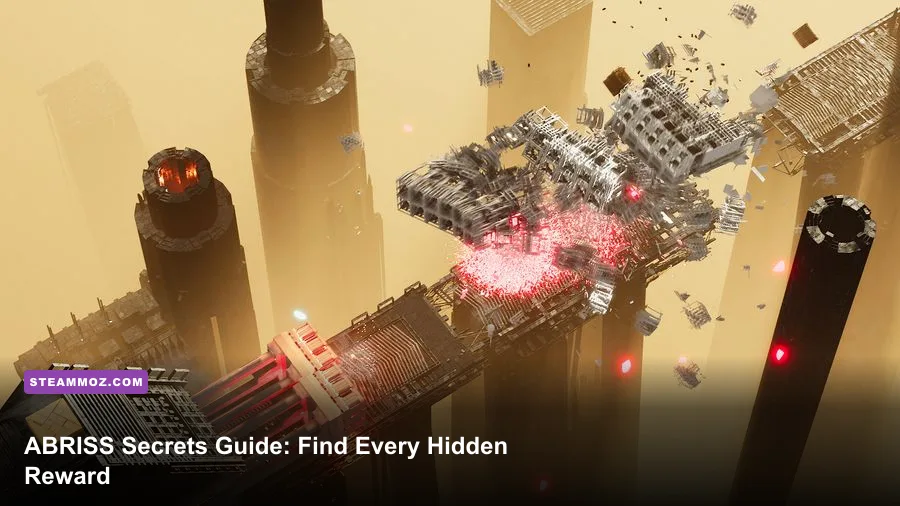
The fastest way to find ABRISS secret locations is to stop treating each level like a straight demolition job. Before launching your machine, orbit the camera around the entire arena, inspect the rear and upper edges of the structure, then build a compact scout machine with a Stabilizer, Connector, Thruster and light weapon. Hidden rewards are usually placed off the obvious destruction line, and rushing the main target can permanently bury the route you needed to reach them.
ABRISS: build to destroy is not a conventional collectathon. It has no character skill tree, no loot rarity ladder and no RPG stat sheet to carry you through missed secrets. Your progress comes from reading geometry, choosing parts intelligently and rebuilding after a failed launch. That makes every secret hunt a small engineering puzzle. A powerful Bomb or Impact Head can finish the objective while also collapsing the only bridge to a reward, so exploration needs to happen before demolition.
How ABRISS secrets actually work
The campaign presents destruction objectives, but the arenas contain more information than the target marker suggests. Look for isolated platforms, narrow ledges, suspended blocks, gaps behind the main building and small structures that appear decorative. If a section looks deliberately framed by walls or floating debris, assume it may be hiding a route until you have checked it from several angles.
There is no reliable “secret detected” sound that replaces visual searching. Pause the action whenever the camera becomes difficult to read and rotate around the machine before committing to a launch. The free camera is your most important discovery tool. Check four places in this order: behind the objective, above the objective, below the starting platform and outside the direct line between your spawn point and the target.
Also remember that ABRISS physics can move a reward without destroying it. A blast may knock a capsule or concealed object onto a lower platform, while a collapsing tower can cover the approach with rubble. If you hear an impact away from the main target, stop firing and inspect the surrounding area. The best secret route is often easier to use before the first major chain reaction.
🎮 ABRISS - build to destroy
Looking to experience this game? Grab your digital key directly on our store for $5.99.
View on Steammoz Store →The best discovery build for hidden rewards
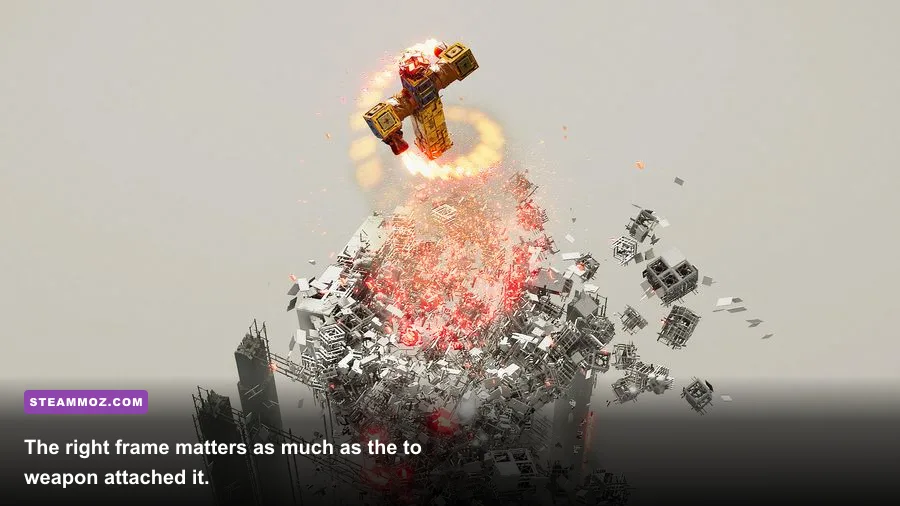
Build for control first and damage second. A discovery machine has one job: reach awkward angles, survive a bad landing and let you inspect the environment without accidentally flattening everything. Start with the largest stable core available, place the Stabilizer close to the centre of mass and use Connectors to keep the frame short. Long, decorative builds look impressive but flex violently when a Thruster fires.
Attach a single Thruster for controlled repositioning rather than stacking every propulsion part immediately. Add a Rotator if the level requires a side-on approach, but test it with a low-power movement before adding explosives. The Impact Head is useful when a blocked passage must be opened, yet it is safer than a Bomb because it concentrates force at the contact point. Save Rockets and Bombs for the return trip or the final objective.
| Part or tool | Discovery role | Main risk | Best use |
|---|---|---|---|
| Stabilizer | Keeps the scout frame predictable | Extra mass and slower movement | Place near the centre of mass |
| Connector | Creates a compact, repairable frame | Weak joints can twist under thrust | Use short branches, not long arms |
| Thruster | Reaches ledges and adjusts approach | Torque can spin the whole machine | Fire in short bursts |
| Rotator | Changes attack or camera-facing angle | Over-rotation ruins alignment | Use for side entries and recovery |
| Impact Head | Opens a precise obstruction | Needs a clean contact angle | Break one barrier at a time |
| Rocket or Bomb | Clears the final target quickly | Can collapse secret routes | Attach only after scouting |
Avoid placing the only Thruster at the very end of a long arm. That creates a lever, and the force will rotate the entire machine instead of moving it cleanly. Two smaller, symmetrical propulsion points are usually more controllable than one extreme attachment. If the machine keeps yawing, move heavy weapons inward, add another Connector near the core and reduce the distance between the Stabilizer and the active Thruster.
Where to search in every campaign arena
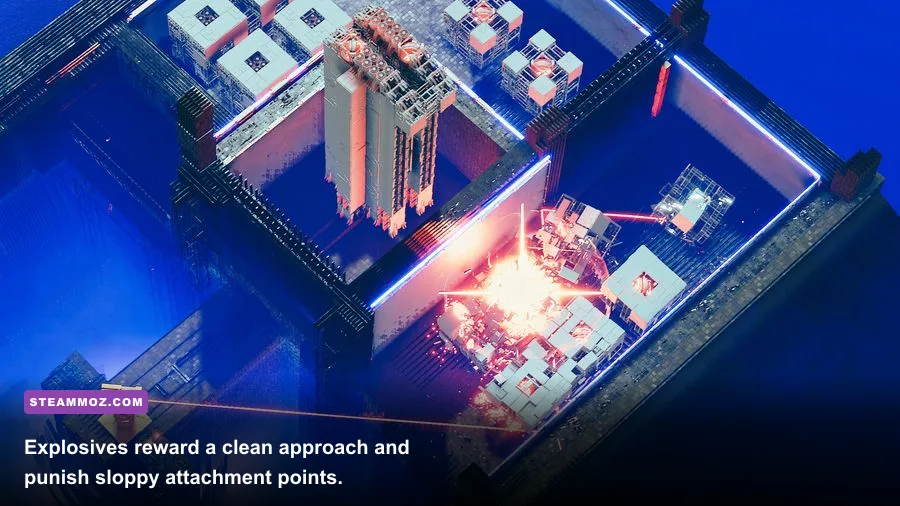
Search patterns beat random camera spinning. At the start of a level, do not launch immediately. First identify the objective, then trace the arena boundary clockwise. Pay special attention to architecture that is partially hidden by the starting view. ABRISS frequently uses depth to disguise a ledge: a reward can sit behind a tower that looks solid from the front but has a gap from the side.
Behind and above the main target
Large targets naturally draw your attention forward. Orbit to the rear before making contact. Look for narrow shelves, detached platforms and small targets mounted higher than the objective marker. A Thruster burst followed by a Rotator adjustment is safer than trying to fly directly over a tall structure. If the camera clips into debris, zoom out and inspect the silhouette rather than relying on surface detail.
Below the launch platform
Drop routes are easy to miss because the game’s scale makes lower platforms look like background scenery. Move the camera below your starting position and check whether a ledge catches the light or forms a deliberate landing surface. Use a light frame for the descent. Heavy explosives can pull the machine off balance, while a short Thruster burst lets you correct without committing to a full flight.
Inside side structures and rubble gaps
Not every suspicious wall needs to be demolished. Some gaps are wide enough for a compact build, and entering them with an oversized machine causes the frame to snag. Remove unnecessary weapons, keep the core centred and approach slowly. If a route closes after the main objective falls, restart rather than trying to blast through the collapse; the reset is faster than wrestling a broken machine through unstable rubble.
Secret-hunting route and reward checklist
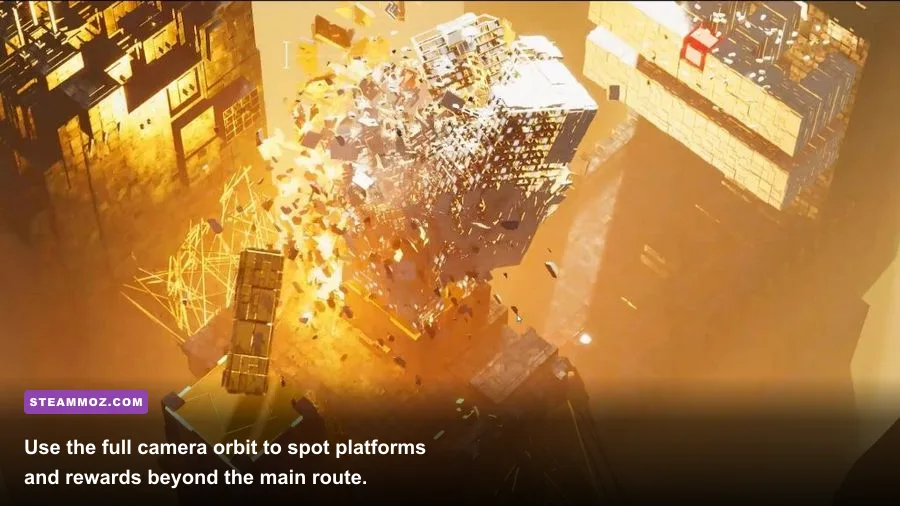
Use this sequence on every level. It prevents the most common mistake: completing the destruction objective before confirming that the hidden route is still accessible.
- Pause at spawn. Rotate the camera horizontally and vertically. Mark every visible platform, tower, gap and isolated object.
- Inspect the objective from the rear. The front face is usually the least informative angle. Check for ledges and openings behind it.
- Build a scout frame. Use a core, Stabilizer, short Connectors and one Thruster. Leave high-yield explosives off the machine.
- Test one movement. Fire the Thruster briefly. If the frame yaws or pitches, fix the balance before exploring.
- Reach the highest safe platform first. Elevated positions reveal lower routes and make the camera less deceptive.
- Collect or trigger the hidden reward. Approach slowly and watch where the object lands if physics moves it.
- Return to the objective. Rebuild with the Rocket, Bomb or Impact Head needed for the actual destruction requirement.
| Search phase | What to inspect | Failure warning | Correct response |
|---|---|---|---|
| Spawn scan | Outer walls, upper silhouettes, lower platforms | You cannot see the arena’s rear | Orbit the camera before building |
| Scout launch | Side ledges and suspended routes | Frame spins after thrust | Move weight inward and rebalance |
| Reward approach | Gaps, shelves and isolated structures | Landing looks unstable | Use short thrust taps, not a long burn |
| Objective attack | Collapse direction and escape path | Main blast blocks the return route | Attack from the far side or restart |
For a visual reference point, the official ABRISS Steam page shows the game’s central design philosophy: assemble a machine, launch it and learn from the wreckage. The developer’s ABRISS page is also useful when you want the intended part-based construction context rather than community guesses about secret triggers.
How to use destruction without losing rewards
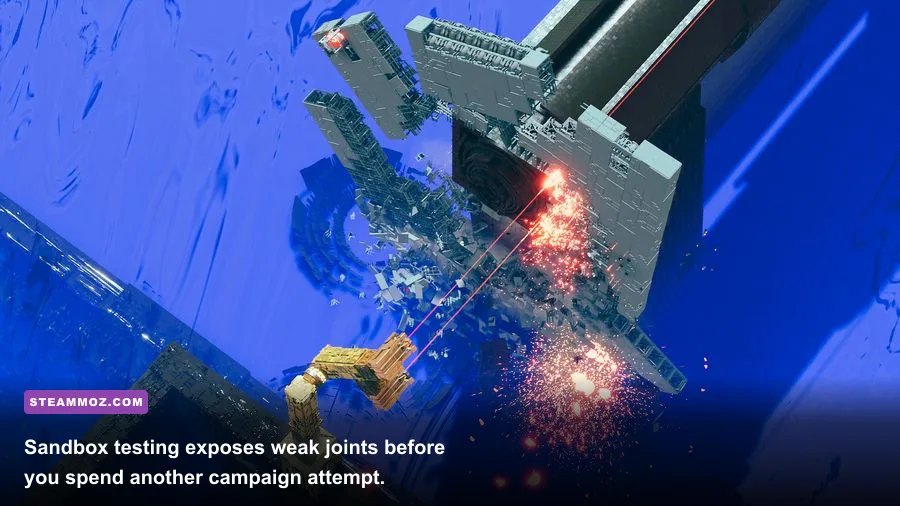
Demolition is about force direction, not simply maximum explosive count. A Rocket is excellent when you need a fast, straight-line strike against a distant section. A Bomb is better for a clustered structure, but its radial blast can turn a stable platform into falling debris. The Impact Head gives you the most control because the damage is tied to the exact surface you hit.
Attack support structures last whenever possible. If the objective is held up by several towers, remove the side supports first and leave the rear route intact. This creates a predictable collapse and keeps a platform available for the return path. If the level asks for a specific destruction result, do not assume that a huge explosion is automatically better; uncontrolled debris can miss the required target or push it outside the useful impact zone.
There is also a practical reason to keep your final attack machine compact. A small machine has fewer joints to fail, lower rotational inertia and a much clearer camera view. Use the same core layout that worked for scouting, then replace the exploration Thruster with the damage part required by the objective. Rebuilding from a proven frame is faster than designing an entirely new contraption after every failed attempt.
Performance settings for cleaner secret searches
Stable frame pacing matters more than maximum graphics quality when you are lining up a narrow landing. Destruction effects can create short spikes as structures fracture, so prioritize consistency. If your frame rate dips during large collapses, lower effects and shadows before reducing resolution. Keep the camera movement responsive; a delayed orbit can make a hidden platform look like it has vanished.
| Setting | Recommended value | Performance impact | Visual trade-off |
|---|---|---|---|
| Resolution | Native monitor resolution | High if reduced | Lower values soften small reward silhouettes |
| V-Sync | On for inconsistent displays; off with VRR | May add latency | Prevents tearing during camera orbit |
| Shadows | Medium | Medium to high | Still preserves useful platform depth |
| Effects | Medium | High during collapses | Less debris brightness and blast drama |
| View distance | High if available | Medium | Helps identify distant ledges |
| Frame limit | Monitor refresh rate minus 2 or 3 FPS | Improves consistency | Less fluctuation during physics spikes |
If ABRISS feels stuttery, compare your setup with Steamoz’s smooth 60 FPS settings advice and the troubleshooting approach in this stutter-to-smooth-FPS guide. Those articles are not ABRISS-specific, but the same priorities apply: cap unstable frames, reduce heavy effects and avoid sacrificing the clarity needed to read geometry.
Common secret-hunting mistakes to avoid
The biggest mistake is firing before scouting. The second is building an enormous machine because the target looks enormous. ABRISS rewards precision: a compact frame reaches more places, turns more predictably and leaves fewer parts snagged on architecture.
Do not trust the first camera angle, either. If a reward seems absent, it may be behind the structure or below the platform rather than missing from the level. Do not repeatedly add Thrusters to solve a balance problem; propulsion amplifies bad weight distribution. Move the heavy weapon closer to the centre, shorten the arm and use the Stabilizer to calm the frame.
Finally, treat failed attempts as data. Note which route collapsed, which joint broke and whether the machine spun clockwise or counterclockwise. Then change one variable at a time. That approach is much faster than rebuilding randomly, and it turns ABRISS’s wonderfully chaotic physics into something you can actually control.
For more build-focused reading, Steamoz’s equipment ranking guide and survival gear breakdown are useful reminders that the strongest option is not always the best option. In ABRISS, the best tool for a secret run is usually the part that keeps your machine intact long enough to see what the level is hiding.
For official updates and version-specific changes, check the ABRISS Steam news hub and the Randwerk YouTube channel. Parts, physics and level behaviour can change between updates, but the core rule stays reliable: scout first, protect the route, then destroy everything that remains.