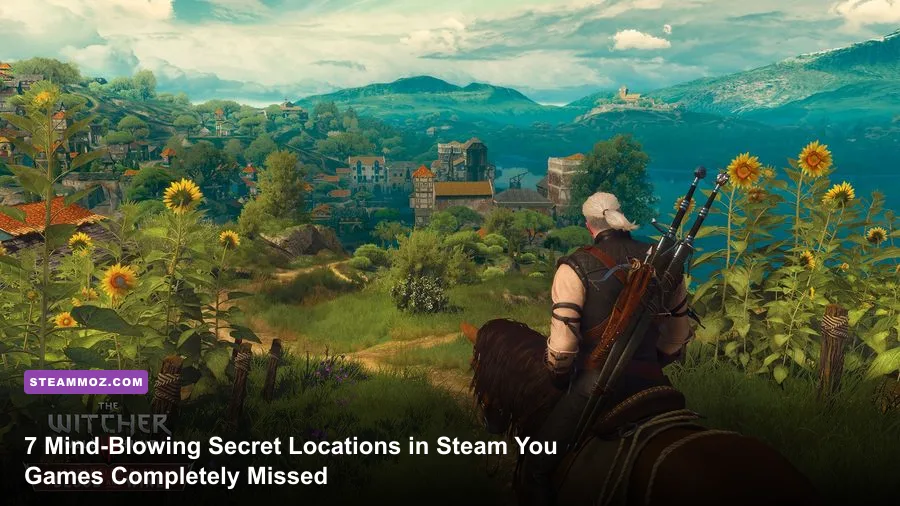
You didn't find them, and frankly, the developers didn't expect you to. Tucked beneath out-of-bounds terrain geometry, hidden behind faux ventilation shafts, and sealed behind six-digit security pads lie some of the most intricate developer secrets on the PC platform. We aren't talking about mundane chest locations or standard collectibles; we are talking about unmapped physical spaces: Doug Rattmann's frantic acoustic dens in Valve's Portal 2 on Steam, CD Projekt Red's fourth-wall-shattering mountain summit easel in The Witcher 3: Blood and Wine, and id Software's fully emulated 1993 MS-DOS terminal operating inside DOOM Eternal. These locations demand spatial trickery, pixel-perfect collision exploitation, and dedicated puzzle decryption to see with your own eyes.
The Hall of Fame: Steam's Most Elusive Secret Rooms

Modern game design rarely lets players stray off the critical path without invisible walls pushing them back. Yet the greatest PC titles embrace the open architecture of personal computers, leaving easter eggs that reward boundary-breakers, console-command tinkerers, and persistent explorers. Tracking these rooms down is just as rewarding as dissecting puzzle mechanics in our Everspace 2 secret locations and hidden rewards guide.
Before breaking down how to break into each location step-by-step, review this quick index of the most technically impressive secret locations hidden inside top Steam hits:
| Game | Secret Location / Easter Egg | Discovery Difficulty | Core Trigger Requirement | Primary Reward |
|---|---|---|---|---|
| Portal 2 | Doug Rattmann's SSTV Dens | High | Radio Transport & Wall Flipping | SSTV Audio File & Lore Murals |
| The Witcher 3: Blood and Wine | Mount Gorgon Summit Easel | Extreme | Free-cam / Boundary Clipping | CDPR Developer Team Portrait |
| DOOM Eternal | Slayer's Retro PC Station | Medium | 14 Floppies + Password "FLYNNTAGGART" | Fully Playable DOOM (1993) & DOOM II |
| Cyberpunk 2077 | Kabuki Market Dev Room | Low-Medium | Keypad Entry: 605185 | Johnny Guitar Jam & Dev Slideshow |
| Cyberpunk 2077 | Murk Man's Badlands Cave | Medium | Post-"Ghost Town" Shipping Container | Free Rayfield Caliburn Supercar |
| Half-Life 2 | All-Knowing Singing Vortigaunt | High | Sludge Hopping in Water Hazard | Unused Prophecy Dialogue & Health |
🎮 1bitHeart
Looking to experience this game? Grab your digital key directly on our store for $2.99.
View on Steammoz Store →Portal 2: The Schizophrenic Hauntings of Doug Rattmann
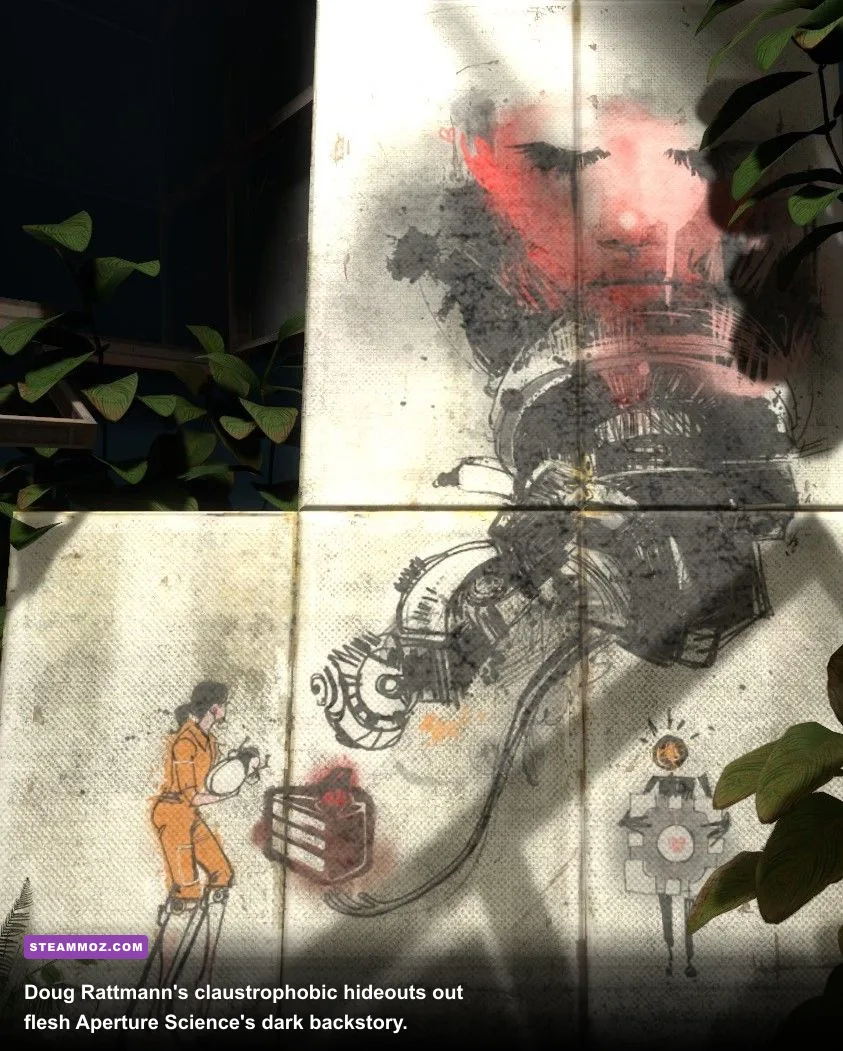
Valve's storytelling shines brightest when it isn't delivering dialogue through an intercom. Throughout Aperture Science's test shafts, you can discover seven individual hideouts left behind by Doug Rattmann, the lone surviving schizophrenic Aperture technician who saved Chell's life before the events of the original game. While several dens sit just off the standard path, Test Chamber 17 and Chamber 06 hide auditory payloads that 99% of players completely miss.
To reach Rattmann's primary auditory hideout in Chapter 2, Test Chamber 06, fling yourself through the high-velocity aerial faith plate puzzle. Instead of continuing straight toward the exit door, spin your view 180 degrees at the peak of your trajectory and cast a portal onto the angled surface beneath the ceiling catwalk. Step through the lower wall portal to fling yourself into an elevated, recessed crawlspace obscured by trash piles and rusted metal sheeting.
Inside, the environment shifts drastically. The clinical white tiles give way to frantic charcoal sketches of companion cubes, mathematical formulas tracking the decay rate of Aperture's reactors, and a sputtering radio resting on a mattress. If you pick up this radio and carry it to the marked spot under the mural, the standard jaunty elevator tune transforms into sharp, screeching static. Valve encoded an actual SSTV (Slow-Scan Television) signal into this audio wave. When extracted and run through an audio spectrum analyzer, that exact screech generates a hidden monochrome picture of a Weighted Companion Cube sitting on the lunar surface—a direct visual telegraph of the game's finale.
The Witcher 3: The Unreachable Mountaintop Dev Team Portrait
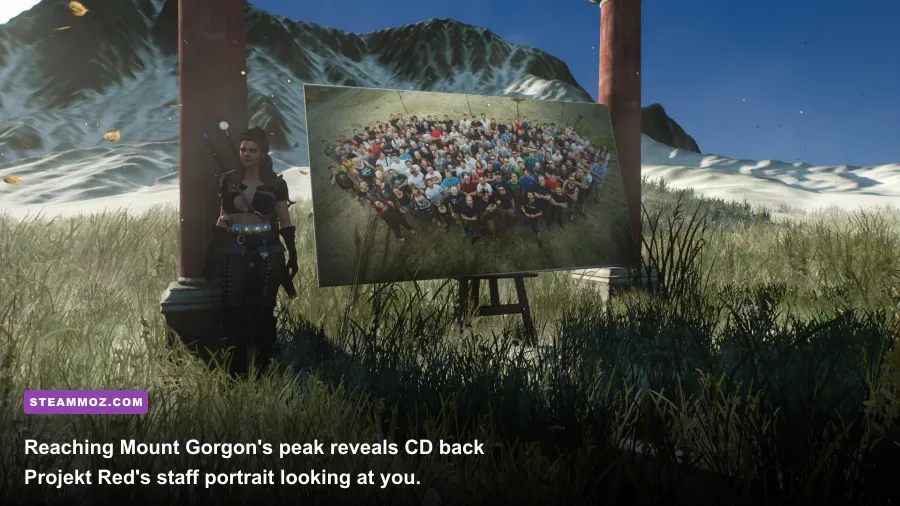
The southern reaches of the Toussaint duchy are dominated by Mount Gorgon, a snow-capped spire towering over the vineyards of The Witcher 3: Wild Hunt - Blood and Wine. The mountain looks like standard skybox dressing, framed to look majestic while sitting strictly outside the playable boundary. If Geralt approaches on foot or horseback, the game hits him with the classic forced-turnaround prompt: "You have reached the world's edge, none but devils play past here."
However, CD Projekt Red hid an intentional, tactile developer memorial right on top of that supposedly empty peak. Accessing it legitimately via game mechanics is practically impossible without severe terrain exploits, but opening the PC debug console (by setting DBGConsoleOn=true in your general.ini config) lets you teleport Geralt past the boundary coordinates using free camera controls.
Perched upon the highest flat poly surface of Mount Gorgon sits an idyllic wooden easel flanked by two burning torches. Resting upon the easel is a framed portrait of the entire CD Projekt Red development team, grinning at the camera in casual modern clothes. There are no quest markers, achievements, or map icons tied to this setup. It exists purely as a warm, meta-textual farewell note from the artists and programmers who spent years building the Witcher universe before moving on to Night City. Finding hidden curiosities like this echoes the excitement of tracking down obscure loot in our Eternal Destiny secret locations and hidden rewards guide.
DOOM Eternal: Unlocking the Fully Playable 1993 Retro PC
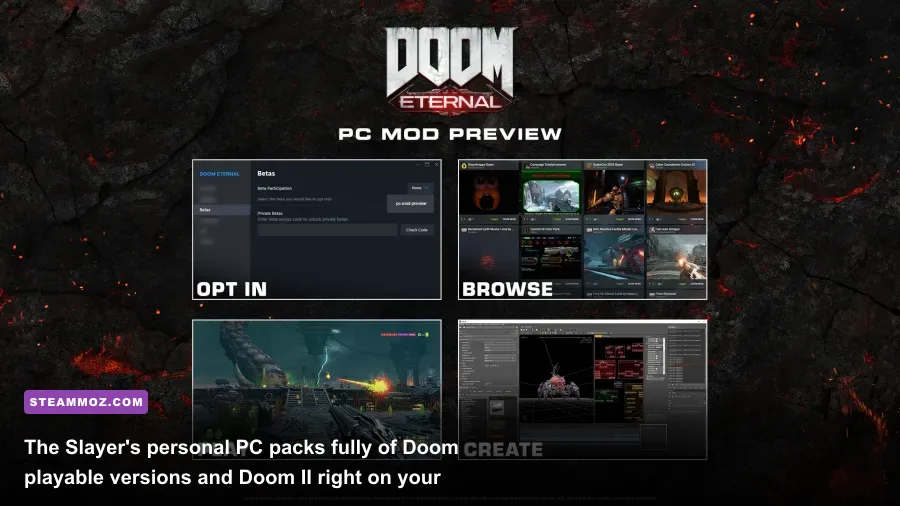
id Software has a storied tradition of nesting retro titles inside their modern engines, but the retro setup inside DOOM Eternal on Steam goes far beyond a quick novelty. Sitting in the Slayer's personal man-cave aboard the Fortress of Doom is an old-school beige cathode-ray tube (CRT) monitor resting on a desk littered with classic gaming boxes, comic books, and custom gaming peripherals.
When you start the campaign, interacting with the terminal shows two locked 3.5-inch floppy disc files labeled DOOM and DOOM II. This isn't just cosmetic dressing: it is an embedded native DOS emulation running completely inside the id Tech 7 engine, letting you play the original shooters with authentic sound fonts, full mouse look, and zero loading pauses.
Unlocking these classics requires tackling two very different challenges:
- DOOM (1993): You must locate and collect all 14 Cheat Code Floppy Disks hidden across the campaign missions. These are tucked behind breakaway walls, beneath elevator shafts, and over high platforming chasms in levels like Cultist Base and Nekravol. Once the 14th floppy is slotted into your codex, File 1 unlocks completely.
- DOOM II: File 2 doesn't care about campaign items. It demands a password input directly through the in-game terminal keyboard. Click File 2 and type in FLYNNTAGGART—the canonical name of the Doom Marine from the original 1995 Doom tie-in novels written by Dafydd ab Hugh. The terminal unlocks instantly, granting immediate access to the full, uncut 32-level campaign of DOOM II: Hell on Earth.
Tuning your game rig to run buttery smooth during these retro-within-modern sessions is critical; if you love squeeze-every-frame tuning, check out our guide on Far Cry 6's best beginner build for the GOTY upgrade pass to balance raw graphics power and responsiveness.
Cyberpunk 2077: The Hidden Developer Room and the Murk Man Caliburn
Night City is packed with locked doors, but two hidden spots in Cyberpunk 2077 showcase the polar opposites of easter egg design: one offers a quiet, surreal developer chill room, while the other gives you the fastest vehicle in the entire game completely free of charge.
The Kabuki Market Developer Sanctuary
Head to the circular Kabuki Market roundabout in northern Watson. Take the stairs down to the lower tier near the waterside shops and head into the dark pedestrian alleyway behind the prefab food stalls. You'll run into a nondescript shutter door with a lit access keypad beside it. Typing in the access code 605185 unlocks the hydraulic lock.
Step inside, sit down on the plush leather couch, and Johnny Silverhand will materialize beside you. Rather than berating your choices, Johnny picks up his acoustic guitar and starts fingerpicking an intimate, bluesy melody. As the music plays, the giant flat screen on the opposing wall turns on, cycling through high-resolution framed headshots of the environment designers, writers, sound engineers, and QA leads who assembled Night City. It remains one of the calmest, most atmospheric spaces in the game.
Murk Man's Cave and the Free Rayfield Caliburn
If you'd rather score legendary horsepower than introspective developer credits, drive out to the Badlands north of the Rocky Ridge fast travel point. Deep inside a long, unlit highway tunnel carved into the rock face sits an unmarked blue shipping container. This container only spawns its contents after you complete the main story mission "Ghost Town" alongside Panam Palmer.
Inside the crate rests an all-black Rayfield Caliburn—Night City's fictional equivalent of a Bugatti Chiron—alongside a computer datashard detailing the brooding exploits of "Murk Man," a direct satire of Batman. Stepping into the driver's seat permanently binds the Caliburn to your vehicle summoning list. With a top speed of 211 mph and exceptional handling, it instantly outperforms vehicles that cost 150,000 Eurodollars in the fixer shops.
| Vehicle / Secret Gear | Top Speed / Output | In-Game Purchase Cost | Free Secret Value | Acquisition Requirements |
|---|---|---|---|---|
| Rayfield Caliburn (Murk Man) | 211 MPH | 157,000 Eddies | S-Tier Supercar | Clear "Ghost Town" + Return to Tunnel |
| Jackie's Tuned Arch | 178 MPH | Priceless | A-Tier Bike | Nomad Lifepath dialogue + "Heroes" |
| Overwatch Sniper Rifle | Suppressed Physical | Unique Loot | S-Tier Weapon | Complete "Riders on the Storm" |
Just like maximizing your offensive loadouts in retro shooters like Far Cry 3: Blood Dragon weapons ranked from S to C, grabbing early S-Tier transport without spending a single Eurodollar rewrites your entire early-game tempo.
Half-Life 2: The Hermit Singing Vortigaunt in the Toxic Canals
During the frantic airboat sequence in Chapter 4 ("Water Hazard") of Half-Life 2 on Steam, players spend most of their time fleeing Hunter-Chopper gunfire and jumping hazardous ramps. Because of the breakneck pacing, almost everyone skips the rusted drainage grates lining the canal walls.
Just past the red steel barn gate where you lower the concrete pipe counterweights, look to the left embankment across a field of radioactive green sludge. A large circular drainage pipe sits slightly above the toxic water level, blocked by two rusted iron bars. Sprint across the floating debris, jump crouch through the gap between the bars, and proceed into the pitch-black pipe.
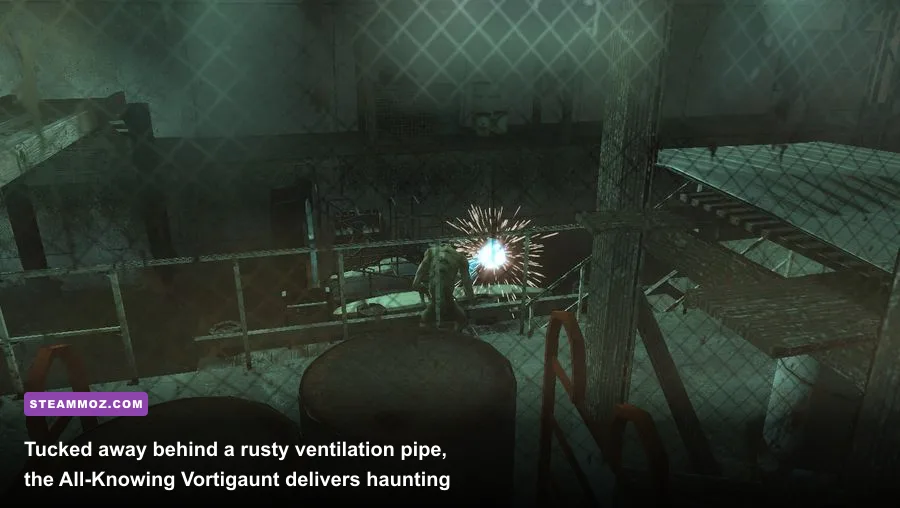
Following the pipe brings you to an illuminated subterranean cave where a solitary Vortigaunt stands beside an improvised campfire, turning a Headcrab on a spit. Unlike the other Vortigaunts you encounter, this hermit is disconnected from the shared Vortessence network. If you approach him, he emits a haunting, multi-layered harmonic chant that echoes off the pipe walls.
Wait for the song to conclude, and interact with him repeatedly. He delivers chilling, cryptic prophecies about Gordon Freeman's past, the true nature of the G-Man, the fate of the Combine Advisors, and the illusion of choice long before those plot points were explicitly revealed in Episode Two or Half-Life: Alyx. It remains one of the finest ambient narrative secrets ever written in the Source engine.
Why Modern PC Engines Hide Boundary Secrets This Way
Have you ever wondered why developers put these massive secrets outside the playable map instead of in regular rooms? It comes down to asset streaming, occluder culling, and memory limits.
In engines like Source, REDengine, and id Tech, game worlds rely on aggressive spatial partitioning. Objects inside the normal game map constantly consume memory for navmeshes, NPC patrol logic, active lighting passes, and dynamic physics bounding boxes. If developers drop a complex easter egg with custom textures right in the center of a dense city hub, it drags down minimum system requirements and risks frame drops.
To avoid tanking performance, developers drop these secret rooms far outside the map's active processing zones, as broken down in the structural comparison table below:
| Engine Architecture | Representative Steam Game | Culling Technique Used | How Secrets Are Hidden | Performance Impact |
|---|---|---|---|---|
| Source Engine | Portal 2 / Half-Life 2 | Binary Space Partitioning (BSP) | Sealed skybox volumes outside VisLeafs | Near 0% until entered |
| REDengine 4 | Cyberpunk 2077 | Umbra Occlusion Culling | Unrendered interior shells behind dummy doors | Zero memory draw when shutter is shut |
| id Tech 7 | DOOM Eternal | Dynamic Vulkan Tile-Based Streaming | Embedded sandbox code in UI textures | Isolated thread; zero impact on core loop |
When you force your way out of bounds to uncover these hidden spaces, engine stability becomes your biggest challenge. If your game begins stuttering or crashing when crossing boundary triggers, stabilizing your engine pipeline using technical walkthroughs like our ELEX PC fixes that stop crashes and rescue your FPS will keep your game rock-solid while you hunt down every last secret.
Whether you're decrypting audio data in Valve's puzzle chambers or taking a free hypercar for a spin in the Badlands, finding these hidden gems is one of the best parts of PC gaming. Put these coordinates to the test, fire up your Steam library, and see what you've been walking past all these years.