
If your Steam wishlist is choked with the same three over-hyped AAA blockbusters that are destined to launch at seventy dollars with broken shader compilation and microtransactions, it is time to wipe the slate clean. The absolute best PC experiences landing over the coming months are not parading around glitzy summer showcases; they are lurking deep in Steam's discovery queue, forged by boutique development teams that care about mechanical depth, physical reactivity, and uncompromising game design. From the unhinged gun-modding extraction madness of Sulfur to the terrifying, hyper-tactile survival climbing of Cairn, these are six incredible upcoming PC hidden gems that deserve a priority spot on your wishlist right now.
Sulfur: The Brutal Dungeon Extraction Shooter You Didn't See Coming

Developed by Swedish indie studio Perfect Garand, Sulfur's Steam page pitches an aesthetic that looks like an early-2000s low-poly cartoon crossed with a fever dream. Do not let the charming visuals disarm you: beneath that vibrant art style lies a relentlessly lethal, fast-paced single-player extraction shooter combined with deep dungeon-crawler systems. You plunge into cavernous labyrinths armed with firearms, melee blades, and spell scrolls, scavenging every loose bullet and scrap of food while managing a grid-based inventory that demands your full attention.
The gunplay is remarkably visceral. Weapons possess ferocious recoil, distinct projectile travel times, and tangible mechanical weight. Unlike boomer shooters where weapons are static instruments of destruction—a balance dynamic we explored in our Far Cry 3: Blood Dragon weapons ranking—Sulfur lets you modify every firearm down to its firing pin. You can strap makeshift silencers made of cured cheese to your revolvers, infuse submachine guns with explosive elemental oils, or run high-caliber hunting rifles that fire silver nails to shred undead abominations.
The extraction tension is authentic. Dying inside the depths means forfeiting the bespoke weapons you spent hours fine-tuning at your home base. Every excursion forces you to weigh your remaining armor durability against the promise of delving one floor deeper for legendary weapon blueprints. It bridges the gap between retro first-person shooters and modern hardcore survival with effortless swagger.
Skin Deep: An Immersive Sim Where Sneezing and Broken Glass Kill You
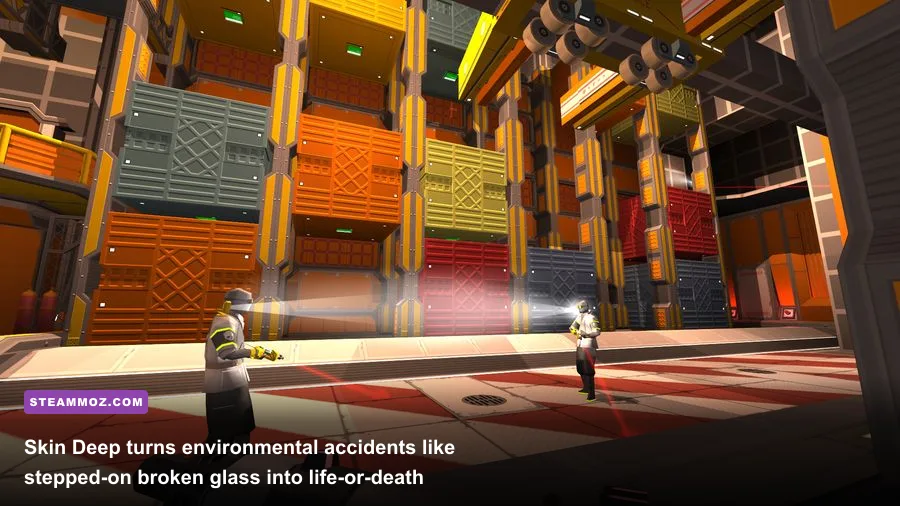
Brendon Chung and his team at Blendo Games (the brilliant minds behind Quadrilateral Cowboy and Thirty Flights of Loving) are building what may become the most reactive, unscripted immersive sim since Arkane's glory days. Detailed extensively on the Blendo Games official website, Skin Deep puts you into the boots—or rather, the bare feet—of an insurance commando unfrozen from cryo-stasis to rescue VIP cargo cats from hijacked space freighters.
What sets Skin Deep apart is its obsessive commitment to physical vulnerability. This is not a power fantasy where you soak up plasma fire like a walking tank. You start missions barefoot, outgunned, and desperately scavenging tools across sprawling, non-linear starships. If you shoot out a fluorescent light bulb or shatter a cockpit window, the resulting sea of jagged glass creates a deadly environmental hazard. Step on that broken glass without footwear, and shards drive directly into your soles. Your character limps, gasps in pain, and leaves bloody footprints across the floor—footprints that roaming pirate patrols can track right to your hiding spot. To fix it, you have to physically pull the shards from your foot while hiding inside a ventilation shaft.
Environmental reactivity goes even further. Crawling through neglected utility ducts kicks up clouds of thick dust. Inhale too much, and your character triggers an audible sneezing telegraph; if you fail to hold a button to muffle your own face, an explosive sneeze alerts every pirate on the deck. Decompressing entire compartments into hard vacuum, welding maintenance doors shut, and setting up cascading traps makes Skin Deep an unhinged sandbox of tactical problem-solving where plans never survive contact with the enemy.
Cairn: Realistic Survival Climbing That Pushes Physics to the Edge

French studio The Game Bakers shocked the community when they pivoted from the lightning-fast boss rush action of Furi to an exhaustive mountaineering survival simulator called Cairn. Revealed through Cairn on Steam, the game chronicles the desperate journey of Aava, a professional climber determined to conquer Mount Kami—a monolithic peak that has killed every soul who ever dared challenge its vertical summit.
Forget the automated, one-button parkour popularized by blockbuster action games. In Cairn, climbing is an intricate, mechanical puzzle where you independently manipulate all four of Aava's limbs. You select handholds and footholds based on rock composition, grip angle, and surface friction. Placing your weight on wet shale demands far more balance than anchoring into solid granite. Overextending your reach rapidly depletes your stamina bar, shifts your center of gravity outward, and risks catastrophic falls that will snap your safety ropes.
Between harrowing ascents, you are fighting off hypothermia, dehydration, and mental exhaustion. You must pound pitons into freezing cliff faces, tether your bivouac tent to a sheer ninety-degree drop, melt snow for clean drinking water, and bandage torn finger calluses. The sheer physical tension is suffocating. Much like tuning precision hardware configurations to eliminate micro-stutters in our Filament settings for higher FPS guide, Cairn requires absolute frame-perfect stability; a single missed hold or delayed grip adjustment due to input lag means falling hundreds of meters into the icy abyss.
Menace: Battle Brothers Creators Bring Tactical Lethality to Deep Space

When Overhype Studios announced they were shifting away from their celebrated low-fantasy mercenary sim to craft a gritty sci-fi turn-based tactical RPG, hardcore strategy enthusiasts rejoiced. Accessible via the Menace official Steam hub, this title drops players into an isolated planetary fringe cut off from civilized space. As a commander of the Republic Marine Corps, you oversee strike teams composed of hardened marines, questionable mercenaries, and armored combat vehicles deployed to quell planet-wide rebellions and cosmic horrors.
Menace entirely rejects the simplistic half-cover/full-cover tropes that have turned modern tactical games stale. Combat takes place across massive 3D battlefields where ballistic suppression, armor deflection angles, vehicle subsystem damage, and psychological morale govern every exchange. An enemy rocket striking an armored infantry transport will not simply subtract hit points; if the warhead hits sloped composite plating at a shallow angle, it ricochets harmlessly into the terrain. If it strikes flat against the side armor, the spalling will decapitate your driver, disable the turret traverse, and send the infantry squad pinned inside into a blind panic.
The strategic layer is just as unforgiving. Planetary campaigns are generated procedurally, forcing you to manage limited munitions, mechanical spare parts, and fuel reserves. Navigating logistics under intense pressure mirrors the structural discipline discussed in our Empires of the Undergrowth fast leveling guide: if your supply lines collapse on the macro map, your soldiers enter battle under-equipped and starved of air support. Every tactical operation carries long-term consequences that can end your expedition in an instant.
Falling Frontier: Hard-Sci-Fi Real-Time Logistics and Tactical Warfare

Almost entirely designed by solo developer Todd D'Arcy at Stutter Fox Studios, Falling Frontier represents an evolution of real-time space strategy. While conventional space strategy games gather fleets into gigantic blobs to shoot lasers until health bars hit zero, Falling Frontier treats space combat with the cold, calculating realism of authentic astrophysics and military doctrine.
Combat operations are dictated by real-time orbital mechanics, radar cross-sections, and heat signatures. Space is vast, empty, and terrifyingly dark. Ships do not automatically know where the enemy is hiding. You must deploy reconnaissance probes, monitor solar radiation flares, and establish listening outposts across asteroid belts to detect faint propulsion emissions. If a cruiser powers up its main fusion drive or fires active radar sweeps, it lights up like a miniature sun across the entire planetary system, inviting railgun fire from unseen vessels positioned thousands of kilometers away.
Logistics rule supreme. Capital ships require immense supplies of fuel propellant, atmospheric gas, and solid kinetic munitions. You can win an entire interstellar war without ever firing on a flagship simply by ambushing the fragile resupply freighters hauling helium-3 along trade corridors. Hunting down remote orbital stations and uncovering hidden pirate outposts captures the exploratory thrill of searching for secret coordinates in our Everspace 2 secret locations and hidden rewards guide or outfitting custom ship hardpoints as explored in our Everspace weapons worth your credits breakdown. However, Falling Frontier delivers that thrill on a grand, strategic Newtonian scale where a single drifting projectile can punch through an unshielded hull decades after it was fired.
Tactical Breakdown and Hardware Demands: How These Gems Stack Up

To help you decide which games match your specific tastes and gaming rig capabilities, we have constructed comprehensive comparison breakdowns. The table below analyzes the core genre, defining gameplay innovation, target player audience, and mechanical complexity of each featured title.
| Game Title | Sub-Genre | Core Gameplay Innovation | Primary Appeal | Complexity Rating |
|---|---|---|---|---|
| Sulfur | Extraction Roguelike FPS | Modular gunsmithing, alchemical bullet alterations, and tactical inventory tetris | Fans of classic boomer shooters mixed with Tarkov-style extraction stakes | Medium-High |
| Skin Deep | Immersive Sim Sandbox | Granular physical vulnerabilities (broken glass in feet, sneezing alerts) | Deus Ex and Dishonored purists who love non-linear, emergent stealth | Very High |
| Cairn | Physics Survival Simulator | Tactile four-limb kinetic climbing mechanics and cliffside survival management | Gamers seeking grueling, deliberate simulations with emotional weight | Extremely High |
| Menace | Sci-Fi Turn-Based Tactics | Ballistic deflection physics, squad morale breakdowns, and vehicle subsystem simulation | Battle Brothers and classic X-COM diehards hungry for tactical brutality | High |
| Falling Frontier | Hard-Sci-Fi Real-Time Strategy | Deep orbital reconnaissance, emission signatures, and vulnerable supply lines | Hardcore RTS commanders tired of arcade deathballs and shallow macro systems | Extremely High |
Beyond gameplay mechanics, running complex simulation systems puts a distinct load on PC hardware. Titles built around advanced physical reactivity, ballistic tracking, and volumetric environmental systems rely heavily on multi-threaded CPU performance rather than raw GPU rasterization. Understanding these hardware demands ensures you can dial in optimal frame-rate pacing, just as we did when analyzing the competitive framework in our Fatal Fury: City of the Wolves PC specs explained breakdown.
The table below provides projected PC hardware bottlenecks, engine architectures, and optimization targets for these upcoming PC gems:
| Game Title | Game Engine | Primary Hardware Bottleneck | Recommended GPU Tier | Target Performance Profile |
|---|---|---|---|---|
| Sulfur | Custom Unity Pipeline | Single-Core CPU Clock (Bullet calculation & AI pathing) | RTX 2060 / RX 6600 (VRAM friendly) | 1080p / 144+ FPS Locked |
| Skin Deep | Enhanced id Tech Mod | CPU Cache & Physics Engine Tick Rate | RTX 3060 / RX 6700 XT | 1440p / 90-120 FPS |
| Cairn | Custom Engine Build | Real-time IK Physics & Environmental Shaders | RTX 3070 / RX 6800 | 1440p / 60 FPS Stable |
| Menace | Custom Proprietary 3D | Multi-Threaded CPU (Subsystem damage & procedural maps) | RTX 2070 Super / RX 6700 | 1440p / 60-90 FPS |
| Falling Frontier | Highly Modified Unity | System RAM (16GB Min / 32GB Rec) & CPU Ballistics Math | RTX 3080 / RX 6800 XT (High VRAM demands) | 1440p / 60 FPS (Ultra Simulation) |
The common thread uniting every one of these titles is an absolute refusal to chase corporate trends. They do not care about battle passes, daily login rewards, or hollow cinematic set-pieces designed for trailer clicks. Instead, they double down on deep mechanical interaction, meaningful player agency, and ruthless systemic challenge. Head over to Steam, slap these games onto your wishlist, and get ready for a slate of PC experiences that treat your intelligence, your reflexes, and your hardware with the respect they deserve.