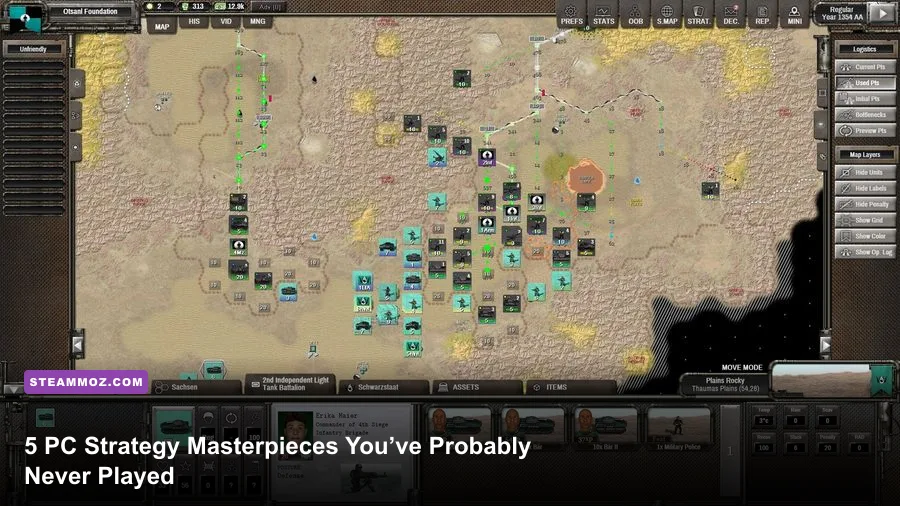
If your strategy library begins and ends with Civilization VI, Stellaris, and Total War, you're missing out on the most daring design work in PC gaming. The mainstream strategy space often sandpapers away friction in favor of accessibility, but true tactical euphoria comes when systems bite back. The games featured here trade glossy cutscenes for sheer mechanical depth: procedural planetary geology, realistic radio frequency direction-finding, granular supply lines down to individual truck fuel points, and asymmetric AI opponents that don't need to cheat to crush you.
Shadow Empire: The Ultimate Post-Apocalyptic 4X Logistics Nightmare
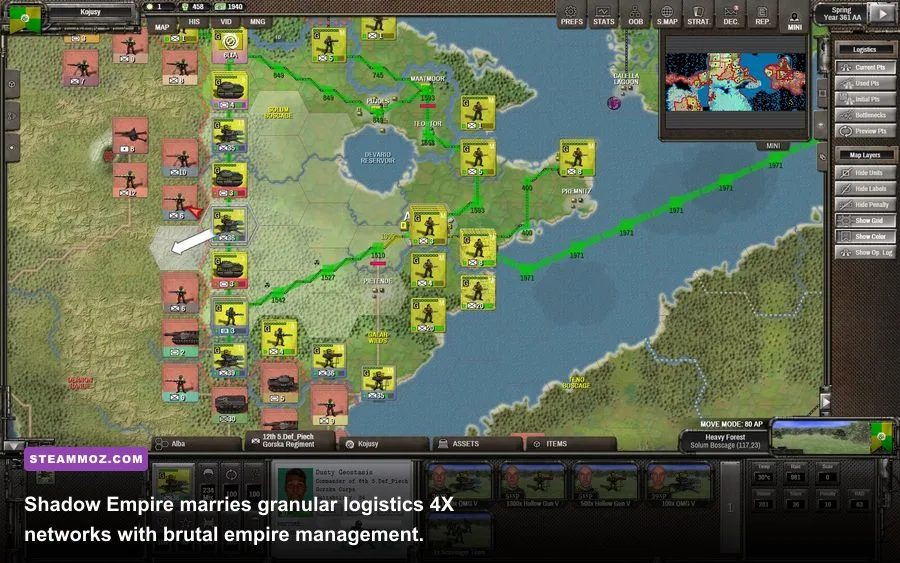
Developed by VR Designs and published by Slitherine, Shadow Empire blends procedural post-apocalyptic planetary generation with grognard-tier wargame mechanics. You aren't just clicking a button to build a "Barracks"—you're balancing the industrial throughput of private versus state-owned enterprises, manufacturing individual 105mm artillery pieces, and sweating over whether your logistical railheads have enough Action Points (AP) to send ammunition through a mountain pass.
What makes Shadow Empire transcendent is how its logistics system dictates operational tempo. Units do not merely run out of supply; they suffer graduated penalties to readiness, morale, and ammo reserves based on logistical bottlenecks. If your truck station produces 400 Logistics Points but your spearhead pushes three hexes beyond your dirt road network into muddy terrain, your tanks turn into multi-million-credit paperweights. Add internal cabinet politics where disgruntled ministers can stage coups or hoard stratagem cards, and you get an uncompromising 4X simulation that makes mainstream titles feel like checkers.
Much like resolving brutal bottlenecks and tweaking system files when troubleshooting with our Elex PC stability tweaks, getting Shadow Empire's supply pipelines running cleanly requires patience, analytical diagnostic thought, and methodical planning.
AI War 2: The Only Grand Strategy Game Where Winning Too Fast Kills You
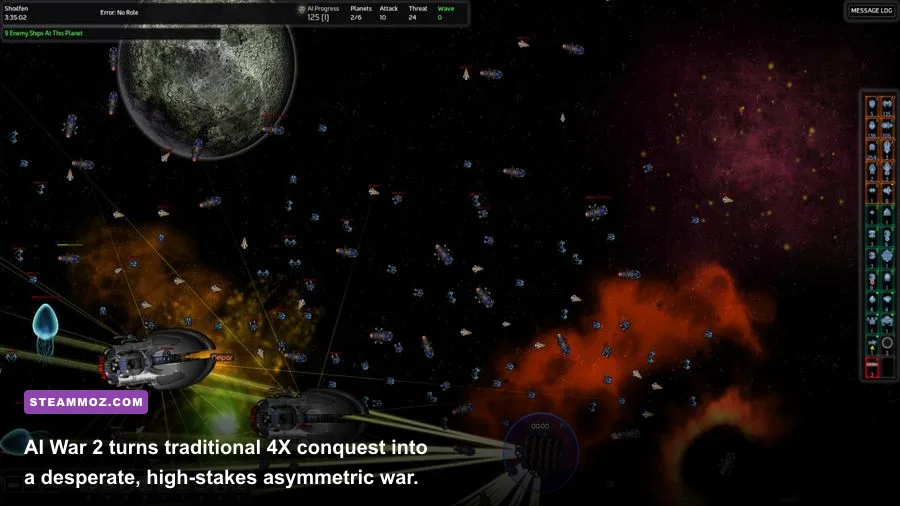
Most strategy games struggle to program an AI that can challenge human players without giving it gross statistical cheats. Arcen Games solved this in AI War 2 by making asymmetry the fundamental core of the entire experience. The premise is simple: humanity has already lost the war. A monolithic artificial intelligence controls 99% of the galaxy, and you start with a single, battered home planet. The catch? The AI doesn't view you as a peer threat—it views you as a minor insect.
The central mechanic governing every decision is AIP (AI Progress). Every command station you capture, every planet you annex, and every superweapon you liberate permanently increases the AI's awareness of your existence. Keep AIP low (under 120), and you face modest planetary garrisons and sluggish response fleets. Let AIP skyrocket past 250, and the AI's Hunter and Warden fleets will warp in apocalyptic Mark V dreadnoughts and planetary shredders that wipe your civilization from existence in three minutes.
Success requires surgical strikes rather than territorial expansion. You hack enemy data centers to lower AIP, cripple wormhole routing infrastructure, and steal critical tech blueprints before retreating into deep space. If your brain enjoys high-stress spatial routing and problem-solving akin to untangling logic puzzles in Filament Marmalade Edition, AI War 2 turns galactic conquest into the ultimate cognitive test.
HighFleet: Radio Intercepts, Ballistics, and Dieselpunk Paranoia
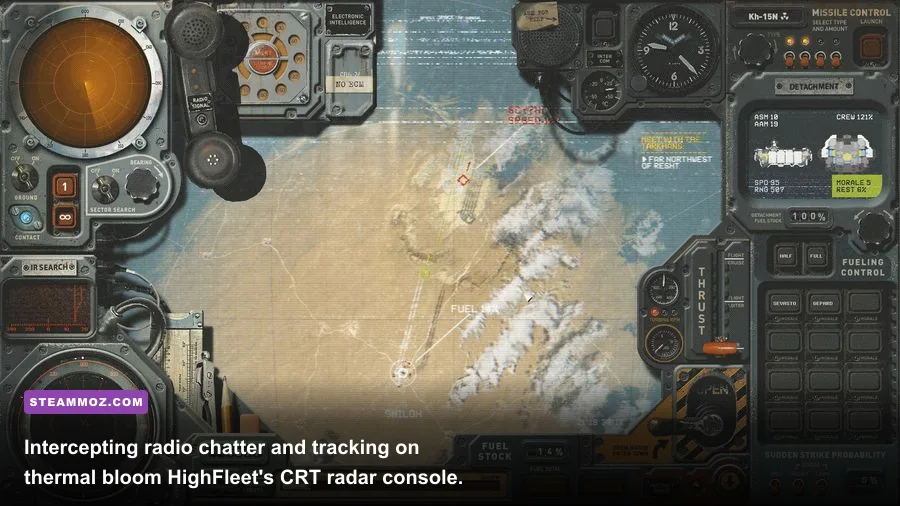
Created by solo developer Konstantin Koshutin, HighFleet sits at the wild intersection of operational wargame, physics-based dogfighter, and cold-war electronic warfare sim. You command the Sayadi Grand Fleet traversing the arid skies of the rebel-held kingdom of Gerat. You spend hours hunched over an analog CRT console, manually tuning radio receivers to intercept coded enemy transmissions, plotting bearing lines with a virtual pencil and compass, and analyzing thermal signatures to calculate the vector of approaching strike groups.
When fleets collide, the strategic layer dissolves into a terrifying 2D physics-based brawl. Controlling massive, multi-thousand-ton diesel thruster behemoths requires adjusting for inertia, gravity, and shell deflection angles. Firing 130mm armor-piercing shells tears through modular ship plating, while managing active radar requires high-stakes discipline: pinging active radar exposes your exact coordinates to enemy ELINT detectors hundreds of kilometers away.
Just like engineering tailored loadouts in our Everspace weapons loadout breakdown, surviving in HighFleet demands ruthless modular ship design. Over-armor your interceptors, and fuel consumption skyrockets; skimp on point defense, and a single A-100 cruise missile ends your run instantly.
Empires of the Undergrowth: The Brutal Biological RTS You Slept On
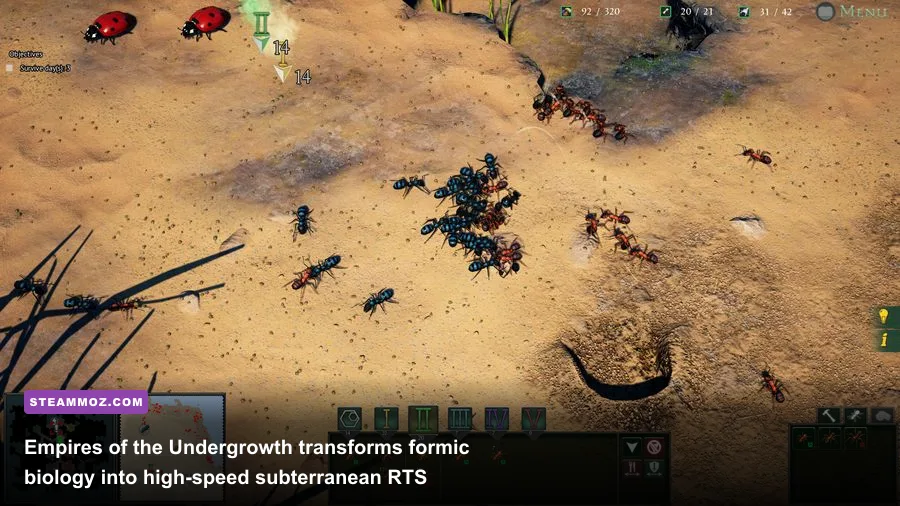
Do not let the insect theme deceive you: Empires of the Undergrowth by Slug Disco is one of the tightest, most mechanically punishing base-building real-time strategy games released in the past decade. Taking heavy inspiration from the classic SimAnt but supercharged with modern RTS tactical mechanics, it puts you in control of an expanding formicarium fighting against amphibians, rival swarms, and environmental hazards like nocturnal ocean tides.
The mechanical genius lies in its control scheme. Instead of standard RTS click-and-drag unit grouping, you manage distinct pheromone trails. Worker and soldier ants respond dynamically based on pheromone allocation priority, meaning your front-line positioning, underground chamber architecture, and resource hauling routes must be engineered like a biological microchip. Pairing wood ant acid-sprayers with high-health black ant frontlines mirrors modern combined-arms tactics, punishing anyone who treats it as a simple swarm simulator.
To master the campaign's punishing gene-point economy and maximize colony output, study our Empires of the Undergrowth fast leveling and resource guide before jumping into late-game challenges.
Conquest of Elysium 5: Procedural Dark Fantasy With Insane Asymmetry
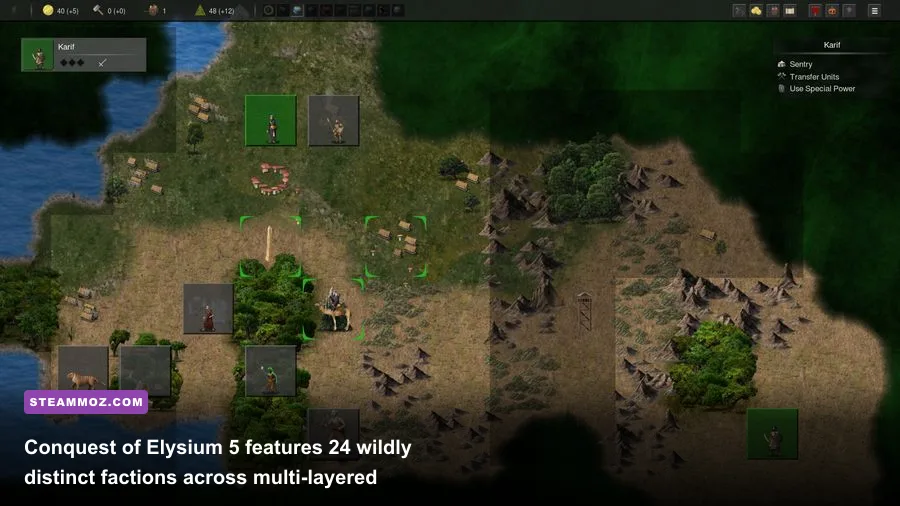
Developed by Illwinter Game Design, Conquest of Elysium 5 is the dark fantasy turn-based rogue-strategy game that defies every standard 4X convention. While it looks like a retro 90s indie title at first glance, its sheer mechanical breadth is staggering. It features 24 distinct factions, and virtually none of them play by the same rulebook.
Play as the Baron, and the game functions as a standard feudal simulator: you conquer hamlets, collect taxes in gold and iron, and pay upkeep on spearmen and crossbowmen. Switch to the Necromancer, and gold becomes worthless; you trade entirely in corpses and hands of glory, raiding battlefields and opening portals to the underworld. Pick the Voice of El, and you convert civilian settlements to your religion, praying for divine miracles and summoning archangels, while the Dryad relies entirely on harvesting wild herbs and awakening forest spirits.
Much like weighing optimal offensive options in our Far Cry 3 Blood Dragon weapon tier list, mastering CoE5 demands knowing which tools counter specific supernatural horrors. Send mortal archers against an ethereal wraith, and your army will evaporate without dealing a scratch.
Hidden Gem Strategy Showdown: Complexity, Pacing, and Tier Breakdown
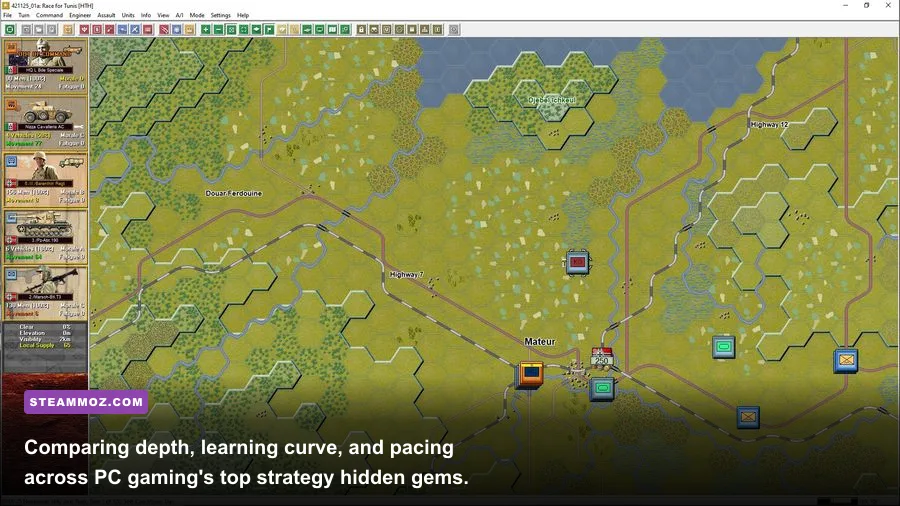
To help you decide which rabbit hole to dive down first, we've broken down each title's operational complexity, core gameplay loop, and strategic style in the comparison table below.
| Game | Sub-Genre | Complexity (1-10) | Core Strategic Mechanic | Ideal Player Profile |
|---|---|---|---|---|
| Shadow Empire | 4X / Operational Wargame | 9.5 / 10 | Granular logistics points, supply bottlenecks, unit design | Hardcore spreadsheet generals who miss old-school micro |
| AI War 2 | Asymmetric Grand RTS | 8.5 / 10 | AIP threat management, hacking, deep-strike hit-and-run | Players bored of crushing passive, predictable RTS bots |
| HighFleet | Naval Sim / Tactical Action | 8.0 / 10 | ELINT radar tracking, fuel-to-weight combat physics | Cold War tech nerds who love tense cat-and-mouse dogfights |
| Empires of the Undergrowth | Biological Base RTS | 7.0 / 10 | Pheromone routing, underground hive efficiency, morphs | RTS veterans wanting fresh, non-human tactical combat |
| Conquest of Elysium 5 | Turn-Based Rogue-4X | 7.5 / 10 | 24 radically asymmetric economies & planar dimensional travel | Fans of emergent storytelling, wild magic, and rogue elements |
Hardware Demand & Session Pacing Guide
While none of these games require top-of-the-line RTX hardware, their engine architectures vary wildly in how they utilize CPU threads, RAM caching, and long-turn calculations. Use this baseline reference to pick the right title for your rig and gaming schedule:
| Title | Average Campaign Length | Turn / Tick Calculation Demand | Recommended Hardware Target |
|---|---|---|---|
| Shadow Empire | 25 - 50+ Hours | Very High (Heavy single-core CPU usage late-game) | Modern 6-Core CPU (Ryzen 5 / Intel i5), 16GB RAM |
| AI War 2 | 10 - 20 Hours | High (Calculates thousands of autonomous ship units) | Multi-core CPU, dedicated GPU with 4GB+ VRAM |
| HighFleet | 15 - 30 Hours | Moderate (Real-time particle & physics engine) | Nvidia GTX 1060 / AMD RX 580 or better |
| Empires of the Undergrowth | 12 - 25 Hours | Moderate-High (High model counts in swarm battles) | Solid Quad-Core CPU, 8GB-16GB RAM, modern mid-tier GPU |
| Conquest of Elysium 5 | 2 - 6 Hours per run | Very Low (Runs smoothly on virtually any machine) | Runs on basic integrated graphics and legacy laptops |
Stop buying predictable 4X expansions that only add cosmetic factions or incremental diplomacy tweaks. Whether it's tracking radioactive fallout across the skies of Gerat in HighFleet or calculating the ammunition delivery capacity of a narrow-gauge railway in Shadow Empire, these five hidden gems deliver the deep, unapologetic strategic complexity PC gaming was built for.