
If you want PC games with genuinely incredible gameplay, start with Baldur’s Gate 3, Elden Ring, Hades, and Doom Eternal. They lead this list because every fight, build, or decision asks you to understand a system rather than simply follow a waypoint. The other six games bring the same quality through hunting, parrying, puzzle design, exploration, deckbuilding, and automation.
The ten games ranked by gameplay strength
This ranking favors games that stay mechanically interesting after the first few hours. A gorgeous world helps, but it cannot rescue repetitive combat or shallow progression. Each pick below has a distinct gameplay hook and enough depth to reward mastery.
| Rank | Game | Core gameplay strength | Best for |
|---|---|---|---|
| S-Tier | Baldur’s Gate 3 | Reactive turn-based encounters | Choice-driven RPG fans |
| S-Tier | Elden Ring | Build variety and exploration | Open-world action RPG players |
| S-Tier | Doom Eternal | Resource-focused movement combat | Fast FPS players |
| S-Tier | Hades | Repeatable runs with meaningful upgrades | Roguelike newcomers |
| A-Tier | Sekiro | Posture-based sword duels | Precision combat specialists |
| A-Tier | Monster Hunter: World | Weapon mastery and preparation | Long-form co-op hunters |
| A-Tier | Factorio | Automation and logistical problem-solving | Systems-minded strategists |
| A-Tier | Portal 2 | Physics puzzles and pacing | Puzzle fans |
| A-Tier | Hollow Knight | Exploration and demanding boss design | Metroidvania players |
| A-Tier | Slay the Spire | Deep deckbuilding decisions | Turn-based strategy fans |
Why these picks still feel fresh
They all create useful friction. Baldur’s Gate 3 makes you think about terrain, initiative, concentration, and action economy. Elden Ring lets a Faith build, bleed setup, colossal weapon, or sorcery build solve the same region differently. Hades turns failure into permanent story and mechanical progress. That kind of design gives you a reason to keep playing beyond simply seeing the ending.
For a wider look at technically demanding RPGs, Steamoz’s Elex PC fixes guide is also worth bookmarking before you troubleshoot an older system.
Baldur’s Gate 3 and Elden Ring reward experimentation

Baldur’s Gate 3
Larian’s standout RPG is at its best when you stop searching for the intended solution. A level 5 Wizard can cast Fireball for 8d6 fire damage across a large area, but the more interesting play is often Create Water followed by lightning damage, or Web combined with fire to create a burning hazard. A Rogue can shove an enemy from a ledge, while a Druid’s Spike Growth turns a narrow bridge into a damage trap.
Combat uses a clear action economy: one Action, one Bonus Action, movement, and sometimes a Reaction. That makes Action Surge, Haste, and high-ground advantage genuinely meaningful rather than decorative bonuses. Watch concentration, too. Losing Hold Person or Spirit Guardians after taking damage can completely change a fight. The strongest early party core is often Shadowheart for Bless, Lae’zel for control and burst, and a flexible protagonist who fills the missing damage role.
Its progression curve is generous without becoming mindless. Level 5 unlocks major power spikes such as Extra Attack and third-level spells, while respecs through Withers let you test multiclass ideas without restarting. The official Steam page for Baldur’s Gate 3 is the right place to check current platform details.
Elden Ring
FromSoftware’s open world works because exploration directly feeds combat experimentation. Finding Flame, Grant Me Strength, the Mimic Tear, or a new Ash of War can completely change your build. A 60-Vigor character has a far more forgiving endgame than a glass cannon, while 80 points in a primary damage stat usually approaches the practical soft cap for many weapons.
Weapon choice also changes your rhythm. The Bloodhound’s Fang offers a strong curved greatsword moveset and a mobility-focused skill. Moonveil rewards Intelligence investment with fast magic slashes. Against bosses, do not panic-roll every animation. Margit’s delayed cane swings punish early dodges, while Malenia’s Waterfowl Dance demands distance, a shield strategy, or a carefully timed escape. The game’s best lesson is simple: observe the first attempt, then build around what killed you.
Hades and Doom Eternal make aggression feel intelligent

Hades
Supergiant’s roguelike is not about hoping for a lucky run. Zagreus’s movement, dash timing, and weapon aspect give you a reliable foundation, while Boons create the run’s identity. The Stygian Blade works well with close-range damage and the Nemesis Aspect’s critical-hit potential. The Adamant Rail favors distance, ammo management, and effects that keep damaging enemies while you reposition.
God pairings matter. Aphrodite’s Weak reduces incoming damage, Artemis’s Pressure Points boosts critical potential, and Poseidon’s Tidal Dash turns rooms with walls into pinball tables. The Mirror of Night upgrades are equally important: Death Defiance gives you a revive, while Greater Reflex adds a second dash. If a run feels weak, improve your room choices and boon compatibility before blaming the weapon.
Doom Eternal
Doom Eternal’s combat loop is a resource triangle disguised as an arena shooter. Use the Flame Belch to create armor, the Chainsaw to recover ammunition, and Glory Kills to restore health. Ignoring one corner of that triangle leaves you empty and turns a controlled fight into frantic pistol fire.
Weapon swapping is the real skill ceiling. The Combat Shotgun’s Sticky Bomb can destroy a Cacodemon’s weak point, the Ballista melts aerial targets, and the Rocket Launcher’s lock-on burst punishes heavy demons. Arachnotrons are far easier after you remove the turret on their back; Mancubi become less dangerous once their arm cannons are destroyed. The game expects you to target weaknesses while moving, not hide behind cover. On PC, a mouse with weapon binds or the weapon wheel is dramatically better than cycling through the arsenal.
That same focus on performance matters in other shooters. Steamoz’s Far Cry 6 settings guide explains how to trade visual effects for steadier frame rates.
Sekiro and Monster Hunter: World turn bosses into lessons
Sekiro: Shadows Die Twice
Sekiro replaces conventional stamina management with posture. Deflecting attacks fills an enemy’s posture bar, and a perfectly timed deflection creates immediate pressure. The goal is not to retreat until an opening appears; it is to stand close, read the rhythm, and keep the opponent from recovering.
Against Genichiro Ashina, jump over his sweep, Mikiri Counter his thrust, and keep deflecting rather than backing away. The Mikiri Counter is mapped to the dodge input and deals massive posture damage when used against thrust attacks. Later, Ichimonji: Double restores some of Wolf’s posture while hitting hard, making it useful in longer duels. Prosthetics are situational tools: Loaded Umbrella handles dangerous projectiles, while Firecrackers interrupt beasts and create a brief offensive window.
Monster Hunter: World
Monster Hunter: World asks you to prepare before the fight and adapt during it. The Great Sword’s True Charged Slash can deliver enormous damage, but only if you understand positioning and monster recovery windows. The Sword and Shield offers faster item use and constant mobility, while the Insect Glaive trades raw simplicity for aerial movement and Kinsect buffs.
Learn the three-part hunt loop: break parts, exploit topple windows, and sharpen before your damage falls off. Flash Pods can interrupt flying monsters, but they are not a universal answer, especially against tougher Master Rank targets. Against Alatreon, elemental damage is mandatory because the Escaton Judgment wipe is checked by your elemental threshold. That is a perfect example of a boss teaching preparation rather than merely demanding faster reflexes.
If space combat is more your style, Steamoz’s Everspace 2 hidden rewards guide covers the same rewarding habit of exploring beyond the obvious objective.
Portal 2 and Hollow Knight prove level design is gameplay

Portal 2
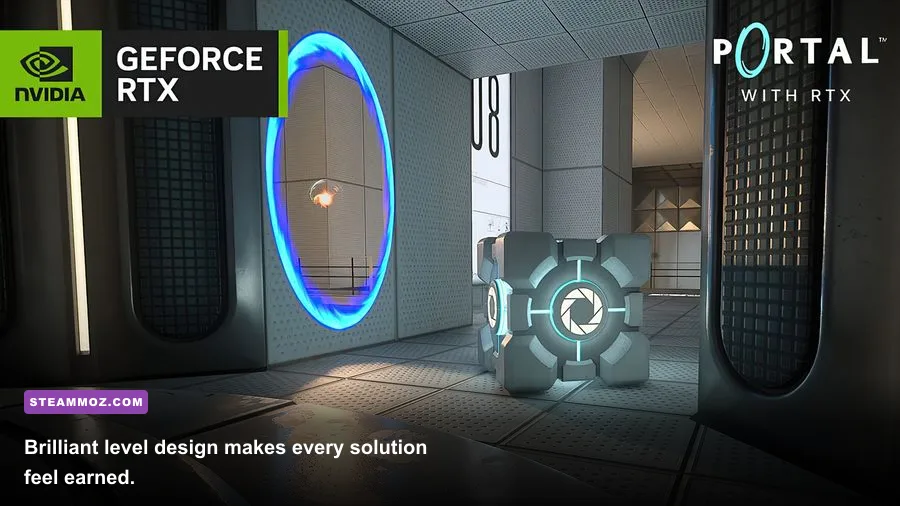
Portal 2 rarely needs a stat screen because the environment is the progression system. You learn one rule at a time, then combine it with momentum, lasers, light bridges, and excursion funnels. The first time you use a portal to launch yourself across a chamber, the solution feels like your own discovery rather than a scripted unlock.
Pay attention to surfaces. White moon-rock panels accept portals, while metal walls do not. Repulsion Gel launches you, Propulsion Gel accelerates movement, and Conversion Gel lets you place portals on otherwise unusable surfaces. In co-op, communication becomes another mechanic: mark portal locations, call out timing, and never assume your partner sees the same solution.
Hollow Knight
Team Cherry’s metroidvania combines demanding bosses with a map that rewards curiosity. The Mantis Claw opens wall-jumping routes, Crystal Heart enables horizontal super dashes, and Shade Cloak lets you pass through attacks. These upgrades are not just keys; they expand how you move through old areas and reveal shortcuts that make later attempts less punishing.
Charms create compact build decisions. Quick Focus shortens healing time, Mark of Pride increases nail range, and Shaman Stone makes spells substantially more threatening. Against the Mantis Lords, stay centered, respect the boomerang trajectory, and heal only after a clearly safe pattern. The game’s bosses telegraph well, but greed still gets punished.
Factorio and Slay the Spire deliver endless strategic depth
Factorio
Factorio turns production into a chain of solvable bottlenecks. Early automation starts with burner drills and stone furnaces, but the real breakthrough arrives when belts, inserters, assemblers, and electricity work together. A yellow transport belt moves 15 items per second, while a red belt doubles that throughput to 30, so upgrading one belt without fixing the mining or smelting bottleneck often changes nothing.
Use splitters to balance lanes, leave room for future belt expansion, and separate your science packs by production block. Oil processing introduces petroleum gas, light oil, and heavy oil, creating a new logistics puzzle rather than a simple resource upgrade. Keep turrets supplied, automate ammunition, and build walls before pollution reaches nearby nests. Factorio is at its most satisfying when a factory that once required constant babysitting runs cleanly for an hour.
Slay the Spire
Slay the Spire rewards coherent decks, not piles of individually powerful cards. The Ironclad’s Strength scaling makes cards such as Inflame and Heavy Blade work together, while the Silent can build around poison with Noxious Fumes and Catalyst. The Defect’s Orbs create another layer: Focus improves orb output, and Defragment can turn a defensive setup into a scaling engine.
Do not draft every rare card. Remove weak Strikes and Defends when possible, prioritize upgrades at campfires, and choose elite fights only when your deck can survive them. The Act 3 bosses test different weaknesses: Time Eater punishes excessive card spam, Donu and Deca demand scaling damage, and the Awakened One makes careless Power-heavy builds dangerous. Every route decision matters as much as the card draw.
PC settings that protect the feel of these games
Gameplay quality collapses when stutter ruins a parry or input delay blunts a dodge. Use these broad settings as a starting point, then tune for your GPU and monitor.
| Setting | Recommended value | Typical FPS impact | Visual trade-off |
|---|---|---|---|
| Resolution | Native, or 90% scale | High | Lower scale softens fine detail |
| Ray tracing | Off for competitive action | Very high | Less reflective lighting |
| Shadow quality | High | Medium | Reduced contact shadow detail |
| Volumetric effects | Medium | Medium | Less fog and light scattering |
| Textures | High if VRAM allows | Low | Keep high for sharper surfaces |
| Motion blur | Off | Minimal | Cleaner camera movement |
For slower games, a locked 60 fps is perfectly comfortable. For Doom Eternal, Sekiro, and Elden Ring, consistent frame pacing matters more than chasing an unstable peak number. Close background overlays, use an SSD, and cap frames slightly below your monitor’s refresh rate when you see uneven delivery. Steamoz also has practical performance coverage for crashes and low FPS and older PC specifications.
These ten games cover nearly every flavor of excellent PC gameplay: reactive storytelling, precision duels, explosive FPS combat, puzzle solving, exploration, automation, and strategic deckbuilding. Start with the game that matches your preferred decision-making style, not the one with the loudest marketing. The best pick is the one whose core loop makes you say, “Just one more run,” long after you planned to stop.