If you want PC games with gameplay that stays exciting beyond the opening hours, start with Elden Ring, Baldur's Gate 3, Counter-Strike 2, Doom Eternal, and Factorio. Those five lead this list, while Red Dead Redemption 2, Cyberpunk 2077, Hades, Monster Hunter: World, and Slay the Spire round out ten exceptional games that reward skill, experimentation, and smart decision-making instead of empty map-clearing.
This isn't a ranking based on graphics alone. The best PC gameplay creates a satisfying loop: learn a system, make a mistake, understand why it happened, then come back with a sharper plan. Some picks here demand mechanical precision, others reward long-term planning, and a few turn failure into the main progression system. All ten remain excellent choices on keyboard and mouse, gamepad, or a Steam Deck-style handheld.
How These Must-Play PC Games Rank

I judged each game on four things: moment-to-moment feel, depth after the tutorial period, meaningful progression, and how well the mechanics support different playstyles. A huge world doesn't automatically qualify. Red Dead Redemption 2 earns its place because exploration, hunting, missions, and weapon handling reinforce its setting. Factorio qualifies for the opposite reason: its entire universe is a tightly connected production puzzle.
| Rank | Game | Gameplay Strength | Best For |
|---|---|---|---|
| S-Tier | Elden Ring | Combat discovery and build variety | Solo action RPG fans |
| S-Tier | Baldur's Gate 3 | Reactive turn-based encounters | Choice-driven RPG players |
| S-Tier | Counter-Strike 2 | Precision, economy, and team tactics | Competitive FPS players |
| S-Tier | Doom Eternal | Resource-based arena combat | High-speed shooter fans |
| A-Tier | Factorio | Automation and optimization | Systems-minded builders |
| A-Tier | Red Dead Redemption 2 | World interaction and atmosphere | Immersive open-world fans |
| A-Tier | Cyberpunk 2077 | Flexible builds and encounter design | Action RPG players |
| A-Tier | Hades | Fast roguelike combat | Players who enjoy repeated runs |
| A-Tier | Monster Hunter: World | Weapon mastery and boss hunting | Co-op action fans |
| A-Tier | Slay the Spire | Deckbuilding decisions | Strategy players |
Performance matters, too. Before buying a demanding title, check our PC requirements guide for the sort of hardware details that can make or break a smooth experience. For older or poorly behaving releases, our crash and FPS fixes are also worth bookmarking.
1–3: The Games With the Best Player Agency
1. Elden Ring
FromSoftware's open world works because every obstacle teaches you something. The Uchigatana applies Bleed, Bloodhound's Fang combines strong physical damage with the Bloodhound's Finesse skill, and a basic shield parry can completely change how you approach knight enemies. You can also ignore a wall, ride Torrent elsewhere, find a better upgrade stone, and return with a new answer.
The early progression is unusually generous: Limgrave, the Weeping Peninsula, and underground areas offer enough runes, Smithing Stones, and Ashes of War to support wildly different builds. Watch boss telegraphs rather than health bars. Margit's delayed cane swings punish panic rolls, while Godrick's phase-two fire attacks demand lateral movement instead of repeated backsteps. Elden Ring is at its best when you stop asking, “What level should I be?” and start asking, “What mechanic am I failing to read?” Visit the official Elden Ring site for current game information.
2. Baldur's Gate 3
Baldur's Gate 3 turns combat into a playground of surfaces, verticality, and action economy. A Fire Bolt can ignite grease, Create Water doubles down on lightning or cold damage, and Shove can remove an enemy without dealing conventional damage. The game tracks your choices through companion approval, faction reactions, hidden checks, and alternate quest solutions.
Combat gets much more interesting once you understand concentration. A cleric maintaining Spirit Guardians should protect that concentration, while a wizard can use Counterspell to erase a dangerous enemy cast. Advantage and disadvantage don't stack numerically; multiple sources simply ensure the roll is made with advantage or disadvantage. That small rule makes positioning and status effects more valuable than blindly adding buffs. The official Baldur's Gate 3 website has news and patch details.
3. Counter-Strike 2
Counter-Strike 2 is pure competitive feedback. The AK-47 kills with a headshot against an unarmored opponent at any practical range, but recoil control, counter-strafing, utility timing, and economy management decide whether you get that shot. A smoke grenade is no longer just cover; with volumetric smoke, bullets and grenades can briefly clear sightlines, creating tactical openings.
Learn one map properly before collecting a dozen. On Mirage, know the default A smoke, jungle flash lineups, and the timing from T spawn to mid. More importantly, stop taking unnecessary duels after your team gains a numbers advantage. Counter-Strike rewards boring decisions that preserve a round. The official Counter-Strike 2 page explains the game's current direction.
4–6: Precision, Automation, and Immersion

4. Doom Eternal
Doom Eternal isn't a cover shooter with demons. It's a resource circuit. Glory kills restore health, chainsaw executions refill ammunition, and flame belches create armor. The game expects you to rotate those tools while moving through arenas at speed. The Combat Shotgun's Sticky Bomb breaks Arachnotron turrets, the Rocket Launcher handles heavier targets, and the Ice Bomb creates a short freeze window for burst damage.
Enemy priority matters. Delete the Arachnotron turret early, stagger a Mancubus before it corners you, and use the Plasma Rifle to strip energy shields. Standing still is usually more dangerous than taking a risky jump. The difficulty curve spikes around Super Gore Nest, but that level is also where the combat loop finally clicks.
5. Factorio
Factorio begins with hand-mined iron and ends with trains, circuit networks, robots, and a rocket launch. Its brilliance is visible in every bottleneck. If green circuits stall, the problem may be copper smelting, belt throughput, inserter placement, or insufficient power rather than the circuit assemblers themselves.
Start with a main bus carrying iron plates, copper plates, green circuits, and gears. Use underground belts to keep lanes readable, then move to trains when ore patches become impractical to belt. Steam engines output 900 kilowatts each, while a boiler consumes 30 water per second at full load, so power expansion can be planned instead of guessed. Factorio's official site is the best place to track updates.
6. Red Dead Redemption 2
Red Dead Redemption 2 is slower, but that pace serves its systems. Dead Eye lets Arthur mark targets, weapon condition affects performance, and horse bonding unlocks handling improvements across four levels. A worn Cattleman Revolver feels different from a customized Schofield, and gunfights reward taking cover, using Dead Eye economically, and looting before moving on.
The world also reacts to your behavior. Keep the bandana on during crimes, clean weapons at a gunsmith or camp, and use tonics before difficult missions rather than waiting for the health core to collapse. It isn't the most mechanically demanding game here, but few open worlds make travel, weather, wildlife, and social encounters feel this connected.
7–10: Buildcrafting That Keeps Paying Off
7. Cyberpunk 2077
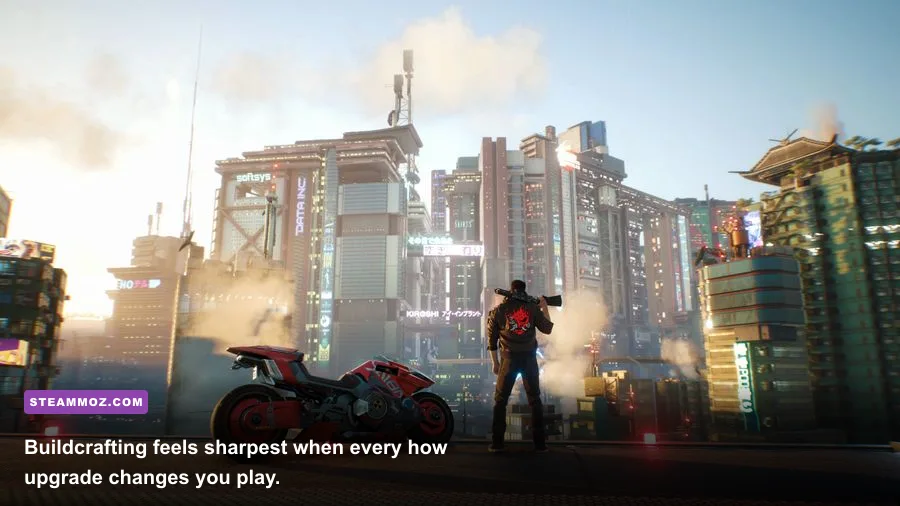
Cyberpunk 2077 becomes an exceptional action RPG once you commit to a build instead of distributing every perk. A Reflexes-focused V can combine Dash with air movement and blades; a Technical Ability build can stack cyberware capacity and explosive weapon bonuses; an Intelligence netrunner can queue Overheat, Short Circuit, and Contagion while staying behind cover.
Phantom Liberty adds Relic perks that make arm cyberware more meaningful, while the level-scaling overhaul keeps weapons and enemies relevant. Watch your cyberware capacity and armor thresholds. More implants aren't automatically better if they drain your RAM, stamina, or survivability. Players chasing higher frame rates should also see our PC graphics optimization guide.
8. Hades
Hades makes repetition feel productive. Zagreus's weapons radically change the rhythm of a run: the Shield of Chaos controls space, the Adamant Rail rewards ranged kiting, and the Twin Fists demand close-range aggression. Boons from Athena, Dionysus, Artemis, and Poseidon combine into builds that can be deliberately shaped through keepsakes and rerolls.
Don't chase rarity at the expense of synergy. Artemis's Pressure Points supports critical-hit builds, while Ares's Blade Rift can control a room when paired with movement tools. The Mirror of Night upgrades, especially Death Defiance and Greater Reflex, make early runs less punishing without removing the need to learn boss patterns. Hades is the ideal choice if you want twenty-minute sessions with real mechanical growth.
9. Monster Hunter: World
Monster Hunter: World treats every hunt as a knowledge test. The Great Sword's True Charged Slash can deliver enormous damage, but only after you read a monster's recovery window. The Insect Glaive controls vertical space, the Bow manages coatings and stamina, and the Charge Blade switches between sword-and-shield defense and explosive axe damage.
Preparation is half the combat. Eat a meal for useful skills, carry Nullberries against elemental blights, sharpen during safe transitions, and learn whether a monster's roar can be blocked, dodged, or interrupted. Breaking a Rathalos wing or cutting a tail isn't cosmetic; part damage changes the fight and improves reward tables. This is one of the best co-op PC games because every weapon contributes a distinct job.
10. Slay the Spire
Slay the Spire looks simple until you realize that every card is a long-term commitment. The Ironclad can build around Strength and Limit Break, the Silent can stack Poison with Catalyst, and the Defect can manipulate Lightning, Frost, and Focus through Orbs. The Watcher is even more volatile, switching between Calm and Wrath to double damage while risking catastrophic turns.
Pathing matters as much as drafting. Elite fights provide relics but can end a run if your deck lacks reliable damage, while campfires let you upgrade a key card or heal. Avoid adding cards just because they look powerful; a bloated deck makes your crucial powers less consistent. The game's best lesson is also its harshest: a strong card in the wrong deck is often a liability.
| Game | Core Loop | Difficulty Profile | Ideal Session |
|---|---|---|---|
| Elden Ring | Explore, fight, respec | Demanding but flexible | 1–3 hours |
| Counter-Strike 2 | Practice, compete, review | Extremely demanding | 30–90 minutes |
| Factorio | Build, automate, expand | Low reflex demand, high planning demand | 2–6 hours |
| Hades | Run, upgrade, retry | Fast and learnable | 20–40 minutes |
| Slay the Spire | Draft, route, adapt | Strategically brutal | 30–90 minutes |
Which PC Game Should You Play First?
Pick Elden Ring if you want exploration and combat discovery, Baldur's Gate 3 if your ideal game remembers every decision, and Counter-Strike 2 if measurable improvement is the entire point. Choose Doom Eternal for adrenaline, Factorio for systems, and Hades for short sessions that still feel meaningful.
For the deepest long-term investment, Monster Hunter: World and Factorio are difficult to beat. For the most immediately satisfying action, Doom Eternal and Hades deliver the fastest feedback. Cyberpunk 2077 is the broadest single-player sandbox, while Red Dead Redemption 2 remains the strongest choice when atmosphere matters as much as combat.
Hardware can shape that choice. Use a 60-fps target for Red Dead Redemption 2 and Cyberpunk 2077, prioritize low latency and a stable frame rate for Counter-Strike 2, and don't underestimate loading times when managing large Factorio factories. If you enjoy hunting secrets, our guides to hidden rewards in Everspace 2 and secret locations show the same principle in action: the best games make curiosity mechanically worthwhile.
These are the top PC games to play when you want more than a pretty world and a checklist. Each one gives you a language to learn, then trusts you to speak it your own way. That's why their gameplay keeps pulling players back long after the credits roll.