
When internet connections drop or live-service fatigue sets in, offline games live or die purely on the strength of their moment-to-moment mechanics. Without multiplayer chatter or battle passes to mask sloppy design, true single-player standouts hook you through instantaneous input response, immaculate enemy telegraphs, and systemic depth. If you are hunting for titles where the mechanical loop never gets stale, these ten masterclasses deliver the most rewarding offline combat, exploration, and strategy systems ever built.
S-Tier Combat Mastery: Action Games With Zero Input Latency

Pure mechanical action demands frame-perfect execution that multiplayer network jitter simply ruins. The pinnacle of this design is Sekiro: Shadows Die Twice. Sekiro discards traditional stamina meters in favor of a dual Posture system. Deflections possess a generous 30-frame activation window when unspammed, but that window shrinks down to 7 frames if you mash the parry input, forcing genuine rhythm over panic reactions. Bosses like Sword Saint Isshin test your literacy across thrust attacks (punished with the 0.3-second input buffer of the Mikiri Counter), sweep attacks (requiring head-stomp posture punishment), and lightning reversals mid-air. It feels less like a battle and more like high-speed percussion.
On the stylistic spectrum sits Devil May Cry 5. Playing as Dante or Nero demands deep muscle memory. Dante’s style-switching allows seamless transitions between Trickster iframes, Royal Guard frame-one blocks, and Gunslinger aerial juggles within a single jump cancel. Achieving the coveted SSS rank isn't cosmetic; it unlocks Dante's Quadruple S passive, granting a free 1-second Sin Devil Trigger burst that cancels recovery frames without consuming your transformation bar. Much like hunting for peak damage efficiency in our Far Cry 3 Blood Dragon weapons ranked from S to C breakdown, DMC5 challenges you to squeeze every drop of DPS out of your available toolset.
Rounding out this mechanical trio is FromSoftware's Armored Core VI: Fires of Rubicon. AC6 shifts the focus to mechanical kinematics. Your mech's Attitude Control System (ACS) overload bar dictates engagements. Weapons like the dual Zimmerman shotguns inflict massive kinetic impact, forcing enemies into an ACS Stagger state where subsequent strikes deal direct-hit bonus damage. Every component matters: choosing lightweight Reverse-Joint legs gives you explosive jump-boost evasion at the cost of AP, while heavy Tank treads let you fire shoulder-mounted grenade cannons without anchoring yourself to the ground.
Unrivaled Replayability: Roguelike and Tactical Powerhouses
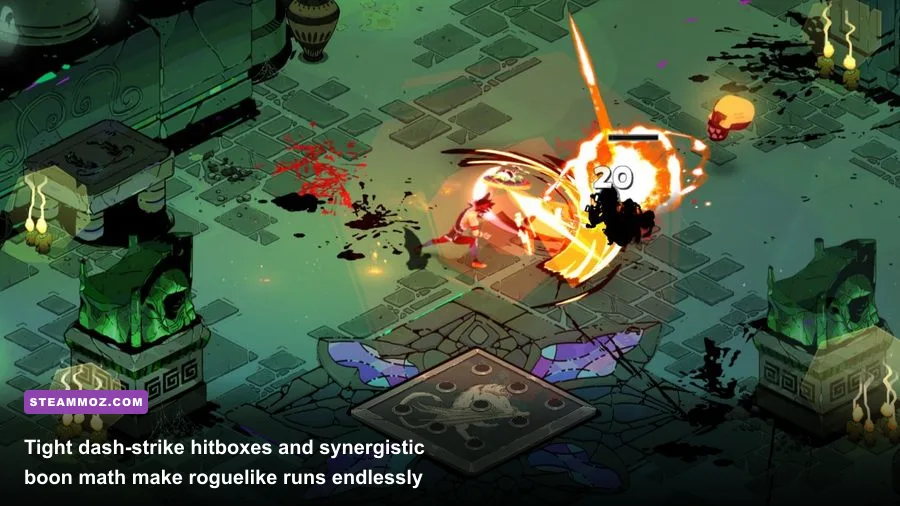
Mastering a deterministic combat system is thrilling, but unpredictable procedural generation provides infinite shelf life. Hades achieves perfection by fusing responsive isometric dash-strikes with algebraic build scaling. Zagreus's dash possesses precise 8-frame invulnerability, letting you weave through bullet-hell barrages in the chambers of Elysium. The true mechanical brilliance lies in Duo Boon math. Pairing Ares' Doom mechanics with Athena's Deflect via Merciful End causes your attacks to detonate Doom effects instantly, turning a slow hit-and-run weapon into an explosive boss-melting engine.
If you prefer side-scrolling precision, Motion Twin's Dead Cells offers the fastest combat loop in the indie space. The platforming operates on an uncapped frame response where your roll cancels weapon recovery states instantly. At 5 Boss Stem Cells (the maximum difficulty setting), the game introduces the Malaise mechanic—an aggressive infection timer that increases enemy speed and spawns additional mobs if you linger. You have to maintain relentless forward momentum, prioritizing Brutality, Tactics, or Survival scrolls to scale weapon damage exponentially (roughly 15% compounded damage per scroll).
For cerebral tacticians who want mathematical tension over twitch reflexes, Mega Crit's Slay the Spire is the undisputed king. Its gameplay loop revolves around card micro-economics: you start every turn with 3 Energy and 5 Cards, calculating incoming intent damage against card draw probabilities. Thinning your deck down to a reliable 5-card infinite loop using the Watcher's Rushdown and Tantrum delivers unparalleled intellectual satisfaction. Optimizing your resource economy here feels just as rewarding as mastering economy loops in our level fast and farm zeni in Kakarot Master Edition guide.
Systemic Sandbox Immersion: Mechanics That Truly React

Immersive simulations and systemic builders treat gameplay not as a series of scripted triggers, but as an interplay of reactive physical rules. Arkane Studios' Prey (2017) drops you onto the Talos I space station and refuses to hold your hand. Its flagship tool, the GLOO Cannon, is fundamentally a physics engine exploit disguised as a weapon: it freezes Typhon organisms, extinguishes electrical fires, insulates broken junction boxes, and lets you spray climbable platforms directly onto vertical walls to bypass locked bulkheads. If a door code is missing, you can use the Mimic Matter neuromod to transform yourself into an apple and slip through a tiny breach in the security window.
If you crave emergent storytelling dictated by brutal underlying simulations, Ludeon Studios' RimWorld is unmatched. RimWorld’s internal engine tracks every pawn’s bone structure, internal organs, temperature tolerances, and emotional thresholds. Managing pawns while engineering defensive killboxes requires serious logistical precision. You must manage thermal venting, calculate weapon firing cooldowns down to the tick, and manipulate AI pathfinding around barricades. The organizational depth required to keep a colony functioning against hostile raids mirrors the rigorous unit routing explored in our Empires of the Undergrowth fast leveling and gold farming guide.
Open-World Freedom With Heavyweight Physics

Most modern open worlds clutter your screen with compass markers and map icons, turning gameplay into checklist navigation. Dragon's Dogma 2 does the exact opposite by letting tactile physical systems dictate encounters. Stamina governs every meaningful action. When you tackle an enraged Minotaur, your character’s body weight and movement momentum calculate real-time impact. Playing as a Warrior allows you to time shoulder-tackles to knock charging beasts clean off their hooves. Meanwhile, the Thief vocation lets you scale a Griffin’s feathers mid-flight to bury your daggers directly into its skull while burning your stamina gauge before it soars across the horizon.
Underwater, Unknown Worlds' Subnautica presents one of the tensest exploration loops in survival gaming. Without auto-maps or radar aids, your gameplay loop revolves entirely around depth management and acoustic awareness. Fabricating depth modules for the Seamoth and Prawn Suit pushes your operational limit from 200 meters down into the terrifying, pitch-black 1,300-meter trenches of the Inactive Lava Zone. Navigating the depths demands careful battery conservation, oxygen gauge timing, and utilizing your Cyclops submarine's silent running mode to slip past Reaper Leviathans. Uncovering these uncharted ocean biomes feels just as thrilling as discovering the deep secrets mapped in our Everspace 2 secret locations and hidden rewards guide.
Rounding out the ten is Elden Ring played strictly offline. Stripping away player phantoms and glowing floor messages transforms the Lands Between into an oppressive, pure action RPG. Combat encounters force you to decipher subtle boss delays—like Margit’s infamously held overhead strikes—while tuning your character's equip load below 70% to preserve your medium roll invulnerability frames. Crafting specialized offline builds requires deliberate stat allocation, much like crafting optimal setups in our Far Cry 6's best beginner build for the GOTY upgrade pass walkthrough.
Complete Offline Gameplay Comparison and Performance Matrix

To help you pick the exact flavor of gameplay loop you want to conquer next, here is how these ten offline titans stack up across mechanical skill ceilings, core design loops, and replayability ratings:
| Game Title | Core Gameplay Mechanic | Input Skill Ceiling | Progression System | Replay Value |
|---|---|---|---|---|
| Sekiro: Shadows Die Twice | Rhythm Deflection & Posture Breaking | Very High (Frame-tight windows) | Prosthetic Tool upgrades & Skill trees | High (NG+ Charmless runs) |
| Devil May Cry 5 | Style Switching & Jump Cancels | Extremely High (APM intensive) | Combo buy-outs & Weapon unlocks | Extremely High (DMD difficulty) |
| Armored Core VI | ACS Stagger & Assembly Kinematics | High (Spatial awareness) | Garage assembly & Component tuning | High (3 Alternate endings) |
| Hades | Dash-strike iframes & Boon Synergies | Medium-High (Reaction speed) | Mirror of Night & Weapon Aspects | Infinite (Pact of Punishment) |
| Dead Cells | Fast-twitch Dodge-rolls & Weapon Combos | Very High (5-Cell difficulty) | Scroll stat scaling & Collector Blueprints | Infinite (Malaise scaling) |
| Slay the Spire | Turn economy & Card synergy math | Extremely High (Decision-making) | Deck-thinning & Relic acquisition | Infinite (Ascension 20 climbs) |
| Prey (2017) | GLOO geometry & Emergent physics | Medium (Problem solving) | Neuromod human/alien trees | High (No-needle/Alien-only runs) |
| RimWorld | Colony AI logic & Base pathology | High (Macro management) | Research tree & Pawn bionics | Endless (AI storyteller chaos) |
| Subnautica | Depth resource pacing & Oxygen tension | Low-Medium (Survival planning) | Vehicle fabrication & Habitat depth | Moderate (Hardcore mode) |
| Dragon's Dogma 2 | Momentum physics & Monster mounting | Medium-High (Positioning) | Vocation levels & Pawn training | High (Unmoored World endgame) |
Optimizing Your Offline Rig for Zero Latency and Rock-Solid Frames
When you are reacting to 12-frame combat animations, micro-stuttering is your worst enemy. Running games offline completely cuts out server-side desync, but poor frame pacing will ruin your inputs just as quickly. Use the performance tuning profiles below to lock down stable frame deliveries on desktop or handheld systems like the Steam Deck. For troubleshooting engine-level framerate issues on legacy systems, check our technical guide on Elex PC fixes that stop crashes and rescue your FPS.
| Game Engine Type | Recommended Display Cap | Sync Setting | Key Setting to Reduce | Input Latency Impact |
|---|---|---|---|---|
| FromSoft Engine (Sekiro / Elden Ring) | 60 FPS (Hardcoded limit) | Driver-Level G-Sync / FreeSync | Volumetric Quality (High to Medium) | Reduces frame pacing jitter by ~16ms |
| RE Engine (Devil May Cry 5 / DD2) | 120 FPS or Display Max | NVIDIA Reflex ON / Anti-Lag | Mesh Quality & Subsurface Scattering | Cuts input lag down to sub-8ms |
| Custom 2D Engines (Hades / Dead Cells) | 144Hz / 240Hz Uncapped | Fast Sync / Enhanced Sync | Screen Shake / Particle Overlays | Near-zero latency (~2ms response) |
| CryEngine (Prey 2017) | 90–120 FPS Cap | In-Engine V-Sync OFF, Driver ON | Screen Space Reflections (SSR) | Eliminates micro-stutter during sprint |
Whether you want the surgical, lightning-fast deflections of Sekiro, the infinite tactical card calculations of Slay the Spire, or the emergent problem-solving of Prey, these offline games prove that nothing matches the thrill of a single-player campaign firing on all mechanical cylinders. Pick the loop that speaks to your playstyle, lock in your frame rates, and dive into gameplay systems built to stand the test of time.