
You do not need to drop $70 to get genre-defining mechanics, razor-sharp gunplay, or bottomless build craft. The modern free-to-play landscape is packed with bloated predatory titles, but a rare tier of games completely flips the script by prioritizing mechanical depth over aggressive monetization. If you want games where movement feels instantaneous, combat rotations reward surgical execution, and high skill ceilings keep you hooked for thousands of hours, these ten standouts wipe the floor with full-priced releases.
The Movement & Combat Kings: Unmatched Kinesthetics
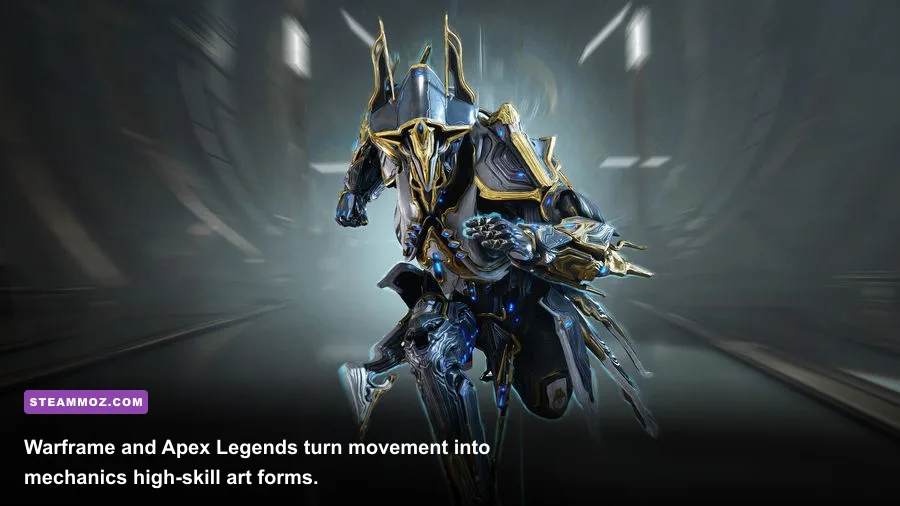
Great gameplay starts with how a game feels under your fingers. When a studio nails momentum, weight, and input responsiveness, basic traversal transforms into an addictive loop. Nowhere is this truer than in the movement shooter space, where mastery of physics separates casuals from lobby-clearing demons.
1. Warframe: Parkour Velocity and Power Fantasy
Digital Extremes turned an ambitious third-person looter into the fastest horde shooter on the market. In Warframe, you don't merely sprint through corridors; you chain bullet jumps (Crouch + Jump), double jumps, roll cancels, and Aim Glides to blast through tile sets at 60 miles per hour without touching the floor. Gunplay feeds directly into this flow state: blowing open a room with an Incarnon Torid while airborne before dropping a slash-proccing Exalted Blade slash on an elite Grineer Eximus feels peerless.
The build depth matches the mobility. Warframe features over 50 unique frames, each with distinct kits, augmented by a complex modding system where slotting Galvanized Diffusion, Critical Delay, and weapon Arcanes fundamentally alters weapon fire-rates, status weightings, and base damage types. Much like tuning settings for max FPS in hardware-heavy titles, dialing in your frame's cast speeds with Archon Shards turns clunky ability windups into instantaneous room cleansers.
2. Apex Legends: The Gold Standard of Battle Royale Gunplay
Apex Legends took Titanfall's modified Source engine and built the crispiest gun mechanics in multiplayer history. Every weapon carries distinct spray profiles and handling personalities—from the horizontal recoil pull of the Flatline to the rapid spray punch of an R-99. But the movement tech creates the actual skill ceiling: slide-jumping down slopes to escape crossfire, wall-bouncing off doorframes to snap your crosshair onto an unsuspecting squad, and leveraging mantle cancels.
High-level gunfights also lean on "recoil smoothing"—an engine quirk where counter-strafing fast enough horizontally completely cancels out vertical weapon kick. Combine that with clutch tactical abilities, like Pathfinder's physics-driven grapple swings and Horizon's gravity lift strafes, and you get an adrenaline rush that no traditional military shooter can touch.
3. The Finals: Procedural Destruction Meets Precision Arena Shooting
Built on dynamic Havok destruction, The Finals treats concrete and steel as disposable cover. If an enemy team nests on a second-floor cashout point behind deployable shields and automated turrets, you don't funnel through their crosshairs. You grab a Sledgehammer on Heavy class, blast out the supporting load-bearing pillars with C4, and drop the entire room—objective and all—into the basement.
Beyond structural demolition, the game's micro-mechanics are lethal. Light builds use an Evasive Dash with three instantly recharging bursts to break line of sight, dumping a magazine from an XP-54 submachine gun into an opponent's back before vanishing. Meanwhile, Medium players balance team survivability using Defibrillators with surgical FCAR recoil tracking. It is pure, kinetic chaos where every wall collapse reshapes your crosshair angles in real time.
Complex Action RPGs: Theorycrafting and Rotational Depth
If your idea of incredible gameplay involves spreadsheets, gear synergies, and lightning-fast action rotations, the top tier of free-to-play action RPGs completely dwarfs the mechanics of most single-player titles.
4. Path of Exile: The Deepest Character Progression Ever Coded
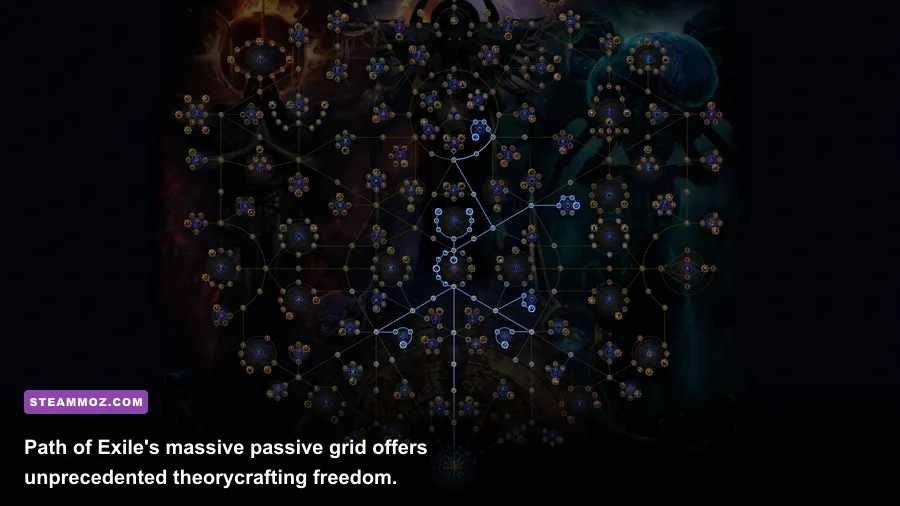
Grinding Gear Games built Path of Exile for gamers who found Diablo too simplistic. The core loop revolves around an intimidating passive skill tree containing over 1,300 nodes, connected to an active gem-linking system. Want a skill where your character spins with Cyclone, but every critical hit automatically casts Ice Nova spells that chain explosions across the screen? Slot Cyclone with Cast On Critical Strike, Awakened Added Cold Damage, and Ice Nova of Frostbolts into a 6-link body armour, and watch the screen detonate.
The endgame mechanics—running juiced Tier 16 maps, tailoring Atlas passive trees, and tackling pin-point boss fights like The Maven—demand split-second mechanical execution alongside intense build crafting. Finding obscure pathing routes and farming valuable crafting currency echoes the thrill of hunting down secret locations and hidden rewards in massive space sims. PoE never holds your hand, but when your custom-built theorycraft obliterates an endgame boss in three seconds, the dopamine rush is unmatched.
5. Genshin Impact: The Nuance of Elemental Gauge Theory
Dismissing Genshin Impact as merely a casual anime open-world misses the underlying elegance of its real-time combat system. Combat revolves entirely around the "Elemental Gauge Theory"—an intricate hidden system where elemental attacks apply specific unit values (1U or 2U) of elemental auras to enemies, governed by strict Internal Cooldowns (ICD).
Executing top-tier damage requires mastering rapid character swapping: setting an Hydro aura with Xingqiu's raincutters, snapshotting Bennett's massive flat ATK burst buff onto Xiangling's Pyronado, and triggering forward-Vaporize reactions with a 1.5x to 2.0x multiplier. Swapping between four characters every 1.5 seconds to funnel energy particles into energy-hungry bursts creates an addictive, rhythmic combat loop that outclasses many premium action hack-and-slash games.
Tactical Mastery & High-Stakes Competitive Play
Pure competitive purity lives in games where random number generation takes a backseat to human reaction, game sense, and pixel-perfect inputs. These two PC titans have spent decades refining their gameplay loops to perfection.
6. Counter-Strike 2: Sub-Tick Precision and Volumetric Tactical Play
Valve’s transition to the Source 2 engine brought Counter-Strike 2, elevating the most legendary tactical shooter on earth. CS2 strips away hero abilities and sprint buttons in favor of raw fundamentals: crosshair placement, spray control, economy management, and counter-strafing. Counter-strafing requires tapping the opposite movement key (tapping D when running left with A) to arrest your momentum to absolute zero the millisecond before you click, ensuring your first AK-47 bullet fires with 100% accuracy.
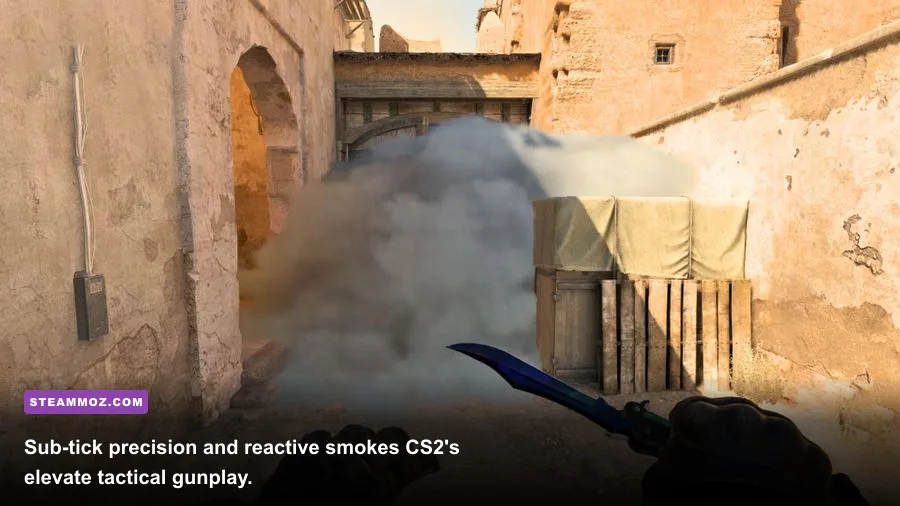
The upgraded volumetric smoke grenades completely redefine competitive gameplay. Smokes now exist as physical 3D objects that react dynamically to environment geometry, expand through broken windows, and get temporarily blown open by HE grenade concussions or sniper fire. This creates high-stakes tactical micro-windows where a player can clear sightlines through smoke with a well-timed grenade, snagging an opening pick before the cloud reforms. It feels as sharp and brutal as matching frames in top-tier fighters like we discuss in our fighting game spec breakdowns.
7. Dota 2: The Most Mechanically Demanding MOBA on Earth
Unlike competitors that streamlined gameplay for accessibility, Dota 2 embraces sheer mechanical friction. It retains turn rates (characters take actual fractions of a second to rotate their models before casting or running), creep denying (killing your own minions to starve enemies of gold and experience), and jungle camp stacking by pulling neutral creeps past their spawn leash boxes at precise game-clock seconds.
Every hero interaction features complex edge cases. Spells can pierce or get nullified by Black King Bar’s magic immunity, vision mechanics use realistic high-ground/low-ground miss penalties, and items like Blink Dagger allow instant repositioning that turns lost fights into team-wipes in 0.2 seconds. Dota 2 demands absurd multitasking, game sense, and lightning mechanics, making it one of the most rewarding multiplayer experiences ever engineered.
Precision Speed, Arena Physics, & Masterclass Gun Feel
The remaining three entries cover unique gameplay niches: physics-driven time attacks, old-school projectile movement, and the finest console-to-PC shooting feel in modern gaming.
8. Trackmania: Millisecond Physics and Time-Attack Perfection
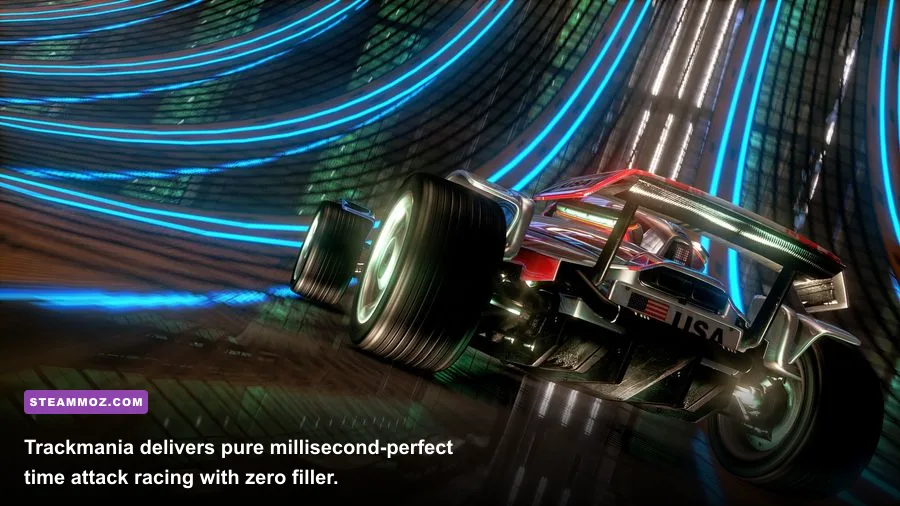
Ubisoft Nadeo’s Trackmania strips away collision, weapon pickups, and tuning stats, handing every player the exact same car on the exact same track. What remains is a pure physics-based driving masterclass. Your car handles completely differently depending on the surface: tarmac rewards perfect racing lines without sliding; dirt demands subtle 80% counter-steering drifts; and ice tracks require full-lock 90-degree slides managed like an olympic bobsleigh.
Top drivers rely on advanced engine tricks like "gear shifts" (preventing automatic downshifts by straightening out on ramps), "air braking" (tapping the brake in mid-air to instantly level car pitch and stick smooth landings), and "bugslides." The core loop—restarting a 30-second track 200 times to hunt down a rival’s ghost by 0.003 seconds—is racing gameplay reduced to its purest, most addictive essence.
9. Team Fortress 2: The Grandfather of Physics-Based Class Combat
Despite releasing in 2007, Team Fortress 2 boasts movement mechanics that modern developers can only dream of matching. The foundation of high-level TF2 lies in classic Source explosive physics. Playing Soldier isn't just about shooting rockets; it's about crouching and jumping simultaneously while blasting a rocket at your feet to launch yourself across the map at blinding speeds, chaining air-strafes without touching the 'W' key to land directly on an enemy Medic.
Every class acts as a masterclass in counter-balancing. The Demoman uses sticky-bomb physics for massive spatial control, the Spy requires exquisite psychological positioning and "trickstabs" (strafing around an enemy’s turn radius to register backstabs on their blind side), and the Scout utilizes double-jump momentum to dodge hitscan fire. Its gun and movement design outclasses modern hero shooters, echoing the classic weapon feel we ranked in our iconic weapon breakdowns.
10. Destiny 2: Bungie’s Masterclass in Gunplay Dynamics
While Destiny 2's broader expansions and seasonal content come with price tags, its core free-to-play offering gives you access to the finest first-person gunplay loop in the industry. Nobody designs the tactile "feel" of firing a weapon better than Bungie. Every Hand Cannon kick, Scout Rifle cadence, and Auto Rifle rattle carries exquisite sound design, reticle bounce, and bullet magnetism tuning that makes clicking heads feel effortless and punchy.
Even in the free package, tinkering with Void, Solar, and Arc 3.0 subclass synergies yields explosive results. Stringing together Solar Ignitions, spreading Voltshot lightning jolt across waves of Hive, and triggering Devour to instantly refill health on every kill creates a power loop that feels incredible on a mechanical level. If you drop frames during massive elemental explosions, make sure you troubleshoot background stutter just like you would when working to rescue your FPS in heavy action games.
The Breakdown: Skill Ceilings, Monetization, and Loops Compared
To help you decide where to invest your hard drive space and gaming hours, here is how all ten titles stack up across gameplay style, mechanical learning curve, and the fairness of their free-to-play systems:
| Game | Primary Gameplay Loop | Skill Ceiling (1-10) | Monetization Fairness | Best For |
|---|---|---|---|---|
| Warframe | High-speed horde clear & frame building | 7.5 / 10 | Generous (Trade premium currency ingame) | Power fantasy lovers & grind fiends |
| Apex Legends | Kinetic movement battle royale | 9.0 / 10 | Cosmetics only (Battle Pass / Skins) | High-mobility shooter veterans |
| The Finals | Destructive physics arena squad fights | 8.0 / 10 | Cosmetics only | Tactical chaos & objective team players |
| Path of Exile | Deep ARPG theorycrafting & mapping | 10.0 / 10 | Fair (Stash tabs essential for endgame) | Hardcore build planners & looter fans |
| Genshin Impact | Elemental rotation quickswap action | 6.5 / 10 | Gacha system (Entire world/story is free) | Action-RPG solo players |
| Counter-Strike 2 | Micro-angle tactical round-based FPS | 10.0 / 10 | Cosmetics only (Prime status recommended) | Pure aimers & strategic shotcallers |
| Dota 2 | Macro strategy & mechanical lane warfare | 10.0 / 10 | Flawless (All heroes 100% free forever) | Hardcore competitive tacticians |
| Trackmania | Physics time-attack racing | 9.5 / 10 | Freemium (Free tracks rotate seasonally) | Time-trial perfectionists |
| Team Fortress 2 | Explosive movement arena shooter | 8.5 / 10 | Cosmetic drops & community markets | Retro shooter & movement purists |
| Destiny 2 | Tactile FPS gunplay & subclass abilities | 7.0 / 10 | Expansions cost $, base gunplay free | Looter shooter fans wanting smooth gun feel |
Every title on this list hits an entirely different mechanical sweet spot. If you want pure execution where only your crosshair placement matters, Counter-Strike 2 will humble you immediately. If you want your brain to hurt from thousands of gear interactions, Path of Exile is waiting with endless spreadsheet bliss.
Engine Optimization: Dialing In Performance for Elite Gameplay
In mechanically demanding games, dropping frames or suffering from input latency directly ruins your gameplay experience. Missing a flick in CS2 or mistiming a superglide in Apex Legends because of frame pacing issues is infuriating. Here are the crucial optimization targets you need to dial in for these top engines:
| Game / Engine | Critical Setting | Recommended Value | FPS & Latency Impact |
|---|---|---|---|
| Apex Legends (Source) | Reflex / Dynamic Spot Shadows | Reflex ON + Boost / Shadows OFF | Cuts input lag by 20-30%, prevents micro-stutters |
| Counter-Strike 2 (Source 2) | NVIDIA Reflex Low Latency | Enabled + Boost | Massive reduction in render queue delay |
| Warframe (Evolution) | Enhanced Graphics Engine / Volumetric Fog | Enhanced Engine / Fog set to Medium | Boosts FPS by 15-22% in dense particle fights |
| The Finals (Unreal 5) | Global Illumination (Lumen) | Static / Low | Recovers 25-40 FPS during heavy building collapses |
| Path of Exile (In-House) | Renderer API | DirectX 12 or Vulkan (Avoid DX11) | Eliminates freeze spikes during 100% delirium maps |
| Trackmania (Nadeo) | Water Reflections & Shaders | Low / PC Performance Mode | Ensures locked 144/240Hz for millisecond turns |
Finding Your Next Addiction
You don't have to keep rolling the dice on unfinished $70 AAA games that release with broken mechanics and shallow progression. The titles featured above earned their massive communities by obsessing over game feel, mechanical depth, and player satisfaction.
If you want fast, acrobatic shooter loops, install Apex Legends or The Finals right now. If you want a long-term progression black hole where your character transforms from an exile in rags to an immortal screen-clearing god, jump headfirst into Path of Exile or Warframe. And if you believe your aim and tactical IQ stand above the rest, boot up Counter-Strike 2 and prepare to test your mettle. Clear your hard drive, load in, and enjoy mechanics refined to absolute perfection—without touching your credit card.