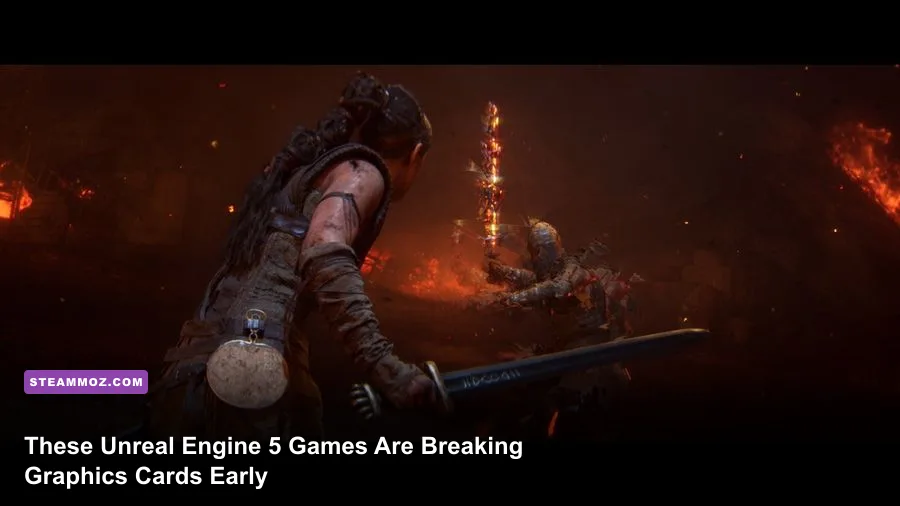
Senua's Saga: Hellblade 2, Black Myth: Wukong, and the still-mysterious Witcher 4 tech demo are the three UE5 titles currently redefining what "next-gen" actually means on PC, leaning hard on Nanite's virtualized geometry and Lumen's real-time global illumination to render skin pores, wet rock, and volumetric fog that genuinely make you second-guess whether you're watching gameplay or a render farm output. These aren't marketing bullet points — they're engines chewing through billions of polygons per frame, and it's why even a 4090 can dip under 60fps at native 4K when ray tracing is maxed.
Why Unreal Engine 5 Changed the Visual Bar Overnight

Nanite and Lumen aren't just buzzwords Epic slapped on a trailer — they're the actual reason these games look the way they do. Nanite lets developers throw film-quality assets (think ZBrush sculpts with tens of millions of polygons) straight into the engine without manual LOD baking, while Lumen calculates bounced light, reflections, and shadows dynamically instead of relying on baked lightmaps. That combo is why Hellblade 2's Senua has pore-level facial detail that holds up in extreme close-up cutscenes, and why Black Myth: Wukong's temple environments shift lighting realistically as fire spreads or clouds pass overhead.
The catch? All that fidelity comes at a brutal performance cost. Lumen's software ray tracing mode is lighter but noisier, while hardware Lumen (which needs an RTX 20-series or better, or RDNA2+ AMD card) looks noticeably cleaner but tanks frame rates hard on mid-range hardware. If you've read our breakdowns on Far Cry 6's FPS-focused settings or Filament's optimization guide, you already know the drill: these graphical leaps always mean a settings menu full of trade-offs.
Senua's Saga: Hellblade 2 — The Benchmark Everyone's Chasing
Ninja Theory built Hellblade 2 almost entirely around cinematic realism, and it shows. The game runs at a locked 30fps on Xbox Series X specifically because Ninja Theory prioritized visual fidelity over frame rate — a controversial choice, but one that lets every scene look like a pre-rendered cutscene. On PC, though, you get more control. With an RTX 4080 or better, you can push toward 60fps at 1440p with high settings, though full path tracing-adjacent Lumen settings at 4K will still choke most single-GPU setups.
What's wild is the facial capture fidelity — Melina Juergens' performance as Senua translates almost 1:1 thanks to MetaHuman Animator, a UE5 tool that captures facial performance from an iPhone and maps it directly onto in-engine models. That's the tech breakthrough nobody's talking about enough.
Black Myth: Wukong Sets the New Combat-Graphics Standard

Game Science's action RPG isn't just gorgeous in cutscenes — the fidelity holds during combat, which is a much harder technical ask. Boss fights against towering yaksha and mythological beasts render dynamic particle effects, destructible terrain chunks, and volumetric smoke simultaneously, all while Lumen recalculates lighting in real time as fire and magic spells light up the arena. On PC, benchmarks show the game demanding a genuine RTX 3080 minimum for stable 1440p/60fps at high settings, with a 4090 needed for consistent 4K ultra performance.
The environmental density is the real flex here — dense foliage, ancient temple ruins, and reflective water all rendered with Nanite's mesh shader pipeline, meaning draw distance pop-in (a classic PC gaming annoyance) is drastically reduced compared to older engines.
The Witcher 4's UE5 Tech Demo Raised Expectations Sky-High

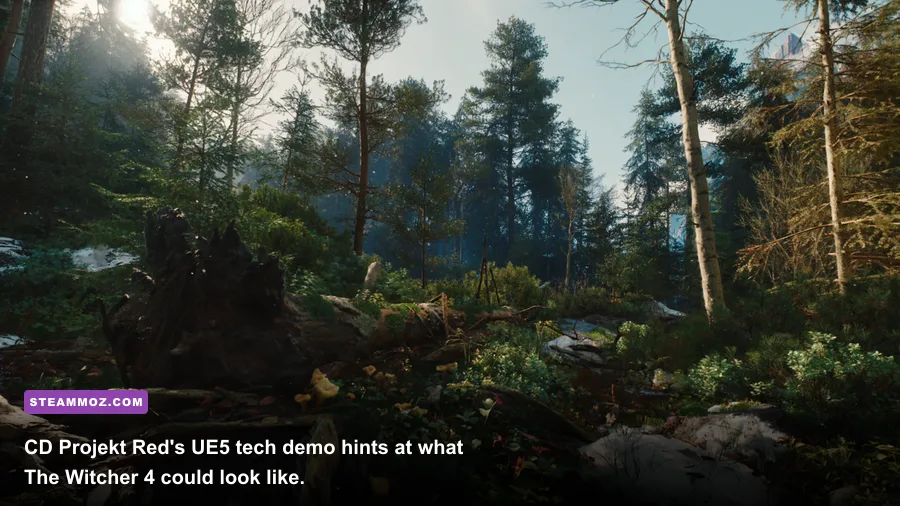
CD Projekt Red's "The Continent Awakens" tech demo isn't gameplay, but it's not vaporware hype either — it's a genuine showcase of what their in-house REDengine successor (now UE5-based) can achieve. The demo showcased dynamic weather systems, physically-based rendering on Ciri's character model, and forest environments with thousands of individually simulated grass blades reacting to wind and movement, all running on a single RTX 4090 at reportedly under 60fps. That's a warning sign for anyone expecting buttery-smooth performance at launch without serious hardware.
CDPR has confirmed via their official studio site that Witcher 4 is a multi-year project, meaning by the time it ships, UE5.5 or later iterations (with improved Nanite foliage support) should shoulder some of that performance burden.
Graphics Settings Breakdown: What Actually Costs You FPS

If there's one lesson across every UE5 flagship title so far, it's that not all "Ultra" settings are created equal. Lumen reflections and Nanite's virtualized shadow maps are consistently the biggest frame-rate killers, while texture resolution and anisotropic filtering barely move the needle on modern GPUs with 12GB+ VRAM.
| Setting | Recommended Value | FPS Impact | Visual Note |
|---|---|---|---|
| Lumen Global Illumination | Medium-High | -15 to -25% | Software Lumen looks grainy; Hardware Lumen needs RT cores |
| Nanite Geometry Detail | Epic (default) | -5 to -10% | Barely scalable, best left maxed |
| Shadow Resolution | High | -10 to -15% | Big visual gain, moderate cost |
| Screen Space Reflections | Medium | -5% | Turn off if using Lumen reflections |
| Motion Blur / Chromatic Aberration | Off | 0% | Pure clarity gain, no performance cost |
| Upscaling (DLSS3/FSR3) | Quality | +30 to +45% | Essential for stable 60fps at 4K |
How Your Rig Stacks Up Against These UE5 Monsters
Here's the honest truth: if your GPU doesn't support hardware ray tracing, you're going to be leaning on software Lumen, which looks noticeably softer and can introduce light-bleeding artifacts in dark scenes. DLSS 3 Frame Generation and FSR 3 are basically mandatory tools now, not luxuries, for anyone wanting stable 60fps+ in these titles.
| Component | Minimum | Recommended | Pro-Tuned Profile |
|---|---|---|---|
| GPU | RTX 2070 / RX 6700 XT | RTX 3080 / RX 6800 XT | RTX 4080/4090 or RX 7900 XTX |
| CPU | Ryzen 5 3600 / i5-9600K | Ryzen 7 5800X / i7-11700K | Ryzen 7 7800X3D / i9-13900K |
| RAM | 16GB | 32GB | 32GB DDR5 6000MHz+ |
| Storage | SSD 100GB free | NVMe SSD | Gen4 NVMe (fast asset streaming) |
| VRAM | 8GB | 12GB | 16GB+ (for 4K texture streaming) |
Notice how much emphasis is on VRAM and NVMe speed — that's UE5's asset streaming system at work. Nanite constantly streams in ultra-detailed meshes on the fly, so a slow SATA SSD or a GPU with limited VRAM will cause visible texture pop-in and stuttering, even if your GPU core itself is powerful enough. This is the same lesson we've covered when diagnosing stutter issues in Everspace 2's crashing fixes and other demanding titles — bottlenecks aren't always where you expect them.
What's Coming Next: State of Decay 3 and Beyond
Undead Labs' State of Decay 3 is quietly one of the most ambitious UE5 open-world projects in development, using Nanite to render decayed suburban environments with an insane level of environmental storytelling detail — rusted cars, overgrown lawns, and collapsed structures that all hold up under close scrutiny instead of looking flat past 20 feet. Microsoft's own Xbox games page confirms it's still early in development, but early gameplay reveals show the same Lumen-driven dynamic lighting shifts we're seeing across the genre.
Also keep an eye on Epic's own Unreal Engine site, where their internal Fortnite tech demos regularly preview features (like Nanite foliage and MetaHuman Animator improvements) months before they show up in these AAA titles. If you're chasing the bleeding edge of PC graphics, that's genuinely the best early warning system you've got.
Bottom line: these games aren't just chasing prettier screenshots — they're fundamentally changing how much horsepower "next-gen" actually requires. If you're planning your next GPU upgrade, budget for VRAM headroom and don't skimp on your CPU either, because UE5's shader compilation and asset streaming lean on both way more than older engines ever did.