
When you cut through marketing budgets, aggregate millions of verified Steam reviews, and scour decades of dedicated forum debates, the community consensus is remarkably clear: Baldur's Gate 3, Half-Life 2, and The Witcher 3: Wild Hunt lead the pantheon of the greatest PC games ever made. These aren't just titles that scored high during launch week; they are architectural milestones that pushed mouse-and-keyboard precision, hardware limits, modding ecosystems, and narrative agency beyond what consoles could ever accommodate.
The Hall of Fame: Definitive Rankings at a Glance
To rank the all-time greats fairly, we didn't rely on day-one review scores from outlets that rushed through a 100-hour campaign in three days. Instead, this ranking measures long-term player sentiment, mechanical depth, replayability, and technical legacy. We evaluated how well these games hold up on modern systems, how thriving their active communities remain, and the degree to which their core design changed the medium permanently.
| Game Title | Tier | Community Consensus | Core Mechanical Strength | Crucial PC Advantage |
|---|---|---|---|---|
| Baldur's Gate 3 | S-Tier | 96% Positive (Steam) | Systemic reactivity & encounter design | Point-and-click UI & extensive mod support |
| Half-Life 2 | S-Tier | 97% Positive (Steam) | Physics integration & pacing | Source Engine modding (Counter-Strike, Garry's Mod) |
| The Witcher 3: Wild Hunt | S-Tier | 96% Positive (Steam) | Morally grey quest branching | Unlocked frame rates, overhaul mods & high-res textures |
| Portal 2 | S-Tier | 98% Positive (Steam) | Spatial puzzle curve & comedic writing | Steam Workshop puzzle creator community |
| Disco Elysium | A-Tier | 93% Positive (Steam) | Branching psychological prose | Crisp text rendering & responsive UI navigation |
| Fallout: New Vegas | A-Tier | 95% Positive (Steam) | Faction reputation & dynamic quest design | Community script extenders (xNVSE) & 4GB patch |
| S.T.A.L.K.E.R.: Shadow of Chernobyl | A-Tier | 95% Positive (Steam) | Unscripted A-Life zone simulation | Total overhaul standalone conversions (Anomaly, GAMMA) |
| Deus Ex (2000) | A-Tier | 94% Positive (Steam) | Multi-solution immersive sim design | Community renderer upgrades (Kentie's Launcher, GMDX) |
🎮 1bitHeart
Looking to experience this game? Grab your digital key directly on our store for $2.99.
View on Steammoz Store →S-Tier Masterpieces: The Undisputed Titans of PC Gaming
The top tier belongs strictly to the games that shattered industry ceilings. These are titles that set new benchmarks for what interactive software could accomplish, leaving entire genres scrambling to copy their playbooks.
Baldur's Gate 3: The Crown Jewel of Emergent Role-Playing
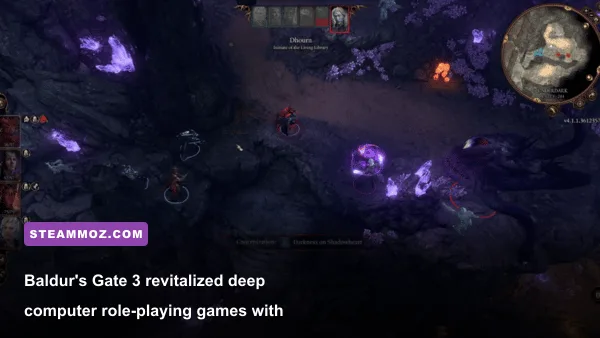
Larian Studios didn't just adapt Dungeons & Dragons 5th Edition; they codified the tabletop experience into a seamless, reactive sandbox. What sets Baldur's Gate 3 apart is its sheer refusal to say "no" to player experimentation. If an iron door locks you out, you don't merely search for a key. You can pick the lock, blast it apart with a smokepowder barrel, shrink yourself into a badger to crawl through a burrow hole, or stack wooden crates to vault the second-story balcony.
Mechanically, the math running under the hood is brutally honest. Feats like Tavern Brawler transform raw Strength modifiers into lethal throwing projectiles, while Great Weapon Master forces you to weigh a -5 penalty to attack rolls against a flat +10 damage payoff. In Act 3's sprawling Lower City, the game pushes CPU draw calls to their absolute limit as hundreds of independent AI schedules tick simultaneously. It is an uncompromised PC CRPG on an epic scale, built with point-and-click inventory management and hotbars that simply feel native to desktop controls. Check out the official breakdown on the Baldur's Gate 3 official site to see how deep Larian's systems go.
Half-Life 2: The Physics Revolution That Never Aged
Released in 2004, Valve's magnum opus remains a masterclass in gameplay economy. While other shooters relied on scripted rail shooters, Half-Life 2 handed you the Zero Point Energy Field Manipulator (the Gravity Gun) and let Havok physics solve combat problems. Dropping saw blades into charging zombies in Ravenholm wasn't a pre-rendered cutscene—it was dynamic trajectory, mass, and velocity working in real-time.
The pacing of Gordon Freeman's journey from the train station in City 17 to the inner sanctum of the Citadel is flawless. There are no bloated filler quests, no artificial gear treadmills, and zero intrusive UI markers. Valve trusted player curiosity and environmental lighting to direct your path. More crucially, Half-Life 2 gifted the world the Source Engine, which birthed Counter-Strike: Source, Team Fortress 2, and Garry's Mod—staples that defined PC LAN culture and multiplayer gaming for two decades.
The Witcher 3: Wild Hunt: Redefining the Narrative Open World
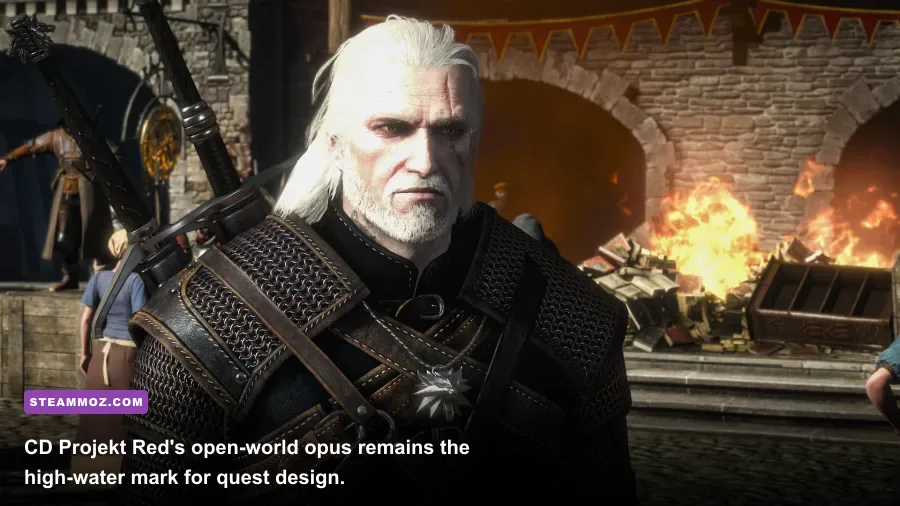
CD Projekt Red achieved the impossible in 2015: creating a massive, 150-hour open world where side quests felt more emotionally devastating than most games' main campaigns. The "Bloody Baron" questline in Velen remains an industry case study in tragic, multi-layered writing with zero clean fairy-tale resolutions.
On PC, The Witcher 3 achieved legendary status through technical scaling. Uncapping frame rates, tweaking rendering budgets, and cranking settings transformed the wind-swept trees of No Man's Land and the canals of Novigrad into living art. If you've spent time tweaking older engines to fix stutters—like the community steps detailed in our guide to rescuing FPS and stability in ELEX—you know how much community engine modifications and driver-level tuning can rescue ambitious RPGs. The game's Death March difficulty demands real tactical preparation: concocting Ekimmara and Water Hag Decoctions, oiling silver blades for specific monster classifications, and timing Quen shield parries down to the millisecond.
Portal 2: The Mechanical Apex of Spatial Puzzles
Few games boast a script as razor-sharp as Portal 2, but its true genius lies in its teaching methodology. Valve introduces game mechanics—momentum preservation, laser refraction, tractor beams, and propulsion gels—in safe, isolated environments before combining them into staggering multi-room puzzle gauntlets. The simple rule that entry velocity equals exit velocity ($v_{out} = v_{in}$) turns mind-bending geometric chambers into pure kinetic joy.
Genre-Defining Innovators: Strategy, Sims, and Tactical Depth
Consoles have always struggled with games requiring micro-level management, extensive hotkeys, and text-heavy systemic depth. This is where the PC platform pulls away entirely, playing host to complex narrative experiments and unforgiving tactical simulations.
Disco Elysium: The Triumph of the Psychological CRPG
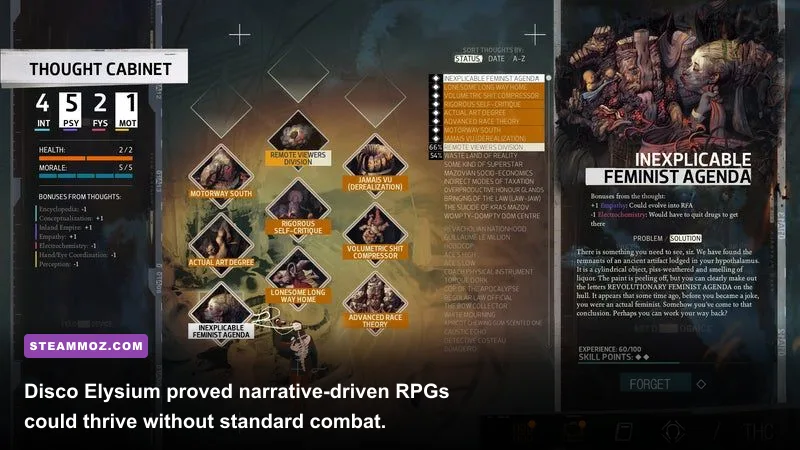
ZA/UM threw out combat encounters entirely, replacing swords and assault rifles with 24 internal psychological voices screaming inside the head of an amnesiac detective. In Disco Elysium, your skills are not external actions; they are characters. High Inland Empire makes you talk to your necktie and sense supernatural undertones in the rotting coastal district of Martinaise, while high Encyclopedia burdens you with uncontrollable trivia dumps during critical murder interrogations.
The Thought Cabinet mechanic acts as an internal inventory system where you internalize political philosophies, moral compromises, and personal regrets, trading temporary stat debuffs for radical permanent narrative perks. It is an unapologetic literary achievement that demands your full intellectual presence, functioning as proof that interactive text interfaces on PC can hit harder than high-budget action cutscenes.
S.T.A.L.K.E.R.: Shadow of Chernobyl and the A-Life Phenomenon
Long before battle royales or extraction shooters existed, GSC Game World dropped players into the Chornobyl Exclusion Zone with a broken Makarov pistol, radiation sickness, and zero safety nets. The secret sauce of S.T.A.L.K.E.R. has always been its proprietary A-Life engine—an autonomous simulation where mutants, bandits, and rival stalkers roam the map, scavenge loot, and fight each other off-screen without waiting for player input.
The ballistic model remains terrifyingly punishing: bullets drop over distance, weapons jam mid-firefight based on internal degradation percentages, and bleeding requires instant tactical bandaging. Much like the brutally atmospheric weapon handling we break down in our ranking of classic FPS weapon arsenals, combat in the Zone demands deliberate shot pacing. On PC, the game evolved through community modding into monumental standalone projects like S.T.A.L.K.E.R. Anomaly and GAMMA, which rebuild the entire experience into the deepest survival simulation ever conceived.
The Hardcore Sandbox and RPG Legacies That Refuse to Die

Certain games leave a permanent imprint not because they launched in a pristine technical state, but because their structural freedom was so vast that players spent the next fifteen years modding, patching, and dissecting them.
Fallout: New Vegas: Obsidian's Unrivaled Writing Machine
Developed by Obsidian Entertainment in just 18 months, Fallout: New Vegas completely outclassed its predecessor by treating player motivation with maturity. Rather than a binary good-versus-evil storyline, the Mojave Wasteland is locked in a cold war between the imperialist New California Republic, Caesar's totalitarian Legion, and the technocratic dictator Mr. House—with the player holding the option to throw them all out via the Yes Man independent route.
Its role-playing mechanics are ruthlessly thorough. The Damage Threshold (DT) system ensures heavily armored targets shrug off 9mm submachine fire, forcing you to carry specialized ammunition like Armor Piercing (AP) or Hollow Point (HP) rounds. While the original Gamebryo engine suffered from notorious memory leaks, the PC community built essential tools—such as New Vegas Anti-Crash (NVAC) and the 4GB Patcher—transforming it into an unshakeable RPG platform. For players exploring tactical character setups, this freedom mirrors the depth found when building specialized loadouts in modern space sandboxes like in our Everspace weapon upgrade breakdown.
Deus Ex (2000): The Sacred Scripture of the Immersive Sim
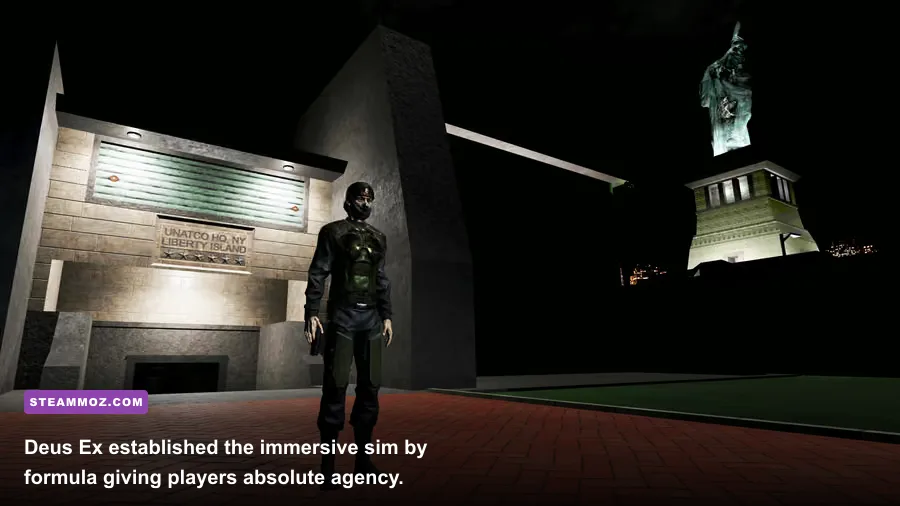
Warren Spector and Ion Storm crafted a design philosophy in Deus Ex that few studios have matched since. Placed in the trench coat of agent JC Denton on Liberty Island, the player encounters a scenario with literally dozens of viable paths. Don't have the lockpicks for the back door? Hack the security terminal. Don't have the hacking skills? Crawl through the underwater ventilation pipe. No swimming skills? Stack biohazard crates against the wall and leap over the electric fence.
Every single room is an interconnected puzzle box of physics, passwords, patrol routes, and philosophical debates about global hegemony. Thanks to community renderers like PCGamingWiki-recommended custom DirectX 10/11 drivers and the comprehensive GMDX mod, this turn-of-the-millennium masterpiece runs cleanly at native 4K resolutions on modern hardware today.
Performance, Hardware Tuning, and Modern Optimization
One of the greatest joys of being a PC gamer is taking generational classics and playing them at hardware targets their original developers could only dream of: locked 144Hz refresh rates, ultrawide 21:9 aspect ratios, and custom field-of-view (FOV) sliders. However, running legacy titles on high-end modern GPUs often introduces unique timing errors, physics engine uncoupling, and memory address bottlenecks.
| Game Title | Native Engine Quirk | Optimal Frame Target | Required Modern Fix or Mod | Hardware Impact |
|---|---|---|---|---|
| Half-Life 2 | FOV resets on wide aspect ratios | 144+ FPS (Unlocked) | Add -fov 90 or default_fov 106 to console |
Negligible (Any modern GPU runs 4K/240Hz) |
| Fallout: New Vegas | Physics tie to frame rate above 60 FPS | Locked to Display Refresh | Tick Fix (NVTF) + New Vegas Heap Replacer | Prevents micro-stutter; eliminates memory leaks |
| The Witcher 3 | DX12 CPU overhead in dense towns | 60 - 120 FPS | HairWorks Off; DLSS/FSR Balanced in Novigrad | Stabilizes 1% low frame times by up to 25% |
| S.T.A.L.K.E.R.: SoC | Single-core CPU bottlenecking | Locked 60 / 120 FPS | ZRP (Zone Reclamation Project) bugfix pack | Eliminates quest-breaking script crashes |
| Deus Ex (2000) | Dark rendering on modern Direct3D | 60 FPS (Avoid physics bug) | Kentie's Launcher + Custom Direct3D 10 Renderer | Restores proper dynamic gamma and lighting scales |
Getting older games to run at peak efficiency requires understanding the bridge between vintage software and cutting-edge silicon. Many gamers facing unexplained frame rate degradation or crash-to-desktop errors overlook simple configuration file tweaks. We often see these exact optimization hurdles when configuring indie and retro puzzle logic, which we broke down step-by-step in our guide to tuning PC settings for maximum frame stability in Filament. If a game is crashing on startup on your modern Windows 11 machine, 90% of the time it's tied to an outdated audio wrapper (DirectSound), lack of an LAA (Large Address Aware) flag, or frame rates uncoupling the internal game loop ticks.
Older physics-heavy engines often break when you exceed 60 frames per second without engine patches. In titles like Fallout: New Vegas, uncapped frames will cause Havok physics to accelerate world speed by 300%, turning mundane clutter into lethal bouncing shrapnel. Community plugins like New Vegas Tick Fix (NVTF) separate render frames from the simulation tick, granting buttery-smooth 144Hz gameplay without breaking walking speeds or physics calculations.
What Separates a Good PC Game From an Eternal Masterpiece?

The definitive factor uniting every game on this list is simple: respect for player agency. Mediocre titles treat the player like a passive observer on a theme park ride, locking inputs behind cutscenes and flashing button prompts across the screen. The greatest PC games hand you a toolkit—a complex set of physics, dialogue variables, skill stats, and environmental factors—and challenge you to manipulate the system to your advantage.
Furthermore, PC gaming's greatest asset will always be its open architecture. When a developer stops updating a title, the community takes the wheel. Through platforms like the Nexus Mods repository, players fix broken code, restore cut content, upgrade low-resolution textures, and even build entire multi-gigabyte expansions for free. A masterpiece on PC isn't a static product preserved in amber; it's a living, breathing digital playground that evolves alongside the hardware powering it.
Whether you are descending into the dark, tactical depths of the Underdark in Baldur's Gate 3, stepping through the dimensional tear of an Aperture Science testing vault, or sneaking past armored guards on Liberty Island, these PC masterpieces represent the artistic and mechanical peak of interactive entertainment. Install them, apply the essential community engine fixes, and experience gaming history at its absolute finest.