If you love Firefighting Simulator - The Squad but want more tactical control, broader emergency systems, or faster arcade action, start with Flashing Lights, EMERGENCY 4, 911 Operator, and EMBR. They are the strongest alternatives in 2026 because each preserves a key part of the fantasy: handling dangerous fires, coordinating a crew, making rapid dispatch decisions, or improvising rescues under pressure.
None of them is a perfect one-for-one replacement. That is actually good news. Firefighting Simulator - The Squad on Steam sits in a very specific lane, combining first-person hose work, vehicle operations, building searches, and four-player co-op. The games below split those ingredients apart and push them in different directions. Here is where each one shines, what it gets wrong, and which game deserves your time.
The best alternatives ranked for different kinds of firefighters
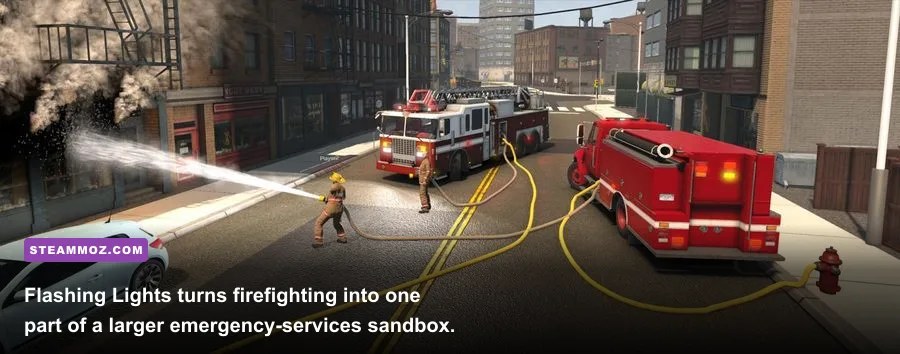
My top pick depends on what you want to do between callouts. Flashing Lights is the closest modern sandbox because it lets you work as a firefighter while also supporting police and EMS roles. EMERGENCY 4 is the best tactical option, especially if directing specialists sounds more appealing than physically dragging a hose through a corridor. 911 Operator is the best dispatch-focused game, while EMBR is the best choice for short, ridiculous co-op sessions.
| Game | Best for | Firefighting style | Co-op or solo | Overall tier |
|---|---|---|---|---|
| Flashing Lights | Open emergency sandbox | First-person response and vehicle work | Solo and multiplayer | S-Tier |
| EMERGENCY 4 | Tactical incident command | Unit placement and specialist control | Solo and multiplayer | S-Tier |
| 911 Operator | Dispatch and triage | Call handling and resource allocation | Solo | A-Tier |
| EMBR | Arcade co-op chaos | Fast rescues and tool-based destruction | Solo and co-op | A-Tier |
| Emergency Call 112 - The Fire Fighting Simulation 2 | Station and vehicle immersion | Detailed German emergency response | Solo | B-Tier |
The important distinction is tempo. Firefighting Simulator asks you to establish a safe approach, connect equipment, control a nozzle, and search rooms methodically. Flashing Lights is looser and more systemic. EMERGENCY 4 pauses the physical action almost entirely so you can solve the incident as a commander. EMBR barely gives you time to think. Pick based on the kind of pressure you want, not simply whether a game contains a fire truck.

🎮 Firefighting Simulator - The Squad
Looking to experience this game? Grab your digital key directly on our store for $9.99.
View on Steammoz Store →Flashing Lights is the closest modern sandbox
Flashing Lights is the first game I would recommend to a Firefighting Simulator player. Its fire department career includes fire engines, ladder trucks, hoses, axes, extinguishers, hydrants, and rescue scenes spread across an open map. You can respond to structure fires, vehicle incidents, medical emergencies, and traffic accidents rather than replaying a narrow chain of scripted building missions.
The big difference is role flexibility. You can switch between firefighter, police officer, and EMS careers, and multiplayer lets several players divide those responsibilities. That creates situations Firefighting Simulator does not fully replicate: one player secures a crash site, another treats casualties, and the fire crew attacks the burning vehicle. It feels less like a polished training exercise and more like a living emergency-services playground.
Why it ranks S-Tier
The strongest moments come from preparation. Park the engine so its equipment side remains accessible, deploy the hose before walking deep into a structure, and keep an escape route in mind. A fire can turn a routine interior search into a visibility problem quickly, and the open map means travel time matters. A distant call is not just another loading-screen mission; it is a planning decision.
Its rough edges are obvious. The AI can behave awkwardly, traffic occasionally gets in the way, and the simulation lacks the same tactile weight as Firefighting Simulator's hose handling. Still, the broader sandbox wins over time. If your ideal evening involves a friend group splitting into roles and improvising at a multi-vehicle accident, this is the game to install first. Check the official Flashing Lights Steam page for current multiplayer and system details.
| Flashing Lights task | Best first move | Main danger | Useful equipment |
|---|---|---|---|
| Structure fire | Position the engine near the access point | Entering without a retreat route | Hose, axe, breathing apparatus |
| Vehicle collision | Secure the scene before treating victims | Traffic and secondary hazards | Road flares, medical kit, rescue tools |
| Medical call | Assess the patient before choosing treatment | Wasting time on the wrong response | Medical bag and ambulance |
| Multiplayer incident | Assign one clear role to each player | Everyone chasing the same objective | Separate vehicles and radio discipline |
For performance, start with shadows on Medium, volumetric effects on Low, and view distance on High. The map and vehicle draw distance benefit from High more than expensive shadow cascades do. A stable 60 frames per second makes driving and nozzle control feel far better than a prettier but inconsistent profile.
EMERGENCY 4 remains the tactical gold standard
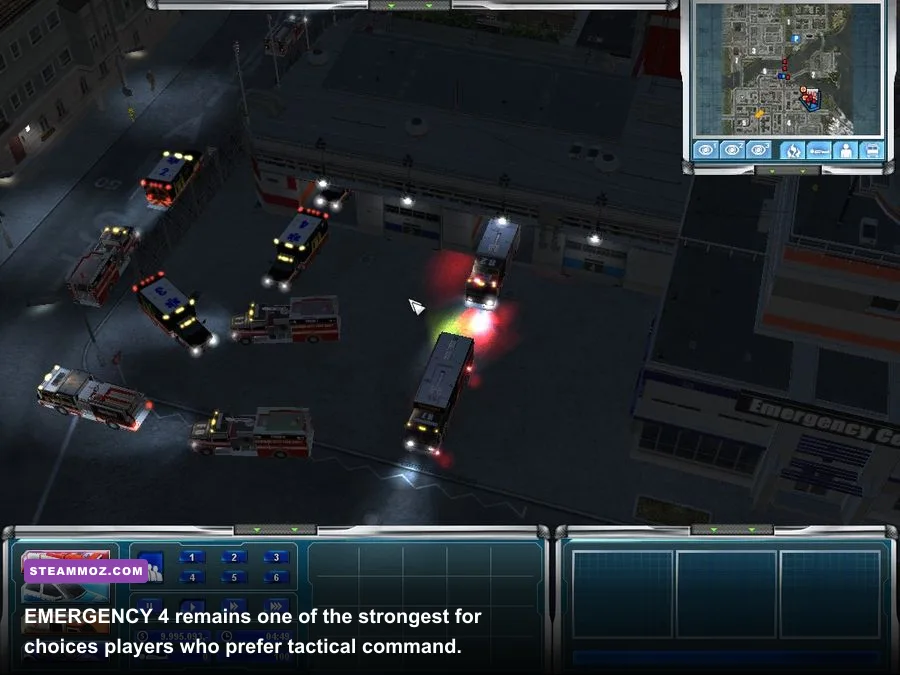
EMERGENCY 4 is older, but its incident design still understands emergency response better than many newer games. You control firefighters, police, paramedics, technical specialists, and support vehicles from an overhead command view. Instead of personally aiming a hose, you decide which unit arrives first, where it deploys, and which threat must be contained before the next one escalates.
The campaign's 20 missions introduce the game's logic through disasters that can chain together. A fire may spread into nearby vehicles. A road accident may create casualties while blocking the route for additional units. A hazardous-material situation can punish the instinct to send ordinary firefighters directly into danger. The best missions are small crisis-management puzzles, not simple extinguish-and-leave jobs.
Firefighters have distinct jobs, and that matters. A standard firefighter can fight flames and handle basic rescue work, while a technical specialist is better suited to cutting through wreckage. Engineers and police units support access and scene control. You are constantly balancing response coverage against the next emergency, especially in freeplay mode where multiple incidents compete for the same limited fleet.
How to play it like a modern commander
Pause early, not late. The moment an incident appears, identify its category, select the closest appropriate vehicle, and avoid sending every available unit to the first fire. Keep at least one fire engine and an ambulance available for escalation. The most common beginner mistake is winning the visible crisis while leaving the wider map undefended.
Mod support is a major reason EMERGENCY 4 still belongs on this list. Community projects expand the map, vehicles, missions, and realism, although compatibility and installation quality vary. The vanilla game is already worth playing, but a carefully maintained mod can turn it into a much deeper long-term command sandbox. If you enjoy systems-heavy games, our guide to games like AI War: Fleet Command explores the same appeal from a science-fiction angle.
| Incident type | Priority | First unit | Follow-up response |
|---|---|---|---|
| Building fire | Stop spread and rescue occupants | Fire engine | Additional engine, ladder, ambulance |
| Road collision | Secure traffic and locate casualties | Police vehicle | Ambulance and technical rescue unit |
| Hazardous material | Create a safe perimeter | Police unit | Specialist and decontamination support |
| Large public disaster | Separate rescue from crowd control | Command vehicle or nearest specialist | Multiple agencies with reserve units |
The interface feels dated and the pathfinding sometimes needs babysitting. That is the price of admission. Once you learn the hotkeys and pause rhythm, its deliberate pace becomes a strength. It rewards attention, prioritization, and restraint in a way that few first-person firefighter games can match. The EMERGENCY 4 Deluxe listing is the natural starting point for new players.
911 Operator turns emergency response into a numbers game
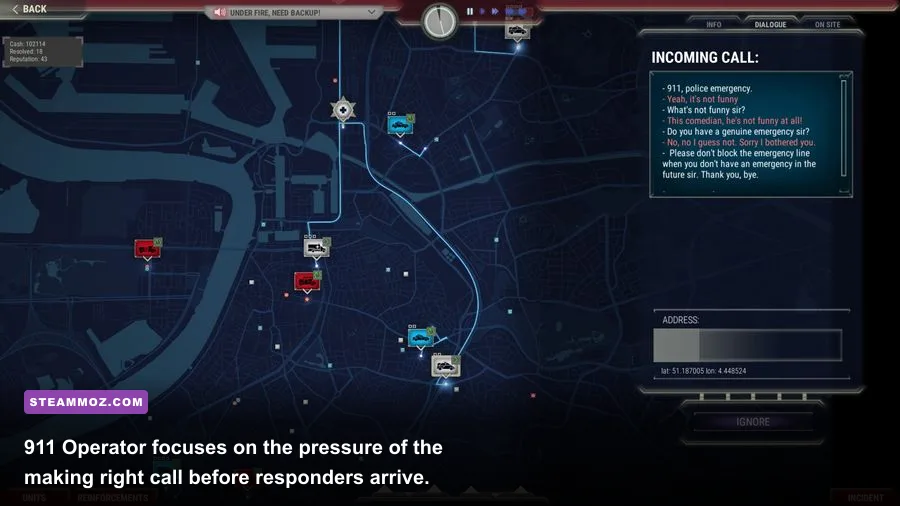
911 Operator strips away the hose, engine, and avatar to focus on the most underrated part of emergency work: deciding what happens before anyone reaches the scene. You answer calls, interpret incomplete information, choose the correct response, and watch units move across a real-world map. The game supports fictional scenarios as well as map data based on real cities, which gives familiar locations a surprisingly personal quality.
Each call is a rapid triage exercise. A report of smoke might be a kitchen fire, a false alarm, or a larger building incident. A medical caller may be panicked, vague, or unable to describe the patient's condition. Your job is not to select the most dramatic response; it is to send enough help without leaving the rest of the city exposed.
Progression adds new vehicles, equipment, and personnel, but the core challenge remains information management. You have a finite number of police cars, fire engines, and ambulances. Sending every nearby unit to a low-risk call creates a gap that the next emergency will exploit. It is a smaller-scale strategy game than EMERGENCY 4, but its feedback loop is immediate and addictive.
| Call clue | Likely response | Common mistake | Better decision |
|---|---|---|---|
| Visible smoke or flames | Fire response with appropriate support | Sending only one unit | Match the response to building risk and location |
| Unconscious patient | Ambulance and urgent medical handling | Treating it as a routine injury | Prioritize arrival time over distant high-level staff |
| Suspicious activity | Police unit | Overcommitting several cars immediately | Send the nearest unit and escalate if confirmed |
| Traffic collision | Police, ambulance, and sometimes fire support | Ignoring road access | Clear the scene while treating casualties |
This is the best choice if the part you enjoy most in Firefighting Simulator is reading a situation and making a call under pressure. It is not a replacement for first-person firefighting, and there is no satisfying nozzle choreography. But the dispatch layer is sharp, accessible, and ideal for short sessions. The official 911 Operator page explains the included map and campaign features.
EMBR is firefighting with the safety rails removed
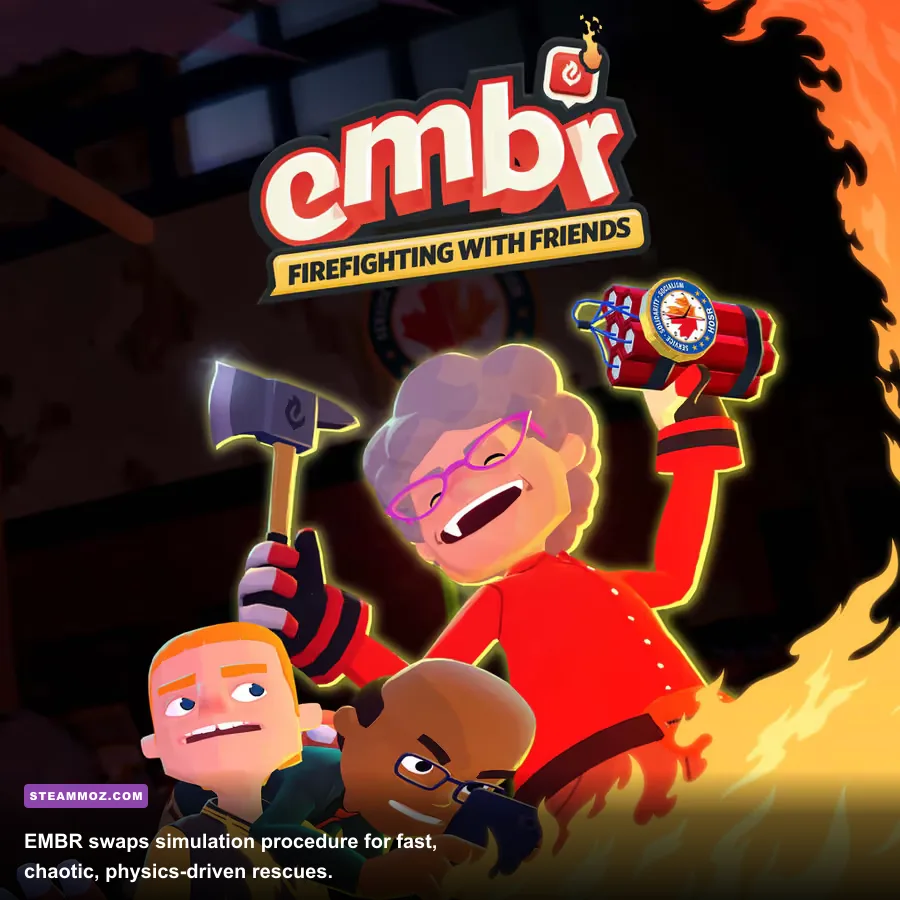
EMBR is the wild card. It imagines a gig-economy emergency service where poorly trained responders smash through buildings, rescue customers, and grab valuables while racing a clock. It has the broad outline of a firefighter game, but the tone is cartoonish, the objectives are score-driven, and the physics are built for chaos rather than procedure.
You carry tools such as the extinguisher, axe, hose, and trampoline-like rescue equipment, then combine them in ways that would make a real incident commander reach for the radio. Breaking a window can create an entry point. Cutting a shortcut can save time. A badly placed tool can launch a teammate across the room or strand a civilian behind a spreading fire. The fun comes from improvisation and the inevitable mistakes.
Its mission structure is ideal for co-op. You are usually chasing ratings, rescued civilians, property damage limits, or time goals, so replaying a level with a better route feels meaningful. The upgrade system gives you reasons to revisit earlier jobs and optimize your kit. It is closer to a physics-based action game than a serious sim, but that distinction is exactly why it works alongside Firefighting Simulator rather than competing with it directly.
The right EMBR mindset
Do not treat every room as a full-clear operation. Identify the fastest safe route to the objective, use environmental shortcuts, and communicate before someone breaks the only useful entrance. In co-op, split responsibilities: one player handles extinguishing, one searches for civilians, and one manages extraction or tools. A team that crowds the same doorway loses more time than it saves.
EMBR is also the least demanding recommendation here on a simulation level. There are no long equipment checks or realistic vehicle procedures. If you want the atmosphere of danger without the slower operational rhythm, it is a terrific palate cleanser. For another recommendation built around strange tools and escalating mayhem, Steamoz's Just Die Already weapon tier list has a similarly chaotic spirit.
| Play style | Recommended approach | Best tool focus | What usually goes wrong |
|---|---|---|---|
| Solo speedrun | Map the shortest route before entering | Extinguisher and mobility tools | Stopping to clear every flame |
| Two-player rescue | Split search and fire-control duties | Axe plus extinguisher | Both players entering the same room |
| Score hunting | Protect property and optimize exits | Precision tools | Taking flashy shortcuts that cause damage |
| First playthrough | Prioritize civilians over bonus objectives | Reliable basic kit | Chasing ratings before learning layouts |
Which game should you buy in 2026?
Choose Flashing Lights if you want the closest open-ended replacement for Firefighting Simulator - The Squad, especially with friends. Choose EMERGENCY 4 if you would rather command a complete response network than control one firefighter. Pick 911 Operator for dispatch, triage, and short strategic sessions. Pick EMBR when you want loud, funny, physics-heavy co-op instead of realism. Emergency Call 112 - The Fire Fighting Simulation 2 is worth considering if station routines, German emergency vehicles, and a more grounded solo structure matter more to you than polished accessibility.
| If you value... | Buy this first | Why |
|---|---|---|
| First-person firefighting and open-world response | Flashing Lights | It offers the broadest emergency-services sandbox |
| Command depth and disaster escalation | EMERGENCY 4 | Its unit roles and campaign scenarios remain excellent |
| Dispatch decisions and city coverage | 911 Operator | Every call tests triage and resource allocation |
| Fast co-op and ridiculous rescues | EMBR | Its tool physics create constant improvisation |
| Detailed station-focused simulation | Emergency Call 112 2 | It leans hardest into procedural fire-service immersion |
Before buying, check controller support, multiplayer activity, and recent community reports. Simulation games can change dramatically through patches and mods, while older strategy titles may need compatibility fixes on modern Windows. Our guide to Katamari Damacy REROLL PC settings covers the kind of practical optimization work that also helps older games run smoothly, and our King's Bounty II PC fixes is useful when a game needs more troubleshooting than expected.
Firefighting Simulator still owns the most convincing first-person hose-and-rescue experience in this group. But the alternatives make the fantasy bigger. Flashing Lights gives you the whole emergency-services sandbox, EMERGENCY 4 gives you the commander's seat, 911 Operator gives you the radio, and EMBR gives you a fire axe and permission to cause trouble. In 2026, that collection is a far better way to explore firefighter games than looking for one clone that does everything.