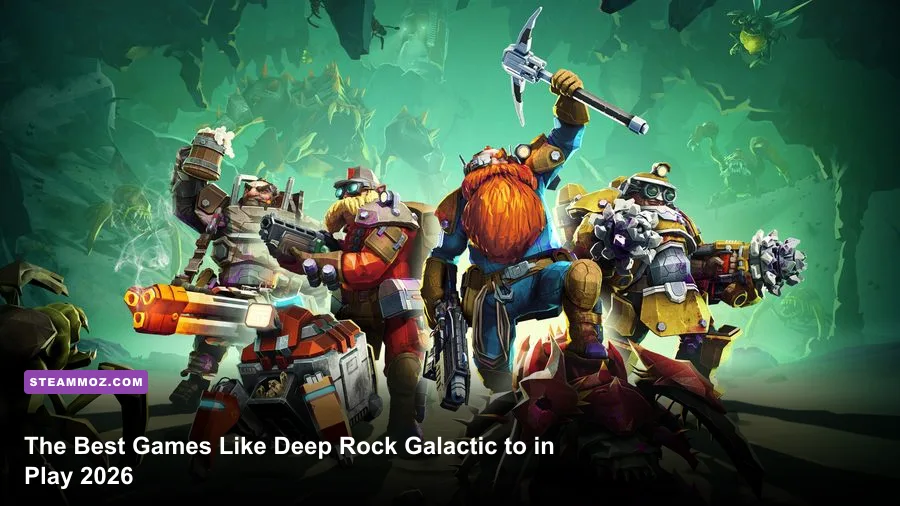
If you love Deep Rock Galactic—including the cosmetic-focused Supporter Upgrade—but want a fresh co-op obsession in 2026, start with Helldivers 2, Warhammer 40,000: Space Marine 2, and Vermintide 2. Helldivers delivers the same four-player communication and escalating objective pressure, Space Marine 2 replaces mining tunnels with enormous horde battles, and Vermintide 2 offers the sharpest close-quarters teamwork. GTFO is the best pick for serious squads, while Risk of Rain 2 scratches the procedural mission and build-chasing itch.
That distinction matters because the Deep Rock Galactic Supporter Upgrade isn't a new campaign or gameplay expansion. It's a way to back Ghost Ship Games while unlocking supporter cosmetics, a special beer, a distinctive armor paintjob, and other vanity rewards. The base game's four classes, destructible caves, procedural missions, and progression systems remain the reason to play. So this list focuses on games that recreate those pillars—not games that merely happen to feature guns, aliens, or multiplayer.

What makes a real Deep Rock Galactic alternative?
The obvious mistake is treating every four-player shooter as a Deep Rock replacement. The comparison only works when a game combines several of the same pressures: a small squad with complementary jobs, missions that can collapse suddenly, meaningful build progression, and a reason to replay the same broad objective under different conditions. Deep Rock's magic comes from how those systems collide. A Scout can light a cavern, a Driller can open a tunnel, an Engineer can create a platform, and a Gunner can turn a bad retreat into a survivable one.
Procedural generation is part of that identity, but it isn't enough on its own. Deep Rock Galactic gives you navigational problems as well as combat problems. Mineral veins may sit above a vertical shaft, an objective may force the team into a cramped chamber, and a swarm can arrive while Molly is still halfway across the cave. The best alternatives create their own version of that push-and-pull: Helldivers 2 makes extraction dangerous, GTFO makes noise and ammunition precious, and Risk of Rain 2 makes every extra minute a gamble against enemy scaling.
| Game | Closest DRG strength | Team size | Best for |
|---|---|---|---|
| Helldivers 2 | Objectives, friendly fire, extraction panic | 4 players | Squads that love explosive improvisation |
| Space Marine 2 | Horde combat and class teamwork | 3 players in Operations | Players who want heavier action |
| Vermintide 2 | Class roles and enemy prioritization | 4 players | Melee-focused veterans |
| GTFO | Expedition tension and communication | 4 players | Organized squads seeking punishment |
| Risk of Rain 2 | Replayability and build escalation | 4 players | Roguelike progression hunters |
For a broader look at demanding PC co-op and action games, Steamoz's Everspace 2 secrets guide is also worth bookmarking. It covers the same satisfying loop of exploring dangerous spaces, upgrading your tools, and returning stronger.
🎮 Deep Rock Galactic - Supporter Upgrade
Looking to experience this game? Grab your digital key directly on our store for $4.49.
View on Steammoz Store →Helldivers 2 is the best all-round replacement
Helldivers 2 is the easiest recommendation for a DRG squad that wants a new shared obsession. Its four-player missions revolve around completing objectives, managing a limited battlefield, and reaching extraction alive. That sounds familiar, but the tone and combat rhythm are completely different. You aren't carving a route through rock; you're surviving an open battlefield where patrols can spot you, reinforcements can snowball, and your own orbital strike can erase the team.
Its most important similarity is role flexibility. Every Helldiver can equip a primary weapon, secondary weapon, grenade, booster, and four Stratagems, but the loadout still creates a job. The Stalwart handles sustained light targets, the Recoilless Rifle punishes armored enemies, and the Grenade Launcher clears clustered bugs and closes bug holes. A squad that brings four damage builds often struggles more than a squad that assigns anti-armor, crowd control, supply support, and area denial.
Helldivers 2 also has the same “the plan was perfect until the swarm arrived” energy. Objectives such as Upload Data, Blitz: Search and Destroy, and Eradicate Terminid Swarm force different time-management decisions. On a standard mission, don't burn every Stratagem at the first contact. Save at least one reliable anti-armor option for the objective area, and keep the Reinforcement budget in mind before starting a terminal sequence. Extraction is a separate encounter, not a victory lap.
| Squad role | Recommended equipment | Primary job | Common mistake |
|---|---|---|---|
| Anti-armor | Recoilless Rifle or Quasar Cannon | Break Chargers, Hulks, and tanks | Firing before the target exposes a weak point |
| Crowd control | Stalwart, Gatling Sentry, Eagle Napalm | Hold lanes against light enemies | Using area damage near teammates |
| Objective support | Supply Pack, Shield Generator Relay | Keep the squad operating under pressure | Dropping support gear far from the terminal |
| Flexible scout | Jump Pack, Eagle Airstrike, Autocannon | Clear patrols and solve side objectives | Engaging every patrol instead of bypassing it |
Friendly fire makes positioning more important than raw weapon damage. Call out Eagle strikes, throw explosives away from the retreat path, and don't stand in front of an Autocannon user. The game runs best when the team agrees on a direction rather than splitting into four solo shooters. If you want the same voice-chat energy as “platform here” or “zipline up,” Helldivers 2's quick pings and Stratagem callouts fill that role beautifully.
Space Marine 2 makes every swarm feel enormous
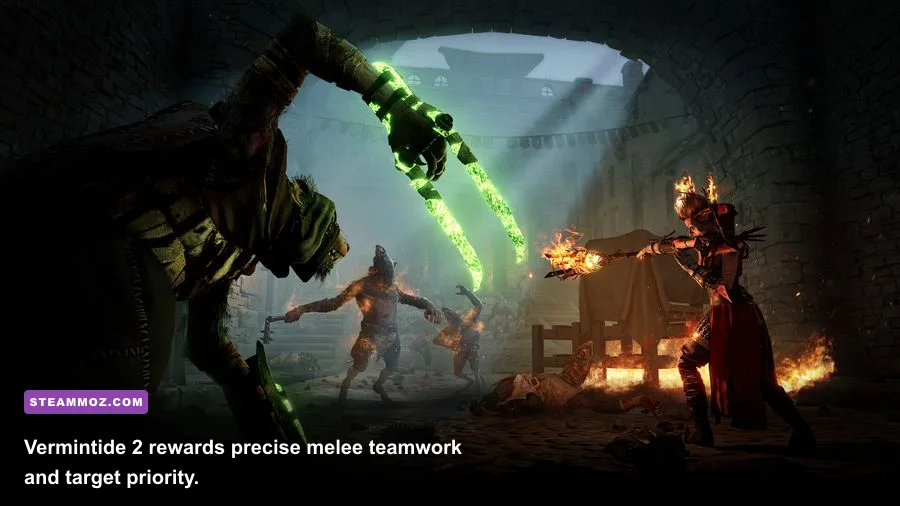
Warhammer 40,000: Space Marine 2 is the pick for players who want Deep Rock's cooperative class structure but far more physical combat. Its three-player Operations mode follows Titus and the Ultramarines through missions where the battlefield can suddenly fill with Tyranids. The scale is the selling point: gaunts climb over walls, Warriors direct the swarm, and a Carnifex can turn an open arena into a survival problem within seconds.
The class system has six roles: Tactical, Assault, Vanguard, Bulwark, Sniper, and Heavy. They aren't interchangeable. Tactical's Auspex Scan amplifies damage against marked targets, Bulwark carries a shield and protects allies, and Heavy provides ranged suppression with weapons such as the Heavy Bolter. Assault's jump pack creates mobility and crowd-clearing opportunities, while Sniper rewards players who can consistently hit priority targets instead of wasting shots on the swarm.
The combat loop is more melee-driven than Deep Rock's gunplay. Your armor is not a passive health bar: contested melee, executions, and careful parries help you survive pressure. Watch the white or blue attack indicators around an enemy. A clean parry can create a stagger window, while an orange unblockable cue demands a dodge. Don't spam executions in the middle of a horde if the animation strands you away from the squad; use them when the team needs a brief recovery window.
Operations also has a satisfying upgrade curve. Weapons gain experience, classes unlock perks, and higher difficulty increases the value of coordinated builds. The trade-off is mission variety. Space Marine 2's Operations missions are more authored and repeatable than DRG's procedural caves, so it offers spectacle and mastery rather than endless environmental surprises. Players who want new cave layouts every run may prefer GTFO or Risk of Rain 2.
Steamoz's PC fixes and FPS coverage is useful if you're tuning a demanding action game. Space Marine 2 can become CPU-heavy when the screen fills with Tyranids, so a steady frame rate matters more than maxed-out texture quality.
Vermintide 2 remains the melee co-op king
Warhammer: Vermintide 2 is the best Deep Rock-like game if your favorite moment is not shooting a Glyphid but watching four players lock down a corridor together. Its five heroes—Markus Kruber, Bardin Goreksson, Kerillian, Victor Saltzpyre, and Sienna Fuegonasus—cover distinct careers with different weapons, talents, and combat identities. Bardin's Engineer, for example, plays nothing like his Ironbreaker career despite sharing the same character.
The combat is built around stagger, dodge timing, block management, and target priority. Clan Rats are manageable until a Stormvermin patrol pins the front line, a Gutter Runner isolates a player, or a Globadier fills the corridor with poison. Specials must be called out immediately. A team that kills a Blightstormer before it casts can keep moving; a team that ignores it may spend the next thirty seconds rescuing someone from a vortex.
For a reliable beginner setup, try Ironbreaker Bardin with a shield weapon for frontline control, a handgun for specials, and the career skill that grants temporary defensive protection. Pair him with Waystalker Kerillian for ranged special killing, Mercenary Kruber for crowd control and team sustain, and Battle Wizard Sienna for area damage. This isn't the only strong composition, but it teaches the game's central lesson: stagger the horde, delete specials, and never let the group become a collection of isolated duels.
| Career | Core strength | Recommended weapon focus | Team contribution |
|---|---|---|---|
| Ironbreaker | Durability and stagger | Shield and handgun | Anchors the frontline |
| Mercenary | Horde control and support | Two-handed sword or executioner sword | Creates breathing room |
| Waystalker | Ranged damage and special removal | Longbow or swift bow | Eliminates distant threats |
| Battle Wizard | Area damage and crowd clearing | Fire staff and melee backup | Controls overwhelming density |
Vermintide 2 has a steeper mechanical curve than DRG because difficulty exposes weak fundamentals quickly. Learn to dodge diagonally rather than backing straight away, push before swinging into a dense horde, and keep your stamina available for the next impact. The Dungeon Siege review on Steamoz is a different kind of RPG retrospective, but it is a good companion read if you enjoy older PC progression systems with distinct party roles.
GTFO is Deep Rock Galactic after the safety rails disappear
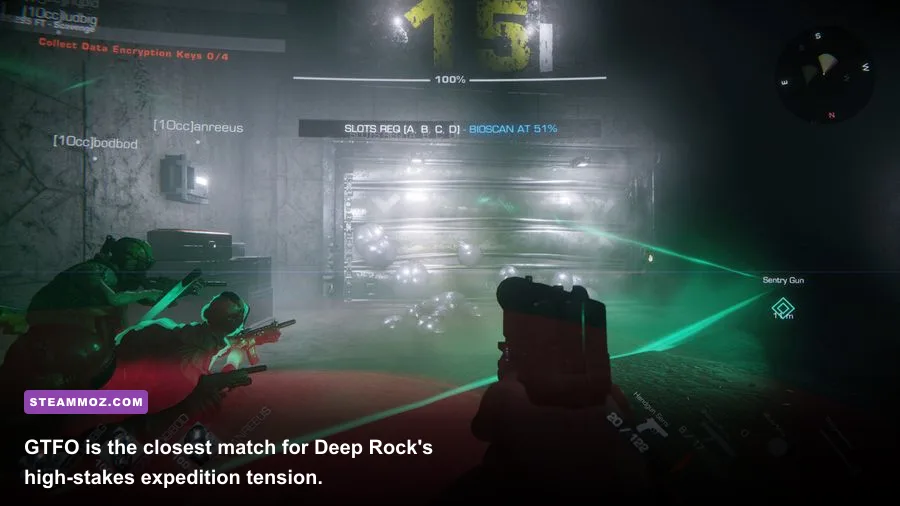
GTFO is not a casual substitute. It's the choice for a four-person squad that wants the expedition tension of Deep Rock Galactic without forgiving mistakes. The Rundown structure sends players into underground complexes where ammunition, tools, and information are scarce. Darkness is not decoration; it changes how you move, how you identify enemies, and how much danger you invite by firing.
Stealth is the foundation. Sleepers react to movement, light, and sound, so a team must coordinate melee takedowns rather than waking an entire room. The Bio Tracker helps identify threats and can reveal moving enemies through walls, while tools such as the C-Foam Launcher, Mine Deployer, and Sentry create a defensive plan before an alarm sequence begins. A squad that drops equipment randomly will run out of answers long before the level ends.
GTFO's objectives are deliberately awkward. You may need to search a zone for a key, complete a security scan while enemies attack, or carry a resource through areas you already cleared. There is no simple “shoot everything and move on” solution. Assign one player to watch the rear, mark doors that should remain closed, and decide who carries the tool that solves the next known obstacle. Voice chat isn't a luxury here; it is part of the control scheme.
The biggest warning is accessibility. GTFO has no real equivalent to Deep Rock's relaxed Hazard 2 session. Its trial-and-error design expects failure, memorization, and a patient group. New players should start with introductory expeditions, learn enemy behavior, and avoid burning resources during the first alarm. If your squad celebrates a successful extraction more than a high kill count, GTFO can become one of the most rewarding co-op games you own.
Risk of Rain 2 owns the replayability battle
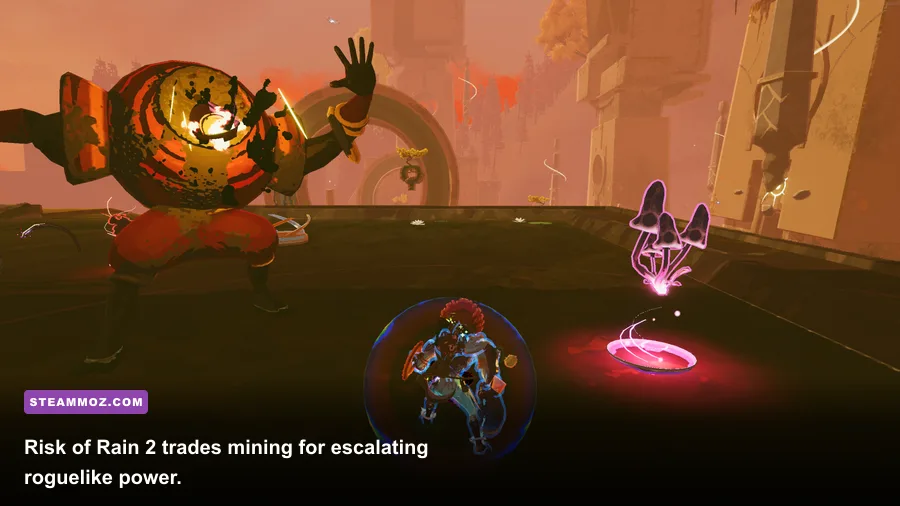
Risk of Rain 2 is the best alternative when what you really want is an endlessly replayable run with dramatic power growth. It replaces DRG's class-and-mission structure with survivors, randomized stages, items, and a difficulty clock that keeps escalating while you search for loot. Every run on Petrichor V asks the same uncomfortable question: do you spend another minute hunting for a chest, or activate the teleporter before enemies become unmanageable?
The playable roster changes the rhythm completely. Commando is a reliable starting point with straightforward dual-wielded fire, while Huntress offers lock-on attacks and excellent mobility. Engineer builds turrets and turns positioning into a defensive puzzle, and Loader can cross huge distances while delivering devastating melee hits. Items then bend those identities further. Lens-Maker's Glasses improve critical-hit consistency, Ukulele adds chain lightning, and Tougher Times provides a chance to block incoming damage.
The teleporter event is where Risk of Rain 2 most closely matches Deep Rock's swarm pressure. Activate it when the team has a route in mind, stay inside the charging zone when possible, and save movement skills for elite enemies or a sudden boss attack. The event ends only when the teleporter reaches 100 percent, so chasing a chest across the map during the fight can leave the squad exposed. Afterward, grab nearby loot quickly and move to the next stage before the difficulty multiplier gets away from you.
Risk of Rain 2 is less dependent on fixed roles than Deep Rock. A four-player team can absolutely succeed with overlapping damage builds, but communication still improves the run. Avoid taking every item just because it appears in front of you. Sharing attack-speed, crit, healing, and mobility items intelligently makes the whole squad stronger. For more hidden-reward hunting, Steamoz's fast leveling guide covers another game where efficient resource decisions shape every run.
Which game should your DRG squad choose?
The right recommendation depends on which part of Deep Rock Galactic you keep thinking about after a mission ends. If it's the escalating objective panic, choose Helldivers 2. If it's the satisfaction of cutting through a wall of enemies with a defined role, choose Space Marine 2. If you want to master melee spacing and special-enemy callouts, Vermintide 2 is unmatched. GTFO is the hardcore option for disciplined teams, and Risk of Rain 2 is the strongest pick for build variety and endless replayability.
| Priority | Best game | Why it wins | What you give up versus DRG |
|---|---|---|---|
| Best overall | Helldivers 2 | Four-player objectives, chaos, and memorable extraction fights | Less class identity and less environmental traversal |
| Best horde combat | Space Marine 2 | Huge enemy density and satisfying melee execution | Three-player Operations and fewer procedural layouts |
| Best melee teamwork | Vermintide 2 | Deep careers, weapon timing, and special prioritization | No mining, traversal tools, or destructible caves |
| Best hardcore option | GTFO | Stealth, resource pressure, and meaningful communication | Much harsher learning curve |
| Best roguelike | Risk of Rain 2 | Massive item combinations and escalating runs | Less structured role coordination |
A practical 2026 rotation
Don't try to replace Deep Rock with one game for every mood. Keep Helldivers 2 for a loud four-player night, Vermintide 2 for focused combat practice, and Risk of Rain 2 for shorter runs when the whole group can't commit to a long expedition. Bring GTFO out when everyone has a microphone and patience. Space Marine 2 is ideal when the squad wants spectacle but doesn't want to study a mission's systems before having fun.
Your PC setup should also influence the choice. Horde-heavy games punish unstable frame pacing more than a quiet solo title does. Start by targeting a locked 60 fps, reduce volumetric effects and shadow quality before texture quality, and use a performance overlay to check whether your GPU or CPU is the bottleneck. Steamoz's settings guide for Dragonkin explains the same sensible approach: tune the expensive effects first, then rebuild image quality one setting at a time.
The verdict on games like Deep Rock Galactic
Helldivers 2 is the game most Deep Rock Galactic players should play first in 2026. It understands that co-op shooters are at their best when the squad has a clear objective, imperfect information, complementary equipment, and enough freedom to create its own disaster. It doesn't copy the caves, classes, or mining loop, but it recreates the feeling of four friends turning a routine mission into a story worth retelling.
Space Marine 2 and Vermintide 2 are better if combat depth matters more than exploration. GTFO is the superior choice for teams that want every bullet and footstep to matter. Risk of Rain 2 wins for players who care about experimental builds and “one more run” progression. None of them makes the Supporter Upgrade necessary—the upgrade remains a cosmetic thank-you to Ghost Ship Games—but each offers a different route back to the same co-op sweet spot.
That is why Deep Rock Galactic continues to hold up alongside newer releases. Its best imitators understand that the memorable part isn't simply shooting aliens. It's the last flare burning in a cavern, the Driller opening an escape route, the Scout grabbing a teammate from a ledge, and four players reaching the drop pod with seconds left. Pick the alternative that recreates the moment you miss most, then get back in the cave—or onto the battlefield—and make a new one.
For more PC recommendations, progression advice, and performance coverage, keep an eye on Steamoz's upgrade-focused guide and PC requirements coverage. Rock and stone.