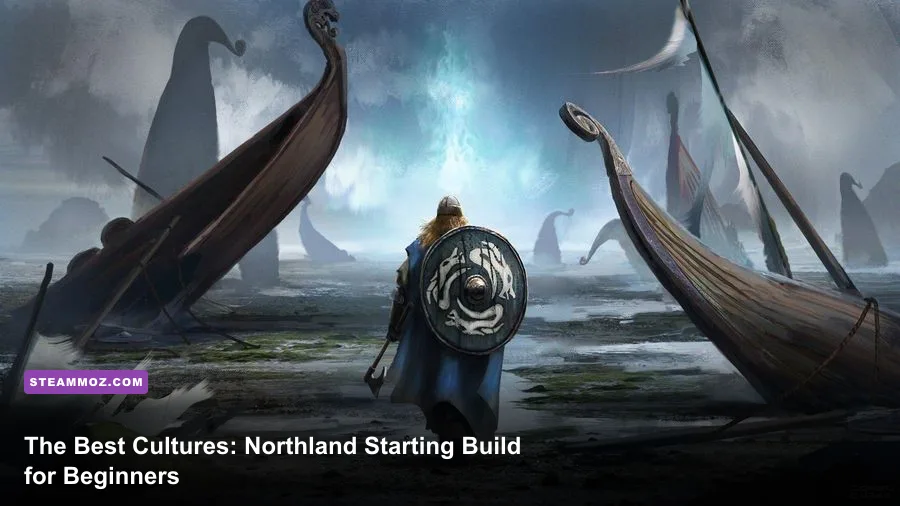
The best beginner build in Cultures: Northland is a compact, food-first settlement that opens with two woodcutters, one builder, a reliable food source, and only then a barracks. Keep your population working instead of recruiting too early, place production buildings close to their raw materials, and use Bjarni and the other heroes to scout danger before you commit to expansion. This opening reaches a stable economy faster than a military rush and works across the early campaign missions and most skirmish starts.
Northland looks like a traditional real-time strategy game, but its real battlefield is the worker queue. A villager does not simply vanish into a building and become an abstract income number. Your settlement grows through jobs, training, supply chains, walking distance, and the time needed for a novice worker to become useful. That makes the first ten minutes unusually important. A misplaced farm or an overbuilt army can leave you with a pretty Viking town that cannot feed itself.
The opening build order that keeps your town alive
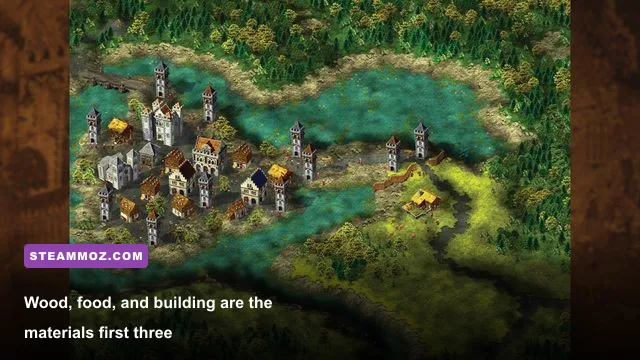
Pause immediately and inspect the starting area. You are looking for a dense stand of trees, a safe food source, and a defensible route toward the nearest hostile camp or objective. Do not spend the opening minutes decorating the settlement or scattering houses across the map. The first town should be compact enough that workers spend their time producing rather than walking.
Minutes zero to three
Assign your initial workers to construction and wood production. Build a woodcutter or lumber operation beside the nearest useful forest, then place a second woodcutter only when the first construction queue is moving smoothly. One worker should remain available as a builder. If every villager is locked into production, your next house, storage building, or food structure arrives too slowly.
Next, establish food. Use the most immediate source offered by the map, whether that means a farmable patch, fishing location, or hunting area. The correct choice is not about theoretical efficiency; it is about travel time. A nearby modest food source beats a richer source on the other side of the map during the opening. Put the food building where workers can reach it without crossing your future military route.
Minutes three to six
Construct housing before your population cap becomes a crisis. A blocked population queue is one of the quietest ways to lose momentum in Northland. Add storage near the wood and food chain, then create your first upgrade or processing building only after the basic economy is producing consistently. The game’s economy rewards continuity: a small stream of wood and food is more valuable than a flashy building that sits idle.
At this point, aim for two woodcutters, one food producer, one builder, and a spare worker who can cover construction, hauling, or a new profession. If the map starts you with more villagers, keep the extra hands flexible. Do not turn every spare villager into a specialist immediately. Northland’s jobs are valuable, but an unemployed worker standing beside an unfinished building is still costing you time.
Minutes six to ten
Build the barracks after your food income is stable, not before. Train a small defensive group and keep it near the settlement entrance. Your first force exists to stop raiders, protect workers, and escort scouts; it is not yet a reason to attack the enemy base. Put a weapon-producing chain online when the mission’s pressure demands it, but avoid stockpiling military equipment while your town still struggles to support new residents.
| Opening stage | Workers and buildings | Primary goal | Common mistake |
|---|---|---|---|
| 0–3 minutes | Two woodcutters, one builder, one food worker | Secure wood and immediate food | Sending every worker into construction |
| 3–6 minutes | Add storage, housing, and a flexible worker | Prevent population and hauling delays | Placing buildings far from resources |
| 6–10 minutes | Construct barracks and a compact defense | Stop raids without starving growth | Recruiting a full army too early |
| 10 minutes onward | Add processing, research, trade, or expansion | Turn a stable economy into mission progress | Expanding before scouting routes |
For a useful comparison, think of this as the opposite of a rush build. The rush sacrifices the economy for an early attack window. The beginner build sacrifices a few seconds of aggression for a settlement that can replace workers, equip soldiers, and recover from a raid. If you enjoy economy-first openings in other strategy games, Steamoz’s A-Train beginner build guide applies the same valuable principle: grow the system before demanding more from it.

🎮 Cultures: Northland
Looking to experience this game? Grab your digital key directly on our store for $0.54.
View on Steammoz Store →Which professions should you prioritize first?
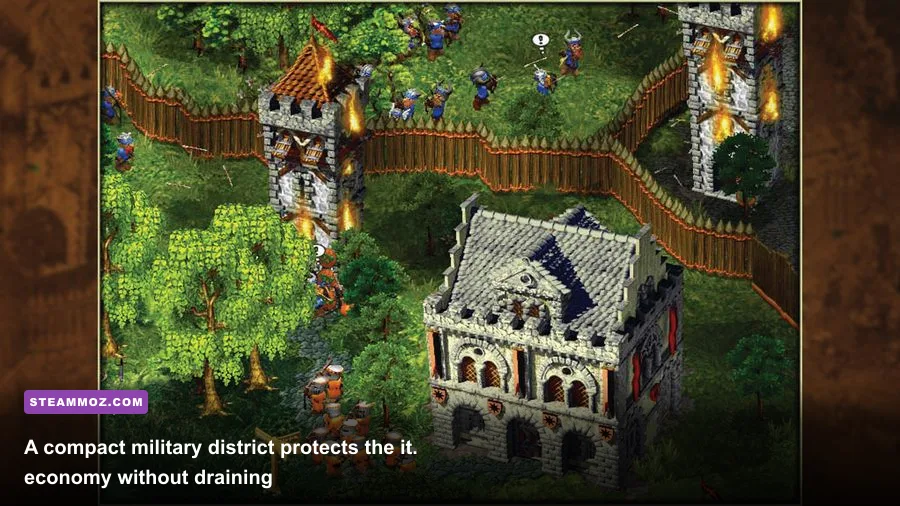
Northland’s progression is driven by turning ordinary settlers into useful specialists. The exact order changes with the map, but the priority is consistent: wood enables construction, food supports population, and builders convert both into momentum. Mining, hunting, fishing, farming, crafting, and military professions become stronger once the first loop is no longer interrupting itself.
Woodcutters are your first economic engine
Wood is the resource that makes the opening feel responsive. It pays for housing, production structures, storage, and much of your early infrastructure. Place woodcutters beside a large forest, but do not consume the entire nearest stand if the map has no replacement nearby. A settlement that strips its closest trees may look efficient at minute five and become painfully slow at minute fifteen.
Two woodcutters are the safe default. Add a third only when you are constructing several buildings at once, expanding to a second district, or preparing a major military push. If the wood stockpile is rising while food is falling, move one worker temporarily rather than blindly adding another building.
Food workers prevent invisible economic collapse
Food is not glamorous, but it controls whether the town can sustain its workforce. Farms are a strong long-term choice when the terrain supports them, while fishing and hunting can be excellent opening solutions when they are close to town. Watch the walking route, not just the resource icon. Long paths create a hidden tax on every meal or delivery.
Keep at least one flexible worker available until the settlement has housing, food, and storage. That worker can repair a stalled chain, help build a defensive structure, or replace a specialist lost during a raid. Beginners often fill every job slot and then wonder why the next building takes forever. A little labor redundancy is worth more than perfect specialization.
When mining, crafting, and research become worthwhile
Mining and crafting should follow the mission objective. If the scenario demands weapons, tools, or a specific upgrade, start that chain early enough for transport and production time. If the objective is exploration or survival, delay expensive industrial buildings and invest in food, housing, and defense instead. Northland does not reward building every available structure simply because the button is available.
Researchers and priests are support investments rather than opening priorities. Add them after the town can replace lost workers and maintain its basic supplies. Merchants become valuable when the map provides a safe trade route or when one missing resource blocks progress. They are not a substitute for fixing an inefficient local chain.
| Profession or role | Priority | Why it matters | Best time to add it |
|---|---|---|---|
| Builder | S-Tier opening role | Converts resources into functioning infrastructure | Immediately and whenever a major district begins |
| Woodcutter | S-Tier opening role | Funds housing, storage, production, and defense | Start with one; add a second quickly |
| Farmer, fisher, or hunter | S-Tier opening role | Supports population and prevents stalled growth | Before adding a large workforce |
| Miner or crafter | A-Tier conditional role | Unlocks tools, weapons, and mission-specific production | After the first food-and-wood loop works |
| Soldier | A-Tier defensive role | Protects workers and buys time against raids | When scouting reveals immediate danger |
| Merchant, priest, or scholar | B-Tier support role | Improves flexibility, morale, or progression | Once the settlement has spare capacity |
Do not treat the table as a rigid script. A fishing start can make a second food building unnecessary. A barren map can force an earlier trade route. The key is to identify what the map is already offering and build around that advantage instead of forcing a favorite economic plan.
How to build a beginner military force
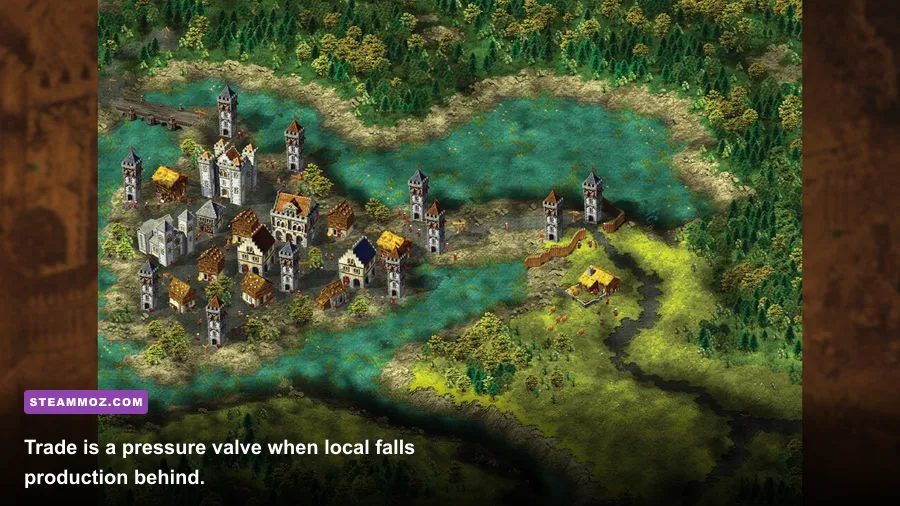
Your first army should be small, visible, and easy to reinforce. Put the barracks inside the settlement rather than beside the enemy’s likely approach. Keep soldiers close enough to cover workers, but do not park them on top of production buildings where they block movement. A compact defensive line gives you time to react when scouts reveal a camp or a raid party.
Use Bjarni and the heroes as scouts first
The named heroes are more valuable than ordinary troops because they can investigate routes, identify threats, and help you avoid marching the entire economy into an ambush. Bjarni is especially useful as an early forward unit in the campaign. Send him along the edge of the explored area, reveal the route, then pull him back before he becomes surrounded. Discovery is the goal; heroic last stands are not.
Save the game before pushing into an unfamiliar section of a mission. Northland’s maps often punish unscouted movement with enemy camps, blocked paths, or objectives that trigger additional pressure. Mark the safe route mentally and keep your military group on a short leash until you know where the next threat is coming from.
Simple combat rules that prevent expensive losses
Focus fire one target at a time rather than scattering attacks across a group. Pull damaged units backward while healthier soldiers hold the enemy’s attention. Do not let a hero chase a fleeing enemy beyond your defensive vision; that is how a successful skirmish turns into a wipe. If the game gives you mixed troops, keep sturdier melee units in front and protect ranged attackers behind them.
Fight near your own buildings whenever possible. A defensive battle shortens reinforcement travel and gives you time to rebuild. Attacking deep into hostile territory is only worthwhile when the objective requires it or when scouting confirms that the target cannot call in help. The first military milestone is not destroying the enemy. It is making sure your economy keeps working while the enemy fails to disrupt it.
| Threat | Warning sign | Counter | Best beginner response |
|---|---|---|---|
| Early raid | Enemy movement toward workers or housing | Pull exposed workers inward and intercept near town | Defend; do not chase beyond vision |
| Enemy camp | Scouts reveal a fortified route or clustered troops | Reinforce, equip, and attack with a clear retreat path | Delay the assault until food is stable |
| Worker loss | Production chain stops after an attack | Replace the missing profession before adding new jobs | Use a flexible settler as a temporary substitute |
| Overextended army | Soldiers are far from town and reinforcements | Fall back and regroup | Never sacrifice the settlement for one chase |
For broader combat habits, Steamoz’s survival tips for new players makes the same point from a different genre: awareness and positioning often matter more than aggression. You can also compare this cautious approach with the equipment-focused advice in our best weapons and equipment guide.
Expansion, trade, and campaign progression

Expand only after three checks pass: food production is positive, wood is not permanently stuck at zero, and your army can answer a raid. A second district should solve a problem, not create a larger walking-distance problem. Keep resource buildings near the resources they use, place storage between production and town, and reserve a clear corridor for troops.
When to open a second district
Open one when the first settlement’s nearby trees or food sources cannot support the next objective, or when a strategic location controls the map. Build the new district around its strongest resource rather than copying the entire first town. If the location is a mining site, start with storage, protection, and the workers needed for mining. Do not duplicate every support building until the outpost proves it can survive.
Housing deserves special attention during expansion. A new district without enough homes creates a population bottleneck, while homes without food create a larger problem. Add houses in measured steps, then watch whether food and worker availability keep pace. If they do not, stop expansion and stabilize the original chain.
Trade is a repair tool, not a crutch
Use merchants when a missing resource blocks a mission objective or when the map clearly favors one surplus over another. Trade can rescue a settlement, but it cannot compensate for poor placement forever. Buying food because your farm sits far from storage is an expensive patch; moving the chain is the permanent fix.
Before starting a mission, consult the official Steam page for Cultures: Northland for the current package and compatibility details. The Funatics website is also useful background for the studio behind the Cultures series, while the GOG edition page can help players compare another PC release.
For players coming from choice-heavy games, Steamoz’s Detroit: Become Human beginner guide is a reminder that early decisions shape later options. In Northland, those decisions are economic rather than narrative: every unnecessary building delays your army, every long walking route drains production, and every unscouted road can cost a hero.
The ten-minute checkpoint
At roughly ten minutes, pause and inspect the whole settlement. You should have a functioning wood supply, dependable food, enough housing for the next population increase, storage placed near production, and a defensive force that can respond to trouble. If one of those pieces is missing, fix it before chasing the next objective.
Once the checkpoint is passed, choose one direction: military pressure, technology, trade, or territorial expansion. Specialization is what turns a stable start into a winning one. Do not attempt all four simultaneously unless the mission gives you a huge resource advantage.
The beginner build in one practical checklist
Use this condensed version when you want a dependable first attempt without memorizing every construction click:
- Scout the starting area with a hero before committing to expansion.
- Place one woodcutter beside the nearest strong forest and add a second when construction begins stacking up.
- Keep one worker available for building, hauling, repairs, and emergency reassignment.
- Start the closest reliable food source before raising the population ceiling.
- Build storage near the resource chain and keep the settlement compact.
- Construct the barracks after food is stable, then train a small defensive force.
- Use Bjarni and other heroes to reveal routes, not to absorb damage from an entire camp.
- Add mining, crafting, research, or trade only when the mission objective justifies the cost.
- Expand when food, wood, housing, and defense can support the new district.
- After every raid, replace lost workers before adding fresh specialists.
The winning mindset is simple: Cultures: Northland rewards a settlement that keeps functioning under pressure. Build fewer things, place them better, and make every worker assignment serve the next objective. Once the first food-and-wood loop is running, your heroes have room to scout, your soldiers have time to train, and the campaign stops feeling like a scramble. That is the real beginner build: not a single perfect order, but a town designed to recover when the map inevitably bites back.