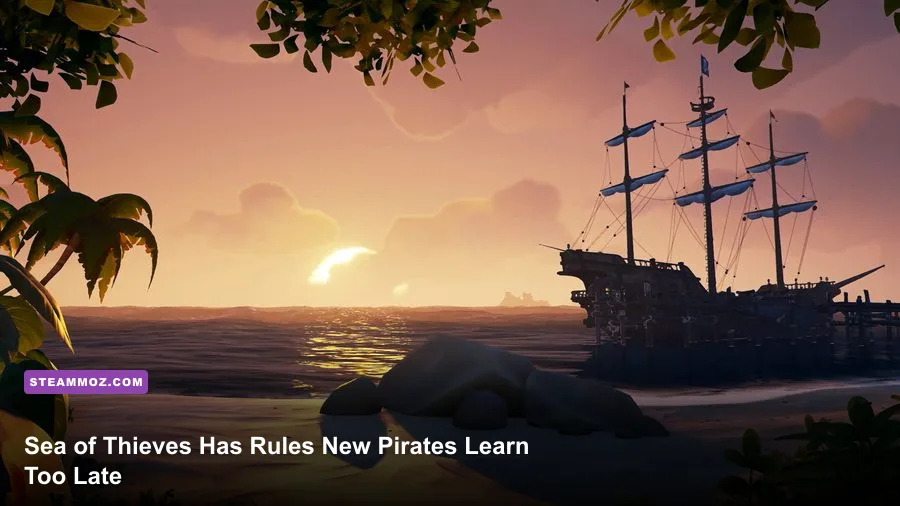
The biggest thing to know before playing Sea of Thieves is that progress is shared, not power-based. Every pirate has access to the same weapons and ship tools from day one, so survival comes from understanding wind, sound cues, supplies, map logic, and crew roles—not grinding a better sword. Learn those systems early, and the sandbox becomes thrilling instead of confusing.
Rare's pirate adventure is deliberately light on traditional tutorials. You can finish the opening Maiden Voyage, grab a voyage from an outpost, and still have no idea why another crew is circling you, why your treasure disappeared, or why your ship sank despite having a full health bar. The following lessons close those gaps before your first serious session.
Your Ship Is a Toolbox, Not a Fast-Travel Point
Your ship is the center of every decision. A Sloop carries one or two pirates, turns quickly, and is the easiest vessel to manage alone. A Brigantine supports two or three players and has excellent speed when sailing with the wind. A Galleon holds four players, carries more cannons, and hits hard, but its sails, wheel, anchor, and lower deck demand real coordination.
Ship speed depends heavily on wind direction. Angle your sails to catch the wind when traveling downwind, but don't assume the biggest ship always wins a chase. A Sloop can outsail a Galleon into the wind, while a Brigantine can be terrifying with a favorable breeze. Raise sails slightly when turning; leaving them fully lowered makes your ship handle like a truck.
Every hull has a limited number of holes. Water rises through the lower deck, and a flooded ship sinks. Use wooden planks to repair holes, a bucket to remove water, and the mop to clean the deck afterward. A large lower-deck hole can flood far faster than a small upper-deck leak. Listen for the sharp cracking sound that signals damage, then check below deck before grabbing treasure.
| Ship | Crew Size | Best Strength | Main Weakness |
|---|---|---|---|
| Sloop | 1-2 | Fast into the wind; agile turns | One cannon per side and limited repair hands |
| Brigantine | 2-3 | Excellent speed with favorable wind | Can be difficult to control with an inexperienced crew |
| Galleon | 3-4 | Four cannons per broadside and high crew capacity | Slow turns, huge repair workload, vulnerable lower deck |
Before leaving port, fill every barrel you can. Stock cannonballs, wooden planks, bananas, coconuts, mangos, pineapples, meat, firebombs, blunderbombs, and throwables. Food is not interchangeable: cooked meat and fish restore substantially more health than fruit, while pineapples can be eaten twice. You can also carry five items in your hand inventory and store more in the ship's barrels.
Learn the Combat Numbers Without Chasing Meta Builds
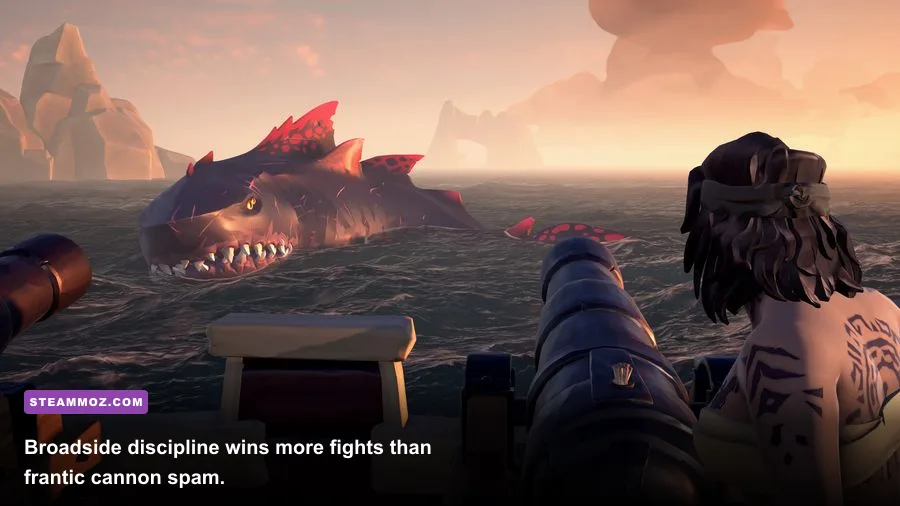
There are no character attributes, armor tiers, or damage perks to grind. Your normal health pool is 100, and fights are decided by positioning, reload timing, hit confirmation, and movement. The Cutlass is reliable at close range, but its three-hit combo locks you into animation if you swing recklessly. The final slash has a short recovery window, so experienced players often stop after one or two swings instead of donating an easy hit.
A charged sword lunge is powerful and travels farther than a normal slash, but it has a clear wind-up and can be interrupted by terrain, water, or a well-timed blunderbomb. Jumping during a lunge can help you cover distance, although it also makes your trajectory predictable. Practice the timing against skeletons before attempting it on another crew.
The Flintlock Pistol is the balanced ranged option. The Eye of Reach rewards accuracy and long sightlines, while the Blunderbuss dominates point-blank encounters but loses force rapidly with distance. Weapon skins change appearance, not damage. A common beginner loadout is Cutlass plus Blunderbuss for boarding, or Cutlass plus Eye of Reach for island combat and long-range pressure.
Remember that weapons are tools, not the entire fight. A blunderbomb can knock a pirate off a ladder, break a revive attempt, or push someone away from a wheel. Firebombs create panic and can force a crew out of a tight lower deck. The speaking trumpet, bucket, shovel, compass, and spyglass matter just as much when you are tracking or defending a ship.
Don't sprint through every island with your weapon raised. Sprinting drains your stamina, and a sword lunge needs room. Keep your reticle at head height, use cover against pistol skeletons, and reload before climbing a ladder. The loud click of an empty weapon is an invitation to get boarded.
| Loadout | Strongest Use | Risk | Beginner Verdict |
|---|---|---|---|
| Cutlass + Blunderbuss | Boarding, ladders, tight interiors | Weak at distance | Best starting combat pair |
| Cutlass + Flintlock | Flexible island and ship fighting | Less burst at point blank | Reliable all-rounder |
| Cutlass + Eye of Reach | Long sightlines and opening shots | Punishes missed shots | Great after aim practice |
| Double Guns | Fast ranged burst and PvP pressure | No sword mobility or emergency defense | Advanced choice, not a requirement |
Treasure Is Not Yours Until You Sell It
Sea of Thieves has no automatic quest completion. Finding a chest is only half the job; you must carry it to an outpost or the correct trading company representative and sell it. If your ship sinks, treasure floating in the water can be recovered by anyone. This is why a crew that looks rich is often more vulnerable than a crew with nothing onboard.
At outposts, the Gold Hoarders buy treasure chests, the Order of Souls buys skulls, and the Merchant Alliance handles cargo, animals, and commodity trade. The Hunter's Call accepts fish and cooked meat at Seaposts, while Reaper's Bones can accept most treasure at The Reaper's Hideout. Sovereigns at an outpost can also collect many treasure types for a captained ship, saving time.
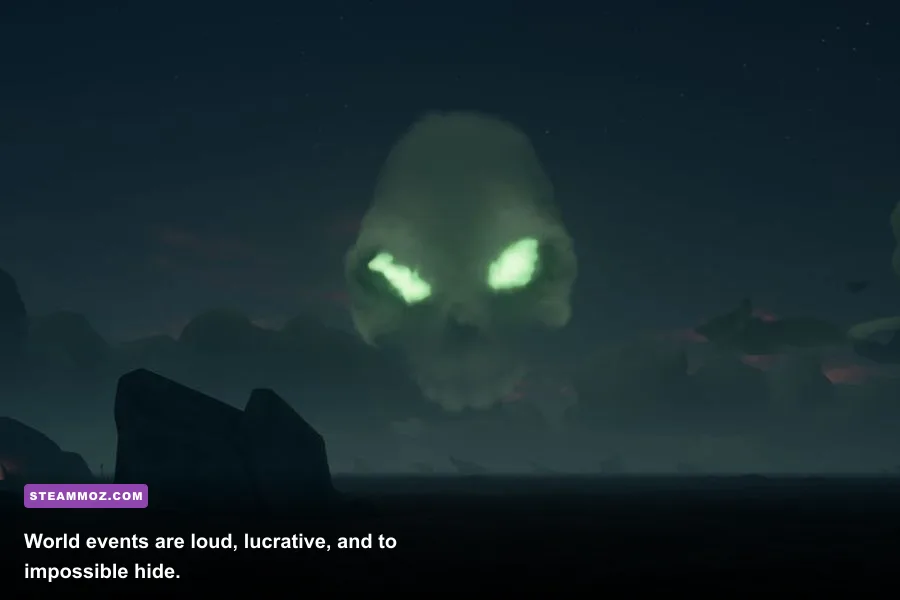
Voyages are not the only source of loot. Skeleton Forts, Skeleton Fleets, Ashen Winds, Ghost Fleets, and other world events announce themselves with enormous clouds or visual effects. That public signal is both an invitation and a warning: nearby crews can see what you're doing. If you start an event, keep one person on lookout and check the horizon between waves.
Map pieces, riddles, X-marked maps, and underwater clues all reward patience. Read every line of a riddle literally, but expect environmental landmarks to be the real solution. A compass can point you to a direction, and your ship's map helps you estimate distance. Take screenshots of complicated maps if your crew keeps getting lost.
Emissary Flags Multiply Risk Along With Rewards
Once you understand basic voyages, emissary flags become the most important economic system to learn. At an outpost, you can vote to represent a trading company, then raise its flag at the company's emissary table. Selling relevant loot increases your Emissary Grade, and higher grades improve the gold and reputation multiplier. Grade 5 is the target, but it also makes your ship more attractive to hunters.
Reaper's Bones is especially dangerous because Reaper emissary ships appear on every crew's map. A Reaper can see other emissary ships after reaching Grade 5, and a Reaper's Mark flag broadcasts a ship's position to everyone. Never raise a valuable flag and assume the server is empty. Watch the horizon, use the ship's map, and sell before greed turns a profitable voyage into a total loss.
Lowering an emissary flag at the appropriate table gives you a separate payout based on your grade. The flag itself is worth selling to the Reaper's Bones representative, but dropping it also ends your multiplier. A smart crew sets a cash-out rule before the voyage: Grade 5, one major event, or a certain amount of loot, then return to port.
| Activity | Risk Level | What You Gain | Smart Habit |
|---|---|---|---|
| Basic company voyage | Low to medium | Steady treasure and reputation | Sell frequently while learning routes |
| Emissary voyage | Medium to high | Higher company payout at better grades | Keep a lookout and track server ships |
| World event | High | Large loot pile and commendation progress | Assign one pirate to watch the horizon |
| Reaper emissary | Very high | Flexible treasure sales and PvP rewards | Expect every marked ship to become a threat |
Safer Seas Is a Classroom, Not the Whole Game
Safer Seas places your crew on a private server, making it useful for learning ship controls, Tall Tales, fishing, cooking, riddles, and island routes without hostile crews. It is an excellent pressure-free introduction, especially for players who find open-world PvP overwhelming. The tradeoff is reduced progression and fewer multiplayer sandbox systems, including the competitive tension that makes high-value voyages memorable.
Use Safer Seas to complete the Maiden Voyage, learn how to raise and lower sails, practice anchoring without crashing, and understand each trading company's basic loop. Then move to High Seas when you can repair a hole, bail water, steer, and sell treasure without needing instructions. You don't have to become a PvP expert, but you should know how to escape.
On High Seas, scuttling is available through the crew menu if your ship is stuck or you want to reset after a fight. It won't save your treasure, but it can end a hopeless spawn camp. You can also use the Ferry of the Damned after death; check the lantern color there for clues tied to certain Tall Tales and adventures.
Communication Beats Mechanical Skill
Sea of Thieves is at its best when every crew member owns a job. One pirate steers, one handles sails, one repairs and bails, and one manages cannons or boards. These roles can rotate, but vague callouts lose fights. Say “two holes lower deck,” “anchor down,” “one boarding ladder,” or “raising sails” instead of shouting that the ship is dying.
Assign someone as navigator before departing. That player watches the map, checks wind, calls island approaches, and marks threats. The helmsman should avoid staring through the spyglass while near rocks. The repair player should carry planks and food, while the cannon player keeps the ship's broadside pointed at the enemy's vulnerable side.
Boarding is about timing, not heroics. Fire yourself from a cannon only when the enemy ship is close enough to reach and your crew can survive without you. A boarder who drops the anchor creates an opening, but an anchor play is useless if nobody is ready to fire. Guard ladders with blunderbusses, listen for swimming sounds, and check the mermaid in the water when a pirate has gone missing.
If your crew wants a smoother first session, start with a Sloop and follow a simple loop: gather supplies, complete one short voyage, sell everything, then attempt a world event. For technical issues, Steamoz's guides on PC crash troubleshooting and higher-FPS settings cover general optimization habits that also help multiplayer games.
Set Up Performance Before Your First Voyage
Sea of Thieves can look spectacular, but water quality, shadows, and resolution scaling affect visibility as much as frame rate. On PC, start with the game's built-in Settings Video presets, then tune individual options. A stable 60 frames per second usually feels better during sword fights and cannon aim than a fluctuating ultra preset.
| Setting | Recommended Starting Value | Performance Impact | Visual Tradeoff |
|---|---|---|---|
| Resolution Scale | 100%; lower only if GPU-limited | Very high | Lower values soften the image |
| Shadow Quality | Medium | Medium to high | Less detailed lighting and shadows |
| Water Quality | Medium or High | Medium | Lower reflections and wave detail |
| Model Detail | Medium to High | Medium | Reduced distant geometry |
| Particle Effects | Medium | Low to medium | Less smoke, fire, and splash detail |
| V-Sync | Off with VRR; On if tearing bothers you | Input-lag dependent | Smoother output versus lower latency |
Use an uncapped frame-rate test near an outpost, during storms, and in a busy world event. If performance suddenly collapses during cannon smoke or fire, lower particles before sacrificing resolution. On Steam, check the official Sea of Thieves store page for current system requirements, and consult Rare's support portal for platform-specific connectivity issues.
Most importantly, don't treat gold as the finish line. Cosmetics, commendations, Tall Tales, guilds, fishing, PvP, and emergent encounters are the real progression. Read the current notes on the official release notes because seasonal changes can alter events, rewards, and quality-of-life systems.
For more PC-focused gaming advice, Steamoz's low-FPS troubleshooting guide and hidden-reward hunting guide are useful references beyond the Sea of Thieves seas.
Go in expecting to lose treasure, miss cannon shots, and occasionally sail directly into a rock. That chaos is the point. Once you understand that a good voyage is measured by decisions—not just loot—you'll stop playing Sea of Thieves like a checklist and start playing it like a pirate story you helped create.