
Yes, Resident Evil 4 on PC is absolutely still worth playing in 2026. The 2023 remake remains one of the best action-horror games on Steam, while the 2005 original is still valuable if you want sharper arcade pacing and a fascinating look at modern game design’s roots. The remake’s combat, exploration, audio, and character writing have aged exceptionally well; its only real drawbacks are a demanding RE Engine workload, a few uneven late-game encounters, and a campaign that sometimes loses the tight horror mood of its opening hours.
This isn’t a recommendation based on nostalgia alone. Resident Evil 4 Remake gives you a campaign with multiple difficulty levels, New Game Plus, weapon experimentation, challenge runs, Mercenaries, and the excellent Separate Ways expansion. On PC, mouse aiming makes precision shots and quick target swaps feel superb. With a sensible settings profile, even mid-range hardware can deliver a smooth experience. Here’s what still works, what doesn’t, and which version deserves your time.
Why Resident Evil 4 Still Feels So Good

Resident Evil 4’s greatest achievement is its combat loop. Leon Kennedy is never a bullet-sponge superhero, but he also isn’t helpless. Every encounter asks you to create a few seconds of control: shoot a Ganado in the knee, kick the group away, knife a stunned enemy, then reposition before the next threat closes in. That rhythm makes ordinary ammunition feel powerful without making the player feel safe.
The remake improves this foundation in several smart ways. Leon can move while aiming, parry many attacks with his knife, stealth-kill isolated enemies, and use the environment more aggressively. The knife has durability, so it’s no longer a limitless answer to every grab or projectile. That one change matters. You’re constantly deciding whether to spend durability on a stealth takedown, a parry, a finisher, or a desperate escape from a grab.
Enemy design also remains unusually readable. Ganados shout, wind up, and telegraph thrown weapons. Brutes commit to heavy swings. Plaga mutations reveal themselves through recognizable shapes and attack patterns. The game can be chaotic, but deaths usually teach you something specific: you stood in a doorway, ignored a ranged enemy, wasted your knife durability, or failed to prioritize a mutation.
The remake versus the 2005 original
The 2005 PC version is faster, stranger, and more deliberately gamey. Leon’s tank controls, fixed animations, laser sight, and dramatic quick-time events create a different flavor of tension. Its inventory grid is iconic, and its progression is more aggressively built around memorizing encounters. The remake is more grounded and flexible, with stealth, parrying, side quests, and a more believable Ashley.
| Version | Biggest Strength | Main Weakness | Best For |
|---|---|---|---|
| Resident Evil 4 Remake | Modern combat, atmosphere, exploration | Heavier PC performance demands | First-time players and replay runs |
| Resident Evil 4 (2005) | Fast arcade pacing and iconic level flow | Older presentation and controls | Fans of classic action horror |
| Separate Ways | Compact campaign with excellent set pieces | Less room for exploration | Players wanting Ada’s perspective |
If you’ve never played either version, start with the remake. If you finish it and want to understand why this series changed the industry, play the original afterward. The contrast is genuinely rewarding rather than redundant.
Capcom’s official Steam page for Resident Evil 4 lists the current PC edition and its downloadable content. It’s also worth checking Capcom’s official Resident Evil 4 website for trailers and edition details.
PC Performance in 2026 and the Settings That Matter
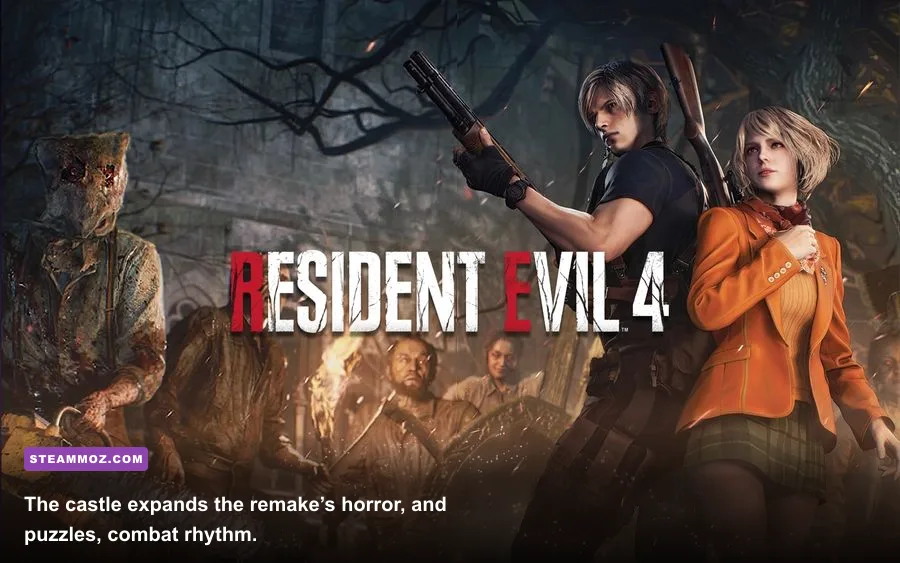
Resident Evil 4 Remake is still demanding because the RE Engine combines dense geometry, volumetric effects, detailed character models, and real-time lighting. The game can look excellent at 60 frames per second, but its default settings aren’t always the best balance. Ray tracing is the first feature I’d disable unless you have plenty of GPU headroom; it adds atmosphere to reflections and shadows, but the performance hit is much larger than the visual payoff during combat.
Capcom’s listed minimum target is an Intel Core i5-7500 or AMD Ryzen 3 1200, 8GB of RAM, and a GeForce GTX 1050 Ti or Radeon RX 560. The recommended specification rises to an Intel Core i7-8700 or Ryzen 5 3600, 16GB of RAM, and a GeForce GTX 1070 or Radeon RX 5700. Those figures remain useful in 2026, but an SSD is just as important as the graphics card for reducing traversal stutter and loading friction.
| Setting | Recommended Value | FPS Impact | Visual Trade-Off |
|---|---|---|---|
| Ray Tracing | Off | High savings | Less detailed reflections and indirect lighting |
| Texture Quality | High, within VRAM budget | Low to medium | Major improvement to surfaces and character detail |
| Hair Strands | Off or On for high-end GPUs | Medium to high | More realistic hair, especially on Leon and Ashley |
| Shadow Quality | Medium or High | Medium | Lower settings soften foliage and character shadows |
| Volumetric Lighting | Medium | Medium | Fog and shafts of light become less rich |
| Screen Space Reflections | On | Low to medium | Improves wet surfaces and reflective environments |
| FidelityFX Super Resolution 2 | Quality at 1440p, Balanced at 4K | Large savings | Some fine-detail softness at lower modes |
| Motion Blur | Off | Negligible | Cleaner target tracking during mouse aiming |
For a mid-range 1080p machine, use High textures if your card has enough VRAM, Medium shadows and volumetrics, Hair Strands off, and FSR 2 Quality. Cap the frame rate at a number your system can hold consistently rather than chasing a fluctuating 90 or 120 fps. A stable 60 fps makes parries, quick turns, and rifle headshots feel far better than an unstable high average.
On a modern RTX 4070-class or RX 7800 XT-class GPU, 1440p High is comfortable, but you should still test the Village, the castle’s water-heavy rooms, and the island during heavy combat. Those areas reveal performance dips faster than a quiet corridor. If you hit unexplained stutter, update your GPU driver, let shader compilation finish, install the game on an SSD, and reduce Hair Strands before lowering textures.
Steamoz’s PC crash and FPS troubleshooting guide covers broader fixes that also apply when Windows, drivers, or background software are the real problem. Don’t blindly add every launch option you find online; RE Engine games often behave better with a clean install and current drivers.
The Best Weapons and Upgrade Decisions
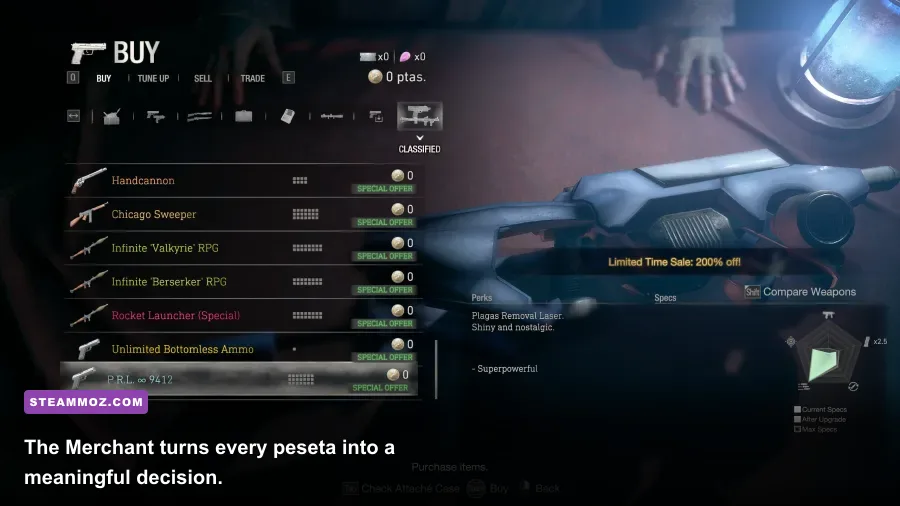
The Merchant’s upgrade system is still one of the remake’s strongest progression tools. Weapons don’t merely become statistically larger numbers; upgrades change how confidently you can solve encounters. Prioritize a dependable handgun, a shotgun for crowd control, and one long-range option. Selling every weapon to chase the newest unlock is usually a mistake because upgrade investment and exclusive perks can make an older gun outperform its replacement for most of a run.
The SG-09 R is a reliable starting pistol with balanced accuracy and stagger potential. The Red9 hits harder, but its recoil and slower handling make it less comfortable without the stock. The Blacktail is compact and fast, making it excellent for players who constantly reposition. The Sentinel Nine is a strong downloadable alternative with a large magazine, though its value depends on whether you want a versatile sidearm or a more specialized handgun.
For most players, the Riot Gun is the best all-purpose shotgun. It has a useful effective range and handles groups without demanding perfect positioning. The W-870 hits hard and is available early, while the Striker offers huge capacity and rapid follow-up shots later. The Stingray is a practical semi-automatic rifle for body-part targeting, and the SR M1903 rewards patient players who can land headshots or hit exposed parasites.
| Weapon | Role | Upgrade Priority | Why It’s Worth Keeping |
|---|---|---|---|
| SG-09 R | Balanced handgun | Power, then reload speed | Reliable stagger and easy early access |
| Red9 | High-damage handgun | Power and stock | Excellent damage when recoil is controlled |
| Blacktail | Fast sidearm | Power and rate of fire | Great handling in crowded arenas |
| Riot Gun | General-purpose shotgun | Power and reload speed | Strong range and consistent crowd control |
| Stingray | Flexible rifle | Power and rate of fire | Excellent against exposed weak points |
| SR M1903 | Precision rifle | Power and scope | Rewards accurate parasite and boss shots |
| Chicago Sweeper | New Game Plus weapon | Exclusive upgrade | Turns later runs into a high-powered experiment |
Don’t neglect the Combat Knife. Its durability upgrade increases your margin for error, while its exclusive upgrade dramatically improves damage. The knife is particularly valuable against stunned enemies, bosses with exposed weak points, and the Garrador if you can circle behind him quietly. Flash Grenades are equally important: they instantly destroy exposed Plaga and can erase several mutated enemies at once.
Charms provide small bonuses that become meaningful over a full campaign. Equip charms that support your play style rather than chasing a theoretical perfect loadout. A healing-related bonus helps beginners; ammunition-crafting and run-based bonuses become more attractive when you already know encounter layouts. The case system also rewards organization: keep healing items together, stack ammunition by type, and rotate temporary treasures into pesetas instead of carrying them through half the chapter.
Where the Remake Stumbles
The opening Village chapter is almost flawless, and the castle is packed with memorable ideas, but the campaign’s tone becomes less consistent as it moves toward the island. The early game makes you feel hunted and under-equipped. Later chapters lean harder into military action, heavy machinery, armored enemies, and spectacle. That escalation is faithful to Resident Evil 4’s identity, but it weakens the oppressive horror that makes the first hours so effective.
Some enemy encounters also feel designed to spend your resources rather than test elegant decision-making. Novistadors can become frustrating in cluttered spaces, shielded Ganados can block clean shots, and certain island arenas throw several high-pressure threats at you at once. The answer isn’t to hoard every grenade until the credits. Use explosives, mines, and powerful ammunition when the arena is built around crowd pressure; the game’s economy is generous enough to support decisive play.
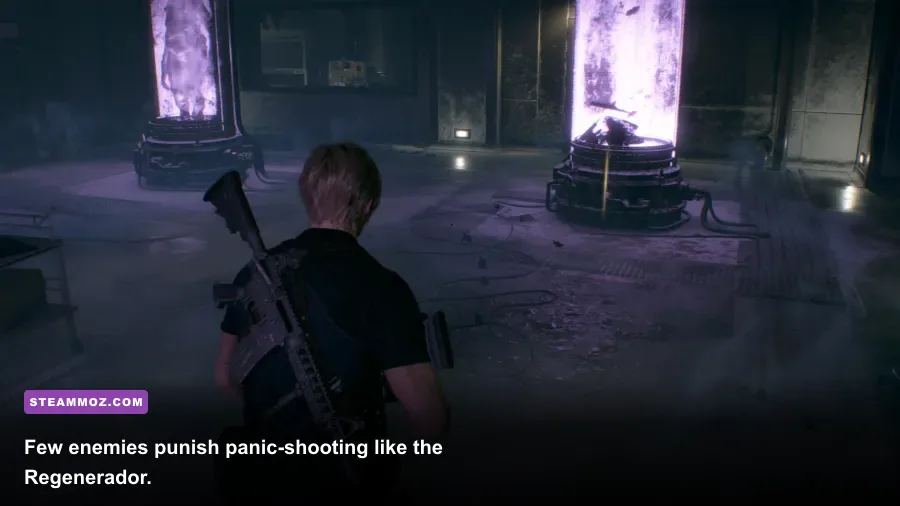
The Del Lago fight is visually memorable but mechanically simple. The El Gigante encounters are more satisfying because they teach you to target the parasite and use the environment. The Garrador battles are excellent stealth-and-sound tests, while the Regenerador forces you to slow down and use the Biosensor Scope. That scope reveals parasites inside the creature; shooting the visible cores is far more efficient than wasting rifle ammunition on its body.
Boss encounters that reward preparation
Against Mendez, stay mobile and use the upper platforms to create distance before targeting the exposed eye. Salazar becomes much easier with explosive damage and careful movement around his acid attacks. Krauser’s remake fight is built around knife parries, making Combat Knife durability and timing more valuable than an oversized stockpile of bullets. Saddler’s final phase rewards eye shots, explosive tools, and saving the Rocket Launcher if you want a quick finish.
| Encounter | Danger | Counter Strategy | Best Tool |
|---|---|---|---|
| Garrador | Blind heavy swings and lunges | Walk quietly, circle behind, attack the parasite | Combat Knife or rifle |
| Regenerador | Rapid healing and close-range grabs | Use Biosensor Scope and destroy parasites | Stingray or SR M1903 |
| Krauser | Fast melee pressure and parry checks | Stay close and parry instead of panic-shooting | Combat Knife |
| Saddler | Area attacks and moving weak points | Target eyes, use cover, save explosive damage | Rifle, grenades, Rocket Launcher |
Separate Ways is worth adding to the 2026 recommendation. Ada Wong’s campaign revisits locations from a different angle, introduces the Grappling Gun, and gives her a distinct pace without simply copying Leon’s route. It’s shorter, but its price-to-content ratio is strong if you want more context around Ada, Wesker, and the Amber plotline.
Who Should Play It in 2026?

Play Resident Evil 4 Remake if you want a polished third-person action game with meaningful resource management, excellent encounter design, and a campaign that supports repeat runs. It’s especially good for players who enjoy learning enemy behavior and gradually turning a stressful first playthrough into a confident speed-oriented run.
It’s also a strong Steam Deck game, with one caveat: don’t expect a locked 60 fps at high settings. A 40-fps cap or a stable 30 fps profile with reduced volumetrics, shadows, and resolution scaling makes more sense. Use a sensible TDP limit only after finding a stable graphics profile; aggressive power saving can create uneven frame pacing in combat-heavy areas.
Buy the original instead if you prefer compact levels, a laser sight, classic tank controls, and an unapologetically arcade-like campaign. It’s a historical landmark, but the PC experience may require more patience with controller setup, presentation, and older interface conventions. The remake is the easier recommendation for a first visit; the original is the more revealing recommendation for a second.
If you enjoy games where exploration pays off with hidden loot, Steamoz’s guides to secret locations and hidden rewards and Everspace 2’s secret rewards cover a similar kind of scavenger-hunt satisfaction. Resident Evil 4’s treasures aren’t filler; they’re the financial backbone that lets you upgrade the weapons you actually enjoy using.
Final Verdict: Still Worth Your Time
Resident Evil 4 Remake earns its place on a 2026 PC backlog because its best ideas aren’t tied to visual novelty. The combat still creates thrilling split-second decisions. The Merchant still makes shopping feel like strategy. The Village and castle still deliver encounters you remember by layout rather than by cutscene alone. Mouse aiming, modern accessibility options, New Game Plus, Mercenaries, and Separate Ways make the package even stronger on PC.
It isn’t perfect. The island can feel overextended, some boss fights favor spectacle over tension, and demanding effects such as ray tracing and Hair Strands aren’t worth sacrificing a consistent frame rate. But those are manageable flaws in a game with an unusually generous amount of replay value.
Final score: 9/10. Resident Evil 4 on PC is still worth playing in 2026, and the remake is the version most players should choose. Turn off the expensive effects, invest deeply in a small weapon core, use your knife and flash grenades intelligently, and let the game’s encounter design do the rest. Few modern remakes understand the original so well while still having the confidence to become their own thing.
For more official technical information, compare your system with Capcom’s Resident Evil 4 product information and the Separate Ways Steam listing before buying. And if another PC game is fighting your frame rate, Steamoz’s max-FPS settings guide is a useful next stop.