
The short version: L.A. Noire: The VR Case Files does not hide a separate treasure system behind every alley. Its meaningful secrets are tucked into free-roam landmarks, optional environmental interactions, film-reel-style collectibles where available, and case-specific achievements. The safest route is to finish each investigation, replay it from the Case File menu, and sweep every accessible room, vehicle, landmark stop, and shooting section before chasing a five-star score.
That distinction matters because the VR edition is a curated selection of seven cases rather than the full original campaign. You won't find every collectible from the flat-screen release, and many guides mix the two versions together. This guide focuses on what you can actually pursue in The VR Case Files: the hidden discovery content, the places worth revisiting, and the rewards attached to thorough play.

What counts as a secret in The VR Case Files?
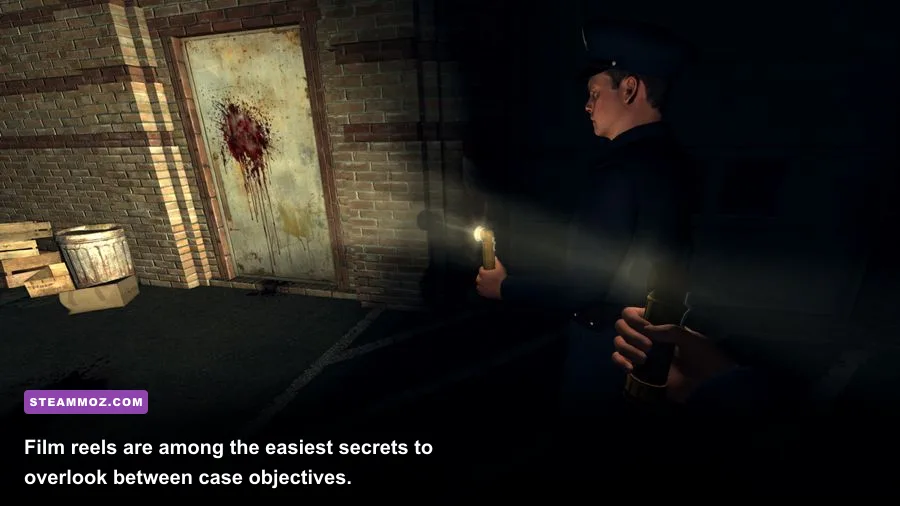
There are four types of optional content to track. First are landmark discoveries, found while driving or walking through Los Angeles. Second are inspectable objects that aren't required to complete a clue chain but can trigger an achievement, a character reaction, or a small bit of period detail. Third are range and combat challenges, where accuracy and speed can produce achievement progress. Finally, there are case ratings and replay rewards: five-star completions, correct interrogations, and clean pursuit sequences.
The VR version's biggest trap is assuming every suspicious object is collectible. Some newspapers, props, and buildings are simply atmosphere. If an object can be picked up, rotated, opened, or examined, give it a proper look; the game often requires you to place it at eye level or turn it in your hand before the clue registers. A quick glance is not always enough.
| Secret type | Where to look | Typical reward | Best tracking method |
|---|---|---|---|
| Landmarks | Driving routes and open city sections | Discovery progress or achievement credit | Explore before following the next case marker |
| Optional objects | Crime scenes, offices, alleys, and cars | Extra dialogue, clue context, or achievement progress | Sweep shelves, desks, trunks, and walls |
| Accuracy challenges | Shooting range and gunfights | Combat-related achievement progress | Use deliberate two-handed aiming |
| Five-star rewards | Case replay and score screen | Completion progress and achievements | Replay failed interviews instead of restarting everything |

🎮 L.A. Noire: The VR Case Files
Looking to experience this game? Grab your digital key directly on our store for $14.99.
View on Steammoz Store →Secret locations to check between cases

The most reliable hidden-location sweep happens during free-roam travel. Before entering the next marked destination, slow down and look for recognizable Los Angeles landmarks. The Hollywood Sign, Griffith Observatory, TCL Chinese Theatre, Egyptian Theatre, and Capitol Records Building are especially easy to miss if you fast-travel through the investigation flow. These are not random loot rooms; they are sightseeing discoveries built into the city route.
Drive around the Hollywood and downtown districts rather than staying on the yellow line. Check major civic buildings, theaters, towers, and large public monuments from more than one angle. If the game pauses briefly or displays discovery feedback, the location has counted. If nothing happens, move closer and face the landmark directly. VR's camera position can make a building appear visible when the trigger volume is still several metres away.
Also inspect the spaces immediately around case destinations. Police stations, alleys, garages, cafés, and courtyards often contain optional props. In Upon Reflection, don't sprint straight to the first body: search the surrounding alley and nearby surfaces first. In The Consul's Car, examine the vehicle carefully before moving on. Openable compartments and interior evidence are easy to skip because the next objective appears quickly.
For a broader exploration checklist, compare the structure with Steamoz's Deleveled secret locations guide and Edge of Eternity hidden-rewards guide. The games handle secrets differently, but the same rule applies: clear the optional space before triggering the next story beat.
Case-by-case sweep for hidden rewards
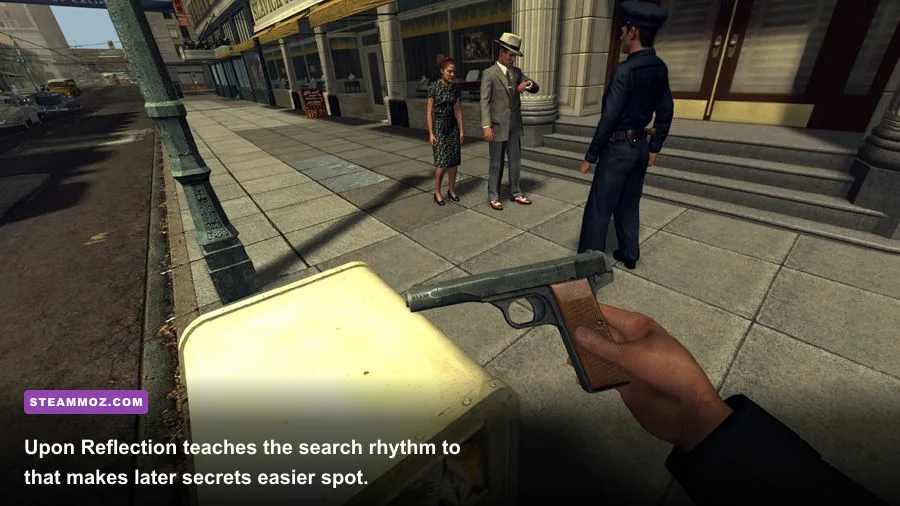
Upon Reflection
This opening Traffic Desk case is the best place to learn the inspection rhythm. Search the alley, examine the victim, and turn every physical clue until Phelps comments on it. Pay attention to the weapon and nearby surfaces rather than relying only on the glowing clue prompt. During the interview, correct evidence selection matters more than simply choosing an aggressive response. A clean interrogation supports the five-star target and helps you learn how intuition points work.
The Consul's Car
At the car scene, inspect the vehicle from both sides and interact with its accessible compartments. VR makes this more demanding than the original game because you physically reach, open, and rotate evidence. Before leaving, walk the edge of the scene and check the adjacent street. The hidden-value play here is thoroughness: the game rewards finding the complete evidence chain, not just the object highlighted by your partner.
The Silk Stocking Murder
This is one of the cases where environmental storytelling can distract from evidence. Search the murder scene methodically, then revisit desks, drawers, and nearby rooms after the main clue appears. When questioning witnesses, use intuition only when you have narrowed the answer. Spending all four intuition points in one interview can help reveal an answer, but it also reduces the safety net available for later questions.
Reefer Madness
Check the interiors before pursuing the major suspects. Bars, offices, and storage areas contain period props that are easy to overlook when the case pushes you toward the next conversation. During action sequences, keep your weapon lowered until you need it: premature aiming can make you miss contextual interactions. Replay this case after completing it once, because you now know which rooms are safe to search and which encounters are time-sensitive.
The Gas Man
Fire scenes are visually noisy, so use a grid. Start at the victim, move clockwise around the room or wreckage, then check the perimeter. Inspect burn patterns, containers, and any object that can be lifted or turned. Don't assume a clue is complete because the controller vibrates; hold the object steady until Phelps finishes his observation. This case is also a strong test of interview accuracy, making it useful for a five-star replay.
A Different Kind of War
This case mixes investigation with heavier combat. Search the accessible environment before the firefight begins, because some optional interactions disappear once the scene advances. In combat, lean and aim rather than waving the controller. Revolvers reward careful head and upper-torso shots, while panic firing burns time and ammunition. Clearing encounters efficiently supports the action-focused achievements and leaves more room for exploration.
Case File replay sections
The final selected case and replay menu are less about discovering one magic room and more about cleaning up missed rewards. Use the case score screen to identify weak categories: evidence, questions, damage, or pursuit performance. Replay only the problematic section when the menu allows it. This is much faster than replaying every case from the beginning, especially when a missed interrogation answer—not a secret location—is what blocked five stars.
| Case or activity | Highest-value sweep | Main failure point | Replay priority |
|---|---|---|---|
| Upon Reflection | Alley edges, weapon, victim, nearby surfaces | Rushing the first clue | High for new players |
| The Consul's Car | Vehicle exterior, compartments, adjacent street | Leaving after the obvious clue | High for evidence cleanup |
| The Silk Stocking Murder | Rooms, desks, drawers, interview evidence | Burning intuition points too early | High for five stars |
| Reefer Madness | Bars, offices, storage spaces | Triggering the next encounter | Medium |
| The Gas Man | Fire perimeter and movable evidence | Missing clues in visual clutter | High |
| A Different Kind of War | Pre-combat rooms and cover positions | Starting combat before searching | Medium |
How to unlock the combat and accuracy rewards

Hidden rewards aren't limited to sightseeing. The shooting range and action scenes have their own skill checks, and VR's motion controls make technique matter. Grip the revolver with two hands when precision matters, keep both eyes open, and bring the sights to your natural line of sight instead of extending your arms wildly. Fire only after the reticle settles. The game doesn't use a conventional RPG damage-stat system, so there is no weapon upgrade route to compensate for poor accuracy.
For gunfights, use cover as a reset point. Pop out, acquire one target, fire, and return behind cover. Enemies telegraph themselves with movement and muzzle flashes, but throwing yourself into the open can produce unnecessary damage and lower the case rating. During pursuits, avoid reckless shortcuts unless the route clearly demands them. A clean sequence is usually worth more than shaving a few seconds.
If you want the highest completion percentage, finish the story once without obsessing over perfection. Then replay with a checklist. The first run teaches where the game allows free movement; the second run is where you collect landmarks, inspect optional objects, correct interview mistakes, and chase five stars.
Settings that make secrets easier to spot
There is no brightness slider that magically reveals every hidden object, but stable VR performance helps. Motion blur should be disabled if available, supersampling should stay conservative, and headset tracking must remain solid. Stutters can make small interactable prompts appear late or cause you to miss a handoff. For PC troubleshooting, Steamoz's guides to crashes and low FPS and FPS-focused settings offer useful general tuning habits.
| Setting or habit | Recommended choice | Why it helps |
|---|---|---|
| Supersampling | Use the headset's stable default | Sharper clues without introducing frame-time spikes |
| Motion blur | Off | Keeps small props and text readable during turns |
| Room lighting | Even, indirect light | Improves controller and headset tracking |
| Case exploration | Pause before each objective trigger | Prevents optional interactions from disappearing |
The cleanest 100-percent route
Start by completing every case naturally and collecting every obvious clue. On the second pass, drive off the marked route and visit recognizable landmarks before entering the next destination. In each crime scene, sweep left to right, inspect every object that supports an interaction, and only then activate the next story prompt. Finish with interview and combat replays for five-star cleanup.
Keep the official Steam listing nearby for the current achievement set, and check Rockstar's L.A. Noire page for version information. The important takeaway is simple: don't hunt for a nonexistent universal loot table. In VR, the real hidden rewards come from seeing more of Los Angeles, handling evidence properly, and replaying cases with the patience of an actual detective.