
Yes—Halo on PC is still worth playing in 2026, especially through Halo: The Master Chief Collection, but only if you know which parts you want. MCC delivers six classic campaigns, a huge multiplayer library, Firefight, Forge, split-era matchmaking, and excellent mouse-and-keyboard support for a price that is usually lower than a new AAA release. Its rough edges are real: uneven PC ports, intrusive anti-cheat requirements, occasional matchmaking quirks, and a player base divided across several games. Still, the shooting, encounter design, music, and co-op replay value have aged remarkably well.
If you want a modern live-service shooter with the busiest current arena scene, Halo MCC on Steam is not the whole answer. If you want a playable history of console FPS design that remains mechanically sharp, it is one of the best bargains on PC.
What You Actually Get With Halo PC
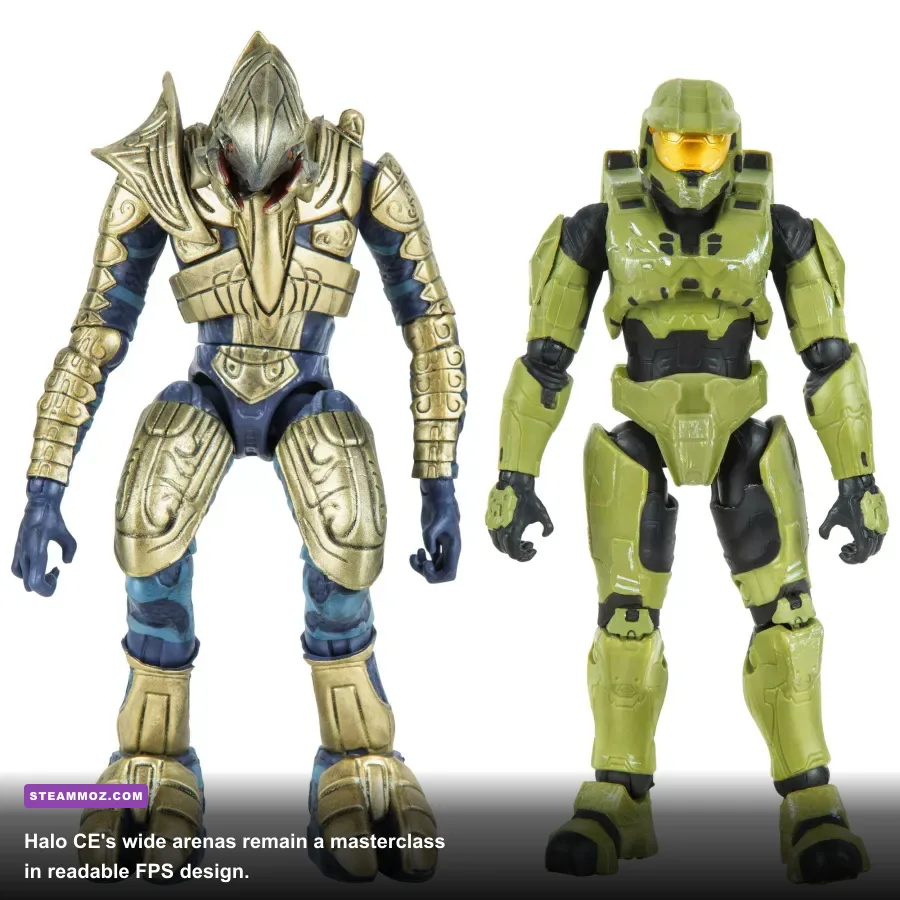
The important distinction is between Halo: The Master Chief Collection and Halo Infinite. MCC contains Halo: Combat Evolved Anniversary, Halo 2: Anniversary, Halo 3, Halo 3: ODST, Halo: Reach, and Halo 4. The collection also includes campaign co-op, competitive multiplayer, Forge, Theater, custom games, and Firefight for the games that support it. That is an enormous amount of content, and it still feels coherent because every title is built around the same fundamentals: two-weapon loadouts, grenades, vehicles, shield management, and map control.
Campaign structure is the biggest reason to buy it. Halo CE is compact and mechanically pure, while Halo 2 adds dual wielding, stronger enemy pressure, and the Arbiter's active camouflage. Halo 3 is the cleanest all-rounder, ODST slows the rhythm with a more vulnerable protagonist, Reach adds armor abilities and a darker military tone, and Halo 4 pushes toward modern cinematic spectacle. You can play them in release order or follow the in-universe chronology; release order is better because the combat systems evolve naturally.
| Game | Best Reason to Play | 2026 Caveat |
|---|---|---|
| Halo CE | Sandbox encounters and iconic level layouts | Repetitive interiors and dated enemy behaviors |
| Halo 2 Anniversary | Best cutscenes and aggressive combat | Legendary difficulty can feel brutally tuned |
| Halo 3 | Excellent weapons, vehicles, and multiplayer maps | Visual style is showing its age at high resolution |
| Halo 3: ODST | Atmosphere, nighttime exploration, Firefight | Shorter campaign and slower pacing |
| Halo Reach | Strong story and flexible armor abilities | Armor Lock remains divisive in multiplayer |
| Halo 4 | Polished presentation and modern movement | Less distinctive sandbox than the earlier games |
Why the Combat Still Feels So Good

Halo's secret is not simply that its guns feel heavy. It is the way the sandbox forces you to solve encounters instead of following a fixed damage rotation. A fully shielded Elite can shrug off body shots, but a plasma weapon such as the Plasma Pistol strips that shield quickly. You then switch to a precision weapon—usually the Battle Rifle, Magnum, or DMR depending on the game—to finish the exposed target. That plasma-to-precision rhythm is simple enough for a new player and deep enough to shape high-level play.
The most famous example is the Halo 2 Anniversary Battle Rifle. Its four-round burst rewards controlled head-level aim, while the Needler becomes lethal when enough shards track one target and trigger a supercombine explosion. The Covenant Carbine offers a faster projectile rhythm and works well at medium range, but it lacks the Battle Rifle's forgiving burst pattern. Meanwhile, the Energy Sword and Gravity Hammer are not panic buttons: smart players use corners, elevation, and radar information to create a clean approach.
Enemy telegraphs are equally important. Jackal shields create a visible opening on the hand side; Grunts often panic after their Elite leader dies; Brutes change behavior when their armor is damaged; Hunters expose the orange weak spot on their back after a committed melee swing. These cues make Halo readable without making it easy. On Heroic, enemies punish careless positioning. On Legendary, the same encounter can demand grenade displacement, weapon cycling, and line-of-sight control before you even consider pulling the trigger.
The weapons that reward returning players
- Battle Rifle: The safest precision choice in Halo 2, Halo 3, and Halo 4. Burst at the head, then immediately reposition.
- Plasma Pistol: Best used as a shield opener, not a primary weapon. The overcharged shot tracks targets in several games, but holding it too long exposes you.
- Needler: Excellent against isolated infantry. Do not waste ammunition on vehicles or targets that can easily break line of sight.
- Shotgun: Devastating inside its effective range, yet much less reliable when latency, spread, or a host advantage enters the equation.
- Sniper Rifle: A power weapon because it changes map control. Two body shots can be safer than gambling on a difficult headshot.
How Halo PC Performs in 2026
MCC is easy to run by modern standards, but the experience depends more on frame pacing and display setup than raw visual quality. The older games can reach very high frame rates, while Anniversary graphics, split-screen emulation, large Forge maps, and some campaign transitions can create inconsistent frametimes. A locked 60 frames per second feels perfectly authentic; a stable 120 or 144 fps makes aiming and camera control noticeably cleaner, especially in multiplayer.
Use the in-game frame-rate limiter if uncapped output produces uneven pacing. Enable Enhanced graphics when you want the remastered assets, but switch to Original graphics in Halo CE or Halo 2 when you want the original lighting and atmosphere. Halo CE Anniversary's remaster can obscure visual landmarks with brighter foliage and altered geometry, so Original mode is not merely a nostalgia toggle—it can improve readability on certain maps.
| Setting or Profile | Recommended Value | Performance Impact | Visual Trade-Off |
|---|---|---|---|
| Resolution | Native monitor resolution | Medium to high | Best clarity for precision weapons |
| Frame limit | Monitor refresh minus 2 or 3 fps | Stabilizes pacing | Slightly less peak performance |
| Graphics mode | Enhanced for newer hardware | Low to medium | Sharper assets, altered classic lighting |
| V-sync | Off with VRR; on without VRR | Low | Off reduces latency but may tear |
| Motion blur | Off | Small gain | Cleaner target tracking |
| Texture quality | High | Low on modern GPUs | Sharper environments and characters |
For a practical baseline, the official Halo Support documentation is worth checking before troubleshooting. A modern six-core CPU, 16 GB of RAM, and a graphics card around the GTX 1660 or RX 580 class are comfortable for 1080p high-refresh play, although lower-end systems can run the older campaigns well. If another PC game is stuttering, our PC crash and FPS troubleshooting guide covers the same useful basics: clean drivers, disable unnecessary overlays, and test frame limits before blaming the hardware.
Multiplayer Is Still Worth Your Time—With One Warning
MCC multiplayer remains compelling because its maps create recognizable strategic problems. On Blood Gulch, vehicle routes and long sightlines make the Sniper Rifle and Rocket Launcher central to control. On The Pit, the Battle Rifle lane is dangerous but valuable, while overshield timing can decide a close match. Guardian is more vertical and punishes players who lose track of lift rooms and power-weapon rotations. These maps are older, but their geometry is still legible, competitive, and fun in a way many larger modern maps are not.
The warning is population fragmentation. MCC matchmaking can place you into different titles, playlists, and input pools, so activity varies by region and time of day. Halo 3 and Reach usually provide the easiest entry point, while niche game-specific playlists may require patience. Mouse and keyboard players also face a different feel from controller users: aim assist, projectile behavior, and close-range tracking can make controller a strong choice in some playlists. Try both before deciding that your accuracy is the problem.
Ranked play is best approached with a squad. Communication matters because power weapons have predictable respawn windows, dropped weapons communicate information, and a two-player crossfire is vastly stronger than isolated duels. If you are returning after years away, start with social Slayer, then play objective modes once grenade throws, melee timing, and weapon swaps feel automatic.
Halo Infinite Versus MCC in 2026
Halo Infinite is the better choice if you want the newest movement model, Grappleshot mobility, modern lighting, and an active free-to-play multiplayer ecosystem. Its campaign has an open-world structure built around Zeta Halo, FOB captures, Spartan Cores, and equipment upgrades. The Grappleshot changes traversal and combat: it can steal a weapon, close distance, reach a ledge, or escape a bad fight. That flexibility is exciting, but it also makes Infinite feel less deliberate than the classic games.
MCC is the better choice for campaigns, co-op, classic arena maps, Firefight, and historical variety. Infinite is the better choice for contemporary matchmaking and a more approachable onboarding flow. You do not have to pick only one: install Infinite for current arena sessions and MCC for the campaign marathon. The official Halo Waypoint site remains the best place to track seasonal updates, patch notes, and playlist changes.
| Priority | Best Pick | Why |
|---|---|---|
| Classic campaigns | MCC | Six games, co-op, original and Anniversary presentation |
| Current free multiplayer | Halo Infinite | Newest systems and active seasonal support |
| Firefight and custom games | MCC | More classic modes and a broader legacy sandbox |
| Open-world exploration | Halo Infinite | FOBs, Spartan Cores, vehicles, and equipment upgrades |
| Low-cost entry | Halo Infinite multiplayer | Free-to-play access without buying the campaigns |
The Verdict for 2026
Halo PC is still worth playing in 2026 because its best ideas were never tied to cutting-edge visuals. The shield system, readable enemy roles, flexible weapon sandbox, and vehicle-focused arenas remain unusually complete. You can play Halo CE on Normal for a quick nostalgia hit, grind Legendary co-op with friends, learn Halo 3 ranked fundamentals, or lose an evening building ridiculous Forge scenarios. Few collections offer that many distinct flavors of the same foundational shooter.
It is not flawless. Halo CE's repeated corridors, Halo 2's punishing Legendary balance, inconsistent PC-era edge cases, and MCC's divided matchmaking can test your patience. Even so, those weaknesses are outweighed by the quality and quantity of the core games. If you have never played Halo on PC, buy MCC first. If you already own it, reinstall it with a focused plan: play the campaigns in release order, use Original graphics for the games where remaster changes hurt readability, and start multiplayer with Halo 3 or Reach.
My honest score for the 2026 PC experience is 9/10 for value, 8/10 for technical polish, and 10/10 for historical importance. The Master Chief Collection is no longer just a museum piece. It is still a remarkably playable FPS anthology—and for campaign co-op and sandbox combat, it remains harder to replace than most newer shooters.
Before installing, compare storage and hardware details on the official Halo Infinite Steam page, and keep your drivers current. For broader performance habits, our guides to maximizing FPS in demanding PC games and fixing crashes and low FPS are useful companions.