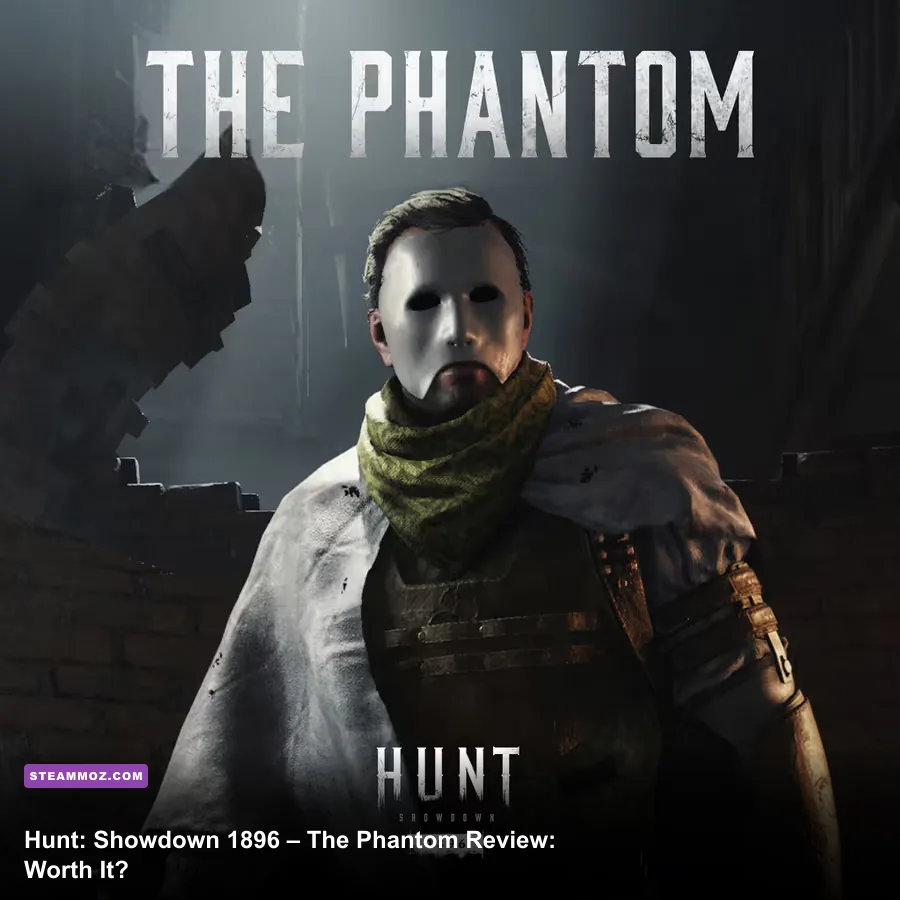
Yes, Hunt: Showdown 1896 is worth playing in 2026—but The Phantom itself isn't a new campaign, mode, or standalone game. It's a cosmetic Legendary Hunter attached to Hunt's full extraction-shooter experience. Buy it if you love the masked, gothic gunslinger design and already plan to spend dozens of hours in the bayou; skip it if you're expecting exclusive weapons, stronger stats, or meaningful gameplay advantages. The real value comes from the base game: brilliant sound-based PvPvE, brutal one-shot firefights, and a progression system that still makes every extraction feel earned.
That distinction matters because the name The Phantom can make the Steam listing sound larger than it is. The DLC doesn't turn Hunt into a different game. It gives you a premium identity inside the same 12-player Bounty Hunt ecosystem, where teams track bosses, steal Bounty Tokens, and try to extract before rival hunters turn the exit into a firing squad. You can start with the official Hunt: Showdown 1896 Steam page, while Crytek's official Hunt website remains the best place to follow live-service changes.

What The Phantom actually adds
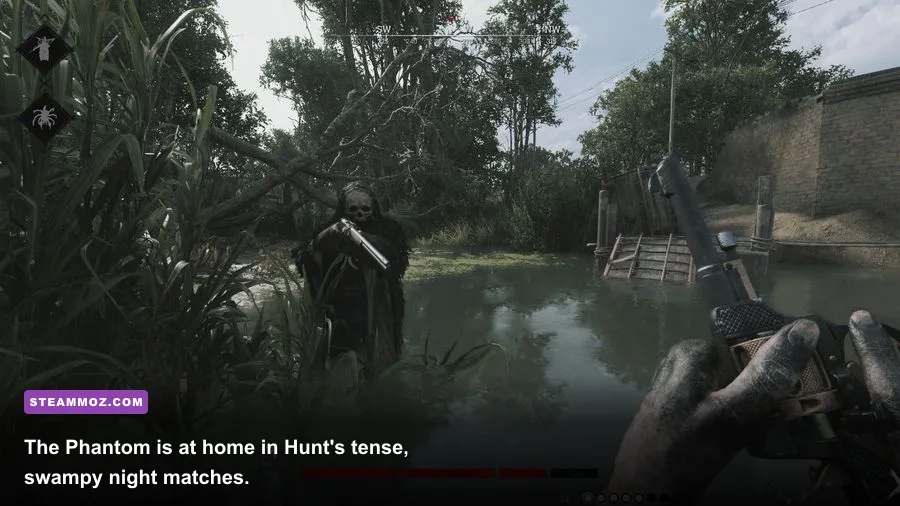
The Phantom is a Legendary Hunter skin, not a class. It doesn't alter movement speed, health, stamina, weapon handling, Dark Sight, or interaction speed. That is important in a competitive game where even a tiny stat advantage would damage the entire premise. The Phantom enters a match under the same rules as every other hunter, and the only practical difference is visual recognition—both yours and your opponent's.
That doesn't make the skin meaningless. Hunt's first-person perspective hides most of your own model during play, but the silhouette and outfit still show up in third-person lobby screens, death screens, revival moments, and post-match results. More importantly, choosing a Legendary Hunter gives your roster personality. Hunt is unusually good at making a cosmetic feel like a character rather than a shop mannequin because every hunter can die permanently during a bad contract.
The catch is value. A Legendary Hunter may cost premium currency or arrive in a bundle, and the cosmetic cannot rescue a match where your trio ignores sound traps, sprints through water, or takes a fight with no exit route. If you want new weapons, traits, map content, or a separate progression path, The Phantom is the wrong purchase. If you want the look, understand the cosmetic-only trade clearly.
| Feature | The Phantom provides | What it does not provide |
|---|---|---|
| Hunter identity | Distinct Legendary Hunter appearance | A new class or special ability |
| Combat performance | Standard Hunt hitboxes and handling | Bonus health, armor, speed, or damage |
| Progression | Access to the normal roster and loadouts | Exclusive levels, traits, or weapon unlocks |
| Matchmaking | Works in ordinary Bounty Hunt play | A separate Phantom queue or scenario |
🎮 Hunt: Showdown 1896 - The Phantom
Looking to experience this game? Grab your digital key directly on our store for $2.49.
View on Steammoz Store →Why Hunt: Showdown 1896 still feels special
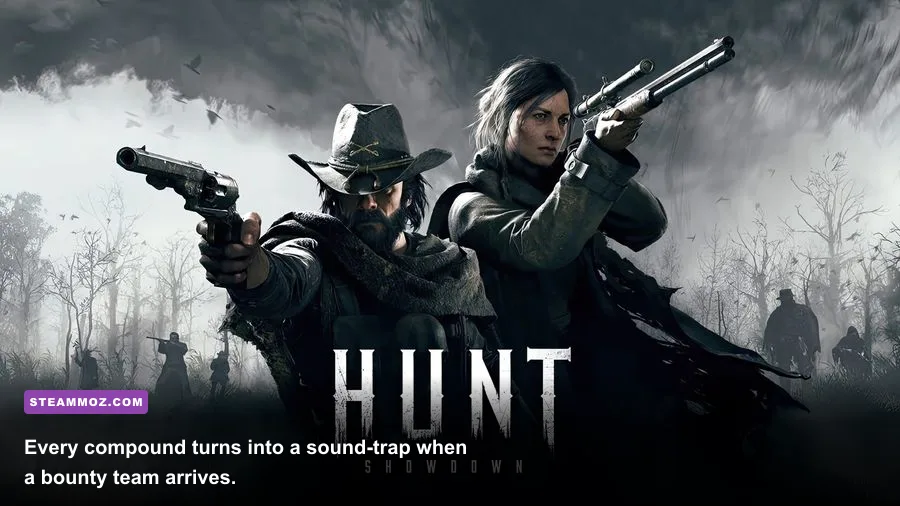
Hunt's hook is simple to describe and difficult to replicate: kill a boss, banish it, take the bounty, and escape. The tension comes from the fact that every step creates information. A suppressed shot might save ammunition but still reveal a muzzle flash. A hive swarm, armored grunt, horse, crow flock, or broken glass can broadcast your route. A team that reaches the lair first gains time, but the banishment pulse also tells every surviving hunter exactly where the fight is happening.
Dark Sight makes the bounty carrier visible through brief pulses, yet using it drains a limited resource. That creates a nasty decision: spend Dark Sight to locate an ambush, or save the charge for the extraction run? Bounty carriers also become targets on the map, and the lightning marking their position means a successful boss kill is only the beginning. The smartest teams don't simply rush the nearest exit. They listen for footsteps, check likely approach lanes, and choose an extraction point that limits sightlines.
Gunfights remain the game's strongest feature because damage is positional rather than sponge-based. A Winfield 1893 headshot can end a fight instantly at the right distance; a Sparks LRR can strip a hunter to a single health point but needs a follow-up weapon to finish the job. The Caldwell Rival 78 punishes close pushes, while the Vetterli 71 Karabiner offers a forgiving medium-range rhythm for players still learning bullet travel and lead.
Hunt's maps also reward memory. Mammon's Gulch introduces steep vertical routes, towers, mine entrances, and long sightlines that make elevation management crucial. Stillwater Bayou favors careful movement through water and dense cover. Lawson Delta creates compound-to-compound engagements where a team can be pinned by several angles. DeSalle's towns and courtyards produce their own rhythm of windows, rooftops, and hard cover. The Phantom looks good in all of them, but map knowledge—not cosmetic choice—wins the contract.
For a useful contrast, Steamoz's Bounty Train review covers a much more forgiving strategy loop. Hunt is the opposite: it turns information and nerves into its primary resources.
Weapons, traits, and the progression curve
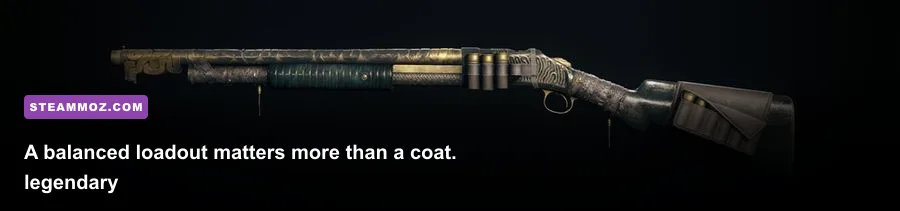
The progression system is intentionally awkward at first. You unlock weapons through Bloodline progression and weapon-family XP, then build a loadout around the ammunition, range, and handling you can actually control. A new player often reaches for the most expensive rifle and still loses because they don't know when to disengage. Hunt rewards a coherent pairing more than a premium price tag.
A practical early setup is the Winfield 1893 Swift with a Caldwell Conversion Pistol. The Winfield's rapid follow-up shots help in medium-range fights, and the Conversion gives you a dependable backup when a reload is unsafe. The Vetterli 71 paired with a Caldwell Pax is a stronger learning loadout once you understand bullet travel. For a long-range plan, the Sparks LRR and a fast-firing sidearm create a clear rule: land the body shot, then immediately switch and finish before the target reaches cover.
Shotgun users need to respect distance. The Caldwell Rival 78 is devastating inside its effective range, but missing both barrels leaves a dangerous recovery window. The Winfield 1893 Slate offers more sustained pressure, while the Romero 77 rewards deliberate aim with a single powerful shell. No shotgun makes poor positioning disappear. If the enemy has a rifle and 70 metres of open ground, the correct answer is usually rotation, not a heroic sprint.
Traits turn these choices into a build. Greyhound extends the hunter's sprint endurance and helps you cross exposed ground without stopping as often. Doctor improves the value of First Aid Kits by allowing a full heal from one kit, while Physician speeds the healing animation. Determination and Bulwark can make melee-heavy or explosive situations less punishing. Necromancer has historically been a high-impact pick for team recovery, but its behavior and cost have changed across live updates, so check the current patch notes before treating an old build guide as law.
The best habit is to buy around a job: breaching, holding a compound, scouting, or extracting. Don't spend every dollar on a rifle and then enter without choke bombs, a medkit, and a source of close-range pressure. Hunt's economy is generous enough to recover from a bad match, but not generous enough to excuse careless purchases every round.
| Loadout | Strength | Weakness | Best use |
|---|---|---|---|
| Winfield 1893 Swift + Conversion | Fast follow-up fire and flexible range | Less reliable at extreme distance | Learning compounds and rotations |
| Vetterli 71 + Pax | Strong medium-range control | Slower handling than compact rifles | Mixed terrain and team support |
| Sparks LRR + fast sidearm | Excellent opening damage | Single-shot reload pressure | Long sightlines and patient picks |
| Romero 77 + compact pistol | High close-range burst | One shell before reload | Compound defense and ambushes |
Bosses, sound traps, and the real learning curve
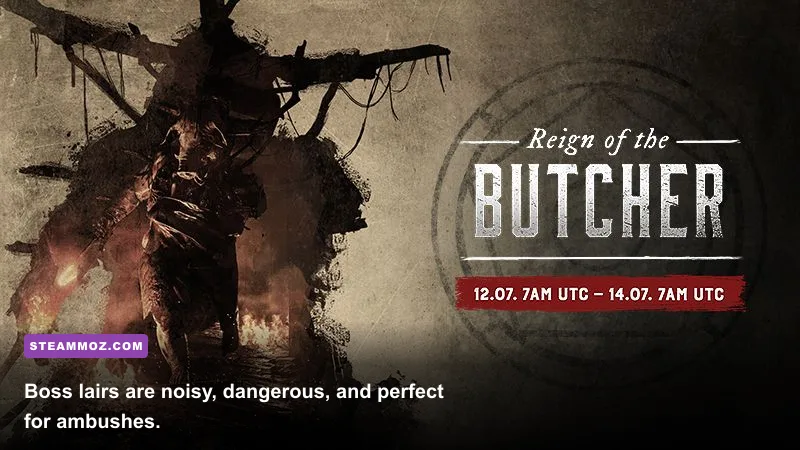
Boss fights are less about mechanically mastering a health bar than controlling noise and timing. The Butcher swings in broad arcs and punishes hunters who stand in front of him; clear an opening, strike, and retreat rather than greedily chaining hits. The Assassin vanishes, sends a swarm of copies through the room, and attacks from awkward angles. Its audio cue is as important as its visual model. Scrapbeak carries valuable supplies but drops fewer items during the fight, so a team that burns all its consumables in the lair may regret the victory.
The Spider's ceiling movement and poison attacks make it difficult to track, while Hellborn pressures players with fire and aggressive movement in the event or map conditions where it appears. Rotjaw changes the traditional boss routine by placing the encounter around water and open approaches. Each boss can be damaged quickly with the right tool, but stealth often matters more than speed. A loud boss kill is an invitation unless your team has already cleared nearby compounds.
Sound is Hunt's most important weapon. Footstep material changes on wood, metal, dirt, mud, and water. Crows and ducks can expose a rotation. Dogs and horses create panic that may cover an enemy push—or reveal your own. Even opening a door carries tactical information. Good players don't merely listen for footsteps; they build a mental map from every sound and ask what the enemy now knows about them.
That is why The Phantom can be fun for veterans but misleading for newcomers. The skin delivers instant atmosphere, yet the first 10 hours of Hunt are still a crash course in audio discipline, compound geometry, healing downtime, and ammunition management. New players should resist sprinting everywhere. Walk when approaching a likely fight, crouch only when the concealment is worth the slower movement, and never assume silence means safety. Another team may simply be waiting.
Steamoz has approached the same kind of knowledge-building from different angles in its Crashout Crew weapon guide and Excubitors starter build guide. Hunt's lesson is harsher: there is no perfect tier list when the player behind the rifle gives away his position.
Performance and PC settings in 2026
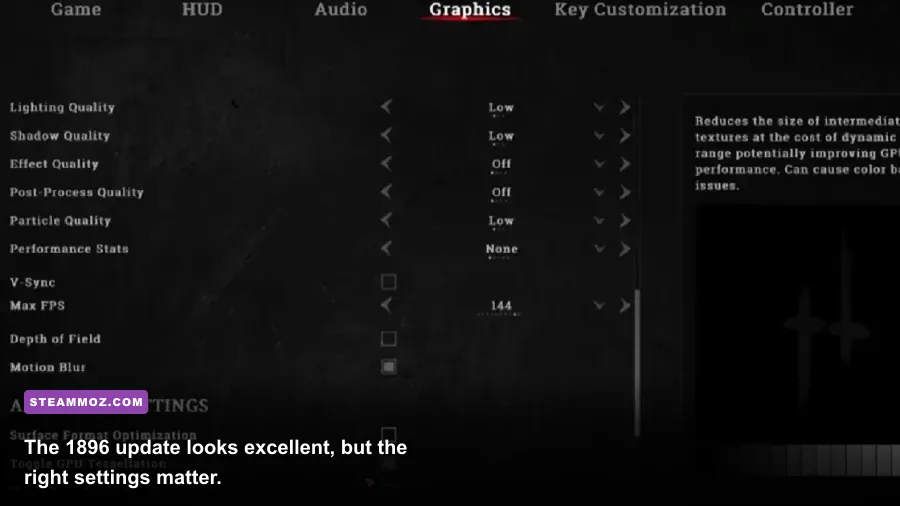
Hunt: Showdown 1896 moved to CryEngine 5.11, bringing a major visual upgrade along with heavier hardware demands. The lighting, volumetric fog, foliage, and distant geometry can look superb, especially on Mammon's Gulch, but unstable frame pacing is more damaging here than in a slower single-player shooter. A clean 90 frames per second with consistent frametimes is preferable to a fluctuating 130 that drops during a compound fight.
Use the official Hunt: Showdown Steam news hub for current optimization notes because patches can change performance behavior. As a sensible baseline, 16GB of RAM is more comfortable than the listed minimum, an SSD reduces loading friction, and a modern six-core CPU helps with busy scenes. DLSS or FSR can recover GPU headroom, but aggressive upscaling may soften distant hunter silhouettes—the exact targets you need to read.
| Setting | Recommended value | FPS impact | Visual trade-off |
|---|---|---|---|
| Resolution scale | 100%; use DLSS/FSR Quality if needed | High when reduced | Lower scale blurs distant targets |
| Texture quality | High if VRAM allows | Low to medium | Mostly affects surface detail |
| Object quality | Medium or High | Medium | Changes distant geometry clarity |
| Lighting and effects | Medium | Medium to high | Lower values reduce atmosphere and glare |
| Volumetric fog | Medium | Medium | Lower settings improve clarity in haze |
| Motion blur | Off | Negligible | Sharper target tracking |
Competitive players should disable motion blur, keep mouse input consistent, and test settings in a real match rather than trusting a static benchmark. Hunt's most important performance test is a crowded compound with fire, smoke, weather, and several hunters exchanging shots. If your minimum frame rate collapses there, lower effects and fog before sacrificing texture quality.
Is The Phantom worth buying in 2026?
The answer splits cleanly between the DLC and the game. Hunt: Showdown 1896 is worth playing in 2026 if you want a demanding extraction FPS where sound, patience, and map knowledge matter more than constant ability spam. It remains a rare multiplayer shooter in which a single missed footstep can decide a 30-minute match, and its weapons still feel distinct enough to make loadout choices meaningful.
The Phantom is worth buying only as a cosmetic purchase. It has no gameplay advantage, no exclusive mission, and no reason to own it if you don't like the design. Treat it like a premium character skin, not an expansion. If the price feels high, buy the base game first, learn whether Hunt's slow approach and permanent hunter risk appeal to you, and revisit the skin later.
There are real reservations. Match quality can vary by region and time of day. Live-service balance changes can invalidate familiar trait routines. New players face veterans who know every compound angle, and the onboarding doesn't fully explain why a team lost after apparently winning the boss fight. Hunt can also be merciless when performance problems, disconnects, or an unlucky third-party attack erase a strong run.
Still, the core loop has remarkable staying power. The Phantom won't make you a better hunter, but Hunt gives you enough tools to become one: a Winfield for confidence, a Sparks for discipline, a medkit for survival, and your ears for everything else. For players who want an atmospheric, high-stakes FPS rather than a disposable cosmetic spectacle, Hunt: Showdown 1896 remains one of the best multiplayer shooters to pick up in 2026.
If you're comparing hardware before jumping in, Steamoz's PC performance troubleshooting guide offers useful general fixes, while this system-specs breakdown explains how to think about demanding PC releases. Just remember the final rule of Hunt: the best-looking hunter in the lobby is still one loud mistake away from the loading screen.