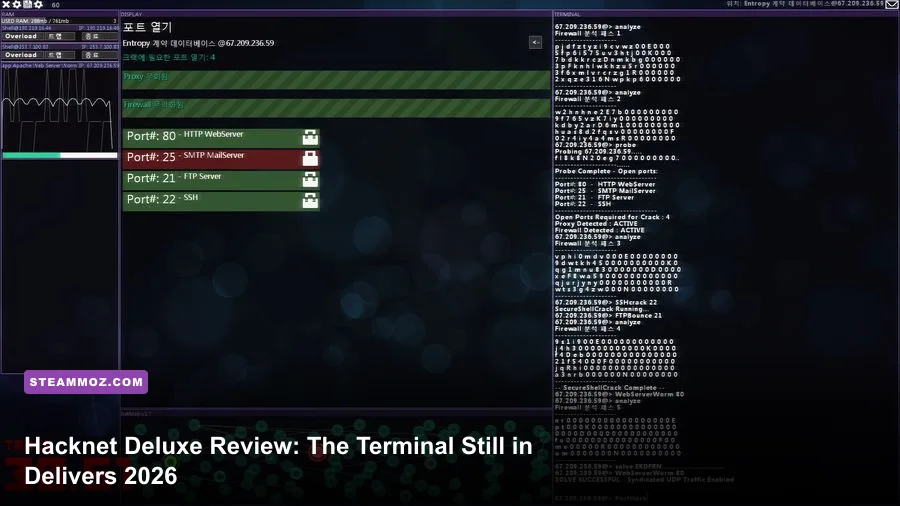
Yes, Hacknet - Deluxe is still worth playing in 2026 if you want a compact, clever hacking thriller rather than a realistic cybersecurity simulator. The Deluxe package combines the original Hacknet campaign with the Labyrinths expansion, and that extra story is the real reason to buy this edition. The interface looks dated, but the escalating trace timers, satisfying command-line tools, and surprisingly sharp writing still create tension that most modern “hacking” games never reach.
What you get is a mouse-and-keyboard puzzle game built around a fictional operating system. You investigate the disappearance of the hacker Bit, follow mission leads through interconnected computers, and use commands such as probe, scan, nmap, ssh, ftp, connect, ls, cd, and cat to break into targets. You are not learning a transferable hacking toolkit, but you are learning how to think under pressure.
What Hacknet Deluxe includes in 2026
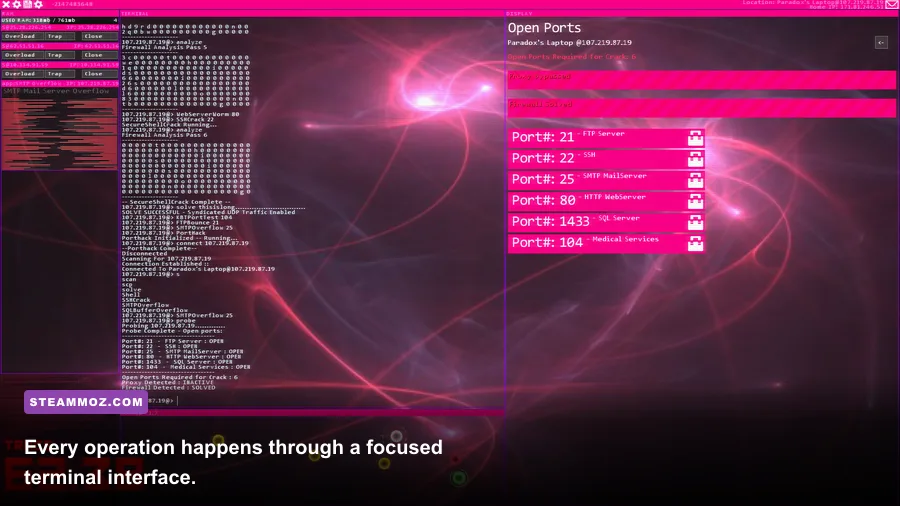
The standard game is built around Bit’s unfinished work. After receiving a mysterious message, you take contracts from different operators, identify vulnerable ports, access remote systems, search files, and complete objectives before the target traces your connection. The campaign is linear enough to keep the story moving, but missions still leave room for experimentation.
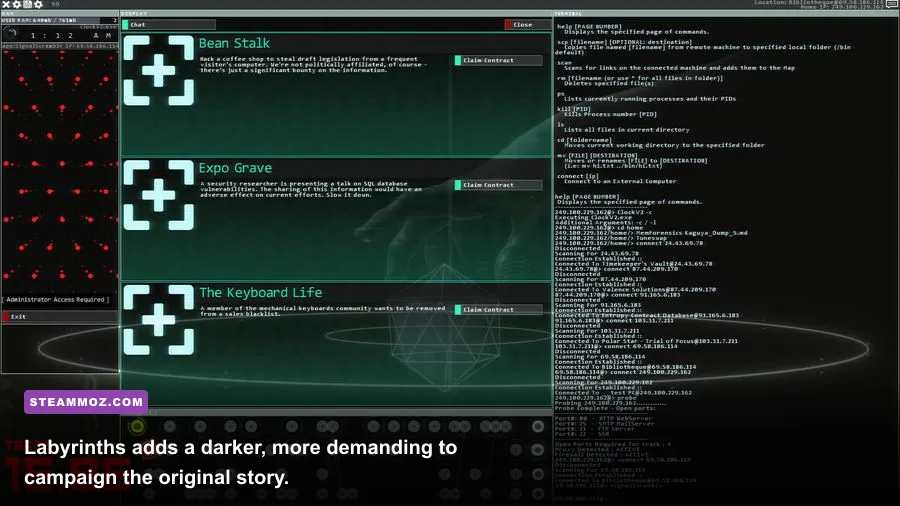
Labyrinths expands that formula with a separate campaign focused on the darker corners of Hacknet’s world. It introduces new characters, additional mission chains, fresh locations, and more demanding network layouts. The expansion expects you to understand the base game’s vocabulary, so it works best after the original campaign rather than as a first stop.
| Edition | Included Content | Best For |
|---|---|---|
| Hacknet | Original campaign and core missions | Players who want the cheapest introduction |
| Hacknet - Labyrinths | Standalone expansion campaign | Returning players who know the command system |
| Hacknet - Deluxe | Base game plus Labyrinths | New players buying the complete experience |
Steam’s official Hacknet page remains the best place to check current bundle pricing and platform support. The Deluxe Edition is particularly easy to recommend during a sale because the base campaign teaches the systems and Labyrinths pays off that knowledge.

🎮 Hacknet - Deluxe
Looking to experience this game? Grab your digital key directly on our store for $2.24.
View on Steammoz Store →How the hacking gameplay actually works
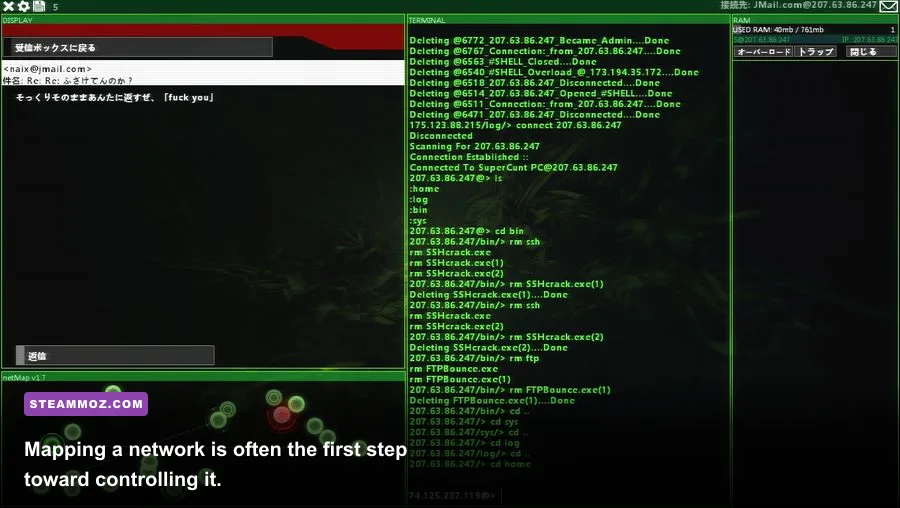
Hacknet’s genius is that it makes simple commands feel consequential. You begin by probing a system to identify available ports. A command like probe reveals the services you can attack, while nmap gives a broader view of the target’s network. Once the correct port is open, you use tools such as SSHcrack, FTPBounce, or WebServerWorm to gain access.
The game does not bury you under real shell syntax. Instead, each command has a clear purpose and the operating system gradually introduces new tools. That makes the early missions feel like a tutorial without stopping the story for long lectures. You learn by needing a tool immediately, then watching how it changes your options.
The real pressure comes from the trace timer. Actions on a target can increase the chance that an administrator notices your intrusion, and once the countdown begins, every second matters. You can disconnect, move through another node, delete logs, or kill processes, but none of those actions guarantees safety forever. A messy attack may succeed technically and still fail because you stayed connected too long.
The most important habits
- Probe before attacking. Do not blindly run tools. Find the available ports and identify the shortest route into the target.
- Use intermediate nodes. A remote machine can act as a bridge, letting you attack from a safer position and complicating the trace path.
- Read every file. Mission-critical information is often hidden in emails, logs, notes, or folders that look like flavor text.
- Clean up before disconnecting. Removing logs and killing suspicious processes can be the difference between a clean result and a failed objective.
- Save your focus for the objective. Exploring every connected system is tempting, but some missions punish wasted time.
There is no character level, skill tree, weapon loadout, or stat grind here. Your progression is player knowledge. That is why a second playthrough can feel faster even though the software never becomes more powerful: you now recognize patterns, remember command behavior, and stop panicking when the trace clock starts.
Story, atmosphere, and mission design
The narrative works because Hacknet understands restraint. Messages arrive as plain text, contacts speak through terminal windows, and plot revelations are usually tied to something you were already doing. Bit’s disappearance gives the opening campaign a strong investigative hook, while the operators gradually reveal competing motives and uncomfortable ethical choices.
It is not a cinematic blockbuster. There are no elaborate cutscenes or voiced performances carrying the emotional load. Instead, the game uses sound cues, terse messages, sudden alerts, and changes in mission structure. The result feels closer to reading a tense technical thriller than playing a conventional action game.
The mission design is strongest when it makes you juggle several goals at once. You may need to access a server, retrieve a file, pivot through another node, and erase evidence before the trace completes. Later objectives also play with your assumptions about which machine matters. The best missions don't merely ask you to press a new command; they make you rethink how the entire network is arranged.
Labyrinths leans harder into that uncertainty. Its writing is less welcoming and its mission flow can feel more opaque, but that is part of its identity. If the base campaign is a guided tour through Hacknet’s systems, Labyrinths is the expansion that asks whether you can operate without constant reassurance.
Graphics, controls, and performance in 2026
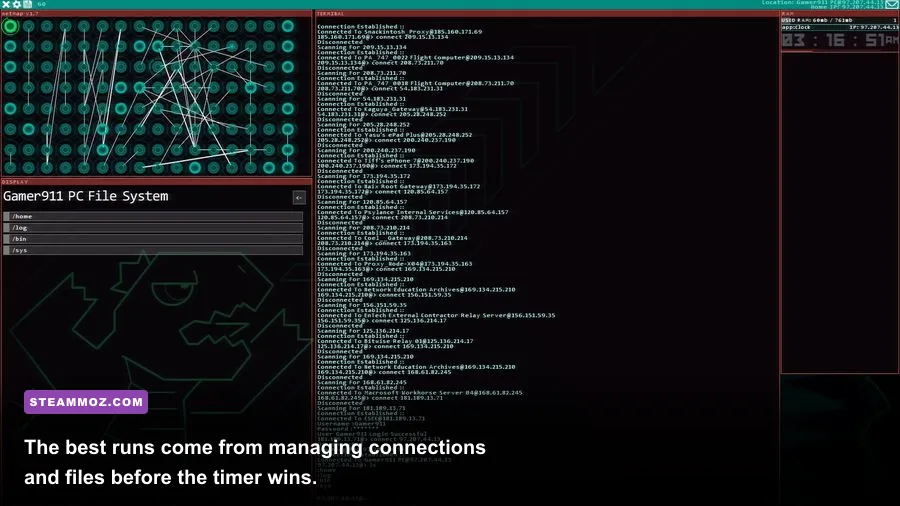
Hacknet is visually simple by design. Most of the screen is a dark terminal, green or white text, network diagrams, and occasional interface effects. That means modern gaming PCs barely notice the workload. The important performance question is not whether your graphics card can run it; it is whether the text remains comfortable to read during a long session.
| Setting or Component | Minimum | Recommended | Practical Note |
|---|---|---|---|
| Operating system | Windows XP-era support listed by the original release | Current supported Windows installation | Check Steam compatibility if using Linux or a handheld |
| Processor | 2 GHz-class CPU | Any modern dual-core CPU | CPU load is extremely light |
| Memory | 2 GB RAM | 4 GB or more | Extra RAM has no meaningful FPS benefit |
| Graphics | DirectX 9-class hardware | Integrated graphics | Expect a largely locked frame rate on modern systems |
| Display | 1280×720 | 1920×1080 or higher | Higher resolution improves workspace, but tiny text can hurt readability |
There are no modern ray-tracing toggles, upscalers, or competitive latency settings to optimize. Use your native resolution, adjust display scaling if the terminal text looks cramped, and disable distracting overlays while working through dense missions. On Steam Deck, the game’s low demands are a major advantage, although a keyboard layout or trackpad-heavy control setup is more comfortable than relying entirely on the thumbsticks.
If you spend more time troubleshooting PC games than playing them, our guides to Cthuloot crash fixes and smooth 60 FPS settings cover the kind of practical optimization work Hacknet mostly avoids.
What feels dated, and what still holds up
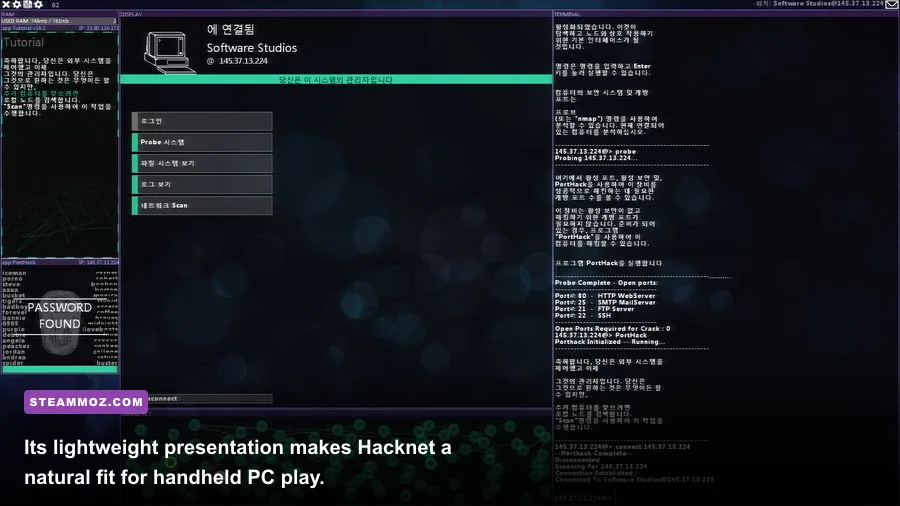
The biggest weakness is presentation. The menus can feel blunt, text-heavy, and occasionally awkward on modern ultrawide displays. Some mission instructions are intentionally vague, but the line between mystery and poor communication is not always handled perfectly. If you dislike reading logs or experimenting with commands, Hacknet can feel like work rather than play.
The interface also has limited room for mistakes. Forgetting where you connected from, leaving a process running, or failing to inspect a folder can force a reload. That friction is part of the tension, but it is not always elegant. The game expects you to keep mental notes, and its old-school design never fully modernizes that demand.
Still, the core loop remains excellent. The clean command feedback, escalating trace pressure, and gradual expansion of your toolkit create a rare sense of competence. You start by following instructions and finish by planning routes through a network, managing risk, and interpreting clues faster than the game explains them.
That makes Hacknet a very different recommendation from the atmospheric survival games covered in our Dark Cult of the Dead tips. There is no loot treadmill here and no reflex-based combat. The challenge is mental bandwidth: can you read, decide, execute, and clean up before the system catches you?
Is Hacknet Deluxe worth playing in 2026?
Buy it if you enjoy short, focused PC experiences built around puzzles, terminal interfaces, and story-driven investigation. The complete package offers enough content for a satisfying campaign run, and Labyrinths gives experienced players a sharper follow-up instead of a token bonus chapter. It is also an excellent choice for a low-spec laptop or handheld PC.
Skip it if you want realistic hacking, open-world freedom, or deep replayable systems. Hacknet is scripted. Once you know the missions, the surprise fades, and there is no procedural network generator waiting after the credits. The game also does not teach practical penetration testing; its commands and exploits are simplified fiction wrapped in authentic-looking terminology.
| Player Type | Verdict | Reason |
|---|---|---|
| Story-focused puzzle fan | Strong buy | Excellent pacing, readable objectives, and meaningful discoveries |
| Cybersecurity beginner | Buy with expectations managed | Good introduction to concepts, not a real training platform |
| Action gamer | Try only on sale | No combat, twitch mechanics, or conventional progression |
| Steam Deck or low-end PC owner | Easy recommendation | Minimal hardware demands and short, focused missions |
| Replayability hunter | Wait for a discount | Great first run, but limited once the story and puzzles are known |
For more official background, check the developer’s Team Fractal website, the Labyrinths Steam listing, and the game’s official Hacknet site. None of those links change the bottom line: this is a small game with a narrow idea, but it executes that idea with unusual confidence.
In 2026, Hacknet - Deluxe is not a technical showcase and it never pretends to be one. It is a tightly designed terminal puzzle game where reading carefully matters, mistakes have consequences, and a blinking trace timer can make typing rm feel like an action sequence. Buy the Deluxe Edition on sale—or at full price if the premise immediately clicks—and you’ll find one of the most convincing fictional hacking games still available on Steam.