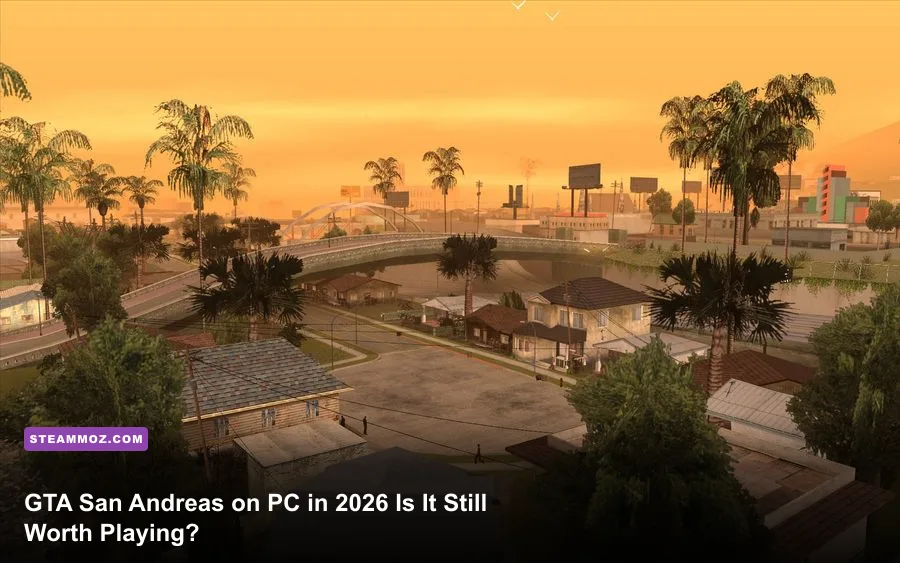
Yes, GTA San Andreas is still worth playing on PC in 2026—but only if you approach it as a brilliant 2004 open-world game rather than a modern Grand Theft Auto sequel. Its writing, soundtrack, enormous map, RPG-lite progression, and mission variety still beat many newer sandbox games. The unpatched PC release, however, has ugly widescreen bugs, inconsistent frame pacing, missing songs, controller friction, and occasional crashes. Play the classic version with a sensible fix pack, and it remains an essential single-player adventure. Expect modern shooting and driving to feel dated, though, because nostalgia can't repair every rough edge.
That distinction matters. Rockstar's original PC port is not automatically the best version just because it is familiar, while the later Definitive Edition brings cleaner presentation but also controversial visual changes and a history of technical problems. This retrospective focuses mainly on the classic PC game, the version most players mean when they search for GTA San Andreas PC in 2026.
Why San Andreas Still Feels Bigger Than Its Age
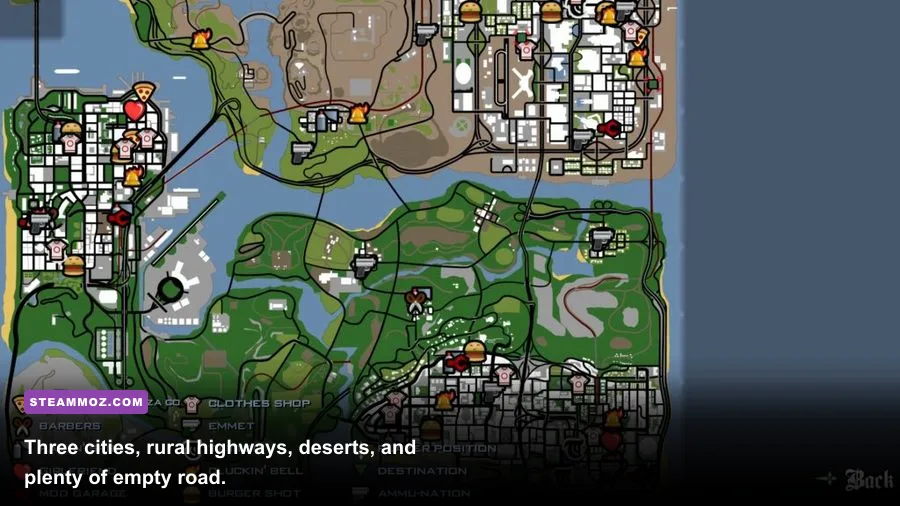
San Andreas still wins its first impression with scale. The 2004 game gives you Los Santos, San Fierro, and Las Venturas, plus countryside, Mount Chiliad, the Red County coast, Bone County, and the enormous desert around Area 69. The map isn't packed with modern checklist icons, but that emptiness has a purpose. Driving from Grove Street to San Fierro feels like a journey, not a fast-travel menu.
The story also has a stronger shape than its reputation suggests. Carl “CJ” Johnson returns to Los Santos after his mother is murdered, gets dragged into the Grove Street Families' collapse, and slowly discovers how Tenpenny's corruption, Big Smoke's betrayal, and Ryder's ambitions connect. The game can be goofy—dating girlfriends, eating burgers, robbing a casino—but the central arc gives those diversions a memorable home.
What makes the campaign unusually replayable is its progression system. Respect unlocks story missions, muscle changes CJ's appearance, stamina affects how long he can sprint, and weapon skill improves from Pistol through Hitman. Drive carefully and you can build a competent character; ignore the systems and missions become noticeably more awkward. This is a real progression curve, not just a string of cosmetic unlocks.
| Feature | What San Andreas Does Well | 2026 Reality |
|---|---|---|
| Map | Three cities plus countryside, desert, and ocean | Still huge, though much less densely interactive than modern open worlds |
| Story | CJ, Big Smoke, Tenpenny, and the Grove Street conflict | Excellent character momentum with some uneven late-game pacing |
| Progression | Stats, weapon skills, properties, gangs, and vehicle schools | More meaningful than many newer sandbox progression systems |
| Side content | Gym training, gambling, races, burglary, girlfriends, and collectibles | Still varied, but several activities are repetitive |
The official Rockstar Store listing remains the best place to verify which edition you're buying. Don't assume every digital listing includes the same soundtrack or the same fixes.
The Gameplay Holds Up Better Than the Gunplay
San Andreas' best mechanics are the ones that let you inhabit CJ's life. You can visit the gym to raise muscle, eat to avoid becoming too skinny, learn martial arts in Las Venturas, customize cars at TransFender, and improve driving, cycling, flying, boating, and motorcycle skills through use. These details create a feedback loop: you explore because exploration improves your character, then use that stronger character to tackle harder missions.
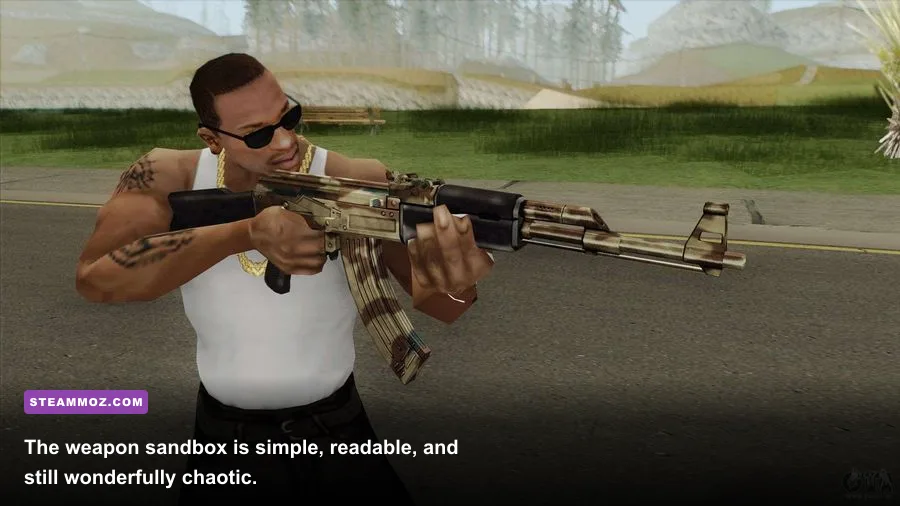
Weapon progression is especially important. At low skill, CJ's pistol aim is slow and unreliable, while Hitman rank allows dual-wielded pistols, faster reloads, and improved accuracy. The Desert Eagle hits much harder than the standard Pistol, but its slow rate of fire punishes panic shooting. The Micro SMG and Tec-9 are excellent from vehicles, the MP5 is the cleaner close-range choice, and the AK-47 is generally more practical than the M4 because it becomes available earlier and handles most missions comfortably.
The combat weaknesses are obvious in 2026. Enemies can soak up bullets, cover is basic, and the lock-on system occasionally targets the wrong person. Drive-by shooting is powerful once CJ develops SMG skill, but aiming from a moving car is still clumsy. The camera can fight you in cramped interiors, and swimming is limited compared with later entries. These aren't deal-breakers, but they explain why a player raised on GTA V may need an hour to adjust.
| Weapon | Damage Profile | Best Use | Practical Verdict |
|---|---|---|---|
| Pistol | Low damage, reliable ammunition | Early missions and basic drive-bys | Replace it when the Desert Eagle becomes available |
| Desert Eagle | High damage, slower firing speed | Accurate single-target shooting | Excellent once CJ reaches strong weapon skill |
| MP5 | Balanced automatic fire | Close and medium-range firefights | One of the safest all-purpose weapons |
| AK-47 | High automatic damage, heavier recoil | Street battles and mission combat | Best early rifle for most players |
| M4 | Fast, accurate automatic fire | Longer-range combat and endgame missions | Excellent, but arrives later than the AK-47 |
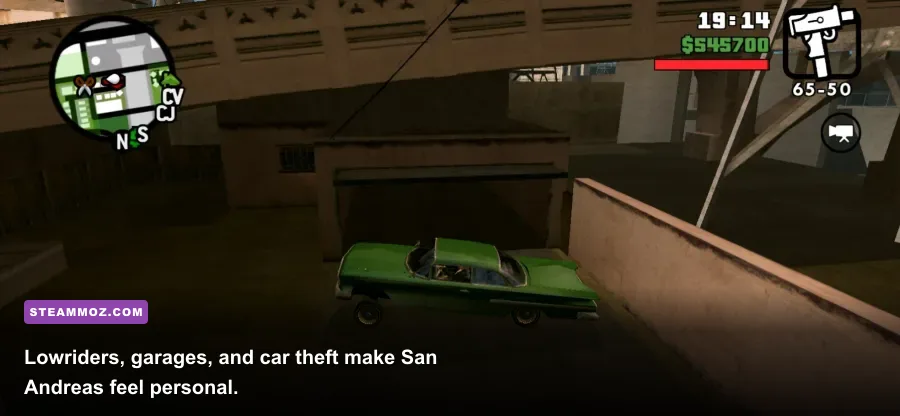
Driving is similarly old-fashioned but still entertaining. Cars have distinct traction and suspension, bicycles reward momentum, and lowrider hydraulics turn otherwise ordinary vehicles into toys. The best missions—“Wrong Side of the Tracks,” “Stowaway,” “Saint Mark's Bistro,” and “Black Project”—use those systems in memorable ways. The infamous train chase in “Wrong Side of the Tracks” is less mysterious once you understand Big Smoke's poor weapon accuracy and keep your bike aligned beside the train, but it remains a classic test of patience.
Where the PC Version Needs Help in 2026
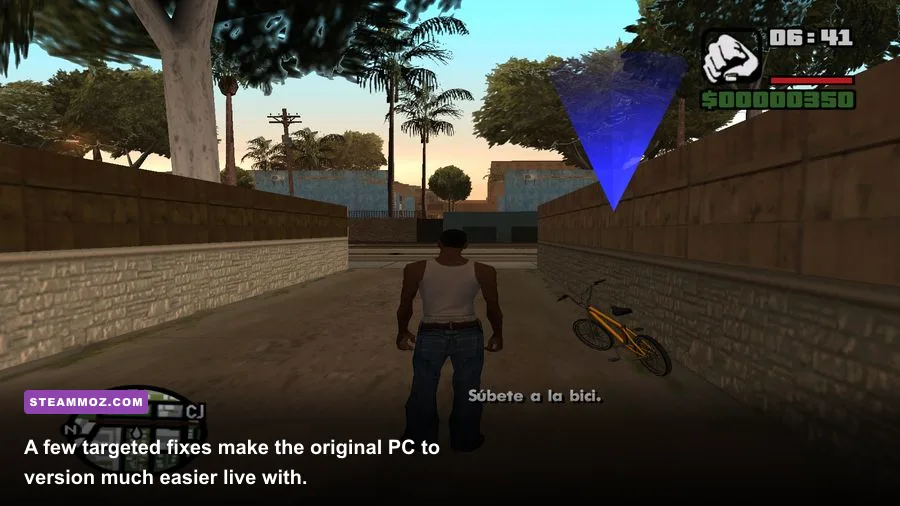
The classic PC port runs easily on modern hardware, but “runs” doesn't mean “works perfectly.” The original release was built around 4:3 displays, older DirectX behavior, and console-era assumptions. Uncapped frame rates can create strange physics, swimming and cycling behavior can feel wrong, and widescreen modes may stretch the HUD or expose camera quirks. Mouse input is also less polished than a modern PC release.
For a clean baseline, use a legitimate copy, back up your save folder, and install fixes one at a time. A widescreen fix, SilentPatch, improved resolution support, and a frame limiter are the sensible starting points. Avoid dumping a giant mod collection into the game before testing the vanilla campaign. If a mission breaks, you want to know whether the problem came from the game or a twenty-mod load order.
SilentPatch is widely used because it addresses numerous original bugs, including frame-rate-related issues, streaming behavior, and miscellaneous collision or audio problems. The SilentPatch GTA San Andreas page lists compatibility information and installation details. For broader community documentation, the GTAForums San Andreas section is still more useful than random download mirrors.
| Setting or Fix | Recommended Value | Performance Impact | Why It Matters |
|---|---|---|---|
| Frame rate | Cap near 60 FPS | Very low on modern hardware | Reduces physics and animation oddities from extreme FPS |
| Resolution | Native monitor resolution with a widescreen fix | Low | Prevents stretched HUD elements and incorrect field of view |
| Draw distance | High, but not excessive through mods | Low to moderate | Preserves the original visual balance and streaming stability |
| Anti-aliasing | Driver-level or modest MSAA | Low on current GPUs | Smooths harsh geometry without overcomplicating the install |
| Texture mods | Use selectively | Varies widely | Large packs can increase pop-in, crashes, and loading times |
| Controller | XInput-compatible pad | None | Usually feels better for driving and lock-on combat |
If you're troubleshooting crashes across your library, Steamoz's guides on PC crash fixes and older PC game requirements cover the same basic habits: verify files, disable conflicting overlays, update drivers, and isolate mods before reinstalling everything.
Classic Edition or Definitive Edition?
This is the decision that determines whether you'll enjoy GTA San Andreas on PC in 2026. The classic release has the original art direction, more consistent character models, and the most mature modding scene. It also has dated lighting, low-resolution textures, and the technical annoyances described above. The Definitive Edition offers higher resolution assets, modern controls, checkpoints, and a more accessible presentation, but its altered weather, facial models, lighting, and occasional visual bugs can make San Andreas feel less like itself.
The Definitive Edition is easier to recommend to someone who refuses to mod or configure an old game. It has quality-of-life features such as mission retry support and a more modern save flow. Yet the remaster's launch reputation was earned: blurry rain, awkward character faces, unstable performance, and inconsistent texture quality damaged confidence. Later updates improved the package, but the classic version remains the safer recommendation for enthusiasts who care about original atmosphere.
| Version | Best For | Strengths | Weaknesses |
|---|---|---|---|
| Classic PC | Modders and preservation-minded players | Original look, mature fixes, broad mod support | Needs setup for widescreen and stable modern play |
| Definitive Edition | Convenience-focused newcomers | Modern resolution, checkpoints, updated controls | Uneven visuals, altered atmosphere, technical history |
| Console original | Players seeking the untouched 2004 feel | Consistent controller experience and original presentation | Less flexible resolution and mod support |
Before buying, check Rockstar's official support site for current launcher and compatibility notes. Rockstar's San Andreas game page is also useful for confirming which release your storefront is advertising. Don't chase a suspicious “free PC download”; malware and broken repacks aren't worth saving a few dollars.
Who Should Play It—and Who Should Skip It
You should play San Andreas in 2026 if you like authored open worlds, character-driven crime stories, older game design, or sandbox systems that actually affect play. The campaign can occupy 25 to 35 hours if you focus on story missions, and completionists can spend far longer on properties, races, oysters, horseshoes, tags, stunt jumps, vehicle schools, and gang territories. Its best quality is still momentum: every new district, weapon, safehouse, or mission type makes Los Santos feel like the start of a larger life.
You should probably skip it if you need modern cover shooting, seamless interiors, realistic driving, dense crowds, or a map full of reactive activities. The game also has dated stereotypes, uneven mission difficulty, and a few sequences that feel designed to test your patience rather than your skill. “Supply Lines...” is the famous example, although the RC Baron becomes manageable when you land nearby, use short bursts, and stop wasting fuel on unnecessary turns.
My recommendation is an easy one. Buy or use the classic PC version from a legitimate source, install a trusted widescreen fix and SilentPatch, cap the game at 60 FPS, and play with a controller if driving feels awkward. Keep the first run lightly modded so the story, soundtrack, and strange early-2000s texture work can speak for themselves. Once you've finished, visual overhauls and quality-of-life mods become fun rather than necessary repairs.
For players comparing it with newer open worlds, Steamoz's weapon-focused retrospective shows how older games can still build memorable combat around a small arsenal. San Andreas does something similar on a much larger canvas. It isn't mechanically cleaner than GTA V, and it certainly isn't prettier, but its mix of personal progression, absurd side activities, radio personality, and three-city structure remains unusually complete.
Final verdict: GTA San Andreas PC is still worth playing in 2026, earning a strong 8.5/10 as a historical open-world classic. Expect friction, fix the port responsibly, and you'll find a game with more character and mechanical variety than its age suggests. Expect a modern technical standard, and the cracks will be impossible to ignore. Grove Street is still waiting—but bring a frame limiter.