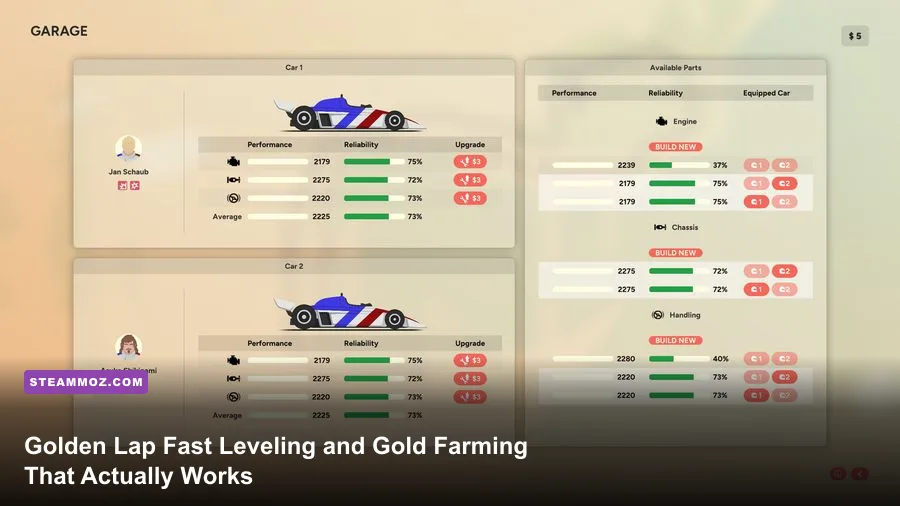
Golden Lap doesn't have a traditional character-XP bar or a literal gold currency to grind. The fastest progression comes from turning race-weekend results into team cash, then protecting that cash with reliable drivers, sensible car development, and low-risk strategies. Win or consistently finish near the front, meet sponsor objectives, avoid unnecessary repairs, and reinvest only in upgrades that improve your next championship result.
That distinction matters because many new teams burn through their starting funds by treating every practice session, upgrade, and pit stop like a mandatory expense. Golden Lap rewards a tighter loop: identify where your car is losing time, make the cheapest useful improvement, and race for dependable points before gambling on a spectacular but fragile victory.
How Golden Lap progression and money really work
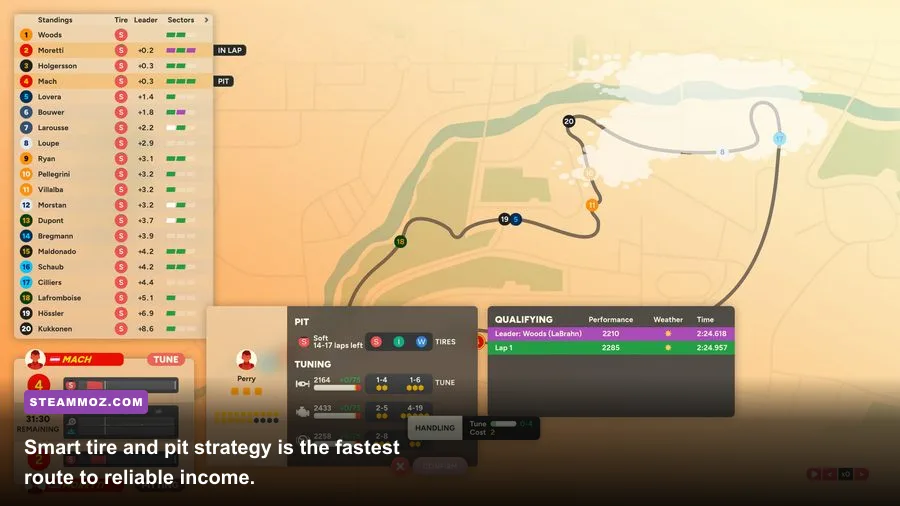
Golden Lap's progression is built around your team rather than a single driver level. Your practical “level” is the strength of the operation: the car's performance and reliability, the quality of your drivers, the money available for development, and your ability to finish a season profitably. Championship results unlock momentum, but cash flow decides whether that momentum survives.
Race weekends are the engine of your economy. Practice helps you understand the circuit and prepare a setup, qualifying determines track position, and the race pays off the preparation. A front-row start is valuable, but a clean points finish is often better than an overaggressive strategy that ends with mechanical damage or a retirement.
Track every expense against the next event. Driver contracts, development, repairs, and race operations all compete for the same budget. If an upgrade will not be ready for the upcoming track, or if it improves a weakness that the circuit barely tests, delay it. That cash is more useful when it supports reliability before a long championship run.
| Progression source | What it improves | Best way to maximize it | Main mistake |
|---|---|---|---|
| Race results | Prize income and championship momentum | Prioritize clean points finishes | Taking needless risks for one position |
| Sponsor objectives | Extra income and team growth | Choose targets that match your car's pace | Accepting an objective you cannot reliably meet |
| Car development | Pace, handling, and reliability | Fix the biggest performance bottleneck | Buying upgrades without checking circuit demands |
| Driver contracts | Race pace and consistency | Pair speed with dependable finishes | Overspending on one star driver |
| Season completion | Long-term campaign progress | Protect the budget through the calendar | Running out of money late in the season |
For a useful baseline, check Golden Lap's official Steam page for current features and updates. The game changes as your campaign advances, so don't assume a strategy from an early season remains optimal once competition and operating costs rise.

🎮 Golden Lap
Looking to experience this game? Grab your digital key directly on our store for $10.49.
View on Steammoz Store →The fastest early-game leveling route
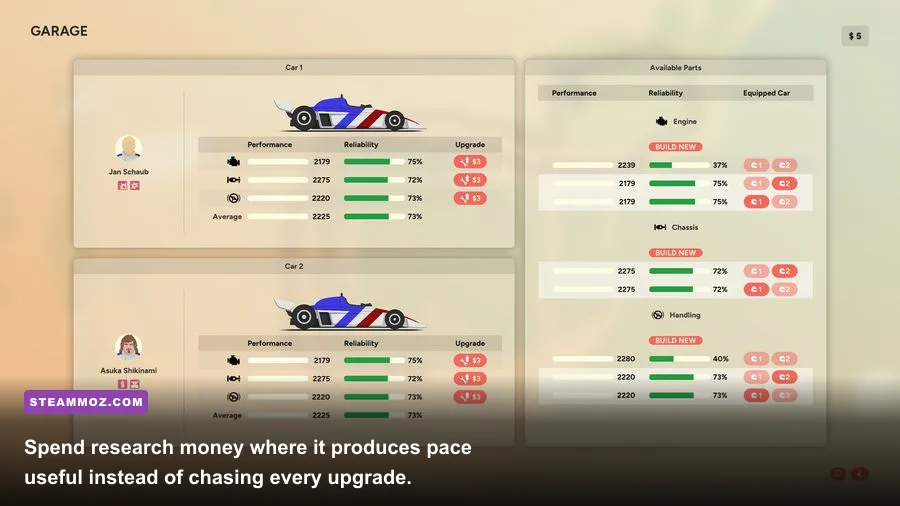
Start by selecting a campaign plan that your initial car can actually support. Your first objective isn't to dominate every circuit; it's to establish positive cash flow. In the opening races, use practice to learn braking points and tire behavior, then stop spending once you have enough information to make a confident setup decision. Extra laps are not free if they increase wear without improving the result.
During qualifying, aim for a clean lap rather than a desperate final-sector push. Track position matters, but a damaged car creates a second problem in the race. If your driver is close to a personal best, preserve the attempt instead of repeatedly forcing the same corner. A strong starting position combined with a conservative first stint produces more reliable money than a risky pole attempt.
For the first several events, use this progression order:
- Secure reliability first. A small pace gain is worthless if failures erase the result. Develop the component or system responsible for your recurring mechanical weakness.
- Improve the car's dominant weakness. If you lose time on straights, prioritize speed-oriented development. If the car struggles through technical sections, spend on handling rather than blindly upgrading top speed.
- Keep both cars operational. Two regular finishers usually produce a better championship economy than one heavily upgraded car and one unreliable backmarker.
- Reinvest after the payout. Do not commit the entire bankroll before the next race. Hold enough cash for repairs, contracts, and an unlucky event.
This is also where Golden Lap differs from a conventional racing game. You are farming money through decisions made across an entire weekend, not by restarting a single race until the reward appears. If a result is merely respectable but leaves the team healthy, it can be the correct result.
For comparison, our Excubitors starter build guide covers the same broader principle: early progression is strongest when every purchase supports the next practical milestone instead of chasing a flashy endgame setup.
Best car upgrades for profitable gold farming
There is no universal best upgrade because Golden Lap's circuits ask different questions. A fast car that destroys its tires can lose more time in the race than it gains in qualifying. Likewise, maximum performance is a poor investment if the car's reliability is low enough to create repeated repair bills.
Use the race calendar as your development roadmap. Before a high-speed circuit, prioritize the performance category that affects acceleration and top-end pace. Before a twisty layout, handling and cornering efficiency become more valuable. Before a long or punishing event, reliability deserves extra weight because a finish has direct economic value.
| Development priority | When to choose it | Economic benefit | When to delay it |
|---|---|---|---|
| Reliability | Frequent failures, long races, heavy wear | Protects prize money and reduces repair exposure | When the car already finishes comfortably |
| Top speed and acceleration | High-speed tracks and poor qualifying pace | Improves overtaking and grid position | On technical circuits where corners decide lap time |
| Handling | Twisty tracks and weak sector times | Raises race pace without relying on risky passes | When straight-line losses are the clear problem |
| Tire performance | Long stints and rapid compound degradation | Reduces pit pressure and preserves late-race pace | For short events where tire life is rarely decisive |
| Overall performance | After reliability and the key weakness are covered | Raises the ceiling of every future weekend | When it would leave no emergency reserve |
Don't upgrade based on the headline rating alone. Compare what the car needs with what the next circuit rewards. A handling improvement that turns a poor qualifying sector into a competitive one can be worth more than a broad upgrade with no obvious race-weekend impact.
If you enjoy optimizing performance settings as much as the car itself, Steamoz's maximum-FPS settings guide is a useful reminder that efficiency comes from targeting the real bottleneck. Golden Lap follows the same logic: diagnose first, spend second.
Driver contracts, sponsors, and the safest income loop
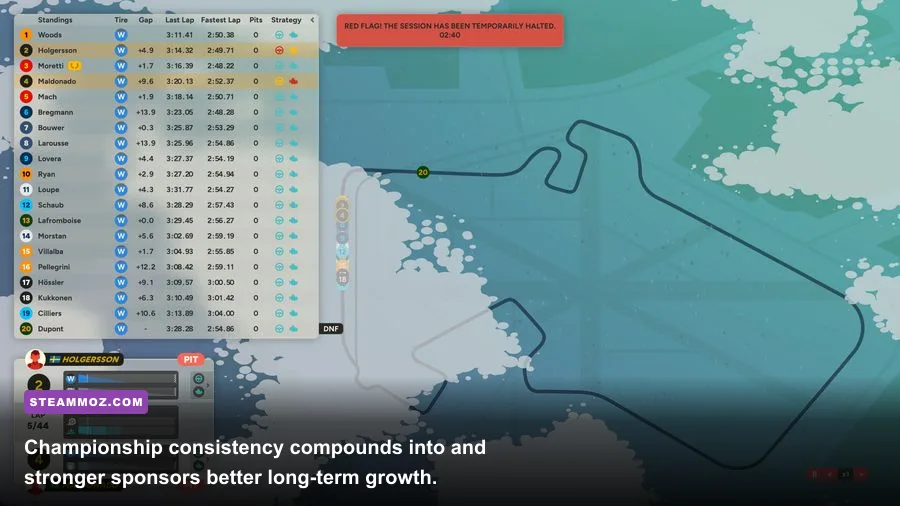
Drivers are not interchangeable pieces. A fast driver can convert a strong car into qualifying advantage, while a consistent driver protects points when conditions or strategy go wrong. For gold farming, the best pairing is usually not two expensive stars. It is one driver who can exploit the car's ceiling and another who reliably brings it home.
Read sponsor objectives as financial risk assessments. A target that asks for a realistic finishing position is effectively free money if your car already performs in that range. A target requiring a podium from a midfield machine is not a challenge; it's a budget trap. The reward only matters if the probability of success is high enough to justify the pressure.
Renew contracts before the team reaches a crisis point. Losing a dependable driver before an important stretch of the calendar can force you into a rushed, expensive replacement. Keep a reserve for negotiations and avoid spending on a driver whose strengths do not match your car's current profile.
During races, protect the income loop by managing risk. Avoid unnecessary battles when a rival is clearly faster, pit before tire performance collapses, and don't force a damaged car to continue if the likely result is retirement. A safe finish can preserve both championship points and the machine needed for the next payout.
For another example of why the right build depends on the job you need done, see Steamoz's beginner build recommendations. The genre is different, but the lesson carries over: specialization is powerful only when it matches the situation.
Race-weekend tactics that stop money leaks
Use practice to answer three questions: where does the car lose time, how quickly do the tires degrade, and which strategy keeps the driver out of trouble? You don't need a perfect simulation of every possible race. You need enough information to avoid an obviously bad setup and choose a stint plan that the car can sustain.
Qualifying is about clean execution. A mistake that costs a few grid places is usually survivable; damage that consumes repair money or compromises the race is not. In the opening stint, avoid treating every overtake as mandatory. Let faster traffic through when fighting it would destroy tire life, then recover time when the rival pits or fades.
Use softer tires when track position and short-term pace are worth the degradation. Use harder compounds when consistency, a longer first stint, or fewer pit stops matters more. Weather and track conditions can shift that balance, so don't lock yourself into a strategy simply because it worked at the previous circuit.
| Race situation | Recommended response | Why it protects income | Risk to avoid |
|---|---|---|---|
| Starting near the front | Defend carefully and protect tires | Converts grid advantage into points | Overheating tires in unnecessary battles |
| Starting in the midfield | Extend the first stint when pace allows | Creates strategic flexibility | Staying out after tire performance collapses |
| Mechanical warning | Reduce aggression and reassess the finish | Preserves the result and avoids retirement | Chasing one extra position at any cost |
| Wet or changing conditions | React early to the correct tire window | Prevents large pace losses | Waiting for the track to become obviously undriveable |
| Late-race points fight | Attack only if the pass is clean and valuable | Balances reward against damage risk | Contact that wipes out both cars |
After every race, review the result instead of immediately spending the payout. Identify whether the loss came from pace, tire management, strategy, reliability, or driver execution. Then make one targeted adjustment. Multiple random upgrades make it impossible to know what actually improved the team.
Golden Lap's charm is that “farming” never feels like mindless repetition. The strongest money route is a disciplined championship: consistent points, realistic sponsor goals, controlled development, and enough reserve cash to survive a bad weekend. Follow that loop and your team will level faster than a reckless operation chasing one spectacular win after another.
For official information on patches and the developer's wider racing projects, visit Funselektor's official website and the Golden Lap Steam news hub. If a balance update changes upgrade costs or sponsor rewards, those are the first places worth checking.
And if you are switching between management games, Steamoz's fast-loot farming guide offers a contrasting approach to efficient progression. Golden Lap's version is slower, more strategic, and far less forgiving—but once the cash loop clicks, every clean finish starts paying for the next breakthrough.