Yes, Diablo Immortal is still worth playing on PC in 2026—but only if you want a constantly updated, social Diablo grind rather than a clean premium RPG. The campaign is entertaining, the class combat remains excellent, and the amount of free content is enormous. The catch hasn't disappeared: Legendary Crests, Resonance, Battleground PvP, and the relentless upgrade treadmill make the endgame much less friendly if you want to compete with spenders. For solo players and casual co-op groups, though, Immortal offers hundreds of useful hours before its monetization becomes impossible to ignore.
This is an honest retrospective rather than a launch-day verdict. Blizzard's PC client has matured, the game has expanded well beyond its original campaign, and the class roster now gives you far more ways to play. But the central question is still the same: can you enjoy Diablo Immortal without treating your wallet as another combat skill? In 2026, the answer is mostly yes—provided you choose your goals carefully.
What Diablo Immortal Gets Right on PC
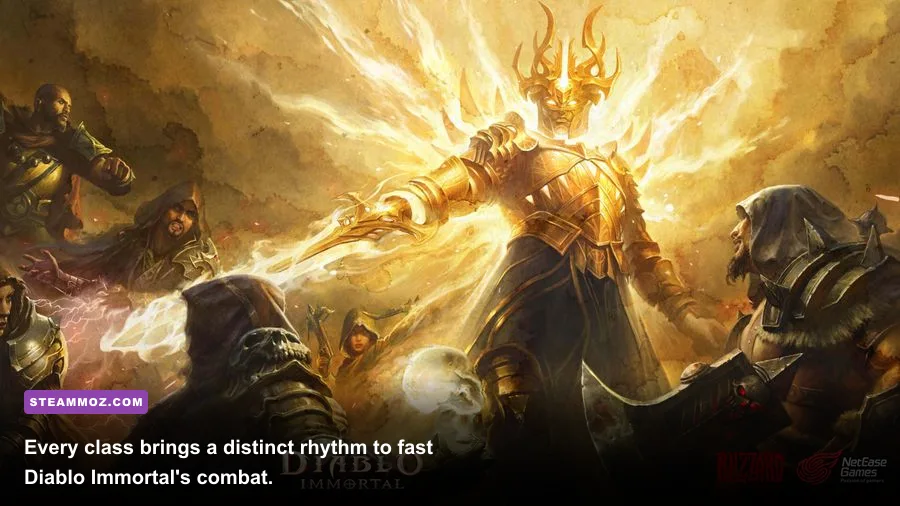
Immortal's best feature is still its moment-to-moment combat. Movement is responsive, attacks land with satisfying impact, and every class has a clear identity. The Barbarian chains Whirlwind through dense packs, the Crusader turns mounted mobility and area control into a frontline engine, and the Demon Hunter rewards constant repositioning while firing Hungering Arrow and Multishot through crowds.
The Blood Knight is especially good proof that this isn't just a shallow mobile spin-off. Its polearm attacks, Shadow Clone interactions, and life-draining skills create a flexible melee-ranged hybrid. Meanwhile, the Tempest adds a faster, more technical style built around wind, water, and movement. The exact balance changes over time, but the broader point survives patches: Immortal has enough class variety to support several complete playthroughs.
That combat is wrapped around a surprisingly broad game. You have the main story across zones such as Ashwold Cemetery, Bilefen, Realm of Damnation, and Stormpoint; daily Bounties; Hidden Lairs; Challenge Rifts; Elder Rifts; Helliquary raids; Warbands; Clans; and the Shadows-versus-Immortals cycle. The official Diablo Immortal site remains the best place to check current class and seasonal announcements because Blizzard regularly changes event rewards and progression systems.
PC also gives Immortal a sharper presentation than most people expect. At 1080p, high settings, and a stable 60 frames per second, Sanctuary's spell effects are readable without becoming visual soup. Keyboard-and-mouse controls work well for movement and targeted abilities, while controller support is a strong alternative for couch play. It doesn't replace Diablo IV's richer physics or moodier lighting, but it looks far better than the game's reputation suggests.
The Free-to-Play Wall Is Real, But It Has Boundaries
The uncomfortable part is the endgame economy. Your ordinary gear—main-hand, off-hand, shoulders, chest, legs, and helmet—can be improved through drops and upgrades without paying. Set items and Legendary Items also come from normal play. The pressure starts with Legendary Gems, Resonance, and the Crest system attached to Elder Rifts.
Legendary Crests add guaranteed Legendary Gem drops to Elder Rifts, while Rare Crests improve the reward table without offering the same certainty. Those gems affect combat rating, resonance, and special effects. A free player can earn useful gems through activities such as daily tasks, the Market, Fading Embers, events, and accumulated currencies, but a fully optimized six-gem setup is a far longer project than simply farming equipment.
| Activity | Free-player value | Main reward | Where monetization matters |
|---|---|---|---|
| Story and side quests | Excellent | Experience, gear, crafting materials | Almost nowhere |
| Bounties and contracts | Strong daily routine | Gold, experience, equipment | Time is the real cost |
| Challenge Rifts | Strong | Upgrade materials and ranking progress | High gem resonance can affect leaderboards |
| Elder Rifts | Mixed | Runes, gems, Fading Embers | Legendary Crests dramatically improve efficiency |
| Battleground PvP | Playable, uneven | Seasonal progression and PvP rewards | Resonance and gem effects can decide fights |
That distinction matters. If your goal is “finish the story, clear group content, and improve every week,” the free route works. If your goal is “top the Battleground leaderboard” or dominate Cycle of Strife content, the spending gap becomes the game. The Steam version of Diablo Immortal doesn't remove that design; it simply makes the game more comfortable to play with a mouse, keyboard, or controller.
The best approach is to set a hard budget of zero—or a small entertainment budget—and ignore competitive comparisons. Don't buy a bundle because a Rift run felt unlucky. Don't chase a six-star gem you can't realistically upgrade. Use the Battle Pass only if you genuinely value its cosmetics and materials, not because the game frames it as mandatory.
How Progression Feels After the Campaign
The campaign is the smoothest section of Immortal. New skills arrive quickly, gear upgrades are frequent, and Combat Rating gives you an obvious target. After the main story, progression splinters into several systems: Hell difficulty, Paragon levels, equipment ranks, Helliquary bonuses, Set Items, Legendary Gems, and activity-specific rewards. That complexity can feel exciting for the first month and exhausting by month six.
Combat Rating is the number you should watch first because it determines whether content is comfortably within your reach. A higher rating does not automatically mean a stronger build—skill effects, cooldowns, gem bonuses, and item essences matter—but entering content under its recommended rating can turn ordinary enemies into brick walls. Upgrade every gear slot rather than obsessing over one perfect Legendary Item; rank upgrades transfer through the game's replacement systems, reducing the pain of changing builds.
Paragon Trees add another layer. Trees such as Vanquisher, Survivor, Gladiator, and Treasure Hunter let you emphasize damage, resilience, or utility, while the active-tree system affects which bonuses are switched on. For general PvE, damage and elite-killing bonuses are usually more valuable than over-specializing in defense. For Battlegrounds, control resistance, cooldown management, and survivability become more important than a pure damage sheet.
| Build direction | Priority stats | Useful activities | Why it works |
|---|---|---|---|
| Solo PvE farmer | Damage, cooldown reduction, movement | Bounties, Open World, Hidden Lairs | Clears packs quickly and spends less time traveling |
| Group dungeon damage | Damage to elites, skill damage, Combat Rating | Dungeons, Helliquary raids | Consistent boss pressure and reliable rotations |
| Support Crusader | Cooldown reduction, beneficial-effect duration, life | Raids, Warbands, party farming | Banner and defensive skills amplify the whole group |
| Free PvP survivor | Life, control resistance, cooldown reduction | Battlegrounds, Cycle of Strife | Staying alive creates more value than chasing burst damage |
For a practical free-player routine, complete the first daily activity bonuses, run Bounties, collect your Codex rewards, check for a Hidden Lair, and join the highest Hell difficulty you can clear efficiently. Group dungeons are usually better than stubborn solo grinding when your Combat Rating is close to the requirement. If you enjoy systems-heavy progression, our fast-leveling and gold-farming guide for Empires of the Undergrowth covers the same kind of efficient daily-planning mindset, even though the games play very differently.
PC Performance and the Settings Worth Changing
Diablo Immortal is not a demanding PC game by modern standards, but its default settings aren't always the best settings. The biggest performance swings come from resolution, shadow quality, anti-aliasing, and effects density during large events. If you have a 60Hz monitor, chase a locked 60fps instead of maxing every slider. Stable input feels better than a pretty screenshot that collapses during an Elder Rift explosion.
| Setting | Recommended value | FPS impact | Visual trade-off |
|---|---|---|---|
| Frame rate | 60fps cap | Low | Stable combat timing and lower heat |
| Resolution | Native 1080p or 1440p | Medium to high | Lower resolution is the fastest GPU-quality compromise |
| Texture quality | High if VRAM allows | Low to medium | Keeps armor and environments sharp |
| Shadow quality | Medium | Medium | Most players won't notice the reduction during combat |
| Anti-aliasing | High or game default | Medium | Lower only if your GPU is struggling |
| Effects density | Medium to high | Medium in raids | Lower values improve readability in crowded fights |
| V-Sync | Off with VRR; on otherwise | Negligible | Use based on tearing and monitor support |
On an older gaming laptop, start at 1080p, medium shadows, medium effects, and a 60fps cap. Close browsers and overlays if you see hitching during zone transitions. If the client crashes, update GPU drivers first, then verify files through Steam. Our coverage of ELEX crash and FPS fixes and Far Cry 6 performance settings applies the same sensible troubleshooting order: drivers, resolution, background apps, then heavier graphics features.
For current platform information, check Blizzard's official PC installation and support pages before blaming your hardware. Live-service clients change, and minimum specifications can shift as new zones and effects arrive.
Who Should Play Diablo Immortal in 2026?
Play it if you want a free action RPG that works well in short sessions, supports cross-platform progression, and gives you a steady stream of events. It is particularly good for players who enjoy logging in for 20 minutes, clearing Bounties, upgrading a few slots, and then joining friends for a dungeon. The social layer is a genuine strength: Warbands, Clans, raids, and open-world events make the game feel busier than a typical solo loot grinder.
Skip it if you want a one-and-done purchase with no shop, no battle pass, and no competitive power gap. Diablo IV is the better premium-scale choice for players who want a larger PC-first experience, while Diablo II: Resurrected remains the cleaner option for classic loot hunting. Immortal occupies a different lane: faster, more social, more seasonal, and much more willing to put monetized progression in front of you.
The 2026 verdict
Diablo Immortal on PC is worth playing as a free campaign-and-co-op RPG, but not as a fair competitive endgame. Its combat is responsive, its class design has matured, and its content pipeline makes the price of entry almost absurdly good. Its gem economy and PvP balance are still the reasons to leave, not reasons to spend more.
Start without paying, choose one class, finish the campaign, and give the endgame two weeks. If daily chores and Resonance comparisons feel like motivation, keep going. If they feel like a second job, walk away. Sanctuary will still be there—and your wallet will be healthier for making the distinction.