
The Lee-Enfield is Deadfall Adventures' best overall weapon, while the shotgun wins point-blank fights, the Thompson dominates panic situations, and the crossbow is the specialist pick for quiet kills and exploration. The Digital Deluxe Edition doesn't radically rebalance the campaign or add a secret overpowered gun, so this ranking focuses on the practical value of the core arsenal: range, stopping power, ammunition economy, reload risk, and how reliably each weapon handles the game's mummies, cultists, armored guards, and supernatural creatures.
That distinction matters. Deadfall Adventures is a linear 2013 shooter built around James Lee Quatermain's expedition through Egypt, the Arctic, and Mayan ruins. Its weapons don't behave like a modern live-service game with visible damage numbers, attachment slots, or upgrade trees. The game exposes no official in-menu DPS readout, and weapon damage can change with hit location and enemy type. The useful question isn't “which gun has the biggest number?” It's “which gun gives you the most control when the next scripted ambush starts?”
This guide ranks the arsenal for a normal campaign playthrough, with special attention to the Digital Deluxe release available through the official Steam page. It also separates weapons that look impressive from weapons that genuinely save ammunition and health.
Deadfall Adventures weapon tier list at a glance
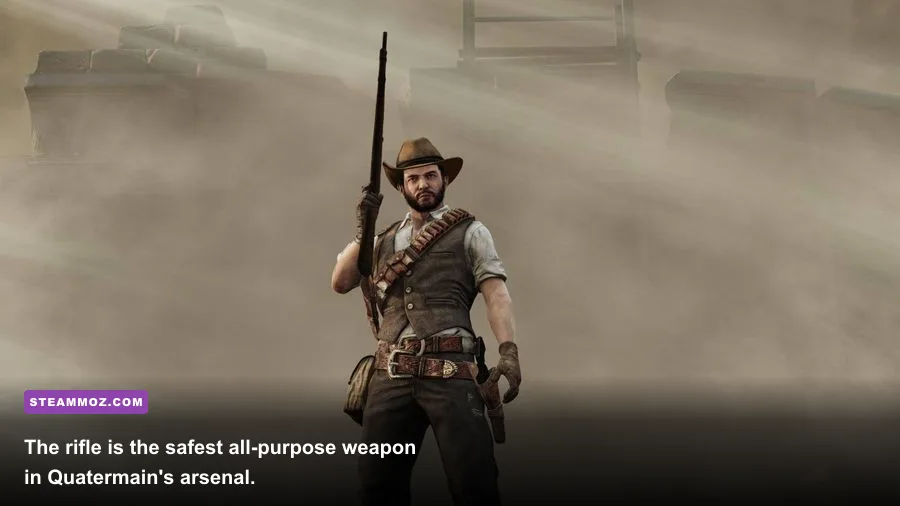
The short version is simple: keep the rifle ready, reserve the shotgun for breaches, and treat automatic fire as a controlled burst tool rather than a panic button. The pistol is dependable but rarely exciting, while the crossbow becomes much more valuable when you understand stealth routes and environmental interactions.
| Rank | Weapon | Tier | Best Role | Main Weakness |
|---|---|---|---|---|
| 1 | Lee-Enfield Rifle | S-Tier | Medium and long-range precision | Slow follow-up shots |
| 2 | Shotgun | S-Tier | Stopping rushing enemies | Short effective range |
| 3 | Thompson Submachine Gun | A-Tier | Close-range crowd control | Fast ammunition consumption |
| 4 | Crossbow | A-Tier | Quiet kills and utility | Slow projectile and reload rhythm |
| 5 | Revolver or Pistol | B-Tier | Backup damage and conserving premium ammunition | Lower stopping power |
There is no genuine D-Tier weapon in the campaign. Every gun has a useful window. The pistol simply falls behind once the rifle and shotgun are available, and the Thompson's ranking depends heavily on whether you can resist emptying the magazine into every target.
How the Digital Deluxe Edition changes the ranking
The Digital Deluxe label is easy to overread. It packages bonus edition content rather than introducing a fundamentally different combat meta. The strongest choices above are still determined by the base campaign's encounter design. Don't buy the edition expecting a deluxe-only damage monster that invalidates the Lee-Enfield.
For more context on older PC releases and their quirks, Steamoz's Far Cry 3: Blood Dragon weapon ranking is a useful comparison, but Deadfall's smaller arsenal demands more careful ammunition discipline.
🎮 Deadfall Adventures Digital Deluxe
Looking to experience this game? Grab your digital key directly on our store for $6.24.
View on Steammoz Store →S-Tier weapons: the guns that carry the campaign
1. Lee-Enfield Rifle
The Lee-Enfield takes the top spot because it solves the largest number of problems. It is accurate enough for headshots across open temple rooms, powerful enough to stagger many human enemies, and economical when you place shots instead of spraying. Its bolt-action rhythm is deliberate, but that limitation teaches the correct habit: fire, move, reacquire, then fire again.
Against cultists and guards, aim for the head or upper torso and use cover between shots. The rifle is particularly strong in rooms where enemies appear on balconies, behind pillars, or at the far end of a courtyard. Those encounters punish the shotgun's range and make the Thompson's recoil and ammunition use feel wasteful.
The Lee-Enfield isn't flawless. A missed shot during a close-range rush can cost more health than the weapon's damage advantage is worth. Don't stubbornly keep it equipped when a mummy is already inside melee distance. Switch to the shotgun before the enemy reaches you; the weapon swap is faster than trying to force a second careful rifle shot under pressure.
2. Shotgun
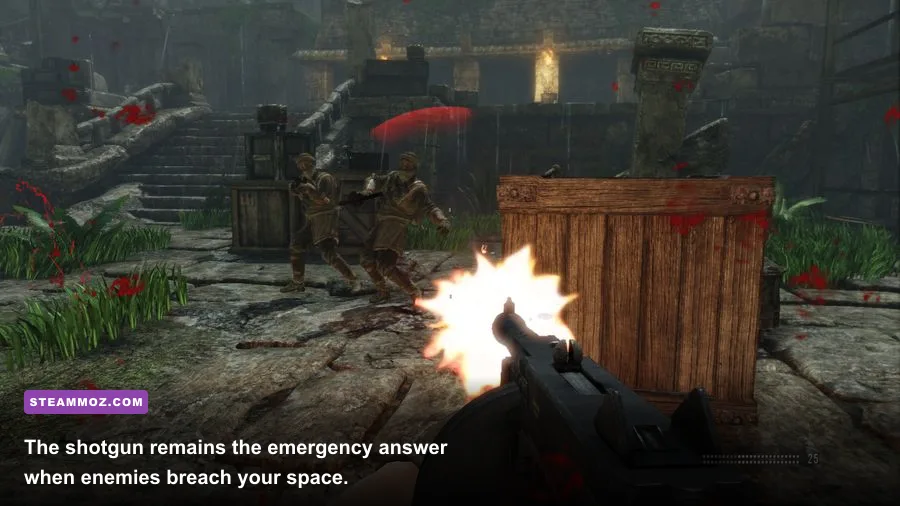
The shotgun is the campaign's best defensive weapon. Its ranking comes from reliability, not versatility. When a supernatural enemy rounds a corner, when several creatures spawn inside a cramped chamber, or when a guard pushes through a doorway, one close-range blast can buy the space needed to reload, retreat, or switch weapons.
Its pellet spread rewards center-mass shots. You don't need pixel-perfect aim, but distance still matters. Firing from the other side of a large room produces a disappointing hit, especially against tougher targets. Walk backward while keeping the crosshair around the enemy's chest, fire only when the target is inside the effective range, and use pillars to prevent flanking.
The shotgun also pairs beautifully with the game's scripted arena design. Many fights begin after a door closes or a relic interaction triggers an ambush. Before touching the objective, equip the shotgun, identify the nearest escape route, and reload. That small preparation step is more valuable than chasing a theoretical damage upgrade that the game doesn't actually provide.
| Weapon | Damage Profile | Range | Reload Risk | Ideal Enemy |
|---|---|---|---|---|
| Lee-Enfield | High single-target damage | Long | Medium | Guards, distant cultists, exposed weak points |
| Shotgun | Very high at close range | Short | High if surrounded | Mummies, rushing creatures, doorway pushes |
| Thompson | Moderate sustained damage | Short to medium | Low during active fire | Groups of human enemies |
| Crossbow | High precision damage | Medium | Medium | Isolated targets and stealth openings |
| Pistol | Low to moderate | Medium | Low | Finishing wounded enemies |
A-Tier weapons and when to pull them out
3. Thompson Submachine Gun
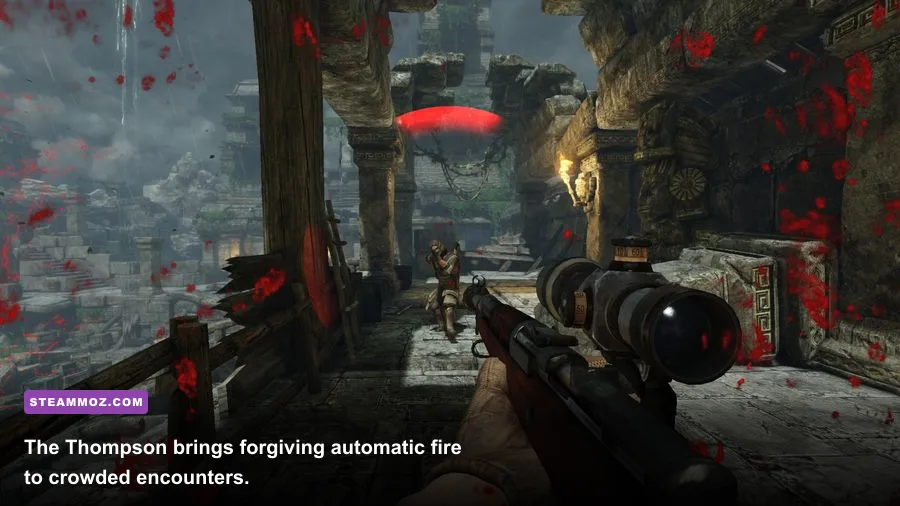
The Thompson is the most immediately satisfying gun in Deadfall Adventures. It spits out rounds quickly, tracks moving targets well, and can erase a cluster of ordinary enemies before they organize. In a close corridor, it often feels stronger than the rifle because the game gives you less time to line up a careful shot.
Its problem is economy. Automatic fire makes missed rounds invisible until the magazine is empty, and reloads become dangerous when you start a fight without nearby cover. Use short bursts of three to six rounds against human enemies. Hold the trigger longer only when several targets are stacked together or a supernatural enemy has already committed to an attack animation.
The Thompson is also less impressive against distant targets. Tap rather than spray, crouch when the room allows it, and avoid chasing a moving head with the entire magazine. The gun is A-Tier because it makes messy encounters manageable, not because it is the highest-damage option in every situation.
4. Crossbow
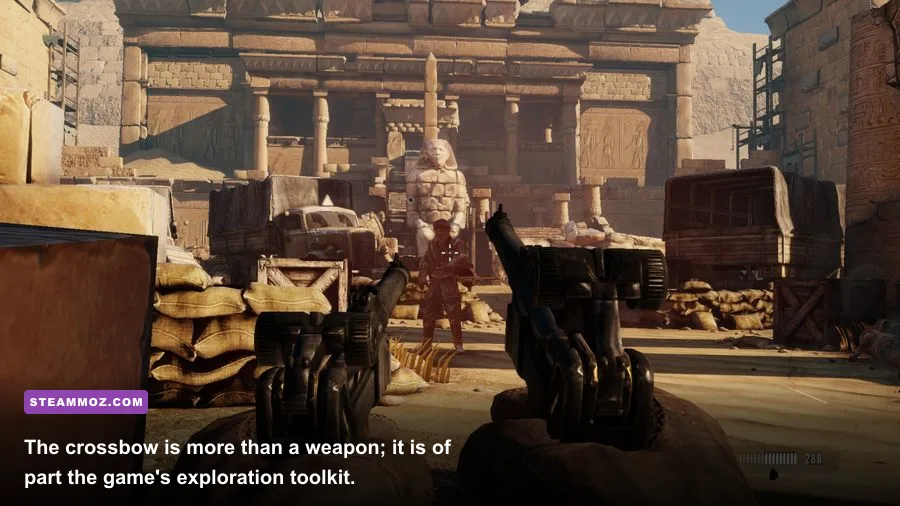
The crossbow is the specialist weapon that many players underrate. It offers quiet, deliberate damage and fits the game's adventure side better than the firearms do. If you can isolate an enemy, the crossbow lets you open combat on your terms. That matters in areas where a loud exchange attracts additional threats or turns a puzzle room into a scramble.
Its projectile travel time requires a small lead against moving targets. Aim where the enemy will be, not where it is. The crossbow is also less forgiving when multiple enemies are already attacking, because its firing and reload rhythm can't match the Thompson's volume or the shotgun's emergency stopping power.
Keep it equipped while exploring suspicious rooms, especially when you can see a single guard before entering the arena. Fire from cover, relocate immediately, and don't assume one quiet hit ends every encounter. The crossbow's real value comes from controlling the opening seconds, not from replacing every firearm in your loadout.
For players who enjoy hunting for optional rewards between fights, the exploration mindset is similar to the hidden-route approach in Steamoz's Everspace 2 secret locations guide. Deadfall's secrets are less systemic, but patient scanning still pays off.
B-Tier backup weapons and ammunition discipline
5. Revolver or Pistol
The sidearm earns B-Tier because it is always useful, never demanding, and rarely the best answer. It gives you a fallback when the primary weapon is empty and lets you finish wounded enemies without wasting shotgun shells or rifle rounds. That sounds basic, but it keeps the stronger weapons available for the fights that actually deserve them.
Use the pistol for isolated human enemies, exposed targets at medium range, and final shots after a rifle body hit. Avoid treating it like a dueling weapon against armored opponents or supernatural creatures. Its lower stopping power means a bad engagement lasts longer, and a longer engagement usually costs health.
The correct pistol habit is conservative: land accurate shots, keep moving, and switch away as soon as a tougher target commits to a rush. It becomes much better when paired with cover because cover removes the sidearm's biggest problem—needing extra time to finish a target.
Grenades and situational explosives
Explosives aren't a conventional tier-list weapon in the same way as the firearms, but they deserve an S-Tier rating for crowded scripted encounters. Save them for moments when enemies are grouped in a doorway, trapped near an objective, or pushing through a narrow corridor. Throwing one at a lone guard is usually a poor trade.
Don't throw explosives immediately after an ambush trigger if you haven't read the room. Back up first, identify where enemies are converging, and use the blast to cut off the largest group. The best grenade is the one that buys you a clean retreat, not necessarily the one that produces the biggest single damage number.
| Situation | Best Weapon | Why It Works | Common Mistake |
|---|---|---|---|
| Enemy across an open courtyard | Lee-Enfield | Accurate damage without crossing danger space | Using automatic fire at maximum range |
| Mummy reaches a narrow doorway | Shotgun | Immediate stopping power and forgiving spread | Waiting until the target is already attacking |
| Three or more guards in a corridor | Thompson | Fast target transitions and sustained pressure | Holding the trigger through every reload |
| Single unaware guard | Crossbow | Quiet opening attack and controlled positioning | Trying to use it after the room is already chaotic |
| Wounded enemy behind cover | Pistol | Saves premium ammunition | Challenging a full-health elite target |
The best loadout and combat rotation
For a balanced playthrough, build your weapon rotation around distance rather than enemy labels. Keep the Lee-Enfield ready while moving through open spaces. Switch to the crossbow when you spot a lone target and have time to establish the first hit. Equip the shotgun before opening doors, touching relics, or entering rooms that look deliberately staged for an ambush. Bring out the Thompson only when enemies are close enough that its rate of fire outweighs its ammunition cost.
A practical rotation looks like this:
- Scout first. Scan balconies, side passages, explosive props, and obvious retreat routes before interacting with a puzzle object.
- Open with precision. Use the Lee-Enfield or crossbow on the most dangerous visible target. Prioritize enemies with a clean line of fire over the nearest disposable target.
- Collapse the distance safely. Move between cover points rather than standing still to admire a headshot. Deadfall's enemies punish stationary play more than slow aim.
- Swap before the breach. When a creature enters shotgun range, stop trying to preserve rifle ammunition and use the weapon designed for the emergency.
- Finish economically. Use the pistol on weakened enemies and reload behind cover, not during the final seconds of an open-room exchange.
The most important hidden “stat” is time to regain control. A rifle headshot can be more efficient than a Thompson burst, but a shotgun blast is better if it prevents a melee hit. Likewise, the crossbow can theoretically save ammunition while costing too much time if three enemies are already active. Rank weapons by the fight in front of you, not by a universal damage fantasy.
Difficulty also changes the value of each tier. On lower difficulty, the pistol can carry more encounters because mistakes are cheaper. On higher difficulty, the Lee-Enfield and crossbow become more important for reducing incoming fire, while the shotgun becomes your insurance policy. If performance is unstable, keep frame pacing smooth rather than chasing visual effects; a consistent 60 frames per second makes tracking moving targets and reacting to melee telegraphs noticeably easier than a fluctuating higher average.
That advice is especially relevant on modern PCs, where older games can behave oddly with overlays, forced sharpening, or driver-level frame-rate tools. Steamoz's ELEX PC fixes guide covers a similar generation of PC troubleshooting, while the Far Cry 2 PC specs article is useful if you're comparing older shooter performance expectations.
Final ranking: what belongs in your hands
If you want one answer, choose the Lee-Enfield. It has the best balance of precision, reach, and ammunition value, and it remains relevant from the first human firefights to the later supernatural set pieces. The shotgun is its equal in a narrower role and may be the more important weapon whenever the game locks you into a cramped arena.
The Thompson is the stylish A-Tier pick: powerful, forgiving, and dangerously easy to waste. The crossbow is the veteran's choice for controlled openings and exploration-heavy players. The pistol is the dependable understudy that keeps the rest of the arsenal healthy.
Deadfall Adventures Digital Deluxe doesn't need a bloated arsenal to stay interesting. Its strongest combat decisions come from switching tools at the right moment. Rifle at range, shotgun at the breach, Thompson for a crowded collapse, crossbow for a controlled opening, and pistol for the cleanup—that five-part rhythm turns a dated shooter into a surprisingly tense expedition. Ignore the tier labels when the room demands something else, but if you follow that rotation, Quatermain's journey becomes far more manageable.
For the official developer background, visit The Farm 51's official website and the game's Steam listing. Just remember the core lesson: the best equipment isn't the loudest gun. It's the weapon that gives you room to make the next decision.