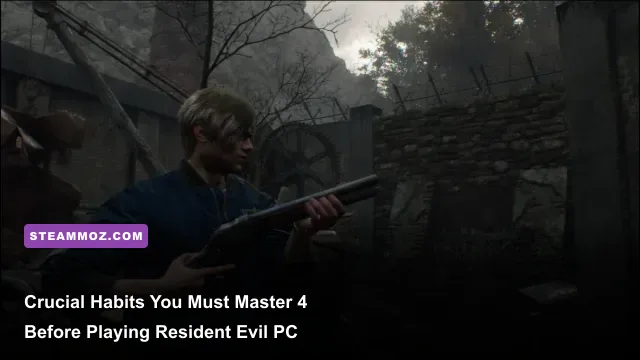
Resident Evil 4 on PC isn't an old-school point-and-click shooting gallery where you can plant your feet, hoard rifle rounds, and sleepwalk through encounters. Capcom rebuilt this survival horror classic with relentless enemy pacing, an unpredictable dynamic difficulty director, and an engine that will chew through your graphics card's VRAM if you blindly max every slider. To make it through Valdelobos with your sanity and supplies intact, you have to treat your knife as an indispensable defensive shield, decipher the merchant's financial ecosystem, and configure your settings to avoid sudden desktop crashes.
1. Mastering the Combat Knife and Parry Timing Over Pure Firepower
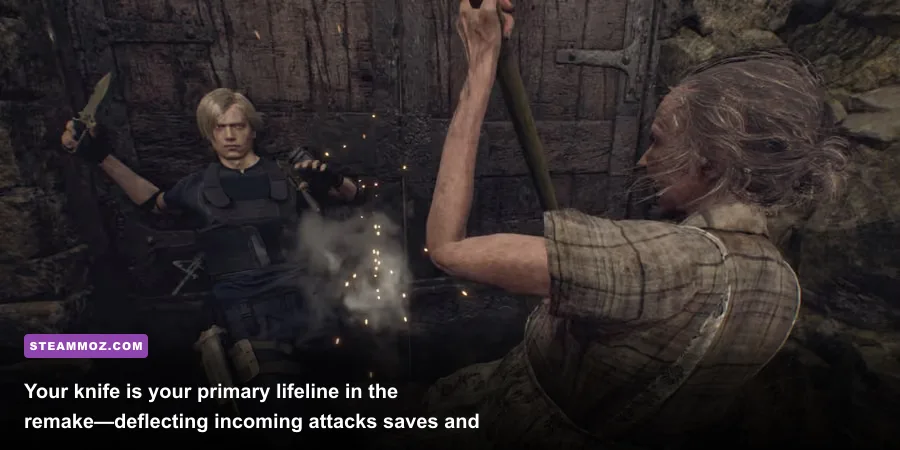
Your firearm is only half of your offensive toolkit in the remake. The biggest mechanical hurdle for newcomers—especially veterans arriving straight from the 2005 original—is underestimating the combat knife. In this modern reimagining, Leon's blade can deflect thrown hatchets, block incoming sickle strikes, interrupt lethal grabs, and even parry Dr. Salvador's roaring chainsaw. Tapping the parry key (Spacebar or Left Bumper by default) during an enemy swing completely halts their momentum and opens a wide window for a melee roundhouse kick. Landing that melee hit triggers critical invincibility frames (i-frames), knocking down neighboring Ganados without spending a single bullet.
However, that defense comes with a brutal catch: knife durability. Slashing downed foes or executing a stealth takedown uses minimal edge health, but blocking a high-velocity attack like a swinging flail or an explosive dynamite bundle drains massive chunks of the durability gauge. If your combat knife breaks in the middle of a cabin siege, you lose your primary countermeasure against instant-kill attacks. Keep spare kitchen knives and boot daggers in your attache case at all times to act as disposable buffers, reserving your primary combat knife for emergencies and boss encounters.
When an infected villager drops to the dirt writhing with a neck spasm, sprint over and finish them with a knife execution immediately. Ignoring that spasm allows the parasitic Plaga Guadaña to burst from their neck, transforming a simple foot soldier into a blade-whip terror that eats an entire magazine of shotgun shells. An ounce of knife wear on a downed villager saves half a dozen handgun cartridges and prevents sudden decapitation.
2. Taming the RE Engine: PC Settings That Save Your VRAM and Frame Rates

Capcom's RE Engine delivers gorgeous character models, wet cobblestone reflections, and gruesome dismemberment, but its memory allocation on PC is notoriously finicky. If you push the in-game settings menu past your GPU's actual hardware limit, you won't just see slight stuttering—you will trigger sudden D3D fatal crashes that kick you straight to your desktop during intense Chapter 3 rain sequences. Just as we discovered when troubleshooting sudden frame dips and micro-stutters, dial back unnecessary background rendering loads before diving into hardware-heavy scenarios.
The single most dangerous setting on PC is "Hair Strands." Turning Hair Strands on makes Leon's signature curtains look incredibly cinematic, but it slashes overall frame rates by 15% to 25% and causes weird physics jittering on mid-range hardware. Keep Hair Strands turned off. Similarly, avoid Ray Tracing unless you are running an RTX 4080 or better. The ambient occlusion and normal SSR (Screen Space Reflections) look remarkably crisp without bogging down the render pipeline during waterlogged lake battles. You can consult the PCGamingWiki RE4 performance guide to audit engine quirks before tweaking your settings.
| Graphic Setting | Optimal Configuration | FPS Impact | Tactical Hardware Rationale |
|---|---|---|---|
| Hair Strands | Off | High (15–25% Gain) | Eliminates severe CPU/GPU strand physics overhead during close-up camera angles. |
| Volumetric Lighting | Medium | Moderate (6–9% Gain) | Maintains dense forest fog atmosphere while clearing up heavy pixel fill rates. |
| Ray Tracing | Off | Severe (20–30% Gain) | Prevents erratic frametime spikes around castle marble floors and village waterways. |
| Mesh Quality | High | Negligible (<2% Cost) | Prevents pop-in on approaching enemies without overloading texture buffers. |
| Shadow Cache | Enabled | Positive (Smooths Frametimes) | Stores static lighting data directly into available VRAM to eliminate stuttering. |
Keep your total estimated memory usage inside the orange zone on the in-game VRAM slider. Crossing into the bright red ceiling invites unstable frame pacing, much like preventing system crashes and memory leaks in open-world PC engines. If you are struggling for frames at 1440p or 4K, set AMD FSR 2 to "Quality" mode, or use community modifications to inject DLSS if you are running Nvidia hardware.
3. The Hidden Dynamic Difficulty System Will Punish Greedy Hoarders
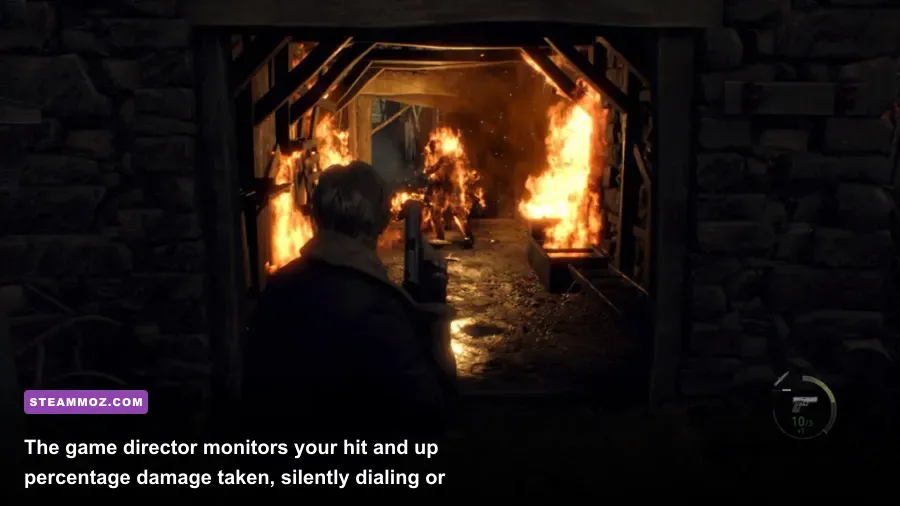
Beneath the surface of Resident Evil 4 runs an invisible game mechanic called Difficulty Adjustment (DA), often referred to as the dynamic difficulty rank. This system tracks your real-time performance on a scale from 1 to 11 on Standard and Hardcore difficulties. Every headshot landed, clean parry executed, and chapter completed without taking damage pushes your rank upward. When your rank climbs toward the top tier, Ganados run faster, lunge from wider angles, attack concurrently instead of taking turns, and gain thicker health pools.
Conversely, taking hits, missing shots, and dying drops your rank, loosening enemy aggression and gifting you larger ammo drops from wooden crates. You can actively leverage this system to your advantage by understanding how the item generation logic operates. The game director constantly scans your attache case before deciding what spawns in breakable barrels:
- Ammo Starvation Logic: If you carry dozens of crafted shotgun shells and rifle cartridges, wooden crates will only give you green herbs or modest heaps of Pesetas.
- Gunpowder Balancing: The game treats raw gunpowder and resources as unallocated ammo. If your stock is depleted, drop rates spike immediately.
- Craft-on-Demand Strategy: Do not synthesize your ammunition in advance. Carry base gunpowder and Resource (S) or Resource (L) packages raw until your weapon magazines run completely dry. This tricks the game into reading your supply as empty, forcing high-value munitions to drop from basic pottery.
If an encounter feels impossibly crowded and aggressive, you don't need to reload your save. Burn through a few basic resources, accept a glancing hit, and watch how the game director loosens the mob's tether. Surviving isn't about playing like an untouchable esports pro; it's about managing the behind-the-scenes math that dictates how hard the AI swings at your neck.
4. Merchant Weapon Economy: Upgrades, Spinels, and the Treasure Inlay Math

The Merchant is your best friend in rural Spain, but he is also a financial vampire who will happily watch you go bankrupt on subpar gear. In the early game, Pesetas are scarce, and wasting funds on minor upgrades for disposable guns leaves you completely broke when high-impact weaponry hits the catalog. Much like crafting an efficient beginner loadout in expansive action games, prioritizing baseline efficiency prevents early gear bottlenecks.
The standard Silver Ghost handgun you start with might seem underwhelming, but its fully upgraded exclusive perk multiplies your critical hit rate by a massive 5x. This makes it an absolute monster for popping heads in the mid-to-late campaign, especially when paired with the Laser Sight accessory bought with Spinels. Avoid spending heavy coin upgrading the early W-870 shotgun; hold your funds until Chapter 6, where the semi-automatic Riot Gun becomes available. The Riot Gun boasts tighter pellet spread, faster follow-up fire, and catastrophic stopping power down narrow corridors.
| Item / Weapon System | Purchase / Upgrade Cost | Primary Combat Utility | Optimal Upgrade Path |
|---|---|---|---|
| Silver Ghost Handgun | Free (Starting Weapon) | Critical Staggers & Melee Setups | Prioritize Damage to Level 3, then rush the 5x Critical Exclusive perk. |
| Riot Gun | 28,000 Pesetas | Mid-Range Crowd Obliteration | Max Power immediately; ignore reload speed since attache reloading works. |
| Stingray Rifle | 30,000 Pesetas | Sniper / Plaga / Boss Annihilation | Upgrade Rate of Fire and Power to burn through armored Regeneradores. |
| Laser Sight (Spinel Trade) | 10 Spinels | Pinpoint Bloom Elimination | Equip to Silver Ghost or Punisher to guarantee 100% focused crosshairs. |
| Treasure Inlay (Quintet) | 5 Different/Same Gems | Massive Peseta Revenue (Up to 2.0x) | Save 5 same-color round gems for Chalices to earn over 100,000 Pesetas. |
Never sell raw, socketed treasures immediately after picking them up. A Flagon, Chalice, or Elegant Mask with empty slots sells for pocket change. If you insert matching or fully diverse gemstones, the multiplier jumps radically. Combining five gems of identical color grants a massive 1.9x to 2.0x value multiplier, turning a modest piece of jewelry into enough cash to fully tune your rifle. When trading Spinels earned from blue request notices, bypass decorative attache case colors until you buy the Treasure Maps for each region. These maps reveal hidden treasures behind fragile walls and hanging lanterns that will easily net you hundreds of thousands of extra Pesetas. For further weapon breakdowns, read through our thoughts on evaluating high-tier weapon investments across tactical action titles.
5. Crowds, Staggers, and Ashley: Positioning Tactics That Conserve Stims

Combat in Resident Evil 4 is an intricate positioning puzzle disguised as a frantic third-person shooter. Ganados do not attack from clean, predictable queues. They actively flank your blind spots, carry bear traps to drop behind your heels, and throw burning torches to flush you out of corners. Standing your ground in wide-open fields is guaranteed suicide. You must constantly route enemies through natural choke points like broken doorways, ladders, and tight bridges.
When an enemy rushes you with a pitchfork, do not panic-dump three rounds into their torso. Aim directly for their knees or shins. Damaging a sprinting Ganado's leg instantly forces them to stumble onto one knee, breaking their attack animation and setting up Leon's melee prompt. If enemies cluster around a window frame or doorway, a single knee-shot followed by a roundhouse kick will knock down the entire group like bowling pins. While they are splayed out on the floor, you can either step back to safely reload or sprint past them to secure an escape route.
Flash Grenades are the most overpowered consumable item in the entire game. Keep two slots in your attache case reserved for them at all times. Beyond briefly blinding crowds of regular humans, Flash Grenades deal lethal radiant damage to exposed Plagas parasites. Whenever a mutated Plaga emerges from a neck or chest cavity, do not waste shotgun shells or rifle ammo trying to shoot the writhing tentacles. Tossing a single Flash Grenade will instantly disintegrate every exposed parasite in the room, ending chaotic horde waves in a single frame. Check out the Resident Evil 4 Steam Store page and cross-reference official announcements on Capcom's official Resident Evil portal to stay aware of incoming balance patches and seasonal gameplay updates.
Finally, once you rescue Ashley Graham, manage her spacing actively using your squad command key. Setting her to "Tight Formation" is useful when running through gauntlets, but it puts her in danger of catching stray shotgun pellets. Switching her to "Loose Formation" gives her enough breathing room to evade grab attempts while you clear lanes. If a cultist hoists her onto their shoulder, don't waste ammo blindly spraying; line up a single precise leg shot or close the distance for a quick knife thrust to drop the captor without putting Ashley in harm's way.
Surviving Resident Evil 4 on PC comes down to respecting its mechanical weight. Keep your graphics configuration balanced, exploit your knife's defensive properties, understand how the hidden dynamic difficulty responds to your resources, and invest your hard-won Pesetas into weapons with long-term scaling potential. Follow those rules, and you will transform Leon Kennedy from a hunted agent into the most dangerous threat in rural Europe.