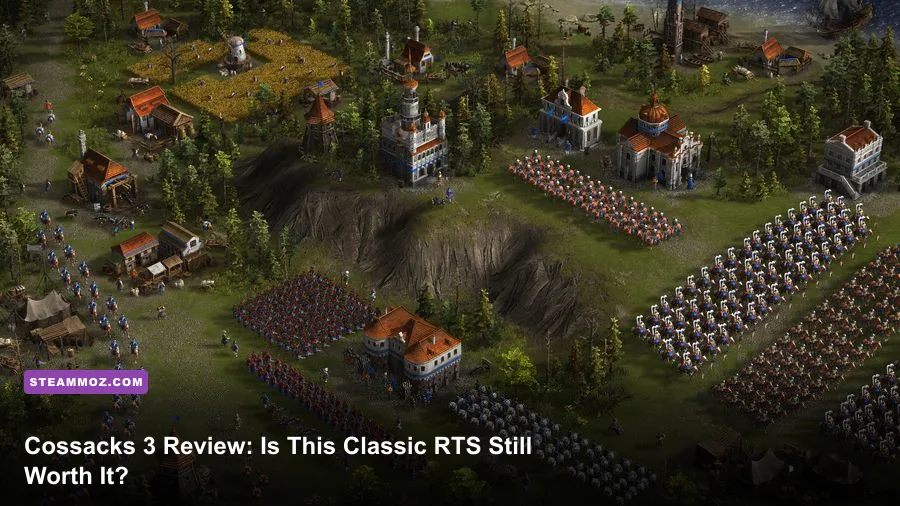
Yes, Cossacks 3 is worth playing in 2026—but only if you want a demanding, old-school RTS rather than a polished modern strategy sandbox. Its enormous armies, satisfying formations, historical factions, and resource-heavy economy still feel distinct. The catch is that its campaign AI is uneven, its interface shows its age, and multiplayer is much better with an organized group than through blind matchmaking. At a discounted price, this remains one of the most entertaining large-scale battle simulators on PC.
Cossacks 3 is a modernized return to GSC Game World's classic Cossacks formula. It covers European warfare from the 17th and 18th centuries, combines economic expansion with tactical battles, and lets you command armies that can grow into the thousands. That scale is the hook. This isn't a game about carefully microing five elite soldiers; it's about feeding a war machine with food, wood, stone, iron, and coal, then keeping formations supplied while the map fills with smoke and cavalry.
What Cossacks 3 Actually Does Better Than Modern RTS Games
The first ten minutes can feel deceptively familiar. You place a Town Hall, train peasants, assign workers to farms and mines, and queue a Barracks. Then the numbers start rising. Population caps reach the hundreds, formations turn individual units into battlefield blocks, and a single engagement can involve line infantry, pikemen, cavalry, dragoons, musketeers, and artillery at the same time.
That scale changes the meaning of tactics. A unit isn't automatically safe because it has a favorable damage matchup. Position, formation width, morale, ammunition, terrain, and reinforcement distance all matter. Musketeers are powerful when deployed in a line and protected by a screen of melee infantry, but they become vulnerable when cavalry reaches their flanks. Pikemen can hold a formation together in a way that fragile ranged units cannot. Hussars and other cavalry are excellent for raids, but throwing them directly into prepared infantry usually turns an expensive force into a brief animation.
The economy is equally important. Food keeps peasants and many military units coming, while wood controls construction and several production chains. Stone matters for defensive infrastructure and expansion, and iron and coal become critical once your army relies on firearms and artillery. A player who sees only the battle line will often lose before the first shot. Cossacks 3 rewards watching income rates, worker assignments, and production queues as closely as the fight itself.
| Resource | Primary Job | What Happens If You Ignore It | Practical Priority |
|---|---|---|---|
| Food | Peasants, units, economy | Production stalls and population growth slows | High from the opening minute |
| Wood | Buildings, farms, infrastructure | Your base and production network fall behind | High during expansion |
| Stone | Walls, defensive structures, some buildings | Fewer safe expansion routes and weaker choke points | Map-dependent |
| Iron | Weapons and military development | Firearms and advanced troops become difficult to sustain | Rises sharply in mid-game |
| Coal | Gunpowder warfare | Ranged formations may stop firing effectively | Essential before a firearm-heavy push |

🎮 Cossacks 3
Looking to experience this game? Grab your digital key directly on our store for $6.79.
View on Steammoz Store →The Campaign Is Useful, But Not the Main Attraction
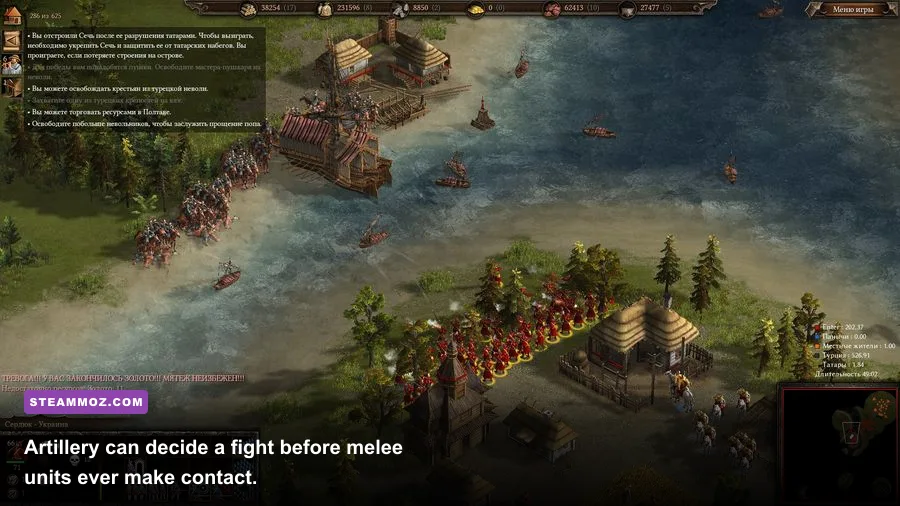
Cossacks 3 includes historical campaigns and scenario content designed to teach the foundations of the game. They are worth playing because they introduce faction identities, map control, naval systems, siege pressure, and the importance of timing upgrades. They also expose one of the game's biggest weaknesses: the computer opponent can be inconsistent.
Some missions create memorable situations. You may need to defend a settlement while building an economy, escort a force across a hostile map, or attack a fortified position before the enemy's technology catches up. These scenarios are at their best when the objectives force you to split attention between production and battlefield command.
At other times, the campaign feels like a collection of traditional RTS tests rather than a tightly authored historical journey. Enemy behavior can be predictable, difficulty spikes can feel artificial, and pathfinding becomes messy when large formations move through narrow streets or around buildings. The campaigns teach the rules, but they don't always provide the elegant pacing found in Age of Empires IV or Company of Heroes 3.
My advice is to treat the campaign as a tutorial with personality, then move into skirmishes. The single-player skirmish mode is where Cossacks 3's systems breathe properly. Choose a map with enough open ground, set a comfortable AI difficulty, and learn how quickly your faction can reach a stable early army. That knowledge matters far more than memorizing a scripted mission opening.
Factions, Technology, and the Best Way to Build an Army
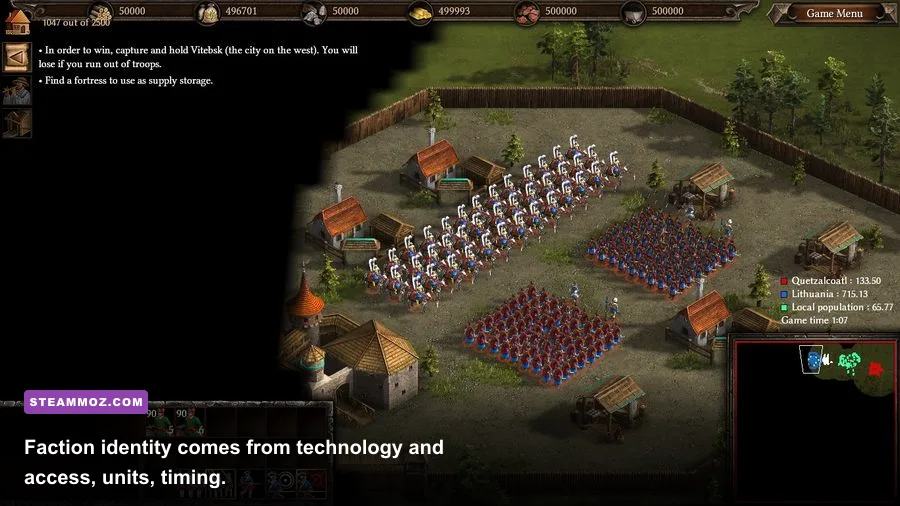
Cossacks 3's factions share a broad European framework, but they aren't simple cosmetic variations. France, Prussia, Russia, Austria, Sweden, Turkey, Ukraine, Poland, Spain, Venice, Portugal, Piedmont, Algeria, and additional factions introduced through expansions have different unit rosters, technologies, bonuses, and timing windows. The practical question isn't “which faction has the strongest unit?” It's “what can this faction field efficiently before the opponent stabilizes?”
France is a comfortable learning choice because its roster supports recognizable combined arms: infantry to hold ground, ranged troops to punish exposed units, cavalry to exploit gaps, and artillery to break formations. Russia and Ukraine can create dangerous pressure through large numbers and aggressive map control, while Prussia rewards a more disciplined player who can protect expensive, effective troops. Turkey offers a different rhythm with strong cavalry and distinctive unit access, but it can punish players who fail to manage costs.
Don't rush every technology just because it is available. Upgrades have an opportunity cost. Spending resources on a mining improvement while an enemy is assembling cavalry may leave you economically clever and militarily dead. Conversely, overproducing early troops without improving food income creates a temporary army that cannot be reinforced.
| Army Plan | Core Units | Key Support | Best Use |
|---|---|---|---|
| Line Infantry Push | Musketeers and infantry | Pikemen, officers, artillery | Breaking open ground defenses |
| Cavalry Raid | Hussars and faction cavalry | Scouts and a reserve force | Workers, mines, and exposed production |
| Fortified Defense | Pikemen and ranged infantry | Walls, towers, cannon | Holding chokepoints while teching |
| Siege Formation | Infantry screen and cannon | Repairing economy and flank cavalry | Attacking dense bases or static defenses |
Formations are the hidden skill check. A mass of units selected as one blob can win against a weaker blob, but it wastes the game's tactical depth. Keep ranged troops behind a durable front, give artillery room to fire, and avoid letting cavalry drift into the enemy's center. If your army is moving through a tight gap, temporarily reducing the formation or splitting the force can prevent the pathfinding pile-up that makes a good attack collapse.
Combat Has Real Depth—and Some Old-School Friction
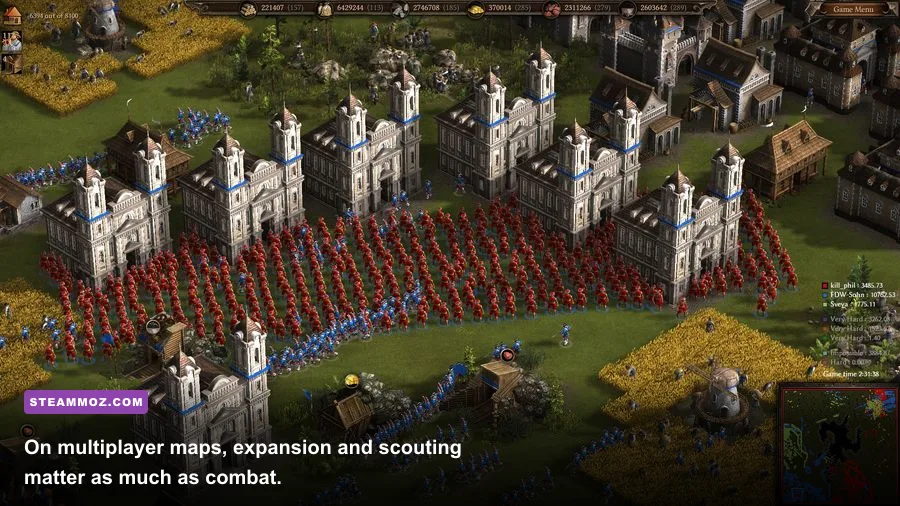
Combat is at its best when both players understand timing. Infantry formations create a front line, ranged units punish stationary targets, cavalry attacks vulnerable sides, and artillery forces movement. Firearms also bring a resource layer that many newer RTS games simplify: maintaining coal and iron matters, especially when a battle lasts long enough for repeated volleys.
Artillery deserves special attention. Cannons are not just oversized ranged units. They need protection, clear firing lanes, and time to reposition. A cannon battery can shred a packed formation, but it is vulnerable to a fast flank. Keep a small cavalry reserve or melee screen nearby rather than escorting every cannon with your entire army. That way, a raid doesn't pull your whole line out of position.
Naval warfare adds another strategic layer on maps with water. Ships can contest trade routes, protect crossings, and force the opponent to spend resources away from the land army. It isn't always worth building a navy, though. On a mostly land map, early ship production can be an expensive distraction. Cossacks 3 consistently rewards reading the map rather than following a universal build order.
The friction comes from control. Units sometimes take inefficient routes, formations can snag on buildings, and large battles become visually spectacular but difficult to parse. The interface includes useful selection and formation tools, yet it never reaches the clarity of StarCraft II. Expect to pause, zoom out, and issue movement commands more carefully than you would in a modern competitive RTS.
Performance and PC Settings in 2026
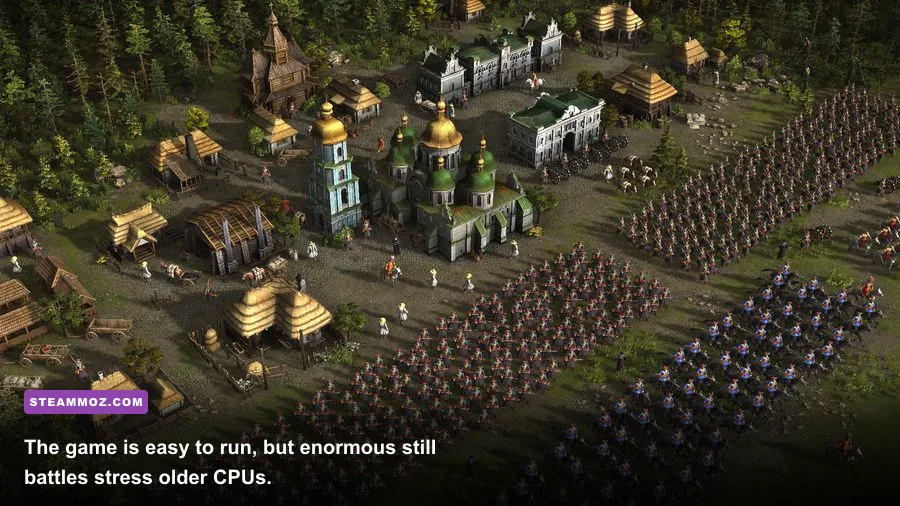
Cossacks 3 is not graphically demanding by modern standards. Steam lists a minimum configuration around a Core 2 Duo 2.4 GHz processor, 2 GB of RAM, and a GeForce 9600 GT or Radeon HD 5670, with roughly 3 GB of storage. The recommended specification is also modest compared with current releases. On a contemporary gaming PC, the game starts quickly and runs comfortably at high resolution.
The important catch is that giant battles can become CPU-limited. When thousands of units, projectiles, smoke effects, and pathfinding calculations fill the map, lowering texture quality won't necessarily restore smoothness. If performance drops during a huge engagement, reduce shadows and effects first, close background applications, and avoid running an unnecessarily high resolution. A stable 60 frames per second feels good, but the simulation itself—not just the graphics—is doing the heavy lifting.
| Setting | Recommended Value | FPS Impact | Visual Trade-Off |
|---|---|---|---|
| Resolution | Native monitor resolution | Medium | Lower only if GPU usage is high |
| Shadows | Medium | Medium to high | Less depth around buildings and units |
| Effects | Medium or High | High during artillery battles | Lower smoke and explosion detail |
| Textures | High | Low on modern GPUs | Keep high unless VRAM is extremely limited |
| Unit Scale and Zoom | Default | CPU-dependent | Large battles remain readable at a distance |
If the game crashes or behaves strangely, start with a clean installation, update your graphics driver, and test compatibility settings before changing community files. For broader PC troubleshooting, our guide to ELEX crash and FPS fixes covers several useful Windows-side checks that also apply to older PC games.
Multiplayer Is Where the Verdict Gets Complicated
Multiplayer is the reason many veterans still return. Human opponents expose weaknesses the AI happily ignores: greedy resource openings, unprotected mines, slow expansion, and predictable cavalry routes. A good match can move from worker harassment to a tense artillery standoff and finally to a battle involving several hundred units.
That same openness makes the experience rough for new players. You can lose quickly without understanding why, and community knowledge matters. Watch replays, learn one faction, and practice a repeatable opening before jumping into serious matches. Start by producing enough workers to keep food income stable, scout the nearest expansion and resource lines, then choose whether your first pressure will be infantry, cavalry, or a technology advantage.
Do not copy a build order blindly. Cossacks 3 maps vary, resource positions vary, and faction technology changes the correct timing. A build that works for France may leave Turkey starved of the resources needed for its preferred army. Your first objective should be a flexible economy, not a perfectly timed attack that collapses when the map refuses to cooperate.
Players who enjoy competitive RTS games may also want to compare this rhythm with the more contained colony warfare in our Empires of the Undergrowth leveling guide. The games are very different, but both reward controlling production before chasing flashy fights.
Pros, Cons, and the 2026 Buying Verdict
The biggest strengths: enormous armies, meaningful resource management, satisfying formations, a broad historical faction roster, naval options, and battles that look genuinely different from the standard modern RTS skirmish. Cossacks 3 also remains approachable on low-end hardware, and its core loop is easy to understand even when mastering it takes time.
The biggest weaknesses: uneven AI, dated pathfinding, a busy interface, occasional difficulty spikes, and multiplayer that can be intimidating without friends or a patient community. The campaign does not deliver the cinematic storytelling some players expect, and the game rarely explains advanced systems as clearly as it should.
So, is Cossacks 3 worth playing in 2026? Yes, at the right price and with the right expectations. Buy it if you want huge historical battles, old-school economic pressure, and the spectacle of watching a carefully built formation advance under cannon fire. Skip it if you want modern quality-of-life features, airtight competitive balance, or a campaign driven by character drama.
For newcomers, I recommend starting with France or Austria, playing the introductory campaigns, and then running skirmishes against the AI on a medium-sized map. Learn worker distribution, protect coal and iron, and practice one combined-arms army before experimenting with naval maps. Veterans of classic Cossacks should find enough familiar texture to justify returning, especially with the expansion content and a regular multiplayer group.
Cossacks 3 isn't the cleanest RTS in 2026, but it remains one of the few that makes scale feel like a mechanic rather than a spectacle. When the economy is humming, the formations are aligned, and three hundred troops surge forward behind a line of cannon fire, its age stops mattering. That moment is still worth playing for.
See the official Cossacks 3 Steam page for current editions, system requirements, and player reviews. You can also check Steam Community guides for faction openings and multiplayer advice, while GSC Game World's official website provides developer news and studio information. If you prefer fantasy dungeon strategy, our Dungeons 3 strategy tips offer a very different but equally satisfying management challenge.