Yes—City of Gangsters: The English Outfit is worth playing in 2026, but mainly for strategy fans who enjoy slow-burn logistics rather than action-heavy crime drama. The DLC adds a distinct faction, new objectives, and a different economic rhythm to SomaSim’s excellent Prohibition-era management game. It doesn’t reinvent the underlying campaign, and it won’t fix the game’s deliberately opaque onboarding, but it gives experienced players a convincing reason to return. Newcomers should buy the base game first, learn its supply chains, then decide whether the English Outfit’s extra layer of personality and replayability is worth the asking price.
That distinction matters. This is not a story expansion with cinematic missions, a new campaign map, or a combat overhaul. The English Outfit is a systems-focused DLC. Its value comes from how it reshapes the opening, what resources it makes convenient, and how its faction identity interacts with the base game’s customers, rackets, crew, police pressure, and neighborhood control.
What The English Outfit actually adds

City of Gangsters is built around a simple but surprisingly demanding fantasy: establish a criminal organization during Prohibition, manufacture alcohol, move it through a fragile network, keep customers supplied, and stay ahead of the law. The English Outfit slots into that framework as a playable organization with its own starting conditions, faction flavor, and progression goals.
The most important thing to understand is that the DLC’s content is functional rather than decorative. Your choice of outfit affects the tone of the run, but the game still asks you to solve the same core problems: securing raw materials, choosing where to place production buildings, recruiting useful specialists, and turning limited movement points into reliable cash flow.
The opening hours remain the best test of whether this DLC suits you. You begin with a modest headquarters and a small crew, then gradually connect buildings such as breweries, distilleries, speakeasies, and warehouses. Every operation consumes time and materials. A route that looks profitable on paper can collapse because a supplier is too far away, a worker lacks the required skill, or police attention makes a previously safe delivery suddenly expensive.
The English Outfit is strongest when you already understand those relationships. Its faction identity encourages a more deliberate, organized approach to expansion rather than reckless map-painting. That makes the DLC feel meaningful without turning it into a completely separate game. If you want a louder, more combat-oriented gangster experience, you’ll be happier with something like an action RPG. If you like optimizing a business network one building at a time, this is exactly the sort of expansion that earns its place.
For a useful comparison, our Drox Operative 2 review covers another systems-heavy game where long-term planning matters more than flashy encounters. City of Gangsters is less combat-driven, but the same patience pays off.
| Content area | What The English Outfit changes | Who benefits most |
|---|---|---|
| Faction identity | Provides a new criminal organization and a different campaign flavor | Returning players wanting a fresh opening |
| Core economy | Uses the same production, transport, customers, and cash-flow systems | Players who enjoy optimization |
| Map structure | Does not replace the base game’s city-generation formula | Players comfortable with replayable sandbox maps |
| Combat | Does not turn the game into a tactical shooter or brawler | Fans of indirect conflict and crew management |
| Replay value | Adds another faction-driven reason to replay campaigns | Veterans who have exhausted familiar openings |

🎮 City of Gangsters: The English Outfit
Looking to experience this game? Grab your digital key directly on our store for $0.99.
View on Steammoz Store →The economy is still the star—and the biggest hurdle
The English Outfit cannot hide City of Gangsters’ central weakness: the first several hours can feel like fighting the interface. The game gives you many moving parts before it clearly explains which ones deserve priority. You’re juggling cash, supplies, crew actions, building requirements, neighborhood relationships, heat, and the distance between production and customers.
The winning mindset is to treat every new building as part of a chain, not as an isolated upgrade. A brewery that produces alcohol is only useful if you can feed it the necessary materials and move the output to a customer-facing business. A speakeasy is not automatically profitable just because it sells alcohol; its position, customer access, staffing, and supply reliability all matter.
Early money should go toward stability rather than visual expansion. Establish one dependable supply loop before claiming several neighborhoods. Keep production close to storage where possible, and avoid sending your best crew members on low-value errands. Movement is an economic resource in City of Gangsters, and wasting a turn can be more damaging than spending a little extra cash.
Specialists are another hidden layer. Crew members aren’t interchangeable workers. Their traits determine whether they’re better suited to production, persuasion, transportation, protection, or dealing with law enforcement. A charismatic operator can unlock relationships that a brute cannot, while a reliable driver may save more money over a campaign than another generic enforcer.
The English Outfit is worth choosing when you want to think in terms of controlled growth. Expand only after your current network can survive a bad event, a delayed delivery, or a sudden increase in demand. That sounds conservative, but it’s the difference between a gang that owns half the map and a gang that can actually afford to operate there.
Players coming from faster management games may find this frustrating. The game rarely hands you a clean “build this next” answer. Instead, it wants you to inspect bottlenecks. If customers are unhappy, don’t automatically add another storefront. Check whether your production is short on materials, whether the route is too long, whether staff are assigned correctly, or whether police pressure is disrupting the chain.
| Early priority | Recommended approach | Common mistake | Why it matters |
|---|---|---|---|
| Production | Build one reliable alcohol loop before broad expansion | Opening several businesses with no supply buffer | Prevents cash flow from collapsing |
| Transportation | Keep routes short and reserve strong movers for critical jobs | Spending crew actions on cheap deliveries | Movement limits every other operation |
| Crew | Match traits to production, persuasion, transport, or protection | Assigning anyone to any task | Specialists compound your efficiency |
| Territory | Secure profitable neighborhoods gradually | Claiming space faster than you can supply it | Influence without income becomes a liability |
| Cash reserve | Keep money available for events and unexpected costs | Spending every dollar on buildings | One disruption can otherwise end a run |
How to play the English Outfit efficiently
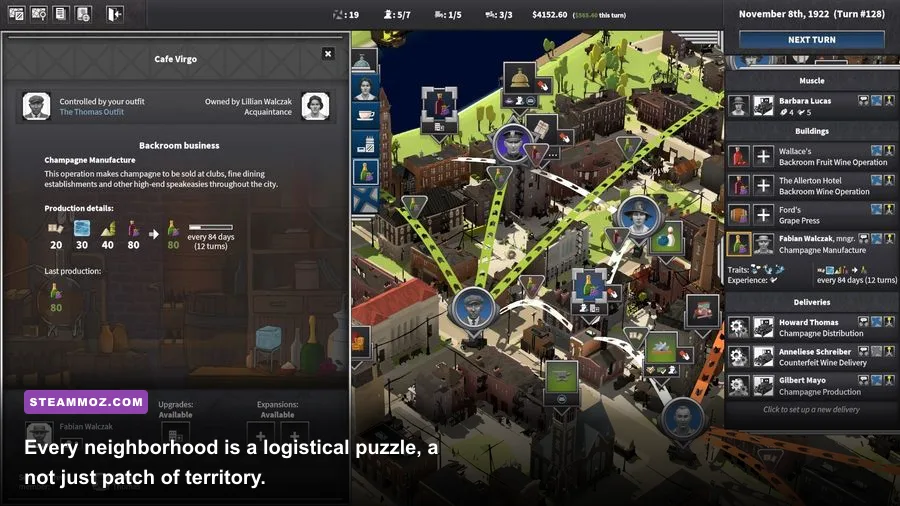
Start with a compact headquarters-centered network. The exact city layout changes from campaign to campaign, so memorizing a fixed build order isn’t as useful as learning a priority order. First identify nearby suppliers, then locate the shortest path to a customer-facing business. Only after that should you think about grabbing a distant neighborhood.
1. Build around distance, not prestige
The most attractive building on the map may be a terrible first investment if it sits far from your production. A short route means fewer wasted actions and fewer opportunities for disruption. Early profits are usually modest, so distance can erase your margin surprisingly quickly.
2. Protect your best action economy
Every crew member is effectively a bundle of actions. Don’t use a specialist to perform a task that a generalist can handle. Save high-value workers for jobs that exploit their traits or unlock new contacts. This becomes especially important when the campaign introduces simultaneous demands from customers, suppliers, and rival organizations.
3. Treat relationships as infrastructure
Contacts aren’t just flavor text. They open access to goods, services, and opportunities that can remove pressure from your main production line. A relationship that looks minor in the first year can become the safest way to acquire a troublesome input later. Keep investing in useful connections instead of assuming buildings alone will carry the campaign.
4. Don’t confuse territory with victory
Neighborhood control feels satisfying, but it can stretch your organization beyond its ability to supply and defend itself. A smaller operation with stable customers is healthier than a sprawling empire full of empty rackets. Expand when the new area improves your network, not simply because the map makes it available.
5. Recover from setbacks instead of restarting immediately
City of Gangsters is designed around imperfect campaigns. A bad event, failed negotiation, or broken supply chain doesn’t always mean the run is finished. Cut unprofitable routes, consolidate around your strongest customers, and use the next few turns to rebuild reserves. The game becomes much more enjoyable once you stop expecting every campaign to follow a clean upward line.
That slower approach is also why the DLC has better long-term value than its first impression suggests. The English Outfit won’t keep you busy if you only want a quick weekend campaign, but it rewards players who enjoy experimenting with openings and comparing how different organizations handle the same city. For more examples of games where the best progress comes from knowing when not to overextend, see our Dragon’s Dogma: Dark Arisen beginner tips.
Performance, presentation, and the 2026 verdict
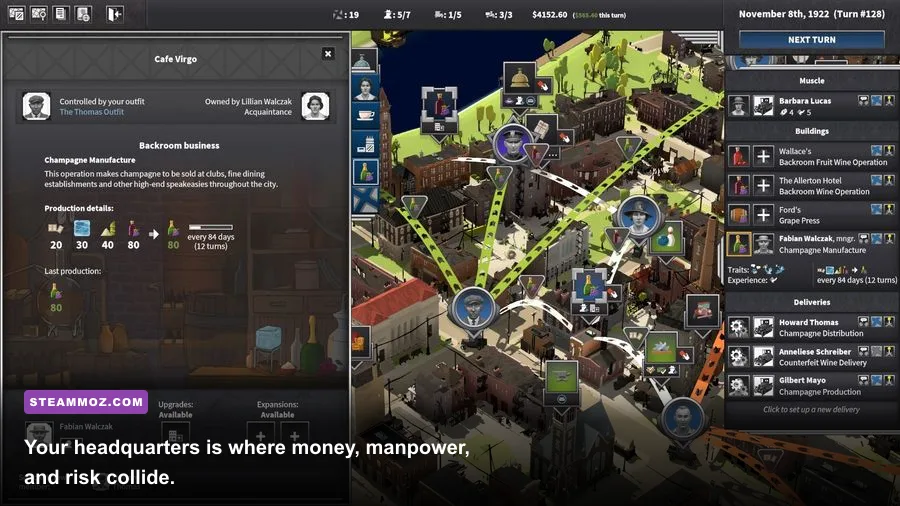
On PC, City of Gangsters is a lightweight strategy game by modern standards. Its camera is mostly zoomed out, the visual style is clean and readable, and the workload is driven more by simulation than by cinematic rendering. You don’t need a high-end graphics card to enjoy it, but a faster CPU can matter more than expected during larger, busier campaigns as the game tracks businesses, crew, customers, and rival activity.
The game’s presentation remains effective because it supports the management fantasy. Menus, neighborhood overlays, building icons, and period-inspired art communicate the state of your operation without drowning the map in visual noise. It’s not a technically spectacular title, but clarity matters more here than ray-traced reflections ever could.
| Profile | Recommended settings | Expected trade-off | Best for |
|---|---|---|---|
| Integrated graphics | Low or medium effects, native resolution, reduced shadows | Less atmospheric lighting | Older laptops and office PCs |
| Balanced PC | High textures, medium shadows, native 1080p | Minimal visual compromise | Most players at 1080p |
| High-end PC | Maximum visual settings and high resolution | Small gains during a mostly static simulation | Ultrawide and high-resolution displays |
For broader PC optimization advice, our Cthuloot graphics settings guide explains the same useful principle: prioritize the settings that affect frame pacing, not the ones that merely look impressive in screenshots. City of Gangsters generally runs smoothly, but keeping background applications closed and avoiding unnecessarily high resolution is still sensible on modest hardware.
There are also quality-of-life limitations you should know about before buying. The interface can make important information feel buried. Some tooltips explain what a building does without making the full cost of maintaining it obvious. Long campaigns can become visually busy, and the pace is intentionally measured. If you want constant dramatic escalation, the quiet stretches may feel like dead air. If you enjoy watching an economic machine slowly become self-sustaining, those same stretches are the payoff.
Steam is the best place to check the current package, reviews, and DLC requirements through the official City of Gangsters Steam page. You can also compare the developer’s broader design philosophy on the SomaSim official website. Pricing and bundle discounts can change, so the DLC is easiest to recommend during a sale or as part of a complete edition.
Is The English Outfit worth buying in 2026?
For existing City of Gangsters players, yes. The English Outfit adds enough faction-specific texture and replay value to justify another campaign, especially if you’ve already learned the base game’s production loops. It encourages a careful, methodical style and makes the early game feel fresh without discarding the systems that made the original compelling.
For new players, the answer is more qualified. Buy the base game first if you’re unsure about the format. Spend a campaign learning how supply, customers, crew actions, relationships, and police pressure interact. Once the game’s deliberately slow rhythm clicks, the English Outfit becomes an appealing second step rather than an unnecessary complication.
| Player type | Verdict | Reason |
|---|---|---|
| Management-sim veteran | Buy | The faction gives the sandbox a worthwhile new opening |
| City of Gangsters owner | Buy on sale or in a bundle | Good replay value, but not a complete campaign overhaul |
| First-time player | Start with the base game | The DLC makes more sense after learning the core economy |
| Action-crime fan | Skip | There is no real-time shooting or cinematic gang warfare |
| Optimization-focused strategist | Strong buy | Short routes, specialist crew, and stable cash flow create rich puzzles |
The broader recommendation is simple: City of Gangsters: The English Outfit is a good expansion for a niche game, not a magical cure for that game’s rough edges. Its menus remain dense, the tutorial still asks you to learn by doing, and the campaign can take a while to reveal why a decision mattered. But once you accept the deliberate pace, the DLC gives the Prohibition sandbox another strong angle and makes repeat runs feel less like repeating homework.
Steamoz’s Central Intelligence review makes a similar case for slow-burn games that depend on player patience rather than spectacle. That’s the right lens here. The English Outfit won’t dominate your backlog, but it can quietly become one of those strategy expansions you return to whenever you want a thoughtful, low-pressure evening of planning, improvisation, and watching a crooked little business empire come alive.