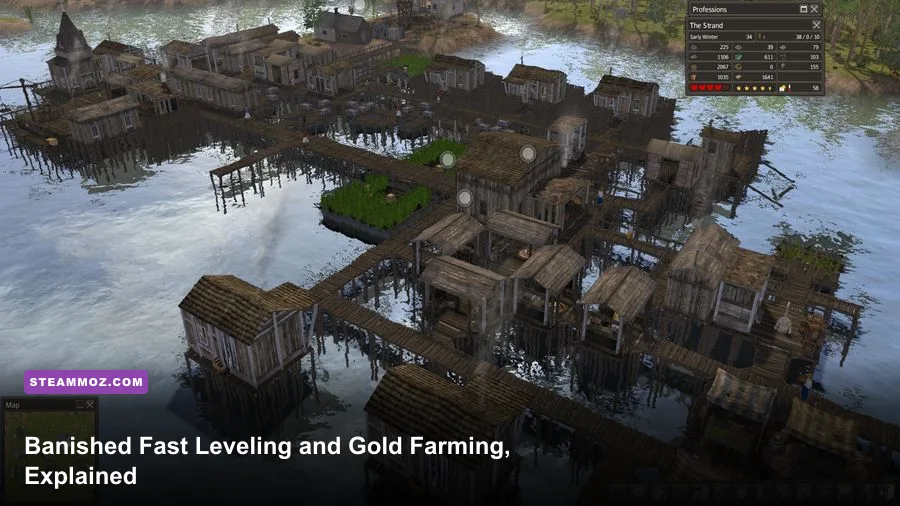
Banished has no character levels, experience points, or gold coins. The fastest way to progress is to grow a reliable population, rush a Trading Post, manufacture high-value trade goods such as firewood and ale, and use those goods to buy seeds, livestock, and missing materials. If you are searching for Banished fast leveling and gold farming, think of it as an economy optimization problem rather than an RPG grind.
That distinction matters because many guides accidentally describe systems from other survival games. In vanilla Banished, citizens do not gain XP from chopping trees, hunting, or building. A Blacksmith does not level into a better Blacksmith, and no enemy drops currency. Your settlement becomes stronger through population, infrastructure, education, production chains, and better logistics.
The official Banished Steam page is useful for confirming the base game's design, while Shining Rock Software's official site covers the developer's original project information. For a similar game with a literal gold-focused economy, compare Steamoz's Dungeons 2 gold farming route; Banished works very differently.

What leveling and gold mean in Banished

Banished replaces conventional progression with several settlement milestones. Your real level is the number of healthy, educated workers you can support without causing a food, fuel, or housing collapse. A town with 100 citizens and no reserve food is not more advanced than a stable town of 40; it is simply closer to a mass death spiral.
The main progression systems are straightforward:
- Population: More adults mean more production, but children consume food before becoming workers. Expanding housing too aggressively creates a delayed labor shortage.
- Education: A School House creates educated workers who gather more efficiently in many professions. Protect the teacher and avoid moving the school constantly.
- Trade: Trading Posts let you convert surplus items into seeds, livestock, food, stone, iron, tools, and other supplies.
- Infrastructure: Markets, storage barns, stockpiles, wells, roads, and Town Halls reduce bottlenecks that otherwise look like resource shortages.
There is no gold-farming route to repeat. Your currency is the trade value stored in manufactured goods. Firewood is the classic early trade commodity because logs are easy to collect and a Woodcutter turns them into a much more valuable item. Ale, tools, coats, and preserved food can become stronger trade goods later, but each requires a longer production chain and more labor.
| Vanilla system | What it actually does | Best fast-progression action |
|---|---|---|
| Experience and levels | Not present for citizens | Raise education and worker efficiency |
| Gold | Not present as a currency item | Stockpile trade goods at a Trading Post |
| Character stats | Health, happiness, age, and education matter | Maintain food variety, herbs, and schooling |
| Loot farming | There are no enemies or loot drops | Specialize production and trade surplus |
🎮 Banished
Looking to experience this game? Grab your digital key directly on our store for $6.79.
View on Steammoz Store →The fastest safe opening for a new settlement

Start by securing food before chasing trade. Place a Gatherer's Hut, Hunting Cabin, and Forester's Lodge close enough to the starting cluster that workers spend less time walking. A Fishing Dock is also excellent if the map gives you a broad river or lake. You do not need every food building immediately, but you do need at least two dependable sources so a poor hunting season does not wipe out the town.
Build houses early, but don't spam them. Each new home creates room for a family and eventually more children, yet those children won't help your labor pool for years. Two or three additional houses are normally enough for the first expansion. Keep at least one adult available for construction, and pause decorative projects whenever food or firewood starts falling.
Your first practical rush is a Woodcutter, a Forester's Lodge, and a Stockpile. Firewood has a strong trade value relative to its simple input chain: a Forester supplies logs, the Woodcutter converts them, and a nearby stockpile keeps hauling under control. Do not clear every tree around the town. Sustainable forestry is slower at first but prevents the mid-game log crash that forces you to demolish buildings.
Tools are the next major breakpoint. A Blacksmith using iron tools can keep workers productive; without tools, gathering and construction slow down sharply. Mine or gather iron before you commit to a large housing wave. If iron is scarce, buy tools from a merchant instead of placing multiple inefficient mines in a cramped starting area.
Build a School House as soon as food, fuel, and housing are stable. Educated workers are one of the closest things Banished has to leveling. The benefit is permanent for that citizen and especially valuable in high-output jobs such as farming, mining, smithing, and tailoring.
Opening priorities by season
- Spring: Assign gatherers, hunters, fishers, and builders. Establish a Stockpile and Barn near production.
- Summer: Finish the first housing cluster and begin firewood production. Avoid assigning every adult to construction.
- Autumn: Harvest crops and move surplus food into a Barn. Keep a reserve instead of immediately increasing population.
- Winter: Watch firewood, tools, and walking distance. Winter is when inefficient layouts reveal themselves.
How to farm trade value without wrecking your town

Once the settlement can feed itself, place a Trading Post on a river or lake with a short road to your main storage area. Assign a dedicated Trader and set the post to hold your surplus. The key is to sell manufactured goods, not raw resources. A pile of logs may look impressive, but firewood, ale, tools, and coats pack more value into the same production footprint.
Firewood is the safest early trade farm. It needs only logs and a Woodcutter, sells consistently, and doubles as your winter fuel. Never sell the entire reserve. A cold winter can kill citizens quickly, and rebuilding a forest-based economy after a fuel crisis is painfully slow. Set a minimum stock threshold in the Trading Post so the trader cannot consume your emergency supply.
Ale is a strong mid-game option once you have a reliable grain supply, a Still, and enough labor to support the chain. It trades well, but turning all your food into ale is a trap. Keep a food buffer first, then convert the surplus. The same rule applies to tools and coats: their value is attractive, but citizens need them for productivity and survival.
Use merchant orders strategically. Seeds and livestock unlock new production, so they usually deserve priority over decorative goods. When a merchant brings something you need, order the exact quantity you can afford and keep the remaining trade value for another visit. A Trading Post is not a shop with infinite inventory; each merchant type has a limited cargo selection, and patience is part of the strategy.
| Trade product | Production chain | Risk level | Best use |
|---|---|---|---|
| Firewood | Logs to Woodcutter | Low | Early seed and livestock purchases |
| Ale | Grain to Still | Medium | Mid-game surplus trading |
| Iron tools | Iron, logs, Blacksmith | Medium | Trade only after worker supply is secure |
| Coats | Hides or wool, tailor, leather | Medium | Compact high-value stockpile |
| Stone and iron | Quarry or mine | High | Sell only when construction reserves are healthy |
For a broader look at games where trading is the central progression engine, Steamoz's Eternam fast-leveling guide covers a genuine RPG economy. Don't copy its grind logic into Banished; production efficiency matters more here.
The logistics tricks that make progression feel fast

Walking time is Banished's hidden experience bar. A worker who spends half a season traveling between a distant forest, a Stockpile, and a Woodcutter produces far less than a worker operating in a compact chain. Put storage beside production, build roads through the busiest routes, and use Bridges only when they cut a major detour.
Markets become valuable when your settlement spreads. A Market's Vendor collects goods from storage and distributes them to nearby homes, which reduces the time families spend searching for food, firewood, tools, and clothing. A Market does not create resources, so building one before you have enough production can make shortages harder to diagnose. Place it centrally after the first town cluster is functioning.
Use priority carefully. Clicking a resource or building with the priority tool can save a town from disaster, but constantly overriding worker assignments creates chaos. Prioritize a road, bridge, or critical mine only when it solves a clear bottleneck. Keep builders available through a small labor buffer rather than stripping every profession.
Education also has a logistics angle. A School House pulls a child away from future uneducated labor, but the long-term gain is worth it in a stable town. If your settlement is starving, don't build a school first; if your food network is secure, delaying education makes every later expansion less efficient.
Performance settings can help on huge towns. Lower shadow quality and disable unnecessary visual effects if the simulation starts stuttering, but remember that a higher frame rate does not make citizens think faster. Steamoz's stutter-free settings guide offers useful general optimization habits, while Drox Operative 2 troubleshooting covers a different game with heavier technical problems.
| Problem | Likely cause | Fix | Priority |
|---|---|---|---|
| Food seems to vanish | Too many houses and children | Pause housing and add food workers | Critical |
| Firewood collapses | Long hauling routes or deforestation | Add storage, roads, and a Forester | Critical |
| Tools stay low | Iron shortage or no Blacksmith labor | Secure iron and reserve a worker | High |
| Trade feels slow | Raw goods and no production chain | Sell firewood first, then ale or coats | Medium |
| Citizens are unhappy | Low food variety, illness, or isolation | Add food types, a Herbalist, and services | High |
Mods, exploits, and the honest gold-farming answer
If you installed Colonial Charter, MegaMod, or another overhaul, the answer can change dramatically. Mods may add currency, profession progression, new trade goods, upgraded buildings, or production chains that make a dedicated gold resource possible. Check the exact mod list before following a vanilla guide. A modded Trading Post may use different values, recipes, and merchant rules.
Vanilla players should ignore claims about secret gold chests, XP exploits, or a best boss route. Banished has no combat bosses, dungeon loot, or hidden gold nodes. The closest thing to an exploit is manipulating save files, merchant inventories, or mod settings, but that removes the economic challenge rather than revealing a legitimate farming method.
The cleanest fast-progression loop is simple: stabilize food, produce firewood, build the Trading Post, buy seeds or livestock, educate workers, then scale a compact production network. Keep reserve stockpiles, protect winter fuel, and expand housing only when your food output can absorb the new families. That is the real Banished fast leveling and gold farming guide: no XP bar, no coins, just a settlement that compounds every good decision.
For official background on the game's systems and updates, consult the official Shining Rock forum. If your settlement survives its first harsh winter with food, firewood, tools, and educated workers intact, you've already beaten the hardest progression check Banished can throw at you.