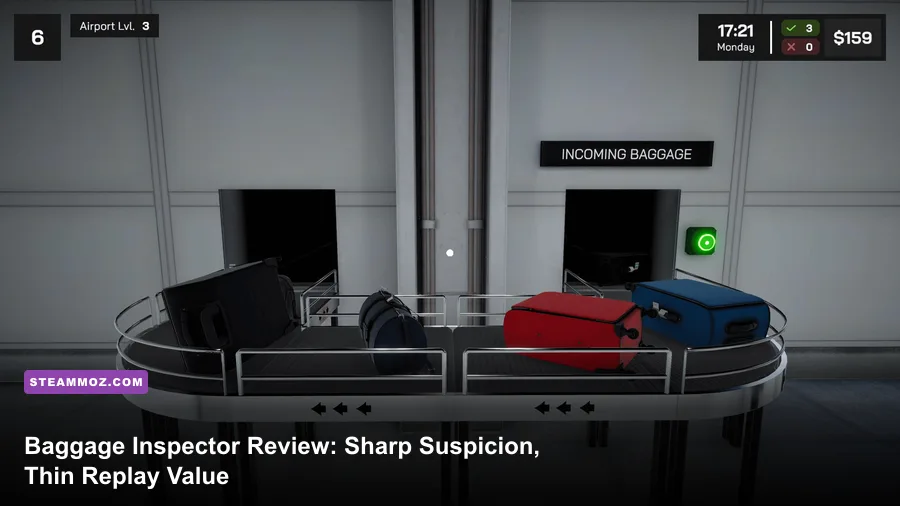
Baggage Inspector is worth playing in 2026 if you enjoy deliberate, low-pressure deduction games, but it isn't a must-buy for players looking for deep progression or endless replayability. Its strongest moments come from spotting a contradiction between a passenger's documents, their story, and the contents of a suitcase. Its weakest moments arrive when the inspection routine becomes predictable and the game offers too little reason to return after you've learned its patterns.
That makes this a compact recommendation rather than a blanket one. If the idea of a smaller, more focused airport-inspection sim sounds appealing, Baggage Inspector delivers a pleasing Papers, Please-style tension without turning every shift into a frantic time-management challenge. If you need character builds, branching systems, competitive scores, or a large campaign, you'll probably feel the game's limits well before the credits roll.
This review focuses on the current PC experience and the question that matters for a 2026 purchase: does Baggage Inspector still feel satisfying once the novelty of looking through bags wears off? The short answer is yes, but only in short sessions and only if you treat its restraint as a feature rather than a missing feature.
What You Actually Do in Baggage Inspector

Baggage Inspector builds its entire loop around one job: examine travelers, inspect their luggage, and decide whether they should pass through. You work through the evidence in front of you rather than controlling a conventional character. The desk, the documents, the scanner, and the passenger's answers are effectively your equipment.
A typical inspection starts with basic paperwork. You compare the passenger's identity details, travel information, and visible documents before moving on to the bag itself. The suitcase is not just a visual prop. You need to inspect its contents, look for items that break the current rules, and decide whether a suspicious object is genuinely important or merely something that looks strange at first glance.
The game is at its best when it makes you slow down. A single item rarely tells the complete story. A passenger may have an apparently valid passport, but their explanation for an object in the bag may not match the available information. Another traveler may look suspicious while carrying nothing that actually violates the rules. That distinction gives the work its appeal: you are not simply clicking every red flag and waiting for a reward.
The basic rhythm is easy to understand:
- Read the available instructions for the current shift.
- Check the travel documents and compare the important details.
- Inspect the suitcase and identify unusual or prohibited items.
- Question or challenge the passenger when the evidence does not line up.
- Approve, reject, or escalate the case based on the information you found.
That loop is deliberately tactile. You are constantly moving between interfaces rather than watching a progress bar fill. The friction is part of the fantasy, although it can also make the early sessions feel slower than they need to be.
| Inspection Stage | What You Check | Why It Matters |
|---|---|---|
| Documents | Names, identity details, and travel information | Small inconsistencies can expose a bad declaration |
| Passenger interaction | Answers, explanations, and visible behavior | Useful context, but not proof by itself |
| Luggage scan | Objects and concealed contents | Confirms or contradicts the passenger's story |
| Final decision | Approve, deny, or escalate | Determines your shift outcome and consequences |
Players coming from Back Then's deliberately limited progression may recognize the same design philosophy here: the point is not to bury a simple idea under dozens of systems. Baggage Inspector wants you to get better at reading situations, not unlock a new inspector class every few hours.

🎮 Baggage Inspector
Looking to experience this game? Grab your digital key directly on our store for $2.79.
View on Steammoz Store →The Inspection Loop Is Clever, but It Has a Ceiling

The strongest design decision is that the game makes observation feel like progress. Your inspector does not suddenly become dramatically more powerful. You become faster at remembering the rules, scanning the right area first, and separating meaningful evidence from visual noise.
That sounds simple, but it creates a satisfying learning curve. During the opening shifts, you may spend too long staring at every item in a bag. Later, you'll develop a practical order of operations: check the documents, scan for obvious contradictions, inspect the unusual object, and only then spend time probing the passenger's explanation. This is the difference between playing the job and understanding it.
The scanner is particularly effective because it turns mundane luggage into a visual puzzle. Dense clusters, concealed objects, and items that don't fit the passenger's stated purpose naturally draw attention. The game doesn't need a combat system or complicated inventory management to create pressure. The pressure comes from knowing that a careless approval is your mistake, not the result of a weak character build.
Still, the loop has a clear ceiling. Once you understand how the game telegraphs suspicious cases, the challenge becomes more about execution than discovery. There are only so many ways to inspect a bag, ask a question, and make a ruling. The absence of a substantial procedural system means the game cannot endlessly surprise you.
That is why Baggage Inspector works better as a focused evening game than as a daily long-term hobby. It has enough variety to make several shifts engaging, but it does not have the systemic depth of a true management simulator. You won't be hiring staff, redesigning an airport, balancing multiple security lanes, or managing a growing department. The job stays close to the desk.
Where the deduction feels fair
Good cases usually provide multiple clues. The luggage may contain an object that conflicts with the declared purpose of the trip, while the paperwork adds another inconsistency. When you reject or escalate that passenger, the decision feels earned because you can explain it to yourself.
The weaker cases are those where the answer depends too heavily on recognizing a particular visual cue. If you miss the cue, the rest of the inspection can feel like busywork. This is not a deal-breaker, but it means the game rewards careful screen reading more than broad investigative creativity.
It is also worth noting that the game does not turn every suspicious traveler into a villain. Some cases are about mistakes, misunderstandings, or incomplete information. That restraint gives the decisions more texture than a simple “spot the criminal” simulator. Your job is to enforce the rules, not to invent a dramatic backstory for every person at the counter.
Difficulty, Progression, and Replay Value
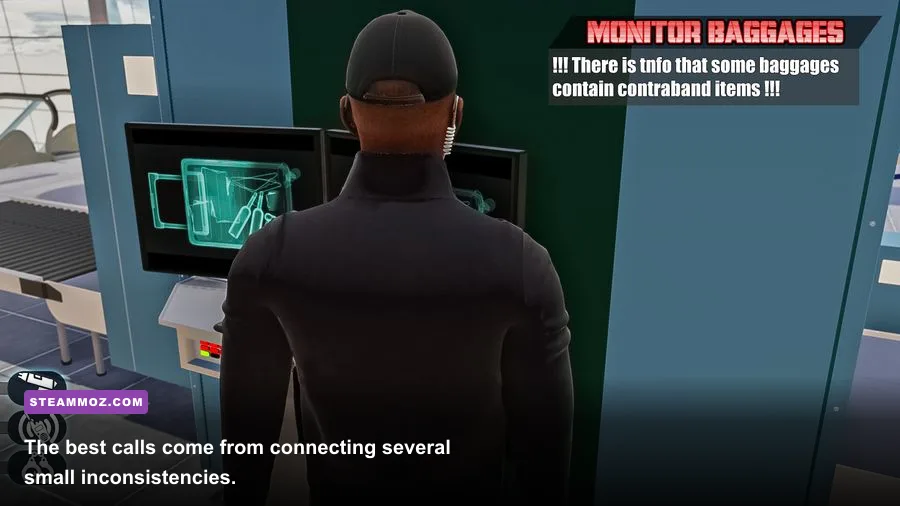
Baggage Inspector's progression is mostly knowledge-based. New rules, stranger cases, and more complicated combinations gradually ask you to process more information. The challenge is not built around numerical stats, weapon upgrades, or skill trees, so there is no optimal build to chase and no equipment tier list that changes the answer.
That makes the game approachable, but it also makes replay value depend heavily on your tolerance for repetition. If you enjoy replaying a scenario to improve your accuracy, reduce wasted movements, or catch clues you missed, the format has appeal. If you expect each replay to produce a radically different story, the experience is more limited.
| Player Type | Likely Experience | Replay Value | Verdict |
|---|---|---|---|
| Casual puzzle player | Easy to understand and satisfying in short sessions | Moderate | Recommended |
| Papers, Please fan | Familiar inspection tension with a lighter structure | Moderate to good | Recommended with caveats |
| Management-sim player | Too little staffing, economy, and facility control | Low to moderate | Wait for a discount |
| Completionist | Clear objectives, but limited long-term mastery systems | Moderate | Depends on price |
| Action-focused player | Slow pace and almost no conventional action | Low | Probably skip |
The game's difficulty is best when it adds information rather than simply reducing the time available. A harder case should force you to compare more evidence, not just click faster. When Baggage Inspector follows that principle, it feels like a thoughtful inspection game. When it leans on visual clutter or repeated routines, the challenge can feel less intelligent.
There is no reason to approach this like a grind-heavy live-service title. You don't need to optimize a route through a skill tree or farm currency for a better scanner. The right strategy is to learn the inspection order and avoid premature decisions. That is a refreshing change from games that turn every activity into a resource treadmill.
Players who like short, methodical games may also enjoy our coverage of Badlands Crew's decision-heavy convoy management and City of Gangsters' slower strategic pacing. Baggage Inspector sits in a similar zone where attention and judgment matter more than reflexes.
Performance and Settings on PC
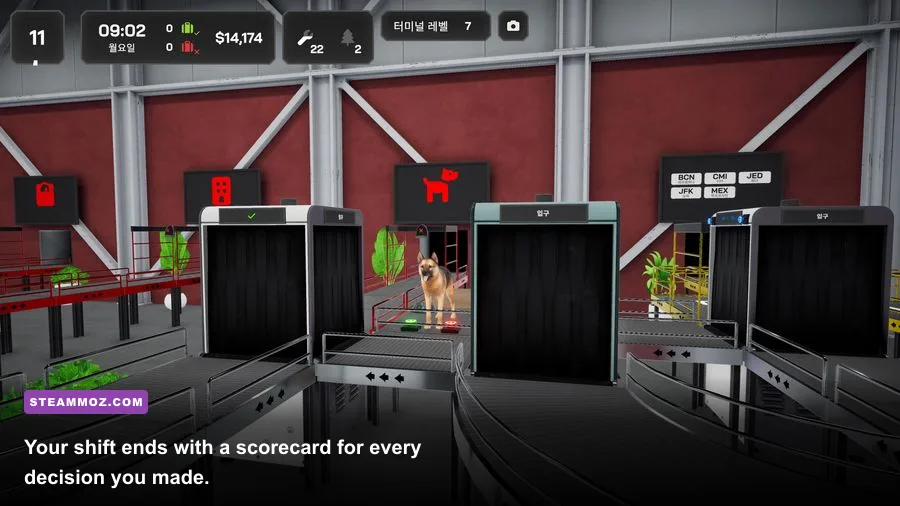
Baggage Inspector is not a graphics showcase. Its environments are compact, the action is desk-bound, and the visual workload is considerably lighter than a modern open-world game. That makes it a comfortable choice for older gaming PCs and handheld play, although the exact experience still depends on resolution, background applications, and whether the build has received performance patches.
The most sensible approach is to prioritize a stable frame rate over cosmetic effects. A locked 60 frames per second makes document reading and object inspection feel cleaner, while extreme visual settings add little to the core experience. If your system struggles, lower resolution or shadow quality before sacrificing interface clarity.
| Setting Profile | Recommended Use | Expected Impact | Visual Trade-Off |
|---|---|---|---|
| Low | Integrated graphics and older laptops | Lowest GPU load | Simpler shadows and reduced scene detail |
| Medium | Mainstream PCs and Steam Deck-style hardware | Balanced load | Most detail remains intact |
| High | Modern dedicated GPUs | Higher scene and shadow cost | Cleaner lighting, limited gameplay benefit |
| Native resolution | Desktop monitors | Highest pixel cost | Sharpest text and inspection visuals |
| Lower resolution with scaling | Handhelds or older GPUs | Meaningfully lighter load | Some softness around text and objects |
For general troubleshooting, our guides to settings that make every frame count and crash and low-FPS fixes cover the same practical basics: update the GPU driver, verify the installation, disable unnecessary overlays, and test fullscreen against borderless mode.
One warning matters more than chasing benchmark numbers: don't lower the game's clarity so far that you miss small objects or document details. In an inspection game, a blurry interface is not merely ugly. It directly undermines the central mechanic. Keep text readable, cap the frame rate if your system produces uneven frame pacing, and use the lowest setting that preserves the silhouettes and contrast of scanned items.
Is Baggage Inspector Worth Playing in 2026?
Yes, if you want a compact deduction simulator with a strong central idea. No, if you're expecting a forever game. Baggage Inspector understands that inspecting a suitcase can be tense when the game gives you just enough information to make a judgment, then asks you to live with the result. The best cases create a satisfying chain of reasoning without requiring a spreadsheet or a wiki.
Its biggest strength is focus. The game doesn't dilute the fantasy with unnecessary combat, bloated progression, or a dozen unrelated minigames. You are an inspector, and almost every meaningful interaction supports that role. The small details matter: reading the paperwork before touching the bag, remembering the current restrictions, and refusing to let an awkward passenger's attitude substitute for evidence.
Its biggest weakness is also focus. Once you have mastered the inspection routine, there isn't enough systemic depth to sustain unlimited sessions. The game needs stronger procedural variation, more consequential career choices, or a broader airport-management layer to compete with the most replayable inspection sims. As it stands, the experience is more memorable than expansive.
| Category | Assessment | Why It Matters |
|---|---|---|
| Core inspection loop | Strong | Clear, tactile, and easy to learn |
| Deduction design | Good | Best cases reward combining several clues |
| Progression | Limited | Mostly new knowledge rather than new systems |
| Replayability | Moderate | Depends on enjoying repeated inspections |
| PC accessibility | Good | Light workload and flexible visual settings |
| Long-term value | Situational | Better as a focused purchase than a 100-hour game |
My recommendation for 2026 is straightforward: buy Baggage Inspector at full price if the premise immediately appeals to you and you value compact indie experiences. Otherwise, place it on a wishlist and grab it during a sale. It is especially easy to recommend to players who enjoyed the moral pressure of Papers, Please but want something less punishing and more approachable.
Don't buy it expecting a large-scale airport tycoon game, a procedural mystery engine, or a deep career simulator. Buy it for the pleasure of noticing that one detail nobody else noticed. When Baggage Inspector is operating at its best, that small realization feels surprisingly powerful. When it runs out of ways to surprise you, the limitations are obvious. In 2026, that makes it a worthwhile niche game—not an essential one.
For the latest availability, platform information, and patch notes, check the official Steam search listing for Baggage Inspector and the game's official community updates before purchasing.