
Yes—ASTRONEER: Glitchwalkers is worth playing in 2026 if you already enjoy Astroneer's base-building and resource loops, but it isn't the best starting point for newcomers. The expansion's new planet, Aeoluz, adds harsher environmental conditions, a separate progression path, new missions, and enough logistical friction to make familiar tools feel newly important. It doesn't reinvent Astroneer, and its story can feel thin beside the sandbox, but the extra pressure gives veteran players a reason to return. Buy it for the survival puzzle, not for a massive narrative campaign or a totally different game.
That distinction matters. Glitchwalkers is an expansion built on Astroneer's existing rhythm: land somewhere beautiful, print a platform, solve oxygen and power problems, unlock research, and slowly turn an improvised camp into an industrial outpost. Aeoluz does not throw away that loop. Instead, it asks whether you can keep it running when the planet itself refuses to cooperate.
If you're new to the series, start with the base game first. Our Dungeon Siege review covers a very different kind of classic, but the same rule applies here: learn the original systems before judging an expansion that assumes you understand them.

Aeoluz is the real reason to return
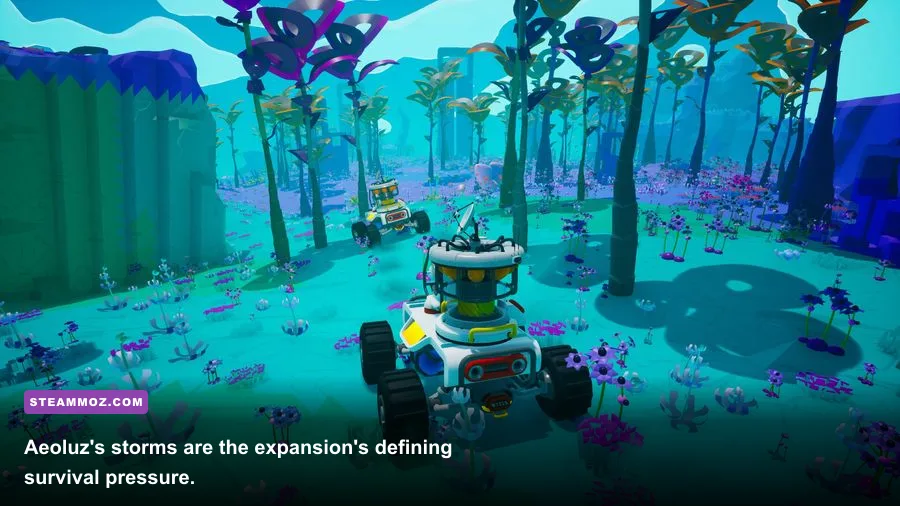
Aeoluz is Glitchwalkers' strongest idea because it changes the value of preparation without discarding Astroneer's sense of discovery. The planet's dangerous storms can interrupt travel, expose poorly placed equipment, and make a short supply run suddenly expensive. You still use the Terrain Tool to reshape the landscape, but flat ground and attractive scenery are no longer enough. Your base needs shelter, power redundancy, storage discipline, and a route back to oxygen.
That last point is where the expansion feels sharpest. On gentler planets, a player can often improvise. On Aeoluz, improvisation has a bill attached. A vehicle expedition without spare power, tethers, or a backup oxygen plan can strand you well outside the safety of your starting platform. The Portable Oxygenator remains one of the most valuable pieces of equipment for exploration, but it doesn't solve every problem: it consumes power, and storms make reckless detours more punishing.
Aeoluz also encourages a more deliberate relationship with terrain. Digging a vertical emergency tunnel with the Terrain Tool is useful, but a badly planned tunnel can become a maze when visibility drops. Building near resources is tempting, yet a base positioned in an exposed area may be harder to defend against environmental disruption than one placed beside a less convenient resource deposit.
This is not a horror game. The threat isn't designed around jump scares or twitch combat. The danger is logistical, which fits Astroneer perfectly. You lose time, oxygen, power, and materials because one small assumption was wrong. That makes every successful return to base feel earned.

🎮 ASTRONEER: Glitchwalkers
Looking to experience this game? Grab your digital key directly on our store for $6.99.
View on Steammoz Store →The progression is familiar, but the pressure feels new

Glitchwalkers adds a new research progression and mission structure that sits on top of Astroneer's established technology economy. You still need Bytes to unlock blueprints, and you still rely on research items, Research Chambers, Research Aids, and a steady production chain to move forward. The difference is that Aeoluz gives those familiar systems a tighter context: you aren't merely unlocking the next convenience; you're building the tools needed to make hostile expeditions sustainable.
The early game is deliberately slower than an experienced Astroneer player might expect. The first hours are spent establishing oxygen, power, storage, and a dependable source of compound and resin before the more interesting expansion systems begin to open up. That pacing can feel conservative, especially if you've already mastered the base game's opening on Sylva, but it prevents the new planet from becoming a checklist of instantly solved problems.
Once the production chain starts moving, the expansion becomes much more satisfying. The Soil Centrifuge turns excess organic material into useful basic resources, the Chemistry Lab broadens your material options, and the Atmospheric Condenser remains central to advanced crafting. The familiar relationship between raw resources, processed materials, and power is still the heart of the game. Glitchwalkers succeeds because it makes that relationship feel urgent again.
The mission structure is better at giving direction than the base sandbox, though it isn't a replacement for a deep campaign. Objectives point you toward Aeoluz's new content and encourage you to engage with the planet rather than immediately optimizing a giant factory. Players who love self-directed construction may find the prompts restrictive; players who normally lose momentum after landing will appreciate the nudge.
| Progression Stage | Priority | Recommended Tools | Why It Matters |
|---|---|---|---|
| Landing and setup | Oxygen and power | Tethers, Oxygenator, Small Generator | Prevents early deaths and keeps research moving |
| First expedition | Reliable mobility | Tractor, Trailer, Portable Oxygenator | Lets you extend resource runs without gambling everything |
| Industrial expansion | Material processing | Soil Centrifuge, Chemistry Lab, Smelting Furnace | Converts common resources into advanced production inputs |
| Late-game Aeoluz | Redundancy and automation | RTGs, Auto Arms, Large Platforms | Reduces downtime when storms disrupt manual supply runs |
Players who enjoy carefully optimizing production may also like our Dragonkin settings guide, although Glitchwalkers' biggest optimization challenge is not frame rate—it is keeping every part of the factory supplied.
What to build first on Aeoluz

The best Aeoluz base is compact, redundant, and boring. That's a compliment. Build a central platform with your Research Chamber, Printer, storage, and power connectors close together. Put your oxygen solution where you can reach it in seconds, not where it looks best in a screenshot. Use Medium Storage or larger storage modules to prevent resources from spreading across every platform, and leave enough room to add an Auto Arm later.
Power deserves special attention. Small Generators and Medium Generators are useful during the opening, but fuel-dependent power becomes tedious once you start running printers, research equipment, and material processors together. Solar Panels and Wind Turbines can carry a mixed setup, but their output changes with conditions and time. A battery bank smooths those gaps. Later, RTGs provide the dependable baseline that makes long production sessions much less fragile.
Don't rush to build an enormous factory. The expansion rewards modular growth. One platform for research, one for smelting and chemistry, and one for storage is easier to repair and expand than a tangled web of machines. If a storm or a bad power draw interrupts one section, the rest of your base should remain useful.
Vehicles are similarly powerful when treated as transport systems rather than toys. A Tractor with Trailers is excellent for early hauling because it extends your oxygen and storage capacity at a manageable cost. The Rover becomes more attractive once you have a larger operation and longer routes, but it also magnifies mistakes: getting a big vehicle stuck far from base is a much more expensive problem than losing a single backpack load.
Keep a recovery cache near major routes. Store compound, resin, graphite, spare power cells, and a few oxygen-related items at strategic points. This feels excessive until you return from a storm with an empty backpack and realize the cache has turned a disaster into a five-minute detour.
Storm survival is about reading the warning, not reacting late
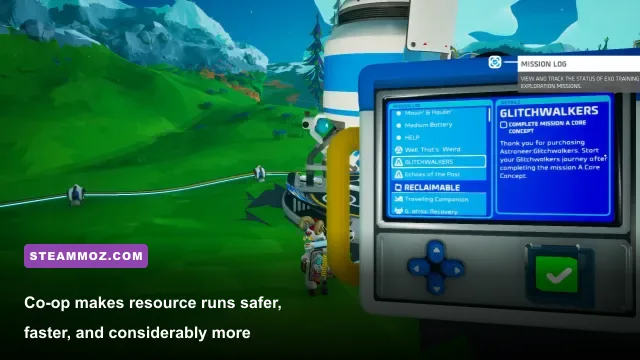
Glitchwalkers' environmental danger works best when you respect its warning cycle. The mistake is treating a storm alert as background atmosphere. When conditions begin to turn, stop extending the expedition. Mark your route, check your power, and move toward a known shelter or vehicle. The expansion rarely punishes cautious players; it punishes players who decide they can grab one more resource node.
Your Terrain Tool is a survival device, not merely a construction tool. A shallow trench can break line-of-sight and give you a moment to reorganize, while a properly connected tether line creates a reliable route through poor visibility. Tethers are cheap compared with a lost expedition, so use them aggressively around unfamiliar terrain. If you are carrying rare research items or advanced materials, the cost of a few extra tethers is irrelevant.
Storm preparation also changes how you evaluate inventory. Carrying only the minimum needed for a planned task is efficient during calm conditions. On Aeoluz, one spare Small Generator or a backup power cell can be more valuable than another resource slot. The Portable Oxygenator is excellent for mobility, but it should support a route—not encourage you to abandon every route.
| Threat or Mistake | Warning Sign | Counterplay | Best Backup |
|---|---|---|---|
| Storm catches you outside | Conditions worsen while exploring | Abort the resource run immediately | Vehicle or tethered shelter |
| Power collapse | Multiple machines run at once | Separate production cycles and add batteries | Small or Medium Generator |
| Lost route | Visibility and landmarks disappear | Follow tethers or vehicle tracks | Beacon and spare tethers |
| Vehicle stranded | Terrain becomes steep or obstructed | Flatten a ramp before committing | Packager and backup power |
This methodical approach may sound slower, but it actually improves your pace. Astroneer's biggest time sink is repeating a trip after a preventable failure. Glitchwalkers makes that lesson impossible to ignore.
Solo and co-op performance in 2026

On PC, Glitchwalkers benefits from the same scalable presentation as Astroneer: its clean art direction remains readable at lower settings, while higher shadow, effects, and view-distance settings make storms and large bases more attractive. The expansion's biggest performance variable is still the size and complexity of your settlement. A clean landing site runs smoothly; a late-game factory filled with platforms, Auto Arms, storage, vehicles, and active machines can create more noticeable dips.
There is no reason to chase maximum settings at the expense of consistency. A stable 60 frames per second makes driving, terrain editing, and storm navigation feel better than a fluctuating higher target. Cap the frame rate to your display, reduce shadows before lowering texture quality, and close unnecessary simulation-heavy machines when you are not using them.
| Setting | Recommended Value | Typical Performance Impact | Visual Trade-Off |
|---|---|---|---|
| Resolution | Native display resolution | Highest GPU cost | Keep native if your target frame rate is stable |
| Shadows | Medium | Medium to high | Lower settings help during large-base play |
| Effects | Medium or High | Medium | Storm atmosphere is more noticeable on High |
| View distance | High | Medium in busy areas | Useful for spotting terrain and distant structures |
| Frame-rate cap | 60 FPS or display refresh target | Improves consistency | Less fluctuation while driving and building |
Co-op is where the expansion's friction becomes funniest. One player can maintain the base while another scouts for resources, but communication matters because Aeoluz punishes duplicated work. Assign one person to power and production, another to exploration and route marking, and swap jobs when the factory stabilizes. The best multiplayer sessions feel like a tiny expedition crew; the worst are four players driving off in different directions with no oxygen plan.
For comparison, our Dins Curse survival tips focus on defending a settlement under pressure. Glitchwalkers is gentler, but the same principle applies: the base is only as strong as the systems you prepare before trouble arrives.
Is Glitchwalkers worth buying in 2026?
For returning players, the answer is a confident yes—provided you want more Astroneer rather than a new genre experience. Aeoluz adds a meaningful environmental twist, the new research path gives progression a fresh shape, and the missions provide welcome direction. Most importantly, the expansion makes routine decisions matter again. Where should the next platform go? How much power is enough? Is that resource deposit worth the trip during a storm warning? Those are excellent Astroneer questions.
The weaknesses are just as clear. The narrative is functional rather than unforgettable, and the early progression can feel familiar if you've already exhausted the base game's technology tree. Glitchwalkers also doesn't turn Astroneer into an action game; there is no deep combat build, weapon tier list, or boss-focused endgame waiting at the finish line. Its drama comes from systems colliding, not from cinematic set pieces.
| Player Type | Verdict | Reason | Best Approach |
|---|---|---|---|
| New to Astroneer | Wait | The base game teaches the essential systems more gently | Learn Sylva first, then move to Aeoluz |
| Solo veteran | Buy | Storms and new progression refresh familiar routines | Play with limited automation early |
| Co-op group | Strong buy | Specialized roles make expeditions more engaging | Assign base, scouting, and logistics jobs |
| Story-first player | Maybe | The campaign supports the sandbox rather than replacing it | Keep expectations closer to a guided expedition |
| Factory optimizer | Buy on sale or full price | Redundancy and production planning are excellent | Build modularly and automate in stages |
Before buying, check the official Glitchwalkers Steam page for current platform details, bundle pricing, and recent player feedback. System Era's official Astroneer website is also the best place to track updates, while the System Era Softworks site provides developer news.
My final verdict for 2026 is 7.5/10. Glitchwalkers isn't essential for somebody who only wants to sample Astroneer, and it won't satisfy players looking for combat-heavy survival. But for anyone who misses the first launch, the satisfying grind of a growing base, and the particular joy of solving a problem with one more platform and a better power grid, Aeoluz is a worthwhile return trip. Pack extra tethers, don't ignore the storm warnings, and remember: the prettiest base on the planet is useless if you can't get back to it alive.
If you're comparing it with other older games worth revisiting, Steamoz's Desperados III review and Disciples: Liberation review offer very different kinds of long-term value. Glitchwalkers' appeal is simpler: it gives Astroneer's sandbox a tougher planet and trusts you to make your own stories there.