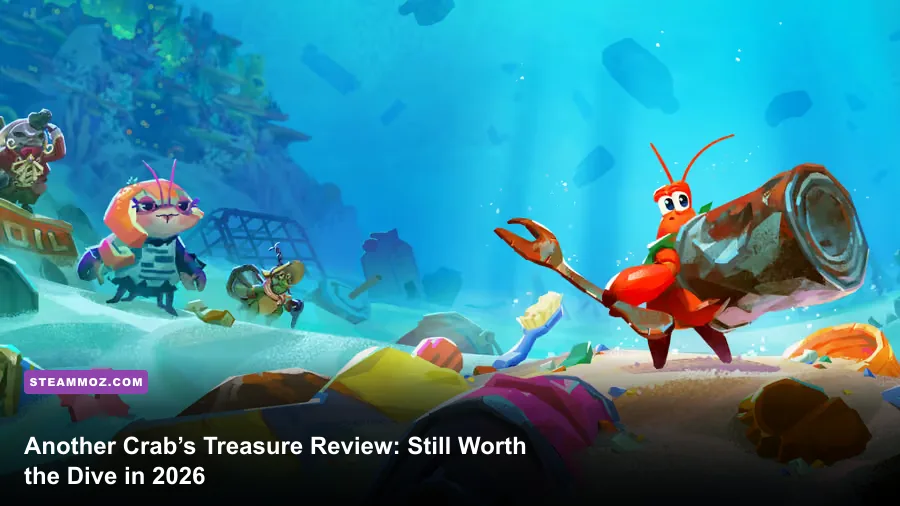
Yes—Another Crab’s Treasure is still worth playing in 2026, especially if you want a shorter, colorful Soulslike with inventive gear and a genuinely funny tone. Its parry timing, camera problems, and occasional performance hiccups keep it from joining the genre’s elite, but Kril’s shell-based defense system gives every fight a distinct tactical rhythm that most imitators never find.
That verdict matters because the game sits in an unusual spot. It looks like a cheerful underwater platformer, yet it borrows the stamina management, corpse runs, shortcuts, and boss pressure of Dark Souls. Aggro Crab softens the punishment with accessibility options and a much more welcoming progression curve, but it doesn’t remove the satisfaction of learning an attack pattern. In 2026, that balance makes it an excellent recommendation for newcomers and a breezy palate cleanser for veterans.
What makes Another Crab’s Treasure different
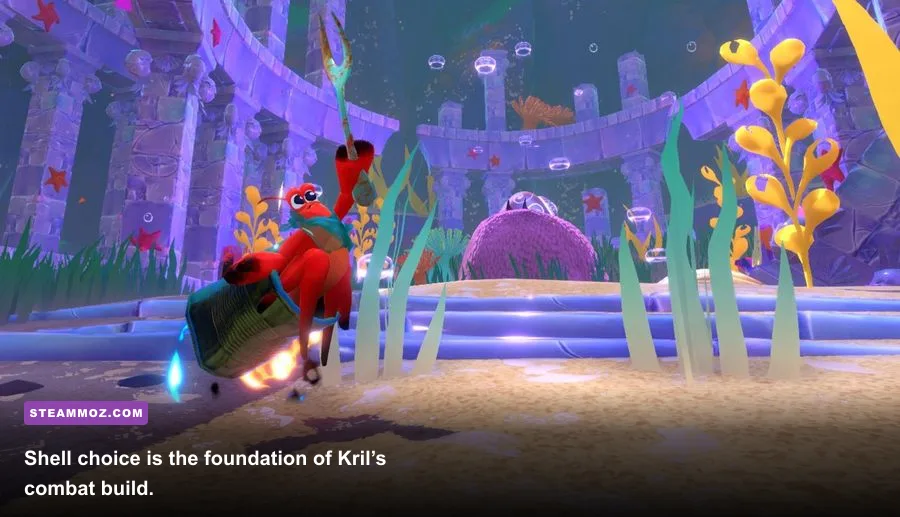
Another Crab’s Treasure casts you as Kril, a hermit crab whose shell is repossessed by a predatory lender. The obvious joke—wearing discarded trash as armor—becomes the game’s most important mechanical idea. A shell isn’t just a cosmetic costume. It changes Kril’s defense, shell ability, weight, and sometimes the way you approach an entire encounter.
You begin with humble options such as cans and cups, then discover shells shaped like soda containers, bottles, thimbles, helmets, and other ocean-floor debris. Each has a durability value and a special ability. Some launch a projectile, some create a defensive effect, and others provide a status-related trick. When a shell breaks, Kril becomes exposed and must either recover it, find another shell nearby, or fight without protection until he can replace it.
That breakable armor creates a useful decision loop. You can play aggressively and use the shell ability whenever its Umami cost is available, or preserve the shell and rely on clean dodges and parries. The best shell is rarely the one with the biggest number. It’s the one whose ability supports the boss, terrain, and enemy mix in front of you.
The game also has a proper Steam store page with the current platform information, patches, and player feedback. Check that page before buying on PC, because performance has improved since launch but can still vary significantly between hardware configurations.

🎮 Another Crab's Treasure
Looking to experience this game? Grab your digital key directly on our store for $11.99.
View on Steammoz Store →Combat is simple until the shells start clicking
Kril attacks with a fork, and the moveset is intentionally compact: light attacks, a stronger charged strike, dodge movement, parries, shell abilities, and a limited set of adaptations. The fork doesn’t have a traditional weapon-inventory treadmill, so progression comes from upgrading Kril’s core abilities and assembling useful shell and stowaway combinations.
The parry is the skill ceiling. A successful parry interrupts an incoming attack and can create a punish window, but the timing is less generous than the game’s bright presentation suggests. Fast enemies often hide their strike behind a wind-up animation, while larger creatures use delayed swings designed to catch an early dodge. Don’t mash the button when an enemy raises a limb. Watch the actual release of the attack.
Dodge rolls are safer against wide-area attacks, but they consume stamina and can leave Kril positioned badly near a ledge. The game rewards staying close enough to circle an enemy rather than sprinting away after every hit. Against standard foes, a light attack string followed by a shell ability is usually more efficient than waiting for a perfect opening. Against bosses, two hits and a retreat is often the smarter rule.
Shells worth prioritizing
Early shells teach the central trade-off between durability and utility. A sturdier shell gives you more room to make mistakes, while a fragile shell with a strong ability can accelerate a difficult phase if you know exactly when to spend it. Shell abilities use Umami, so button-mashing them can leave you empty when a boss enters a vulnerable state.
| Shell approach | Strength | Weakness | Best use |
|---|---|---|---|
| High durability shell | More blocked mistakes | Lower mobility or weaker utility | First attempts and unfamiliar zones |
| Ability-focused shell | Strong burst or crowd control | Breaks quickly if hit repeatedly | Boss punish windows and elite enemies |
| Light shell | Comfortable movement and recovery | Little room for failed parries | Experienced players who dodge consistently |
| Environmental shell | Can interact with specific hazards | Situational outside its intended area | Puzzles, traversal, and themed encounters |
There’s also a satisfying layer of scavenging. Shells are scattered through levels, placed on defeated enemies, or tucked into corners that reward curiosity. That makes exploration practical rather than decorative. If you’re the sort of player who checks every side path, you’ll usually have a better answer for the next major fight.
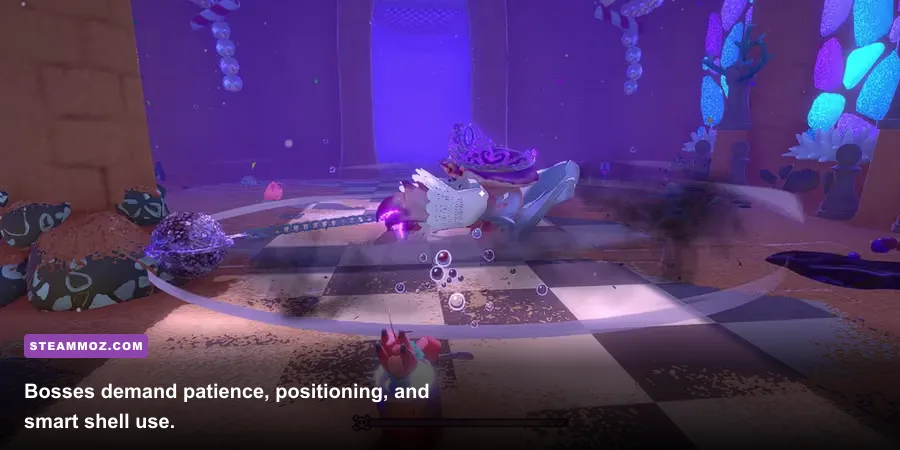
Bosses make the strongest case for playing
The boss roster is where Another Crab’s Treasure stops being merely charming. Fights such as the Duchess force you to read long wind-ups and resist the temptation to attack during every apparent opening. Other encounters use environmental hazards, projectile patterns, or multiple targets to test whether you’ve learned to move without losing sight of the arena.
Boss design is uneven, but the best encounters understand the game’s identity. You’re not just waiting for a three-hit combo to finish. You’re deciding whether to spend shell durability to absorb a mistake, use an adaptation to alter your damage plan, or preserve Umami for a shell ability that can stagger the boss. That choice is particularly important in longer battles where healing and replacement shells are limited.
A practical boss routine
Start every new fight by spending a full minute learning rather than trying to win. Identify the attack with the clearest parry timing, the attack that must be dodged, and the moment when the boss becomes safe to punish. Then test your shell ability once. If it causes a stagger or creates distance, save it for that exact interaction on later attempts.
| Boss situation | Danger | Counter strategy | Optimal tool |
|---|---|---|---|
| Delayed overhead swing | Early dodge gets clipped | Wait for the arm to descend, then dodge or parry | Parry timing |
| Wide arena sweep | Rolling too late traps Kril at the edge | Move toward the safe side before the swing begins | Early repositioning |
| Projectile sequence | Focus breaks while watching the floor | Circle the boss and use cover or lateral dodges | Light shell movement |
| Boss stagger | Wasting the opening on a slow animation | Use a short attack string, then reset spacing | Charged fork strike |
The downside is that some camera angles undermine this excellent foundation. Large bosses can fill the screen, lock-on can tug Kril toward hazards, and cramped arenas occasionally make a clean read feel impossible. These issues aren’t constant, but they’re the reason I’d rate the combat just below the genre’s best rather than calling it a hidden masterpiece.
Progression rewards experimentation, not grinding
Kril develops through a mix of level investment, adaptations, stowaways, shell collection, and story progression. The game doesn’t bury you under dozens of nearly identical swords, which keeps upgrades readable. You can focus on survivability, fork damage, shell efficiency, or Umami-powered abilities without needing a spreadsheet to understand the basics.
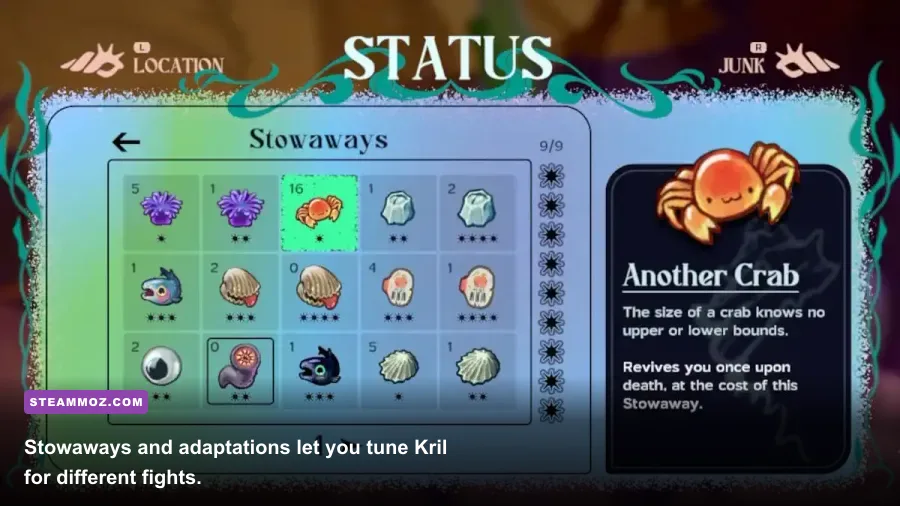
Stowaways act like passive charms. They can improve damage, health, shell-related performance, or other aspects of Kril’s kit. The important thing is to build around a purpose. A general-purpose setup with extra survivability is ideal while exploring, but a boss attempt may benefit more from damage and resource generation. If you’re struggling, don’t assume you need to level five more times. Change the stowaways first.
Adaptations add active options and help the game avoid the flatness that can affect simple action RPGs. They give you more ways to respond to groups and armored targets, but their value depends on your execution. An adaptation you never remember to activate is worse than a modest passive bonus that constantly supports your preferred rhythm.
| Build priority | Recommended focus | Combat payoff | Who should use it |
|---|---|---|---|
| Survival | Health, shell durability, defensive stowaways | More attempts at learning boss patterns | New Soulslike players |
| Fork damage | Attack upgrades and offensive stowaways | Shorter standard encounters | Players confident with dodges |
| Umami utility | Shell abilities and resource support | More control during elite fights | Ability-focused players |
| Balanced | One defensive and one offensive direction | Reliable exploration without extreme weaknesses | Most first playthroughs |
That flexible structure is one reason the game remains easy to recommend. You won’t be punished for choosing an imperfect path early, and the world regularly gives you reasons to revisit your assumptions. It’s a more forgiving progression model than many Soulslikes, without turning every upgrade into a meaningless stat bump.
The world is colorful, funny, and darker than expected
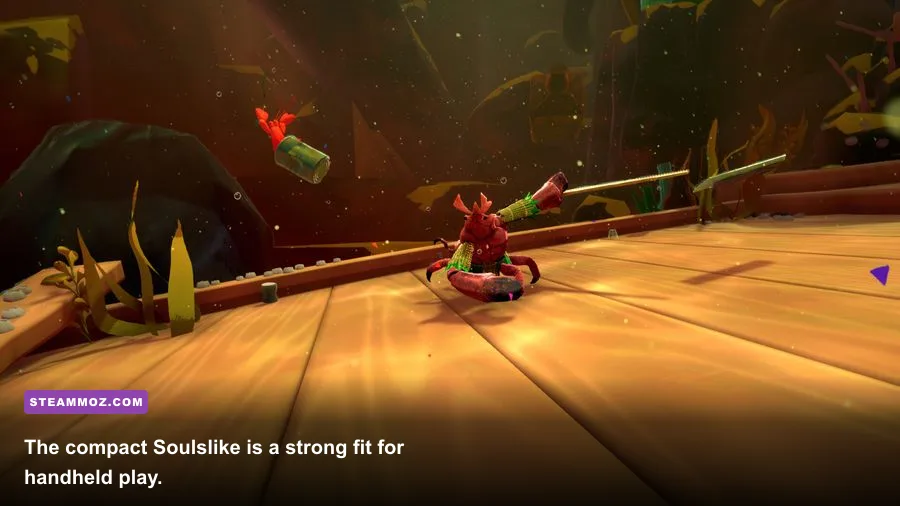
The underwater setting is the game’s visual signature. Kril travels through tide pools, sunken structures, polluted habitats, and strange settlements packed with marine life. Bright colors and oversized objects make navigation memorable, while the ocean’s trash problem gives the world a coherent environmental theme instead of a collection of disconnected fantasy biomes.
That contrast is deliberate. Characters make jokes about debt, consumer culture, and discarded plastic while the story keeps showing the consequences of exploitation beneath the surface. The writing is silly without being weightless. Kril’s quest may begin with a missing shell, but the surrounding world steadily reveals why the ocean’s social order is collapsing.
Exploration is helped by shortcuts and visual landmarks, though the map can become confusing when multiple vertical routes overlap. Marking important locations mentally—or taking a screenshot of an unexplained locked route—will save time later. The game’s most rewarding secrets are often off the obvious path, so don’t rush from objective marker to objective marker.
If you enjoy games where environmental details carry as much personality as dialogue, it’s worth pairing this with Steamoz’s coverage of Beacon Pines PC fixes and exploration. They’re very different games, but both understand how a distinct setting can do much of the storytelling.
PC and Steam Deck performance in 2026
Performance is good enough for most players, but it isn’t perfectly consistent. The colorful art style can make the game look lightweight, yet busy areas, water effects, shadows, and camera-heavy boss arenas can expose frame-time spikes. A stable 60 frames per second feels noticeably better for parries than a fluctuating high reading.
The official PC requirements remain modest by modern standards, although “minimum” should be read as a starting point rather than a guarantee of locked performance. On Steam Deck, a sensible 40-FPS target is often preferable to chasing 60 in every zone. Lowering shadows and effects has a larger practical impact than sacrificing texture quality, since the game’s stylized surfaces still look good at reduced settings.
| Component | Minimum | Recommended | Pro-tuned target |
|---|---|---|---|
| CPU | Intel Core i5-7500 | Intel Core i7-7700 | Modern 6-core CPU |
| Memory | 8 GB RAM | 16 GB RAM | 16 GB dual-channel |
| GPU | GeForce GTX 760 | GeForce GTX 1070 | RTX 2060 or better |
| Storage | 10 GB available | 10 GB available | SSD with 10 GB free |
For a typical PC, start with 1080p, high textures, medium shadows, medium effects, and motion blur disabled. If frame pacing still feels uneven, cap the frame rate to a value your system can hold. On Steam Deck, 40 FPS at 40 Hz is a strong compromise; use medium textures, low-to-medium shadows, and avoid running unnecessary background processes.
Players who regularly troubleshoot PC games can also use Steamoz’s frame-rate settings guide and crash and low-FPS checklist. The advice is general, but the same priorities apply here: update drivers, use an SSD, cap unstable FPS, and test settings one change at a time.
Accessibility makes the difficulty easier to own
Another Crab’s Treasure deserves credit for letting players adjust the challenge without pretending there’s only one legitimate way to experience it. Assist options can reduce incoming damage and expand the margin for error, making the game far more approachable if parry-heavy combat isn’t your thing. These tools don’t erase the world, bosses, or upgrade decisions; they simply reduce the penalty attached to missed execution.
That’s especially valuable for players who love exploration but dislike repeated corpse runs. Use the assist settings if a fight stops being interesting and starts feeling like a tax. Conversely, veterans can leave them untouched and pursue the clean parries and low-damage victories that make the combat sing. The game’s best design decision may be recognizing that both players want the same thing: to keep moving through this strange ocean.
Should you play it in 2026?
If you want a huge, brutally opaque RPG with dozens of weapon classes, Another Crab’s Treasure may feel lightweight. Its world is smaller than the genre’s giants, its camera occasionally fights you, and several encounters don’t reach the standard set by its strongest bosses. The humor also won’t land for everyone, particularly if constant jokes clash with your preferred Soulslike mood.
But those limitations are balanced by a campaign that respects your time. The levels are colorful and purposeful, the shell system gives defense real personality, and the progression lets you fix a weak build without starting over. Kril’s fork feels responsive, the bosses teach readable lessons, and the accessibility options remove a barrier that keeps many curious players away from the genre.
My 2026 recommendation is straightforward: buy it on sale if you’re a Soulslike veteran, and buy it immediately if you’re a newcomer who wants something friendlier than Elden Ring. It’s also an excellent handheld game, provided you accept a 40-FPS target and occasional visual dips. For more genre comparisons, Steamoz’s weapon ranking coverage and build-focused shooter analysis offer useful context for how different progression systems reward experimentation.
Final verdict: Another Crab’s Treasure is worth playing in 2026. It isn’t the most polished Soulslike ever made, but it’s one of the most inventive, approachable, and consistently entertaining. The shells are more than a gimmick, the ocean is worth exploring, and Kril’s adventure still has enough personality to stand out in a crowded genre.
For patch information and developer updates, follow Aggro Crab’s official site, check the official Steam listing, and consult the community wiki when you’re hunting down a specific shell or upgrade.