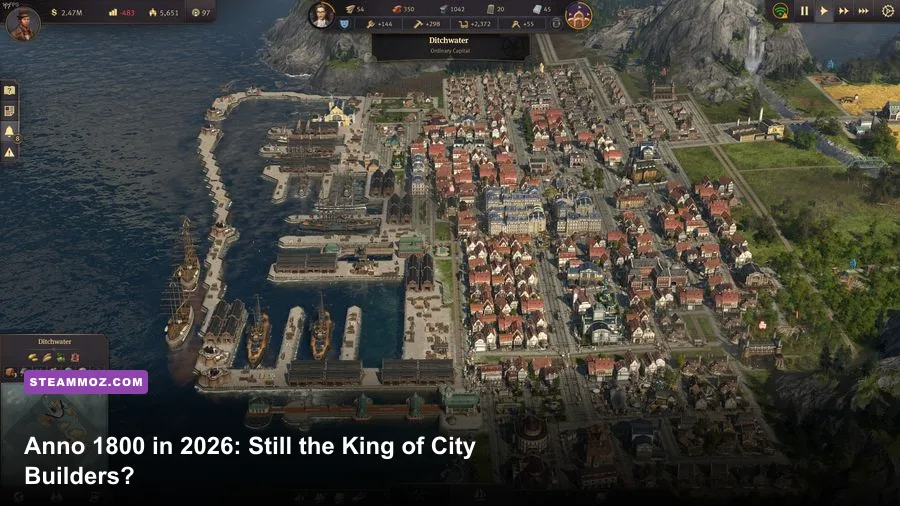
Yes, Anno 1800 is still worth playing on Steam in 2026—but only if you want a deep, deliberate city builder rather than a quick evening strategy fix. Its production chains, gorgeous industrial cities, and enormous DLC ecosystem remain unusually rich, while its biggest frustrations are just as real: Ubisoft Connect is required, the late game can become micromanagement-heavy, and buying every expansion is expensive. For patient players, though, this is still one of the best economic strategy games on PC.
That verdict matters because Anno 1800 is no longer a young release waiting for its identity. Ubisoft Mainz launched it in April 2019, then expanded the original sandbox with major additions such as Sunken Treasures, Botanica, The Passage, Land of Lions, Seat of Power, Bright Harvest, Docklands, Tourist Season, The High Life, Seeds of Change, Empire of the Skies, and New World Rising. In 2026, the question is less whether the game has enough content and more whether its famously demanding rhythm still works for you.

Why Anno 1800 Still Feels Special
Anno 1800 understands that a city is more compelling when every beautiful street has an economic reason to exist. Your Farmer residences need fish and work clothes. Upgrade them to Workers and they begin demanding bread, sausages, soap, and school access. Artisans add canned food, sewing machines, fur coats, and rum to the checklist. Engineers then push the entire machine toward spectacles, coffee, gramophones, light bulbs, and pocket watches.
The best part is that these demands are not abstract research-tree chores. They are physical supply chains. A fishery sends fish to a warehouse. A rendering works turns pigs into tallow. Soap factories consume tallow and wood, while a nearby export route or trading post lets you sell the surplus. One missing input can ripple through several population tiers, dropping happiness and slowing tax income across an island.
That chain reaction gives every expansion project weight. A new district is not simply decoration; it needs roads, fire coverage, warehouses, commuter piers, electricity, and enough workforce from the correct population tier. Anno 1800's visual feedback is excellent here. Watching factory chimneys animate, cargo ships unload, and horse-drawn carts stream toward a warehouse makes a spreadsheet feel like a functioning world.
The period setting also remains a perfect fit. The Old World begins with sail-powered agriculture and modest brick streets, then evolves toward steelworks, oil refineries, electricity, and skyscrapers. The progression from mud roads to a late-game skyline is gradual enough to feel earned. Few modern city builders make industrialization look this attractive while still making it economically intimidating.
🎮 Anno 1800
Looking to experience this game? Grab your digital key directly on our store for $59.99.
View on Steammoz Store →The Campaign Is Useful, but Sandbox Is the Main Event
The campaign follows Carl Leonard von Malching, Hugo Mercier, and other recognizable personalities while teaching the fundamentals of production, diplomacy, trade, and naval conflict. It is a solid onboarding route, especially if you have never played an Anno game. The first chapters explain residence tiers and supply chains without throwing every region at you immediately.
Still, the campaign is not where Anno 1800 reaches its full potential. The real draw is a custom sandbox with adjustable island difficulty, AI opponents, pirates, starting resources, fertility, and victory conditions. You can select easier competitors such as Bente Jorgensen or Willie Wibblesock, or add aggressive rivals like Alonso Graves and Dr. Hugo Mercier when you want diplomacy to become a second battlefield.
For a first serious run, I recommend a medium-sized map, two easy AI players, pirates enabled, and normal starting income. That setup preserves pressure without turning the opening into a restart lottery. Disable the influence requirement only if you already know the game; otherwise, learning to spend influence on trade rights, propaganda, or military capacity is part of the intended strategic texture.
Anno 1800's opening is slower than many modern builders. You spend the first hour stabilizing Farmer and Worker needs before the game gives you truly dramatic tools. Do not mistake that pace for a lack of depth. It is establishing the economic grammar that later regions will remix. Players who need immediate combat or constant unlocks may bounce off it, while anyone who enjoys watching a plan mature will find the opening wonderfully sticky.
The Production Chains Are Still the Best Part
The Old World is the game's economic backbone. A practical early chain looks simple: sheep farms produce wool, framework knitters turn wool into work clothes, and Farmers consume those clothes. But later chains become compact logistical puzzles. A Worker population needs bread, which means grain farms, flour mills, and bakeries. Sausages need pigs and slaughterhouses. Soap needs pigs, rendering works, and soap factories. Each building also consumes workforce, so blindly expanding production can create a labor shortage that stalls the city you were trying to support.
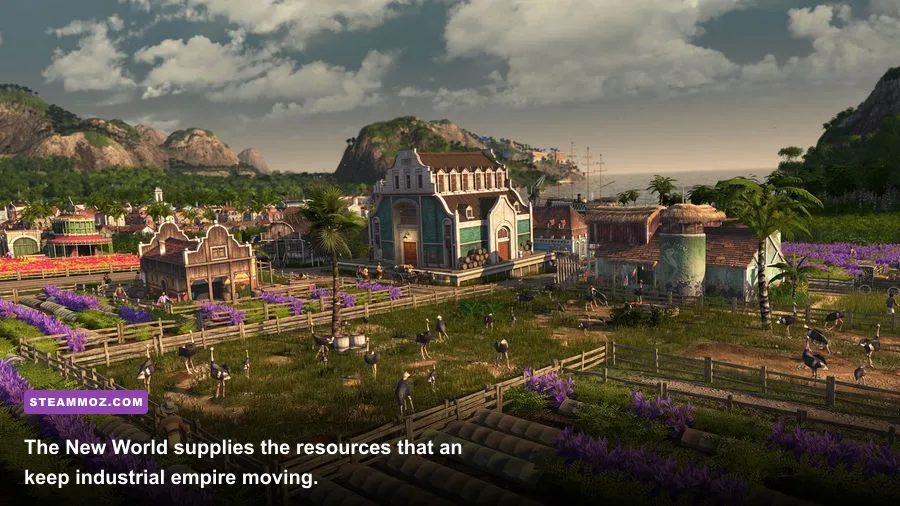
The New World adds a second layer instead of acting like a disconnected map. Your Obreros and Jornaleros require different goods, while Old World residents demand cotton fabric, rum, coffee, chocolate, cigars, and other imported luxuries. That creates a constant question: should you build more plantations, improve production with items, or ship goods from another player's harbor?
Fertility is a particularly important constraint. A New World island with cotton fertility is valuable even if its coastline is awkward, because cotton fabric supports higher Old World tiers. Likewise, coffee plantations and tobacco farms can dictate where your expansion fleet goes. The best island is not always the prettiest one; it is the island that removes a bottleneck from your supply network.
Use the statistics screen aggressively. Select a population tier and check its consumption rate before placing factories. If a group consumes 0.5 tons of a good per minute and your current chain provides 1.0, you have room for two equivalent demand blocks—not an unlimited city. At higher difficulty, the difference between an elegant chain and a pile of emergency imports can decide whether your treasury stays positive.
| Population Tier | Important Early Needs | What It Unlocks | Main Risk |
|---|---|---|---|
| Farmers | Fish, Work Clothes | Basic tax income and workforce | Expanding before food is stable |
| Workers | Bread, Sausages, Soap, School | Industry and basic construction chains | Factory workforce shortages |
| Artisans | Canned Food, Sewing Machines, Rum | Ship construction and advanced industry | Multiple imported goods collapsing together |
| Engineers | Coffee, Gramophones, Pocket Watches | Electricity, Investors, late-game production | Large population and logistics demands |
| Investors | Light Bulbs, Cognac, Steam Carriages | High income and skyscrapers | Expensive luxury chains and congestion |
Trade unions, town halls, and harbormaster offices make the late game more than a matter of building duplicates. Items can improve productivity, reduce workforce requirements, change fertility, or provide extra output. A strong trade union covering several heavy factories can save an entire island's worth of space. The catch is range: the item is only helping buildings inside the relevant radius, so a theoretically perfect layout can fail if its coverage is sloppy.
What the DLC Adds—and What You Can Skip
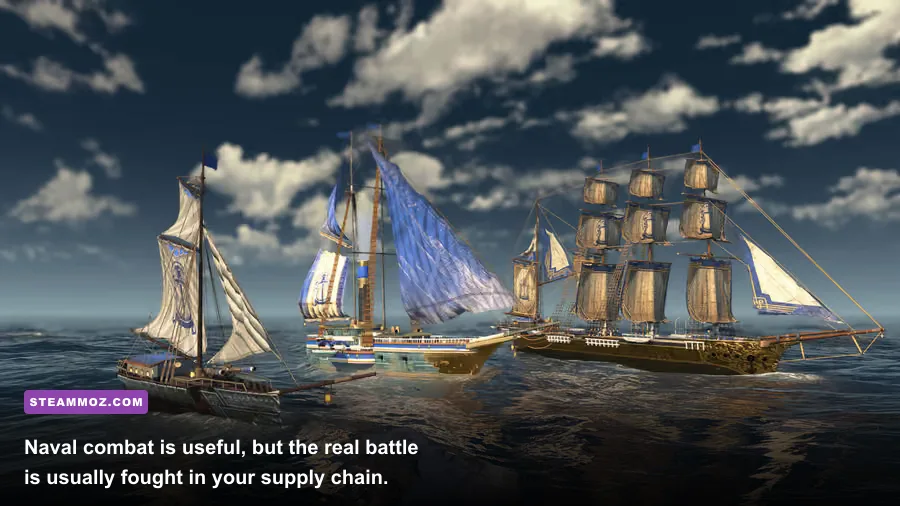
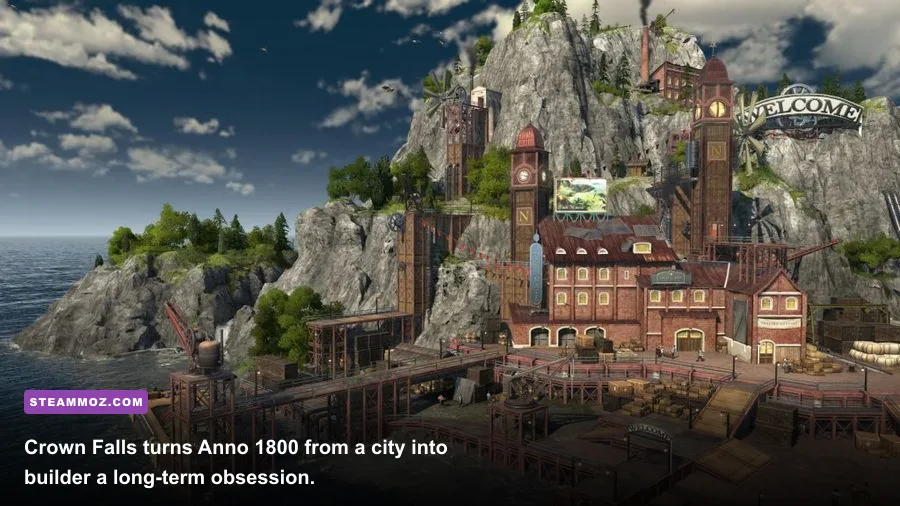
The DLC catalog is enormous, but not every pack has equal value. Sunken Treasures is the standout for long-term builders because it adds Cape Trelawney and Crown Falls, a huge island designed for ambitious megacities. It also gives you a reason to redesign your economy after you already understand the base game. If you love city layout, this is close to essential.
The Passage adds the Arctic region, airship logistics, and gas production. It is harsh, distinctive, and strategically interesting, but it also introduces another demanding supply network. Players who dislike remote-region management should leave it until a second campaign. Land of Lions is arguably the best narrative and mechanical expansion, adding Enbesa, irrigation projects, scholars, and research. Its research institute lets you pursue item blueprints and solve some of the game's most irritating production bottlenecks.
Bright Harvest improves farms with tractors and silos, while Docklands lets you specialize exports and import goods through dock modules. Both can make the economy smoother, though Docklands can feel like an escape hatch if you use it too early. Tourist Season and The High Life are especially good for players who want denser cities, hotels, restaurants, department stores, and skyscrapers rather than new geopolitical problems.
The smaller cosmetic packs are optional. Botanica, Old World, Pedestrian Zone, and the various city ornament packs add personality and layout flexibility, but they do not transform the economic game. New World Rising is more substantial for players who enjoy the New World, adding a bigger island and late-game content there. The sensible buying plan in 2026 is to start with the base game, add Sunken Treasures and Land of Lions, then expand only when you know which region you actually enjoy.
| Expansion | Value in 2026 | Best For | Buy Priority |
|---|---|---|---|
| Sunken Treasures | Huge island and Crown Falls | Megacities and long campaigns | S-Tier |
| Land of Lions | Enbesa, irrigation, research | Story and item-focused players | S-Tier |
| The Passage | Arctic region and airships | Logistics veterans | A-Tier |
| Bright Harvest | Tractors and farm upgrades | Efficient agricultural layouts | A-Tier |
| Docklands | Export and import contracts | Players fixing bottlenecks | A-Tier |
| Cosmetic Packs | Ornaments and visual variety | Screenshot builders | B-Tier |
Combat, Diplomacy, and the Cost of Expansion
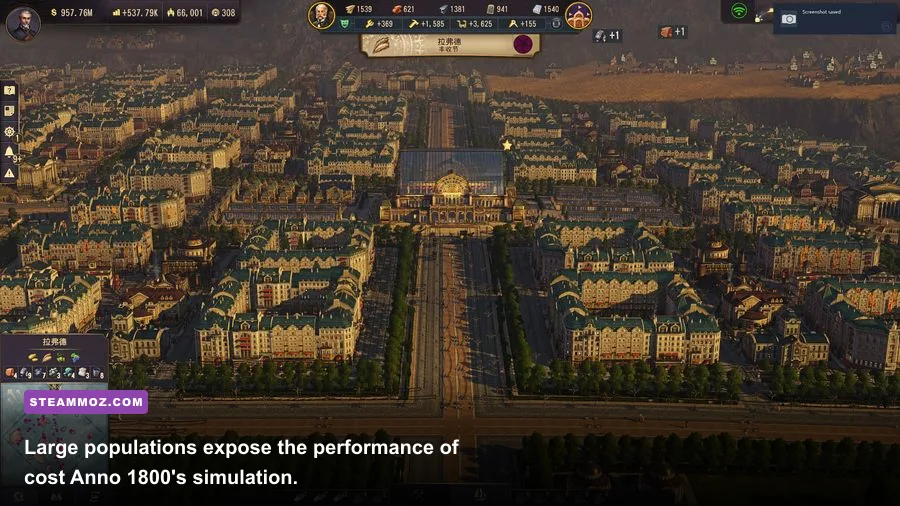
Anno 1800 is not a naval combat game first, and that distinction matters. Ships have weapon slots, hit points, speed, and firing arcs, but battles are generally about positioning and preparation rather than twitch skill. Frigates and ships of the line can protect trade routes, while gunboats and schooners are useful earlier. Repair cranes, harbor defenses, and mounted coastal guns turn an established harbor into a much harder target than an exposed island settlement.
Before declaring war, inspect the diplomacy screen and track each AI's attitude. Trade rights, quests, gifts, and shared enemies can keep an opponent neutral long enough for your economy to catch up. The AI's demands can be irritating, but they create a useful strategic tax: building a beautiful mainland metropolis while neglecting a military fleet is a choice, not a mistake the game hides.
Expeditions are a lighter, more playful system. You choose a ship, crew, and supplies, then respond to event checks based on traits such as naval power, hunting, medicine, or diplomacy. They can reward rare items and influence, but bad preparation can damage a valuable ship. Bring enough rations and select crew that cover the expedition's likely skills instead of treating every voyage as a random lottery.
The bigger problem is late-game administration. Multiple regions mean multiple commuter piers, trade routes, warehouses, and production warnings. The game gives you excellent overlays, but it still asks you to remember why a route was created. Naming ships by purpose, separating raw-material routes from luxury routes, and using minimum stock settings at warehouses can prevent an empire-wide shortage triggered by one missing coffee shipment.
Performance in 2026: Beautiful, Demanding, and Mostly Scalable
Anno 1800 runs well on modern hardware in ordinary situations, but a huge city stresses the CPU simulation far more than a quiet island does. GPU power matters for resolution and visual effects; CPU performance and memory become increasingly important when Crown Falls is packed with residences, factories, ships, and pedestrians. A stable 60 frames per second at the start can become 40 or lower during a dense late-game zoom, even when your graphics card is not fully utilized.
The most useful settings to lower are shadows, volumetric clouds, screen-space reflections, and geometry quality. Texture quality is usually safe to keep high if your graphics memory allows it. Lowering resolution can improve GPU-limited performance, but it will not solve a simulation bottleneck. If the frame rate falls while camera movement is smooth in an empty region but slows above your capital, the city simulation—not your monitor—is the limiting factor.
| Setting | Recommended Value | Performance Impact | Visual Trade-Off |
|---|---|---|---|
| Resolution | Native or 1440p | High on GPU-limited systems | Lower resolution looks softer |
| Texture Quality | High | Mostly VRAM-dependent | Keep high for sharper buildings |
| Shadow Quality | Medium | Moderate | Less detailed building shadows |
| Volumetric Clouds | Medium or Low | Moderate to high | Less atmospheric sky detail |
| Screen-Space Reflections | Low or Medium | Moderate | Water and wet surfaces lose reflections |
| Geometry Quality | High, then Medium for huge cities | CPU and GPU impact | More distant detail disappears |
| V-Sync | Off with VRR, On otherwise | Depends on display | Controls tearing and latency |
For PC troubleshooting, Steamoz's guides on crashes and low FPS fixes and performance settings cover the same practical basics: update drivers, verify files, shut down overlays, and test changes one at a time. Anno 1800 specifically also benefits from checking whether Ubisoft Connect is syncing correctly and whether the game is using the intended GPU on a laptop.
Steam Ownership Has One Awkward Catch
Buying Anno 1800 on Steam does not mean Steam is the only launcher involved. The PC version requires a Ubisoft account and Ubisoft Connect integration. Steam starts the game, but the Ubisoft service handles authentication and ownership checks. That extra layer is manageable for most players, yet it is still a meaningful downside if you want a clean offline experience or dislike launcher accounts.
Before buying, check the Anno 1800 Steam page for the current edition and system requirements, then compare the package with the official Ubisoft game page. Steam Workshop is not the game's central mod ecosystem, so most mod users rely on community tools and manual installation. That is perfectly workable, but it is less convenient than a fully integrated workshop library.
Cloud saves, DLC ownership, and launcher authentication are also worth considering before starting a serious 100-hour sandbox. Keep backups of important saves, especially before installing mods or switching between editions. If you want official patch information, the Anno Union remains the best place to check developer news, while the Anno 1800 community wiki is invaluable for production ratios, item effects, and region-specific mechanics.
Who Should Play Anno 1800 in 2026?
Buy it if you enjoy solving logistics problems, optimizing layouts, decorating districts, and watching a plan evolve over dozens of hours. It is especially strong for players who like games such as Empire of the Undergrowth for its supply-and-expansion loop, but want a much larger economic sandbox. It also rewards the same secret-location curiosity found in Everspace 2's exploration systems, though Anno's discoveries are usually hidden inside production problems rather than asteroid fields.
Skip it if you want immediate combat, a short campaign, or a city builder where you can place anything anywhere without consequences. Anno 1800's beauty is tied to constraint. Fertility, workforce, harbor space, influence, finances, and shipping capacity are always pushing back. The game can also feel overwhelming when three regions demand attention at once, and its late game rarely offers a clean victory lap.
My honest 2026 recommendation is to buy the base game during a sale, play a complete sandbox, and add expansions selectively. Start with Sunken Treasures if cities are your priority, or Land of Lions if you want a new region and a powerful research system. Do not purchase every cosmetic pack expecting new strategy; they are seasoning for a meal that is already enormous.
Anno 1800 is not timeless because it is flawless. Its launcher requirements are clumsy, its late-game simulation can punish even strong PCs, and managing trade routes across multiple regions occasionally feels like unpaid clerical work. But no other current city builder combines industrial atmosphere, production-chain depth, maritime scale, and visual personality quite like it. In 2026, the answer is still yes: Anno 1800 remains worth playing on Steam, provided you are ready to build slowly, fix problems instead of ignoring them, and let one more warehouse upgrade turn into an entire evening.