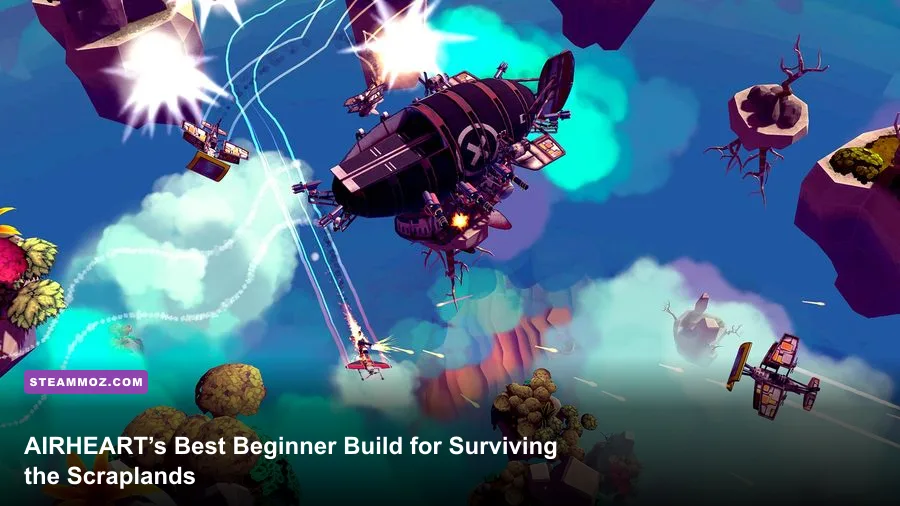
The best AIRHEART - Tales of broken Wings starting build is a balanced survival setup: keep the starter aircraft agile, pair a reliable rapid-fire weapon with a close-range burst option, prioritize hull and energy upgrades before luxury damage parts, and leave every run with more resources than you started with. AIRHEART doesn’t use a traditional RPG skill tree, so your real build comes from the aircraft parts, weapons, fuel discipline, and route decisions you make in the Scraplands.
That distinction matters. You won’t be assigning five points to strength or unlocking a twelve-node talent tree. Instead, Amelia becomes stronger by scavenging components, buying or finding better equipment, and choosing when to descend deeper into the game’s vertical world. A beginner who understands that loop will progress faster than a player who treats every run like an arcade score attack.
This guide focuses on a forgiving first setup for AIRHEART - Tales of broken Wings, including the opening aircraft, weapon priorities, resource management, combat rotation, upgrade order, and performance settings. The names and roles below reflect the game’s actual systems; where AIRHEART doesn’t expose a conventional numeric stat, I’ll explain how to judge the part in practice rather than inventing fake damage values.
The beginner build at a glance

Start by building around consistency rather than maximum burst. Your first objective isn’t to delete elite enemies in one pass; it’s to finish a sortie with your aircraft intact, your inventory full enough to fund the next upgrade, and a route back to safety. The safest early loadout uses a dependable primary gun for ordinary targets and a heavier secondary weapon for armored enemies, clustered opponents, or a clean opening against a large target.
Keep your aircraft light wherever possible. Heavy equipment may offer more damage, but sluggish turning makes incoming fire harder to read and causes a nasty chain reaction: you miss more often, stay exposed longer, consume more energy, and take hull damage while trying to correct your position. In the early layers, maneuverability is effectively another form of defense.
| Build slot | Beginner priority | Why it matters | What to avoid |
|---|---|---|---|
| Aircraft frame | Agility and survivability | Lets you circle enemies and escape crowded fights | Heavy parts that ruin turning before you can compensate |
| Primary weapon | Reliable rapid-fire damage | Handles small craft and lets you pressure targets continuously | Slow weapons with punishing misses |
| Secondary weapon | High burst or armor pressure | Finishes dangerous targets before they surround you | Using all ammunition on weak enemies |
| Defensive parts | Hull first, energy second | Gives you room to survive mistakes and keep exploring | Pure damage upgrades on a fragile frame |
| Utility | Fuel and carrying capacity | Improves the value of every successful run | Deep routes you cannot afford to exit |
Think of this as an A-tier starter build rather than a permanent endgame template. It’s deliberately boring in the best possible way. The setup gives you answers to ordinary fliers, tougher targets, and bad positioning without demanding perfect aim.
If you’re coming from another space roguelite, Steamoz’s Everspace weapon guide is useful context, but AIRHEART’s economy is less forgiving. You’re not simply shopping for the biggest damage number; you’re choosing whether a piece is worth the weight and risk it adds to a run.

🎮 AIRHEART - Tales of broken Wings
Looking to experience this game? Grab your digital key directly on our store for $7.49.
View on Steammoz Store →How AIRHEART’s progression really works
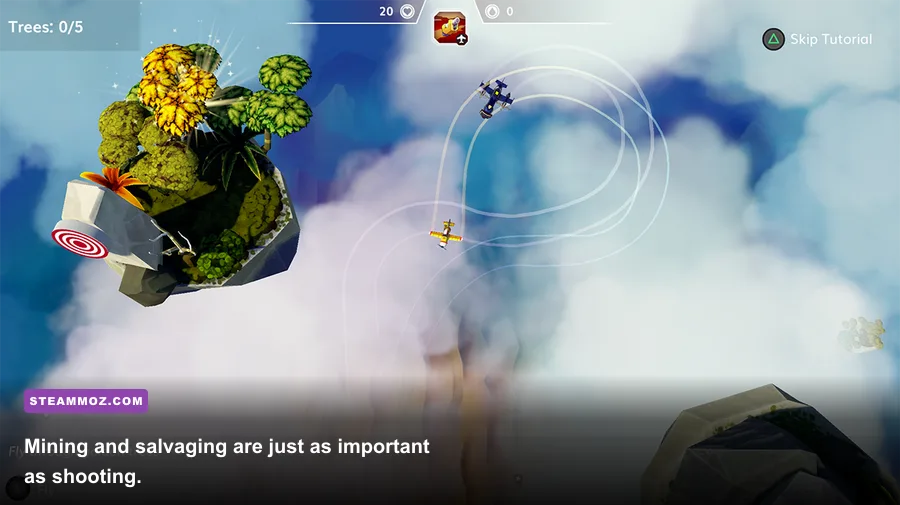
AIRHEART’s progression is built around salvage. Amelia explores floating islands, mines valuable materials, fights hostile aircraft, and brings the results back into the upgrade loop. That means every trip has two possible victories: reaching a deeper area and returning with enough loot to improve your next attempt. Beginners often focus only on the first and lose everything by staying too long.
The game’s pilot is Amelia, but she doesn’t grow through a conventional character-stat screen. There are no standard strength, dexterity, or skill-point allocations to optimize. Your effective statistics come from the parts mounted on the aircraft. A stronger engine changes how the craft handles; a better hull buys more punishment; a weapon changes the distance and rhythm at which you fight.
That makes the correct early question simple: does this upgrade help me survive a complete trip? A weapon that destroys a target faster is useful, but a slightly weaker gun that lets you maintain distance and avoid collisions can produce more profit over an entire run. This is also why you should test new equipment in a low-risk area before committing to a deep descent.
Use the first few runs to learn three things: which resources are worth mining, how much fuel your route consumes, and where the return path becomes dangerous. AIRHEART rewards route memory. Once you know a zone’s enemy entrances and narrow passages, you can spend less time improvising and more time collecting.
Don’t sell every spare item immediately. Keep enough useful components to compare handling and durability between runs. The game’s part system encourages experimentation, and dismantling or selling a piece before you understand its practical benefit can leave you weaker than expected. Make a short mental note of what changed after every major swap: turning, acceleration, weapon reach, energy use, and how quickly the hull disappears under pressure.
Weapon choices and the safest combat rotation
Your primary weapon should be the tool you can use while moving. Rapid-fire guns are ideal for the opening hours because they forgive imperfect aim and keep pressure on small enemy craft. Hold your fire in short, controlled bursts when targets are distant, then commit to longer bursts once an opponent enters a predictable line. Spraying constantly feels aggressive, but it can waste energy or ammunition while you drift into a bad angle.
Use your heavier weapon as a finisher, not as your default trigger. Shotgun-style burst damage is strongest when an enemy is crossing your nose or when several targets stack in a narrow approach. A piercing or high-impact weapon is better against a tougher target that gives you a clean firing lane. The exact inventory names and available variants can change as you discover equipment, so judge the item by its behavior and displayed attributes rather than assuming every gun fills the same role.
- Scout the arena first. Before firing, identify the nearest cover, the open side of the screen, and the enemy most likely to rush you.
- Pick off the fast threat. Small, mobile craft can interrupt mining and force you into collisions. Remove them with your primary weapon before attacking a larger target.
- Keep moving laterally. A shallow arc is safer than a frantic circle. You want to cross enemy fire, not fly directly toward it.
- Save burst damage for commitment windows. Fire the secondary weapon when an enemy finishes a charge, turns slowly, or becomes trapped near terrain.
- Break contact after the kill. Don’t hover over wreckage while another group is entering. Collect only when the immediate space is clear.
Enemy telegraphs are easier to read when you maintain distance. A charging aircraft usually gives you a directional cue through its movement and approach line; don’t try to out-turn it at point-blank range. Cut across its path, let it pass, and rotate back onto its flank. The same principle works against larger enemies: stay off the nose, attack from an angle, and disengage before the arena fills with threats.
| Enemy situation | Preferred tool | Positioning | Beginner mistake |
|---|---|---|---|
| Single light craft | Rapid-fire primary | Maintain a shallow side-to-side arc | Chasing it into a wall |
| Several light craft | Primary, then burst weapon | Keep the group in front of you | Allowing enemies to surround the aircraft |
| Armored or large target | Burst or piercing secondary | Attack the flank after its pass | Trading damage face-to-face |
| Ambush near terrain | Primary while retreating | Move toward open space first | Mining before checking exits |
AIRHEART’s controls can feel loose for the first hour, especially if you’re trying to aim and steer with the same level of precision as a traditional twin-stick shooter. Spend a low-value run practicing movement without shooting. Once the aircraft’s momentum feels predictable, combat becomes dramatically less chaotic.
Upgrade order: what to buy and what to skip
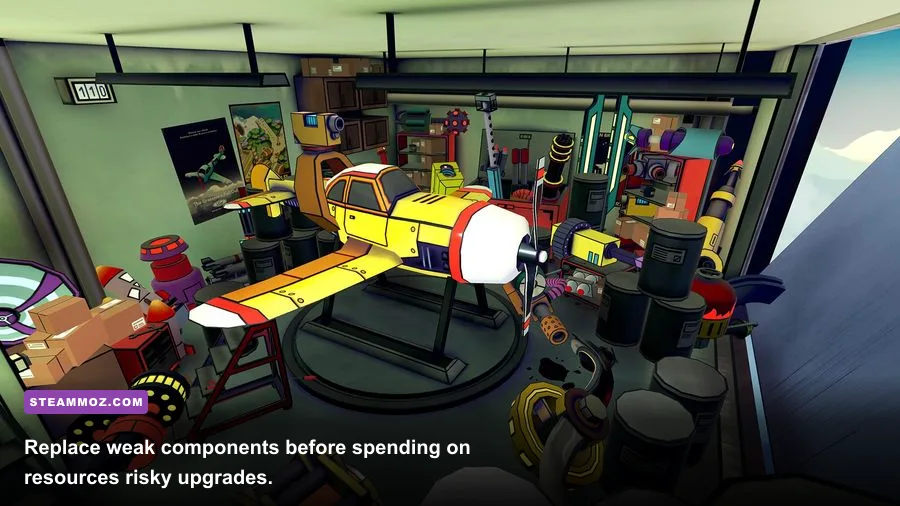
Your first meaningful upgrade should improve the aircraft’s ability to stay alive. Hull durability is the most obvious choice, but it isn’t automatically correct if the replacement adds so much weight that you can’t evade attacks. Compare the handling change before committing. A small durability gain on a responsive craft can be more valuable than a large theoretical health increase on a machine that turns like a brick.
After hull and handling, improve energy management or carrying capacity, depending on what is ending your runs. If you regularly return because the aircraft is damaged, choose defense. If you survive fights but leave valuable salvage behind, choose storage or fuel efficiency. The best upgrade is the one that fixes your actual failure pattern, not the one with the most impressive description.
Damage upgrades come next. Once you can reliably complete early routes, stronger weapons reduce exposure time and make deeper exploration safer. Don’t replace a familiar primary weapon just because a new item has higher damage potential. Test its range, firing rhythm, energy demand, and recovery after a missed shot. AIRHEART is a game where usability creates real damage.
Mobility parts deserve special attention. Faster acceleration helps you leave an ambush, while better turning helps you stay on an enemy’s flank. Those are different benefits. If you keep overshooting targets, turning is the issue. If you’re getting trapped against terrain, acceleration and route planning matter more. Match the part to the problem you can describe clearly.
For a deeper comparison of how to think about upgrade value in a space-action game, see Steamoz’s Everspace 2 secrets guide. AIRHEART is smaller and more arcade-focused, but the core lesson carries over: exploration only pays when your loadout can bring the rewards home.
A practical first-five-upgrades plan
- Install the best balanced hull you can safely afford.
- Choose a handling or acceleration improvement if your current aircraft feels difficult to control.
- Keep a dependable rapid-fire weapon as the primary slot.
- Add burst damage for armored targets and crowded encounters.
- Buy fuel, storage, or energy improvements based on the reason your previous run ended.
Skip expensive specialist gear until you understand your route. A weapon designed for a narrow situation can be excellent later, but early resources should make every run more stable. The goal is to widen your margin for error before chasing a flashy damage ceiling.
Mining, fuel, and the return trip
The return trip is where many new pilots throw away a successful run. After finding valuable salvage, they continue descending because the aircraft still has some health left. That’s the wrong measurement. You also need to consider fuel, ammunition, enemy density, available escape space, and whether your aircraft can survive another unavoidable encounter.
Mine when the surrounding area is quiet, not merely because a resource node is visible. Clear the nearest threat, check the route out, and then collect. If an enemy group arrives during the process, stop mining immediately and reposition. A resource node can wait; a damaged aircraft may not get another chance to leave.
Use a conservative route during your first sessions. Learn one reliable loop through the Scraplands instead of constantly searching for the deepest possible zone. Once you can complete that loop with spare health and fuel, add one riskier detour. This turns progression into a controlled experiment and gives you a clear benchmark for every new part.
Storage upgrades can be deceptively powerful because they increase the value of safe runs, but only if you actually have enough fuel and durability to fill the extra space. Don’t let a larger hold tempt you into staying in a hostile layer for ten extra minutes. Profit per successful return matters more than the biggest single haul.
A useful rule is to leave after a run produces one meaningful upgrade’s worth of resources, especially if the aircraft has taken visible damage. Returning early feels slow, but it compounds. You get a stronger weapon or frame, then the next run becomes safer and more profitable. This is the same steady approach recommended in our fast leveling and farming guide: consistency beats spectacular failures.
Controls, graphics, and performance for cleaner flying
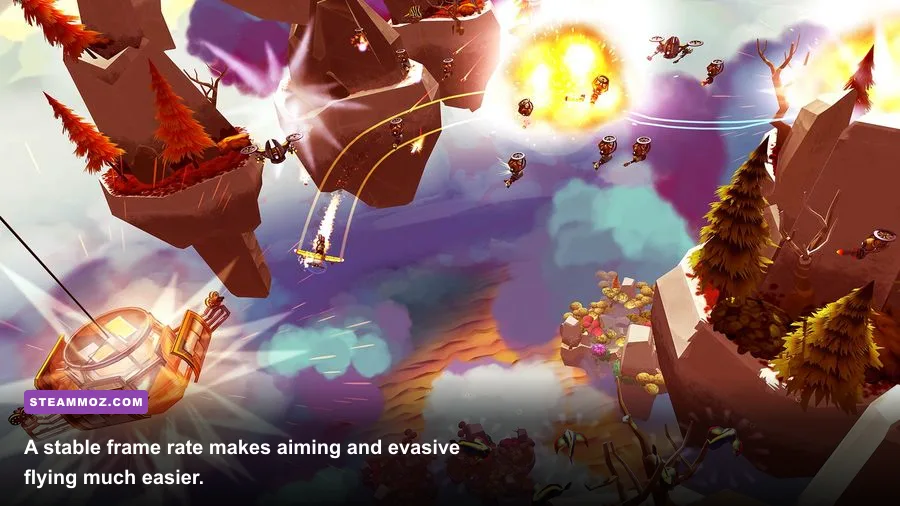
A stable frame rate is more valuable than decorative quality in an aerial shooter. You need to read movement, avoid collisions, and track targets while the camera and environment are constantly shifting. AIRHEART’s stylized presentation generally scales well, but lowering background-heavy settings can reduce visual clutter and make hostile craft easier to spot.
Start at 1080p with a stable refresh target, then raise visual quality only after combat feels smooth. If you’re playing on a laptop, prioritize resolution and frame pacing over shadows or effects. The game’s colorful art direction remains readable at moderate settings, while inconsistent performance can make a perfectly timed dodge feel late.
| Setting or option | Recommended value | Performance impact | Visual note |
|---|---|---|---|
| Resolution | Native 1080p | Moderate | Preserves crisp aircraft silhouettes |
| Fullscreen mode | Exclusive fullscreen if available | Low | Often improves consistency on older systems |
| Shadows | Medium | Medium to high | Lower first on integrated graphics |
| Effects or particles | Medium | Medium | Reduces clutter during crowded fights |
| Anti-aliasing | Medium or application default | Low to medium | Keep if shimmering bothers you |
| Frame limit | Stable target below average maximum | Can improve pacing | Consistency matters more than peak FPS |
Before changing everything, adjust one option at a time and test it during a busy fight. If performance problems continue, verify the game files through Steam, close overlays, update your graphics driver, and check the official AIRHEART Steam page for current support information. The developer’s Blindflug Studios website is also the right place to look for official updates rather than relying on random configuration files.
For troubleshooting habits, Steamoz’s PC crash and FPS fixes cover the same sensible order: check drivers, remove overlays, confirm files, and only then start editing advanced settings.
The mistakes that ruin early runs
The biggest mistake is treating every enemy as mandatory. AIRHEART is built around movement through a hostile world, not clearing every screen before you advance. If a fight blocks the route, engage it. If an enemy is drifting away from your path, conserve resources and keep moving. The safest battle is the one you never need to start.
Another common error is swapping parts without considering the whole aircraft. A weapon may be stronger but heavier. A hull may be tougher but less maneuverable. A storage component may improve profit while reducing the energy or speed that keeps you alive. Judge the complete package after a run, not a single stat in the equipment menu.
Don’t mine while surrounded, don’t chase fleeing targets into unexplored space, and don’t descend simply because the next layer is available. Learn the route, build the aircraft around your failure points, and leave with enough fuel to make the journey home. Those habits are more important than finding a rare weapon early.
Finally, remember that AIRHEART’s best beginner build is supposed to evolve. Start balanced, then specialize once your skill catches up with your equipment. If you’re consistently avoiding damage, shift resources toward offense. If you’re still losing aircraft during ordinary encounters, keep the defensive setup longer. The Scraplands reward pilots who adapt instead of forcing a fashionable loadout.
Follow that approach and your first hours become far less punishing: Amelia stays mobile, the primary weapon handles routine threats, burst damage solves dangerous openings, and every successful return funds a stronger aircraft. That’s the winning AIRHEART loop—survive first, learn the route, then push deeper when the build is ready.