
AER Memories of Old does not have character levels, XP, gold, weapons, or a repeatable farming economy. The fastest route is therefore not a grind: transform Auk into a bird, use major landmarks to cross the Skylands, follow the temple objectives, and collect useful discoveries only when they sit near your route. If you are searching for an AER Memories of Old fast leveling and gold farming guide, the honest answer is that exploration efficiency replaces leveling and currency farming in this short narrative adventure.
That distinction matters. AER is built around freedom of movement, environmental puzzles, hidden lore, and a compact pilgrimage—not an RPG progression loop. There is no XP bar to fill, no merchant inventory to upgrade, and no gold total waiting to be maximized. You improve your run by learning the map, reducing backtracking, and recognizing which optional discoveries are worth the detour.
This guide breaks down the game’s actual progression, the quickest way to reach its temples, how to handle optional collectibles, and the mistakes that make a first playthrough feel slower than it should. It also explains what to do if you expected something closer to a traditional RPG such as Dungeon Siege or a dungeon-management game with real resource loops.
There Is No Leveling or Gold System in AER

AER Memories of Old uses fixed progression. Auk, the protagonist and chosen pilgrim, does not gain experience from discoveries, defeat enemies, or completing temples. The game has no conventional combat system, so there are no enemies to kill for XP and no combat encounters to reset for cash. You also cannot buy better equipment, improve statistics, or unlock a stronger version of Auk.
Your main capability is available from the start: Auk can transform into a bird and fly across the floating islands. That transformation is not a skill-tree unlock. It is the central movement tool, and the game expects you to use it constantly. On foot, Auk can inspect ruins, activate mechanisms, enter buildings, and interact with objects. In bird form, she can cross gaps, scout distant structures, and reach islands that would be tedious or impossible to approach from ground level.
| Expected RPG Feature | What AER Actually Uses | Best Player Approach |
|---|---|---|
| Character levels | No XP or level-up screen | Learn movement routes and temple layouts |
| Gold farming | No gold currency or repeatable loot economy | Prioritize story objectives and nearby discoveries |
| Gear upgrades | No weapons, armor, or stat equipment | Use bird form, lantern, and environmental clues |
| Enemy grinding | No traditional combat loop | Avoid wasted travel and solve puzzles directly |
| Endgame farming | No procedural or respawning reward cycle | Replay for missed secrets or a cleaner completion run |
That makes AER closer to a focused exploration adventure than an RPG. Players coming from Empires of the Undergrowth should reset their expectations immediately: there is no profitable route, no best farming zone, and no reason to spend an hour repeating the same activity. The “fast leveling” strategy is simply moving through the intended sequence without unnecessary detours.

🎮 AER Memories of Old
Looking to experience this game? Grab your digital key directly on our store for $1.49.
View on Steammoz Store →The Fastest Progression Route Starts With the Main Temples
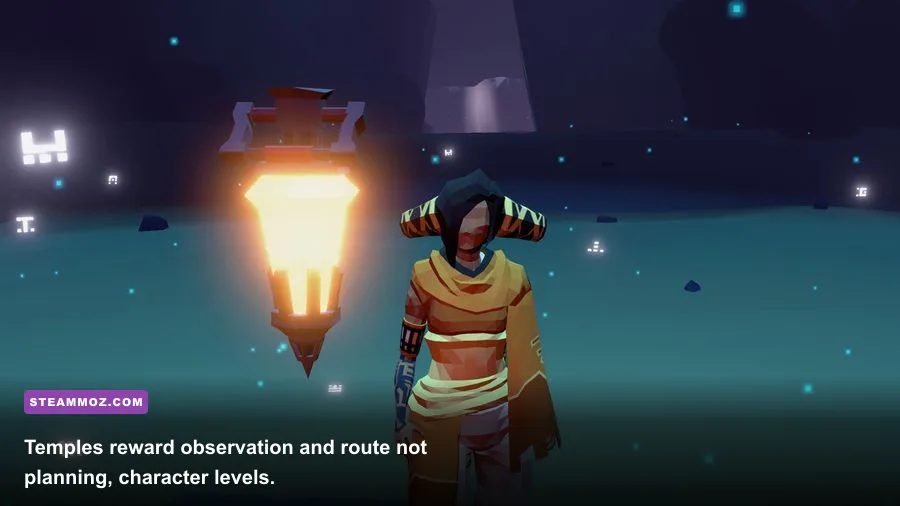
AER’s world is open enough to encourage wandering, but the main temples provide the clearest forward momentum. When you arrive in a new area, first identify the largest visible landmark, then approach it in bird form and land near an entrance or usable platform. Do not begin by combing every small island. That is the most common time sink in the opening hours.
Step 1: Scout from the air
Immediately after reaching a new cluster of islands, transform into a bird and gain altitude. Look for temple silhouettes, tall towers, bridges, glowing points of interest, and unusual rock formations. The camera gives you enough information to plan a route without touching down on every island. Mark the main destination mentally by its shape rather than relying on a strict waypoint.
Step 2: Land only when the environment asks you to
Ground exploration is valuable when you see a doorway, switch, shrine, chest-like object, lore location, or puzzle structure. Otherwise, stay airborne. Flying directly between islands is usually quicker than following low routes, and it reduces the chance of getting trapped behind cliffs or having to climb back to a launch point.
Step 3: Complete the temple objective before sweeping the region
Temples are the game’s real progression gates. Explore the interior, inspect the rooms carefully, and follow environmental clues rather than searching for an invisible power requirement. AER’s puzzles are generally about positioning, switches, light, doors, and interpreting the architecture. If you are stuck, return to the last room where the game introduced a new visual clue; the solution is often nearby rather than hidden across the entire island chain.
Step 4: Sweep nearby secrets on the way out
Once the temple is complete, take a short loop around adjacent islands. This is the efficient compromise between a rushed story run and a completionist crawl. Collect discoveries that are within a few minutes of your exit path, but skip remote points that require a long flight back across the map. You can revisit the Skylands later, so there is no penalty for leaving a distant secret behind.
| Progression Priority | Action | Why It Saves Time | When to Detour |
|---|---|---|---|
| S-Tier | Locate and enter the next major temple | Advances the story and unlocks the next objective | Never skip the objective unless you are deliberately exploring |
| A-Tier | Inspect nearby ruins and lore sites | Adds context with minimal travel | Do it after the temple, not before |
| B-Tier | Search isolated islands | Useful for completion, inefficient for story speed | Save for a dedicated cleanup run |
| C-Tier | Randomly circle the map looking for rewards | Produces little progress and causes heavy backtracking | Only if you are intentionally hunting secrets |
This route is the opposite of a gold-farming circuit. You are optimizing travel minutes, not currency per hour. The same principle appears in Dungeons 2’s fastest leveling route, but AER removes the combat and economy layers entirely.
How to Use Bird Form Without Losing Momentum

Bird form is AER’s closest equivalent to a movement upgrade, and mastering it has a bigger impact than any imagined leveling system could. The transformation lets you cross the world in a straight line, but careless flying can still waste time. Use broad, deliberate arcs instead of constantly correcting your direction near terrain.
Before taking off, face the island or structure you want to reach. A short pause to line up your approach is faster than flying at an angle, landing on the wrong ledge, and climbing around the back. When scouting, gain enough height to see the next destination clearly. Flying too low hides landmarks behind terrain and often forces an unnecessary second trip.
Land near functional spaces rather than pretty viewpoints. A flat platform beside a doorway is more useful than a narrow ledge above it. If the game allows you to land but the location gives you no obvious interaction, take off again and search for a lower entrance, side path, or nearby structure. AER frequently uses visual composition to point toward the intended landing area.
There is also a practical performance benefit to limiting aimless flight. The Skylands can present wide vistas, and constantly sweeping the camera while airborne may produce distracting frame-time spikes on older PCs. The game remains playable on modest hardware, but stable frame pacing makes distant landmarks easier to read and movement less tiring.
| Movement Situation | Recommended Technique | Common Mistake |
|---|---|---|
| Crossing a large gap | Face the destination, gain altitude, then fly straight | Following the terrain and adding unnecessary bends |
| Searching for a temple | Scout from above and identify its silhouette | Landing on every island before checking the horizon |
| Returning from a puzzle | Use the exit platform as a launch point | Walking back through the entire interior |
| Approaching a small ledge | Slow your approach and aim for a broad surface | Trying to land at the highest visible point |
Think of bird form as route compression. It turns a chain of small traversal problems into one clean line, provided you plan before moving. That is the single most valuable “build” in AER: strong landmark recognition, conservative landings, and minimal backtracking.
Collectibles and Secrets: What Is Worth the Detour?
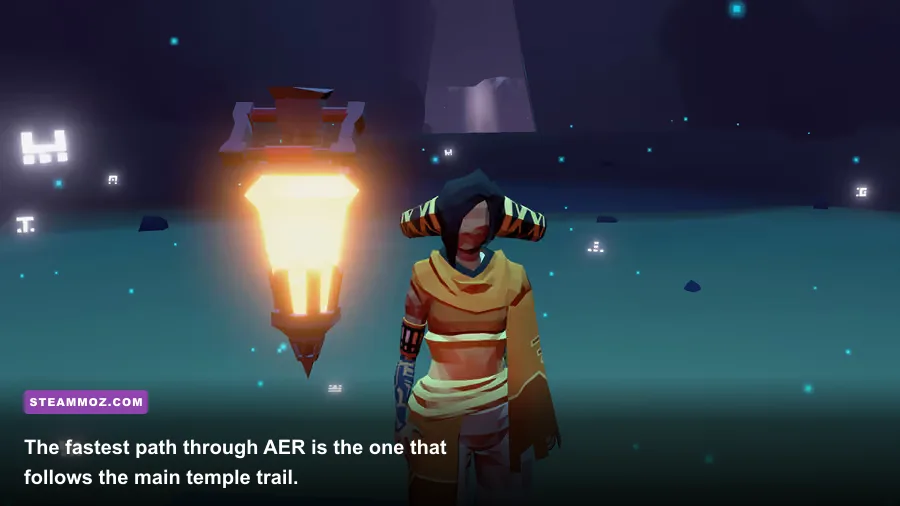
AER contains optional exploration content, but none of it functions like gold. Discoveries, lore, hidden areas, and environmental details deepen the world rather than improving Auk’s damage, health, or movement stats. You should collect them because you enjoy the story and atmosphere—not because they create a stronger character.
For a fast first playthrough, use a two-pass strategy. On the first pass, complete the main temple objectives and grab anything visible from your route. On the second pass, revisit regions with unfinished business and search isolated islands systematically. This keeps the narrative momentum intact while still giving you a clean way to pursue missed content.
Use landmarks instead of trying to memorize every island
Floating-island layouts can blur together, especially when you are flying between them. Anchor your memory to distinctive features: a tall structure, a broken bridge, a bright temple entrance, or a large rock profile. From there, use short radial searches. Fly outward, inspect one nearby location, return to the landmark, and choose the next branch.
Search interiors before assuming a secret is missing
Some of AER’s most rewarding details are easy to overlook because they are tucked inside buildings or temple side rooms. If a location looks important but appears empty from outside, walk through it rather than immediately flying away. Read visual cues, check corners, and examine objects that contrast with the surrounding architecture.
Do not confuse atmosphere with a reward marker
The game deliberately places striking vistas and unusual scenery across the Skylands. Not every glowing object or dramatic viewpoint represents a collectible. If you have spent several minutes circling a location with no interaction prompt or environmental response, move on. The game is inviting you to appreciate the space, not necessarily to harvest an item.
Players who enjoy hidden-location hunting may like the route-planning mindset in Everspace 2’s secret locations guide, though AER is much less loot-driven. Here, the reward is usually context, a visual story beat, or the satisfaction of understanding how the world fits together.
Temple Puzzles Are the Real “Power Checks”
Because AER has no stats, temple puzzles are the moments that test your progress. There is no recommended level for any area and no weapon to equip before entering. The preparation that matters is mental: slow down, observe the room, and identify what changed after each interaction.
When you enter a new temple, make one quiet pass through the room before touching anything. Look for doors, elevated platforms, symbols, light sources, movable objects, and pathways that appear to continue behind the camera. Then activate the most obvious mechanism and watch the environment. A door opening, light shifting, or platform moving is usually the game telling you exactly where to look next.
If a puzzle seems broken, check three possibilities before leaving. First, you may have missed a switch in the previous room. Second, you may need to approach an object from a different angle or interact with it while standing on the correct platform. Third, the solution may be spatial rather than item-based: the game might expect you to move through the room in a particular order rather than find a key.
| Puzzle Problem | Likely Clue | Counter Strategy | Best Tool |
|---|---|---|---|
| Locked doorway | Nearby symbol, switch, or altered light | Recheck the previous chamber and wall edges | On-foot exploration |
| Missing route | High platform or gap above the room | Transform and inspect the upper level | Bird form |
| Unclear object | It contrasts with the room’s normal geometry | Circle it and test interaction from multiple sides | Camera and movement |
| Repeated failure | No environmental response after activation | Look for an earlier prerequisite instead of forcing it | Observation |
The best speedrun habit for casual players is to stop brute-forcing. Randomly activating every object creates confusion because you lose track of what changed. Make one interaction at a time, note the result, and follow the new visual information. That approach is both faster and less frustrating than rushing through a temple while ignoring its architecture.
Settings and Performance for Smoother Exploration
AER Memories of Old is not a demanding competitive game, so maximum FPS is less important than clear visuals and stable frame pacing. Distant landmarks are part of navigation, which means aggressive reductions in resolution or view distance can make the route harder to read. If your PC struggles, lower shadows and post-processing before sacrificing resolution.
| Setting | Recommended Value | Performance Impact | Visual Note |
|---|---|---|---|
| Resolution | Native monitor resolution | High if reduced | Important for reading distant temples and landmarks |
| V-Sync | On for consistent single-player pacing | Minimal to moderate | Reduces tearing during long flights |
| Shadows | Medium on older GPUs | Moderate to high | Usually the safest major reduction |
| Post-processing | Medium | Moderate | Preserves the game’s atmospheric look without excess blur |
| Texture quality | High if VRAM allows | Low GPU-load impact, higher VRAM use | Keeps temple surfaces and symbols readable |
| Frame limit | 60 FPS or your monitor’s stable target | Can reduce spikes | A locked target feels better than unstable highs |
If you encounter crashes or uneven performance, start with a frame cap and verify the game files through Steam. Avoid stacking random launch options unless you know what each one changes. Our broader PC crash-fixing checklist is useful for general troubleshooting, while Dragonkin’s settings guide covers the same frame-pacing-first philosophy in a more demanding game.
The Best AER Run Depends on Your Goal
There are three sensible ways to approach AER, and each has a different definition of “fast.” A story run follows temples with only nearby detours. A balanced run completes the story while collecting visible discoveries and returning to a few missed regions. A completion run treats the entire Skylands as a checklist and accepts slower travel in exchange for finding every secret you can.
| Run Type | Priority | Estimated Feel | Best Route Philosophy |
|---|---|---|---|
| Story sprint | Main temples and required objectives | Fastest and least distracted | Fly directly to landmarks and ignore remote islands |
| Balanced playthrough | Story plus nearby lore and discoveries | Best first-run option | Use a short post-temple sweep before moving on |
| Completion run | Every accessible secret and optional location | Slowest but most thorough | Return region by region with a mental map |
There is no wrong choice, but mixing them accidentally causes the most frustration. If you want the story quickly, do not stop every five minutes to investigate a distant light. If you want completion, do not rush the final temple and then expect the world to behave like a loot-based endgame. Set the goal before you start, and AER’s pacing becomes much easier to appreciate.
Final Verdict on Fast Leveling and Gold Farming
The search term is understandable, but AER Memories of Old simply does not contain the systems that make leveling or gold farming possible. There are no levels to rush, no gold routes to repeat, no combat builds to optimize, and no merchant economy to exploit. The closest equivalent is a clean traversal plan built around Auk’s bird transformation and the game’s major temple objectives.
For the fastest practical run, scout from the air, land near functional entrances, solve temples before sweeping optional content, and use nearby landmarks to avoid backtracking. For a richer playthrough, add short regional searches after each temple and save isolated discoveries for a second pass. Keep your settings stable enough to read the horizon, and treat every puzzle as a visual problem rather than a stat check.
If you came expecting a traditional RPG, AER may feel unusually lightweight. If you approach it as a compact exploration adventure with a deliberately frictionless movement system, the lack of gold and leveling stops being a limitation. It becomes the point: the Skylands are not a treadmill. They are the progression.
For the official game details, check the AER Memories of Old Steam page, visit developer Forgotten Key, and review publisher Daedalic Entertainment for current platform information.