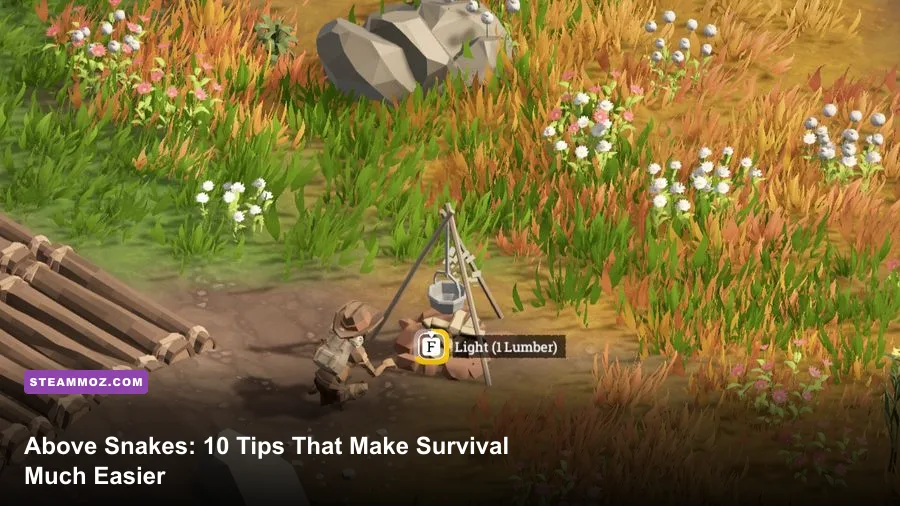
Above Snakes becomes dramatically easier when you treat each island as a planned expedition rather than a quick scavenging stop. Prioritize the basic tools, clear safe routes before chasing story objectives, carry food and healing supplies, and spend resources on permanent progression instead of flashy upgrades. These 10 practical tips cover the early survival loop, map expansion, crafting, combat, base building, and exploration habits that save the most time for new players.
1. Learn the island loop before spending rare materials

The central idea in Above Snakes is that the world is assembled from separate land tiles. You explore the current piece, gather what it offers, complete objectives, and eventually expand into another tile. That sounds simple, but it changes how you should play. A tile is not just a location; it is a temporary resource budget.
Before crafting anything expensive, walk the entire island perimeter. Pick up loose Wood, Stone, and Fiber, inspect abandoned structures, and note enemy positions. Don't rush to place the next map tile while the current one still has visible resources. You may need those materials for a Workbench, storage, a weapon repair, or a quest item a few minutes later.
Keep a mental split between renewable materials and bottlenecks. Wood and Fiber are usually easy to replace, while specialized ingredients from chests, animals, ruins, or hostile areas can delay progression. If a recipe asks for something you haven't seen twice, don't spend it casually.

🎮 Above Snakes
Looking to experience this game? Grab your digital key directly on our store for $6.24.
View on Steammoz Store →2. Build the basic tool chain in the right order
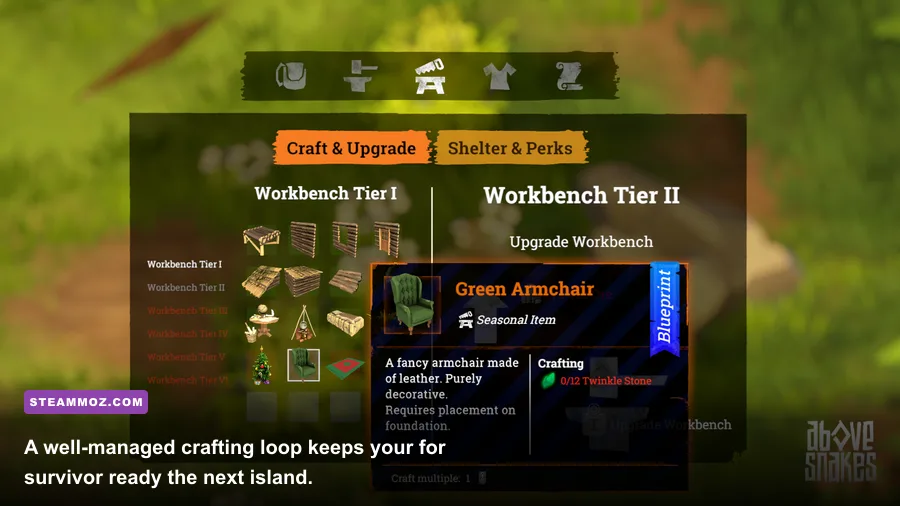
Your first crafting decisions should support gathering, not decoration. Get the early tools and a dependable weapon online before investing in furniture or a large shelter. The exact recipe costs can vary with progression and updates, so use the crafting panel as the final authority, but the priority stays consistent.
| Priority | What to craft | Why it matters | Common mistake |
|---|---|---|---|
| 1 | Basic gathering tools | Unlocks reliable Wood, Stone, and plant collection | Hand-gathering everything and burning stamina |
| 2 | Workbench | Opens better tools, weapons, storage, and utility recipes | Building a decorative camp first |
| 3 | Reliable melee weapon | Lets you clear isolated threats without wasting ammunition | Entering ruins with only a weak starter item |
| 4 | Food and healing supplies | Protects health, stamina, and expedition time | Carrying raw ingredients instead of prepared items |
Craft a second tool before the first one breaks if the recipe is cheap enough. A damaged tool can fail during a resource run, forcing a long return trip. Keep at least one open inventory slot for quest objects and chest loot, too. A full backpack is not efficiency; it's an invitation to leave useful materials behind.
3. Treat food, health, and stamina as separate resources
New players often see food as a simple hunger bar, but the survival loop punishes poor preparation in three different ways. Hunger can affect your ability to stay out, health determines whether one bad encounter ends the run, and stamina controls how safely you gather, dodge, and retreat.
Cook ingredients whenever a recipe improves their recovery. Raw food is emergency fuel, not your default meal. Before leaving your base, carry a small stack of prepared food and healing items rather than every ingredient you own. This keeps your backpack flexible and gives you a buffer after combat.
Don't sprint everywhere. Save stamina for hostile encounters, climbing around hazards, or escaping when multiple enemies aggro together. If you reach a ruin with half a stamina bar and no healing item, the correct move is to restock—not to hope the chest contains exactly what you need.
4. Use combat spacing instead of trading hits

Above Snakes' enemies are most dangerous when you let several attacks overlap. Your goal is to isolate targets, read their approach, and hit during the recovery window. Back away from groups, circle around obstacles, and avoid fighting beside another enemy you haven't pulled yet.
Most hostile creatures telegraph their attack with a brief approach or wind-up. Move laterally rather than retreating in a straight line, then counter once the attack finishes. A melee weapon is efficient against a single exposed target, while ranged attacks are valuable when an enemy is separated or protecting a narrow route. Don't waste ammunition on enemies you can safely kite with terrain.
When two enemies notice you, stop attacking the front one blindly. Create distance, reposition around a corner, and make the faster threat reach you first. This turns a messy fight into two short fights. If your health is already low, leave the island and recover; there is no reward for converting a minor scavenging trip into a corpse run.
| Situation | Best response | What to avoid | Reason |
|---|---|---|---|
| One enemy in open ground | Strafe, bait the attack, counter | Standing still to exchange damage | Movement reduces unnecessary healing use |
| Two enemies nearby | Pull one around terrain | Attacking while both are in range | Overlapping telegraphs are hard to read |
| Enemy near a quest object | Clear the area before interacting | Opening menus during aggro | Interaction locks you into a vulnerable moment |
| Low health or stamina | Retreat and restock | Trying one more ruin | Survival supplies are cheaper than lost time |
5. Expand the map only after finishing the current tile
Map expansion is progression, but rushing it creates a weak economy. Before placing a new tile, harvest visible resources, open accessible containers, finish nearby objectives, and check whether you have enough supplies to survive the next area. The new land can contain stronger enemies, longer travel routes, and recipes that demand materials you haven't stockpiled.
Think of each tile as a staging platform. Put your base, storage, or temporary crafting setup where paths remain easy to reach. A central position near several resource clusters is better than a beautiful camp at the edge of the map. You want short return routes when tools break or inventory fills.
If the game presents a choice between exploring, gathering, and following the main objective, gather first when your tools are new. Quest progression is easier when you arrive with prepared food, a repaired weapon, and empty inventory slots.
6. Upgrade permanent progression before convenience items
Skill and recipe progression should make every later expedition stronger. Favor upgrades that improve gathering, carrying capacity, survivability, or access to better crafting stations before spending materials on cosmetic improvements. More inventory space is especially valuable because it lets you complete a full loop without abandoning common resources.
Read the full recipe chain before committing to a skill or crafting unlock. Some upgrades look useful in isolation but require rare ingredients you won't have for several objectives. When in doubt, choose the option that improves multiple activities: a gathering improvement helps tools, base construction, quest preparation, and future crafting all at once.
| Upgrade type | Early value | Best timing | Why it scales well |
|---|---|---|---|
| Inventory capacity | Very high | As soon as affordable | Reduces wasted trips and discarded loot |
| Gathering efficiency | Very high | Before major exploration | Improves every resource run |
| Weapon access | High | Before hostile ruins | Shorter fights consume fewer healing items |
| Decorative construction | Low | After stable supplies | Doesn't solve early survival bottlenecks |
7. Make your base a logistics hub, not a showroom
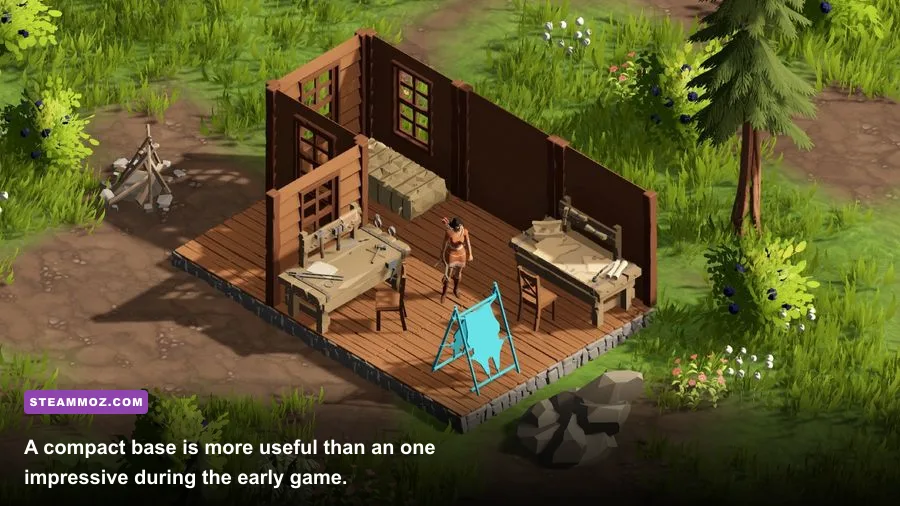
Storage placement matters more than wall size. Put containers beside the Workbench and other crafting stations, then sort materials by function: building resources, food, combat supplies, and quest items. Leave a small personal reserve in each category so a hurried departure doesn't empty the entire base.
Build only what supports your current progression. A compact shelter with organized storage is faster to use than a sprawling base filled with furniture. Later, when recipes and resource income stabilize, you can redesign without constantly interrupting the survival loop.
Keep a “departure box” near the entrance containing food, healing items, spare tools, and a weapon. This is a tiny habit, but it prevents the classic mistake of reaching a new tile with a full pack and no combat supplies.
8. Separate story objectives from scavenging runs
Don't combine every task into one giant expedition. A story run should carry the items needed for combat and interaction. A scavenging run should focus on harvesting, opening containers, and returning safely. Mixing them makes it easy to consume quest-critical materials or fill your inventory before the important objective appears.
Use the map and your own landmarks to create a route: base, resource cluster, ruin, objective, return point. If a quest sends you across multiple connected areas, prepare for the entire route rather than only the first marker. Your best weapon is often the ability to turn around before the situation becomes expensive.
For more PC survival-game troubleshooting habits, Steamoz's Elex performance fixes are useful when a long session starts going wrong. The principle is the same: stabilize the run before chasing more progress.
9. Protect rare materials and quest items
Rare materials should have a job before they leave storage. Check the next Workbench recipes, tool upgrades, and story requirements first. If an item has an unfamiliar name or comes from a limited chest, store it instead of testing a random recipe. You can always craft later; you can't always replace a scarce component quickly.
Keep quest objects separate from ordinary loot. This reduces the chance of consuming, dropping, or accidentally storing something you need immediately. When a mission asks you to deliver or place an item, finish that objective before starting a long unrelated gathering trip.
That discipline also helps with hidden rewards. Exploring side paths and checking unusual structures can pay off, but only when you have enough inventory capacity to bring the reward home. Steamoz's hidden-location guide covers the same kind of reward-first exploration mindset in another game.
10. Tune performance before a serious exploration session
A stable frame rate matters in a game built around positioning, gathering, and reading enemy movement. Start with the game's recommended preset, then lower shadows, effects, and view distance first if your system struggles. Keep texture quality higher when video memory allows; it usually preserves clarity better than reducing every setting equally.
| Setting | Recommended starting value | FPS impact | Visual trade-off |
|---|---|---|---|
| Resolution | Native monitor resolution | High if reduced | Lower values look softer |
| Shadows | Medium | Medium to high | Less detailed lighting |
| Effects | Medium | Medium | Less dramatic combat and environmental detail |
| View distance | Medium or High | Medium | Fewer distant details and objects |
| Textures | High if VRAM permits | Low to medium | High settings need more video memory |
Cap the frame rate at a level your PC can hold consistently instead of chasing unstable peaks. Close overlays and background downloads, verify the game files through Steam, and test a demanding island before committing to a long run. Steamoz's FPS settings guide explains the same frame-time-first approach.
The mindset that carries you through the late game
Above Snakes rewards preparation more than speed. Gather before you expand, keep combat isolated, cook food, protect rare ingredients, and make your base easy to resupply. If you want the developer's current patch information, check the official Above Snakes Steam page and Square Glade Games' website before relying on older recipe or balance information.
Once those habits become automatic, the fractured map stops feeling like a string of emergencies. Every island becomes a controlled loop: arrive prepared, harvest efficiently, fight on your terms, complete the objective, and leave with more than you spent.