A-Train 9 V5.0 has no character levels or traditional gold currency. The fastest way to “level” is to grow your company’s retained cash and asset value through one profitable passenger corridor, then reinvest its operating surplus into stations, feeder buses, and carefully chosen subsidiaries. Don’t begin by covering the map with expensive track. Start with demand, run a timetable that matches the city’s daily rhythm, and let compound growth do the heavy lifting.
This distinction matters because many RPG-style farming guides completely miss how A-Train 9 V5.0: Japan Train Simulator Ultimate Edition works. Your real progression is the company balance sheet: cash, operating profit, land value, subsidiary income, stock performance, and the population growth your transport network creates. The game rewards patient scheduling far more than frantic construction.
What “Leveling” Really Means in A-Train 9
There is no experience bar to fill and no enemy camp that drops coins. Your company advances when its transport services become profitable and the surrounding city becomes more valuable. A station with strong passenger movement can increase land demand, while a profitable commercial subsidiary can provide an additional income stream. Both effects feed back into your next expansion.
The most important early metric is not total revenue. It is operating profit after vehicle, track, station, maintenance, and subsidiary costs. A spectacular-looking railway can still bleed money if trains run nearly empty or if every service is active during low-demand hours. Open the company finance screens regularly and compare a route’s income against the expenses attached to it.
Think of growth in three stages. First, establish a short corridor between an existing population center and a destination with visible demand. Second, improve frequency and access using buses rather than immediately laying parallel rail. Third, use the cash generated by that corridor to develop land and diversify into subsidiaries. This is the closest thing A-Train 9 has to a fast-leveling build.
| Progression Target | What to Watch | Best First Move | Common Mistake |
|---|---|---|---|
| Stable cash flow | Operating profit over multiple days | Short passenger route | Buying too many trains |
| City growth | Passenger volume and nearby development | Add station access and buses | Building far from demand |
| Asset growth | Land value and subsidiary returns | Develop only proven corridors | Speculative construction |
| Late-game expansion | Network utilization and cash reserves | Connect profitable districts | Expanding on negative cash flow |
For a useful management mindset, compare this approach with the deliberate opening principles in our DeltaZeal starting-build guide. The games are different, but the lesson carries over: early resources should create repeatable income, not merely unlock more toys.
🎮 A-Train 9 V5.0 : Japan Train Simulator Ultimate Edition
Looking to experience this game? Grab your digital key directly on our store for $29.99.
View on Steammoz Store →Build One Cash Route Before You Build a Network
Pause at the beginning and inspect the map before spending. Look for an existing cluster of houses, offices, shops, or public facilities that sits close to a natural destination. A station placed in empty terrain may look cheap, but it has no passengers to support the service. A modest station near an established district can outperform a grand terminal in the middle of nowhere.
Your first rail line should be short enough to operate frequently and simple enough to timetable cleanly. Two stations are sufficient for testing demand. Add a third only when the middle stop produces meaningful boarding activity. Every extra stop adds travel time, scheduling complexity, and infrastructure cost, so don’t confuse a longer line with a better line.
Run the route at different speeds and observe the passenger flow rather than letting the simulation race ahead unattended. The goal is a service pattern that catches morning outbound demand, daytime movement, and evening returns. If your timetable sends every train through the station at the same minute, you create long gaps followed by wasteful bunching. Spread departures so the platform has a dependable rhythm.
Use the game’s timetable controls to separate peak and off-peak behavior. A train that is packed during the morning but empty for the rest of the day may need fewer off-peak runs, not another train. Conversely, a route that consistently leaves passengers behind during a rush period is signaling that frequency or capacity needs attention.
| Route Signal | Diagnosis | Adjustment | Why It Improves Cash |
|---|---|---|---|
| Full platforms, missed passengers | Demand exceeds scheduled capacity | Add a departure or larger capacity | Captures existing demand |
| Empty trains all day | Weak corridor or poor timing | Reduce frequency and inspect destinations | Cuts operating waste |
| Busy morning, dead afternoon | Peak-only demand | Concentrate service around peaks | Improves vehicle utilization |
| One overloaded station | Access bottleneck | Add feeder buses or a second stop | Expands catchment without new rail |
Save before every major purchase. A-Train’s simulation can punish a seemingly sensible expansion after a few in-game months, and reversing track or subsidiary decisions is rarely as painless as avoiding them in the first place.
Turn Stations Into Gold Farms With Feeder Buses
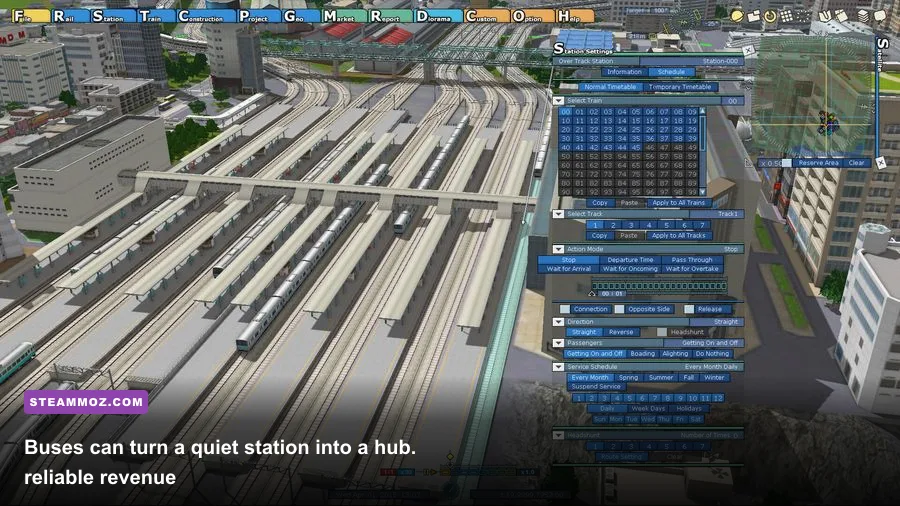
The most efficient early “gold farm” is usually a rail-and-bus combination. Rail gives you the high-capacity spine; buses widen the station’s catchment area at a fraction of the cost of another railway branch. Place a bus stop near a residential pocket or commercial block, then route the bus toward your station rather than duplicating the entire rail journey.
Keep feeder routes short. A bus that spends most of its schedule circling empty streets is not building a profitable network; it’s consuming fuel, maintenance, and time. One residential-to-station loop is easier to evaluate than a sprawling route with six stops. Once passenger activity improves, add another feeder from a separate district.
Bus timing matters. If ten buses arrive at the station together, the first may fill while the others trail behind nearly empty. Stagger departures and watch the platform or station passenger indicators. A good feeder service delivers a steady stream before train departures, not a traffic jam after the train has already left.
There’s also a practical city-building advantage. More accessible stations encourage development around them, which can raise future demand for both rail and subsidiaries. That makes buses valuable even when their direct profit is modest. They are demand multipliers, not just miniature trains.
Resist the temptation to buy every vehicle type immediately. The right fleet depends on passenger volume, route distance, and timetable spacing. A cheap, frequently used service is a stronger early investment than a premium train that only looks impressive on the map.
Subsidiaries and Stocks: When to Diversify
Subsidiaries can accelerate company growth, but they are not instant money printers. A commercial building beside a station makes sense when passenger movement and surrounding land demand already exist. Placing expensive facilities in an undeveloped district ties up cash and may leave you with a beautiful asset that contributes little to the balance sheet.
Use a simple rule: transport first, property second. Build the route, establish passenger flow, then develop the land that benefits from that flow. This sequencing gives your subsidiary a reason to exist. It also reduces the risk of draining the cash reserve needed for vehicle replacement, track upgrades, and unexpected operating losses.
Review subsidiary performance instead of judging it by purchase price. A property with a large upfront cost needs stronger returns than a small facility. If the finance screen shows that a subsidiary is repeatedly underperforming, stop expanding that category and redirect money toward the corridor that is actually producing demand.
The stock market can be useful once your operating business is stable, but it should not replace railway income during the opening. Market positions can consume cash that would otherwise buy profitable infrastructure. Treat stocks as a late-stage use for surplus funds, not as your first farming method.
For a broader perspective on choosing investments instead of hoarding resources, see these town-saving economy tips. A-Train is slower and more systemic, but the same principle applies: protect the engine that keeps paying you.
A Safe Expansion Order for Fast Company Growth
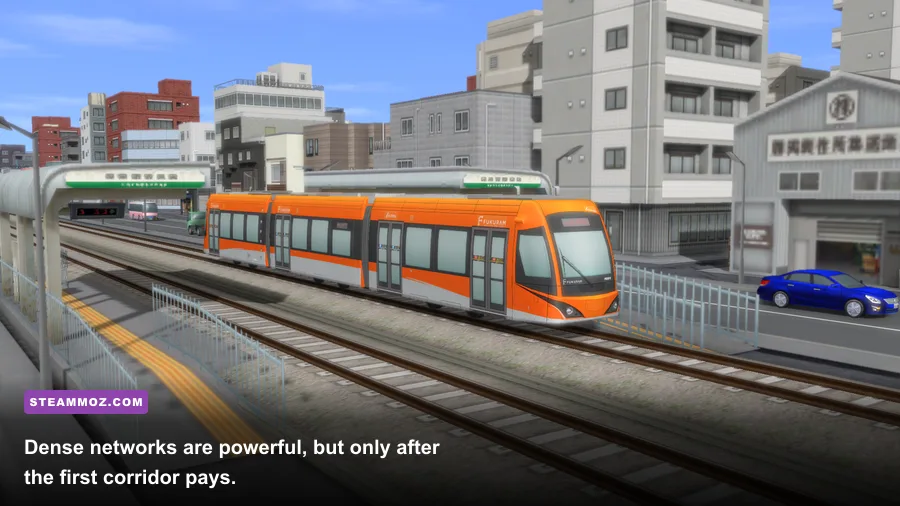
Once your first corridor produces consistent operating profit, expand in layers. First improve access to the existing stations. Next extend toward a nearby district that can feed the current line. Only after both sides show demand should you consider a new branch or major terminal. This keeps each expansion attached to a proven economic base.
Step 1: Confirm the route pays
Let the simulation run long enough to see ordinary and peak periods. A single busy day is not proof of profitability. Check whether the route remains healthy after vehicle expenses and scheduled services are counted. If it doesn’t, adjust the timetable before buying more rolling stock.
Step 2: Upgrade access, not distance
Add feeder buses, nearby stops, or a small station improvement before extending track across the map. Access upgrades are often the cheapest way to increase passengers. They also reveal whether the district truly wants more transport.
Step 3: Reinvest a controlled portion of surplus
Keep a cash reserve for maintenance and operating costs. Pouring every available yen into construction creates a fragile company that looks rich in assets but cannot finance its next month. Expansion should follow cash flow, not the other way around.
Step 4: Add subsidiaries beside proven demand
Commercial and other subsidiary investments work best where your network already concentrates passengers. Develop incrementally and compare actual returns in the finance screens. If the city grows around the station, repeat the pattern in the next district.
Step 5: Use faster simulation carefully
Higher simulation speed is excellent for collecting revenue, but it can hide a timetable failure or a rapidly worsening balance sheet. Run fast only after checking the route, then pause at regular intervals to review passengers, cash, and subsidiary performance. Speed is a farming tool; unattended speed is a bankruptcy button.
| Expansion Phase | Recommended Investment | Hold Off On | Success Check |
|---|---|---|---|
| Opening | Two-station rail corridor | Large terminal and broad land purchases | Consistent passenger revenue |
| Stabilization | Short feeder bus routes | Parallel rail lines | Better station utilization |
| Development | Subsidiaries near active stations | Speculative remote buildings | Positive subsidiary results |
| Scaling | New district connections | All-at-once map coverage | Expansion funded by surplus |
New players often benefit from the same disciplined pacing discussed in our guide to progressing without traditional leveling. The important habit is checking what the game actually rewards instead of forcing an RPG model onto a management simulation.
Performance Settings That Keep Long Sessions Smooth
A-Train 9 V5.0 can become demanding when the city fills with trains, buses, buildings, and detailed scenery. Smooth performance matters because timetable adjustments and passenger observation are much easier when the simulation isn’t stuttering. Start with the official Steam store page for platform requirements, then tune visual options around your hardware.
| Setting Profile | Recommended Use | Performance Effect | Visual Trade-Off |
|---|---|---|---|
| Native resolution, moderate detail | Most mid-range PCs | Balanced | Clear city view with lower scene load |
| High detail, native resolution | Modern gaming PCs | Higher GPU and scene cost | Better buildings and scenery |
| Reduced resolution, high simulation speed | Large late-game cities | Improves responsiveness | Less sharp image |
| Lower scenery detail | Dense networks and weak GPUs | Reduces rendering overhead | Less environmental richness |
When the map becomes dense, prioritize stable interaction over screenshot quality. Lower scenery detail before sacrificing the resolution needed to read stations and routes. If your system struggles specifically during accelerated simulation, reduce the number of active visual effects and avoid keeping unnecessary camera views open.
For troubleshooting habits, our PC performance fixes guide offers useful general advice, while the ARTDINK official site remains the best place to verify current game information. Finally, check the official A-Train 9 website for product details and support updates.
The winning A-Train 9 V5.0 farming loop is straightforward: identify demand, build one short route, timetable it around passenger movement, widen access with buses, and develop subsidiaries only after the corridor pays. There’s no magic gold exploit. The fastest “leveling” comes from making every yen work twice—first as transport profit, then as the city growth that creates your next profitable route.