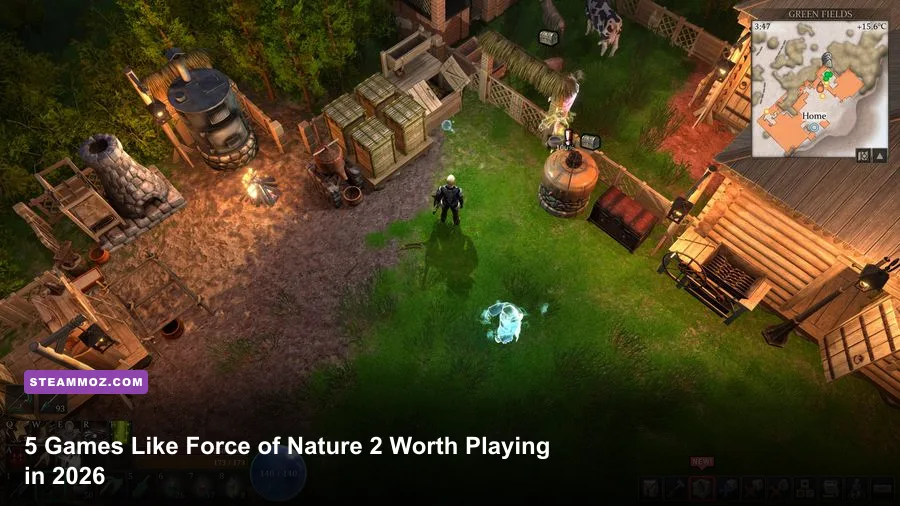
If you like Force of Nature 2: Ghost Keeper for its top-down exploration, farming, crafting, quests, and gradual base growth, start with Core Keeper. It has the closest moment-to-moment rhythm, while Necesse is the best match for its overhead view and settlement management. Terraria, Valheim, and Enshrouded are stronger choices when you want tougher bosses, bigger worlds, or more advanced combat.
Force of Nature 2 occupies an unusual corner of the survival genre. It isn't as brutally punishing as Valheim, as sandbox-driven as Terraria, or as combat-focused as Enshrouded. Instead, it asks you to turn a hostile map into a productive home. You gather wood and ore, unlock workstations, plant crops, improve equipment, follow quest objectives, and slowly make dangerous regions feel routine. That progression loop is the real target here—not just any game with a crafting menu.
The games below are ranked by how well they recreate that loop. I’ve also separated the choices by mood, because the right recommendation depends on whether you want a relaxed solo adventure, a co-op survival challenge, or a world where your settlement becomes the main character.
Which games are most like Force of Nature 2?
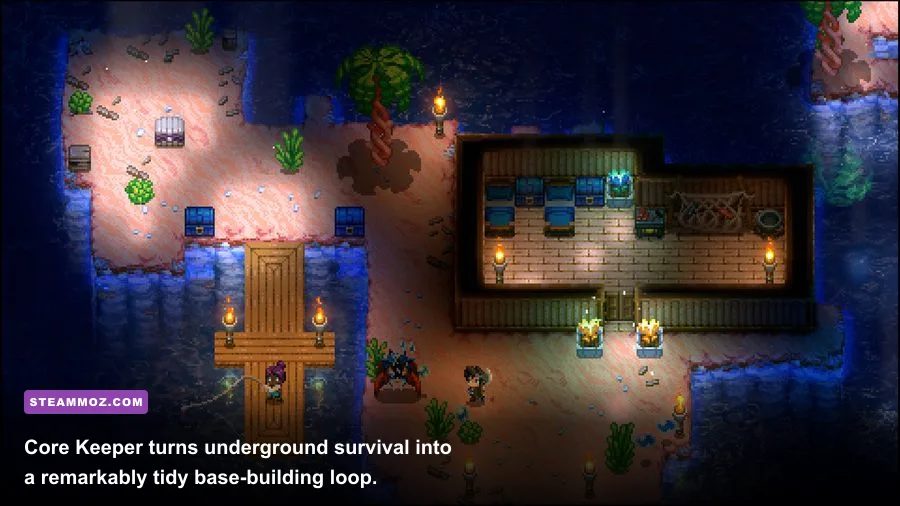
Core Keeper wins on overall feel, Necesse wins on perspective and colony systems, and Terraria wins on content depth. Valheim is the better choice for structured co-op survival, while Enshrouded is the modern action-RPG upgrade. None is a one-to-one replacement: Force of Nature 2’s specific blend of isometric exploration, survival meters, skill progression, and quest-led crafting remains fairly distinctive.
| Game | Similarity | Best For | Main Difference |
|---|---|---|---|
| Core Keeper | S-Tier | Solo or co-op crafting | Underground 2D world and boss gates |
| Necesse | S-Tier | Top-down settlements | NPC jobs and colony defense are central |
| Terraria | A-Tier | Exploration and bosses | Much more platforming and build variety |
| Valheim | A-Tier | Co-op survival | Third-person 3D combat and harsher logistics |
| Enshrouded | A-Tier | Action-RPG combat | Large 3D world with more demanding hardware |
Before choosing, decide how much friction you actually want. Force of Nature 2 lets you spend long stretches gathering materials and improving your production chain. Core Keeper and Necesse preserve that satisfying routine. Valheim adds food management, corpse runs, and sailing. Terraria mostly drops survival meters in favor of equipment progression. Enshrouded replaces hunger with a more conventional RPG structure built around skill nodes, NPC crafters, and combat encounters.

🎮 Force of Nature 2: Ghost Keeper
Looking to experience this game? Grab your digital key directly on our store for $3.99.
View on Steammoz Store →1. Core Keeper is the closest overall match
Core Keeper is the recommendation I’d give first to almost every Force of Nature 2 player. You begin underground with a basic pickaxe, a mysterious Core, and very little room to maneuver. Mining expands the map, while crafting benches, furnaces, farms, and storage turn a dark cavern into a functioning homestead. That “one more room, one more vein, one more upgrade” cadence feels immediately familiar.
The progression is more deliberately gated than Force of Nature 2. Bosses such as Glurch the Abominous Mass, Ghorm the Devourer, and the Hive Mother guard access to new regions and materials. Ghorm is a particularly good early lesson: it circles a huge tunnel at speed, so building a long straight escape route before summoning it matters more than raw armor. The Hive Mother punishes players who stand still, forcing you to manage acid projectiles, summoned larvae, and arena space.
Core Keeper’s skill system also gives gathering a satisfying long-term payoff. Mining, running, melee, ranged combat, crafting, gardening, fishing, cooking, and other activities improve through dedicated skill trees. The system doesn’t simply hand you power; it rewards playing in the way you enjoy. A mining-focused character clears walls faster and gets more value from every expedition, while a gardening-heavy character can turn a compact farm into a reliable food engine.
How to build your first Core Keeper base
Keep the Core itself in a protected central room, then arrange your base around short travel routes. Put furnaces and anvils near ore storage, place cooking stations beside food chests, and leave a dedicated room for NPC housing. Don’t scatter every crafting station across the map. The game becomes dramatically smoother when you can smelt ore, craft equipment, cook food, and restock without crossing a maze of decorative corridors.
For combat, carry one melee weapon and one ranged option rather than filling your hotbar with five versions of the same tool. A sword handles enemies in narrow tunnels; a bow or magic staff lets you chip away at bosses while preserving health. Food buffs matter more than new players expect, so cook before boss attempts instead of treating recipes as optional decoration. The official Core Keeper Steam page is the best place to check current multiplayer and update information.
| Core Keeper Phase | Priority | Why It Matters | Force of Nature 2 Connection |
|---|---|---|---|
| First hours | Pickaxe, furnace, food | Unlocks safe mining and healing | Matches early gathering and cooking |
| First bosses | Armor, ranged weapon, arena | Prevents avoidable deaths | Similar to preparing for dangerous zones |
| Midgame | NPC rooms and automated farms | Reduces resource downtime | Deepens the settlement loop |
| Late game | Biome gear and boss-specific food | Supports long expeditions | Replaces broad quest progression |
2. Necesse is the best top-down alternative
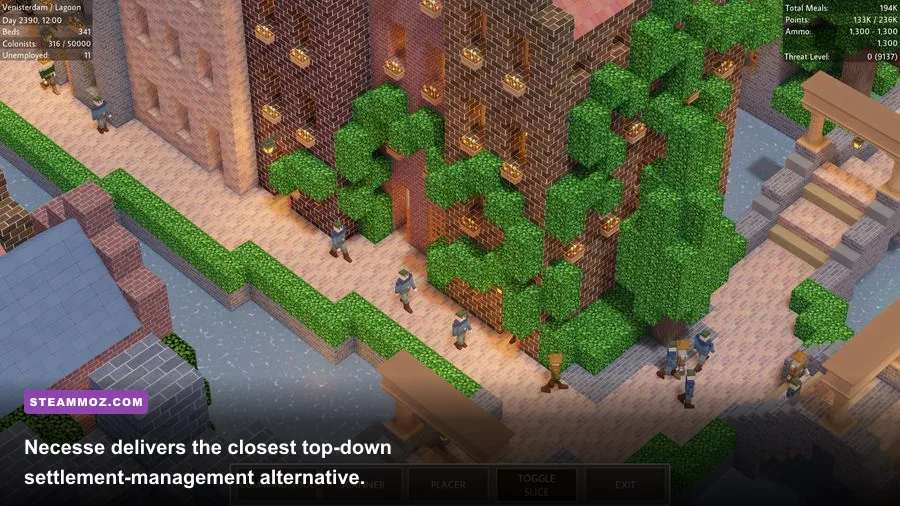
Necesse may be the most relevant answer if what you loved was the camera angle and the feeling of building a living frontier settlement. It combines 2D top-down exploration with procedural islands, farming, crafting, NPC recruitment, and base defense. The key difference is that you don’t remain the only worker. Settlers can farm, fish, mine, haul items, guard doors, and operate parts of your production chain.
That makes Necesse less solitary than Force of Nature 2. Your first base starts as a practical shelter, but it can become a real town with assigned rooms, stockpiles, workshops, and defensive walls. NPC happiness and housing requirements matter, so throwing down random beds in an open field isn’t a long-term solution. Build a compact settlement with clear paths, then place storage near the stations that use it most.
Combat is fast and readable, with melee, ranged, magic, and summon-oriented equipment. Bosses such as the Evil's Protector and Swamp Guardian are designed around movement and telegraphs rather than simply having enormous health bars. This is where Necesse can feel more demanding than Force of Nature 2: enemies punish standing in one place, and a settlement raid can become chaotic if you have not planned your walls and guard positions.
The smartest Necesse progression route
Start with a simple enclosed town, recruit enough settlers to cover essential jobs, and avoid overbuilding before you have a stable food supply. Farming is worth establishing early because it removes repeated emergency gathering trips. Then improve your equipment before hunting bosses; rushing the first major fight with starter gear creates a difficult battle for no real benefit.
Assign workers according to your bottleneck. If ore is slowing every upgrade, prioritize mining and hauling. If your town is constantly short on meals, add farmers and cooks before recruiting another combat specialist. That production-first mindset is the big reason Necesse belongs on this list. It turns base design into a strategic decision instead of a purely cosmetic activity. The official Necesse Steam listing provides the current feature and multiplayer details.
| Settlement Problem | Best Fix | Common Mistake | Result |
|---|---|---|---|
| Food shortages | Assign farmers and cooks | Relying on wild pickups | Stable healing and worker uptime |
| Slow crafting | Place storage by workshops | Spreading stations across town | Shorter hauling routes |
| Enemy raids | Walls, gates, guards | Leaving beds and chests exposed | Fewer interruptions |
| Ore bottlenecks | Recruit miners and haulers | Mining everything personally | Faster equipment upgrades |
3. Terraria has the deepest exploration curve
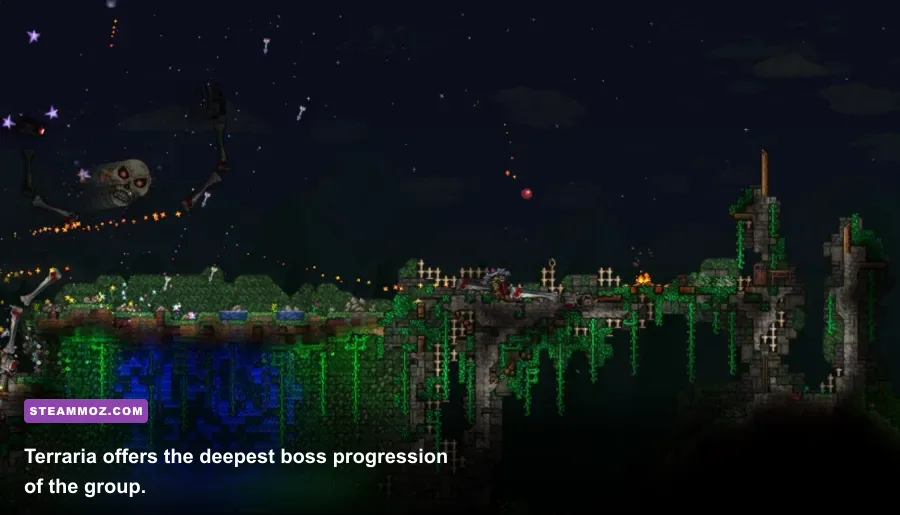
Terraria is less survival simulation and more a giant 2D action sandbox, but it remains one of the best games like Force of Nature 2 because its exploration and crafting progression are outstanding. You build a home, collect materials, attract NPCs, defeat bosses, and repeatedly rebuild your loadout around new biomes. The basic loop is recognizable; the scale is much larger.
The most important progression break is Wall of Flesh. Defeating it activates Hardmode, permanently changing the world and unlocking new ores, enemies, events, and bosses. Before that fight, build a long horizontal arena in the Underworld, stock healing potions, and carry a weapon that can maintain damage while you move. Afterward, mine Cobalt or Palladium, then Mythril or Orichalcum, and finally Adamantite or Titanium. Skipping that ore ladder usually makes the Mechanical Bosses feel unfair.
Terraria’s classes are more distinct than Force of Nature 2’s broader progression. Melee favors defense and close-range damage, ranged builds consume ammunition but offer excellent safety, magic uses mana and powerful staves, and summoner builds rely on minions while keeping the player mobile. You can change direction, but specialized armor bonuses mean that mixing four classes at once usually lowers your damage dramatically.
Why Terraria can be the wrong choice
If you want a calm, quest-guided survival RPG, Terraria may feel noisy. The game rarely tells you exactly what to do next, and its best items are often hidden behind experimentation, fishing, or the official Terraria Wiki. Boss fights also demand arena construction and pattern recognition. Eye of Cthulhu charges in predictable cycles, Skeletron punishes poor movement, and the Moon Lord turns preparation into a full endgame test.
Still, the reward for learning is enormous. A basic wooden shelter can evolve into a themed town, a wiring project, a fishing outpost, or a multi-level boss arena. If Force of Nature 2’s crafting chain is your favorite part, Terraria gives you more systems to master than any other game here. For more progression-focused recommendations, Steamoz’s games like Blood Omen 2 feature is another useful stop.
| Terraria Milestone | Recommended Preparation | Primary Reward | Difficulty Jump |
|---|---|---|---|
| Eye of Cthulhu | Wood platform arena and ranged weapon | Early ore and useful materials | Low |
| Skeletron | Wide arena and movement accessories | Dungeon access | Medium |
| Wall of Flesh | Underworld runway and buffs | Hardmode begins | High |
| Mechanical Bosses | Hardmode armor and class gear | New ores and progression | High |
4. Valheim is the best co-op survival upgrade
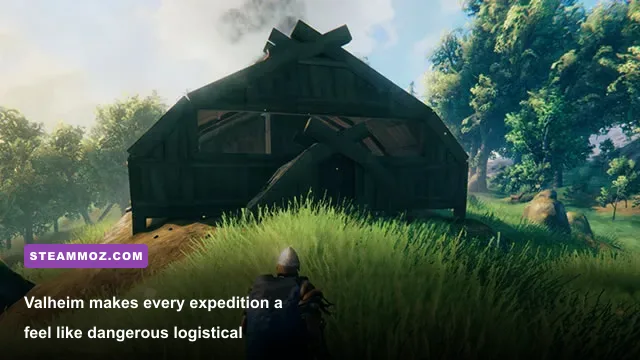
Valheim is the pick for players who want the settlement loop of Force of Nature 2 but with more danger, atmosphere, and co-op teamwork. Its procedurally generated world is divided into biomes including Meadows, Black Forest, Swamp, Mountains, Plains, Mistlands, and the Ashlands. Each biome introduces a new resource economy, enemy roster, and environmental problem.
The food system is central. Food does not merely refill a hunger bar; it raises your maximum health and stamina according to the quality and type of meals you eat. A player carrying cooked meat, carrot soup, or better biome-specific recipes can survive situations that would kill an underprepared character. Before exploring the Swamp, poison resistance is practically part of your equipment checklist. Before entering the Mountains, frost resistance and a reliable route back to shelter save enormous frustration.
Combat uses stamina, weight, attack timing, and damage types. Blocking with a shield at the correct moment can stagger enemies, while rolling grants brief invulnerability but consumes stamina. Blunt damage is valuable against skeletons and other resistant targets; bows are excellent for pulling enemies and handling dangerous creatures before they reach your walls. Death creates a tombstone containing your gear, so long expeditions should include a backup weapon and enough food to recover safely.
What to know before starting Valheim
Build a workbench, roof it, and improve its comfort level before treating your first structure as a permanent home. Repairing equipment at a covered workbench costs no materials, so there is no reason to discard damaged tools. Keep portals connected to major resource zones, but remember that several raw metals cannot pass through them. That rule is one of Valheim’s most important logistical twists: you may need to transport ore by cart or longship.
Valheim is superb with two to five players, but it is slower solo. Gathering, sailing, building, cooking, and corpse recovery all take longer when one person handles every job. If that sounds appealing, it becomes an engrossing routine. If not, Core Keeper is a friendlier solo recommendation. Steamoz’s 2026 survival-game coverage also explores how co-op pacing changes the experience.
| Biome | Key Threat | Preparation | Major Progression |
|---|---|---|---|
| Meadows | Early raids and boars | Wood shield and cooked food | First base and Eikthyr |
| Black Forest | Trolls and Greydwarfs | Bronze tools and stamina food | Mining and Elder access |
| Swamp | Poison and wet debuff | Poison resistance mead | Iron equipment |
| Mountains | Freeze and wolves | Frost resistance and bow | Silver and Moder |
| Mistlands | Infested enemies and terrain | Wisplight and upgraded gear | High-end crafting |
5. Enshrouded is the modern action-RPG choice
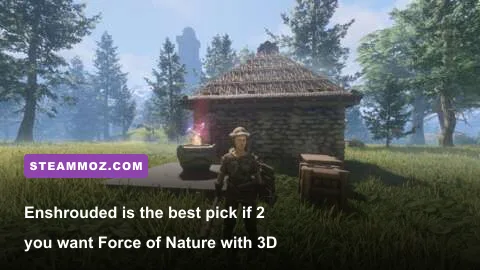
Enshrouded is the biggest departure from Force of Nature 2, but it is also the most polished option if you want the same gather-build-explore loop in a modern 3D world. You play as a Flameborn in Embervale, reclaiming a ruined land from the Shroud. The world is built for traversal: gliding, climbing, grappling, and carefully placed Flame Altars make exploration feel active rather than like a sequence of resource walks.
The game’s strongest system is its NPC crafting network. Rescuing characters such as the Blacksmith, Hunter, Carpenter, Alchemist, and Farmer unlocks new recipes and production chains. Bringing them back to your base turns a plain shelter into a workshop hub. That structure mirrors Force of Nature 2’s workstation progression, but Enshrouded gives each specialist a clearer identity and ties many upgrades to exploration objectives.
Combat is built around a three-part skill system: melee, ranged, and magic branches, with connected nodes that let you specialize or hybridize. A melee character can invest in the Warrior and Tank paths, while ranged builds benefit from Dexterity and bow-focused nodes. Magic users need to manage spell charges and equipment more carefully. The practical advice is simple: pick one main damage type, then spend spare points on movement, stamina, survivability, or utility instead of spreading every node evenly.
Enshrouded settings and performance advice
Enshrouded is much more demanding than the 2D games on this list. On a midrange PC, start with medium terrain and shadow quality, keep texture quality high if your graphics memory allows it, and test volumetric fog separately. The Shroud’s fog effects are atmospheric but can cost noticeable performance. If traversal feels stuttery, reducing shadow quality and disabling depth of field usually helps without making the world look flat.
| Setting | Recommended Starting Value | Performance Impact | Visual Trade-Off |
|---|---|---|---|
| Texture Quality | High with 6GB+ VRAM | Medium VRAM use | Preserves surface detail |
| Shadow Quality | Medium | High GPU impact | Shorter, softer shadows |
| Volumetric Fog | Medium or Low | High in Shroud zones | Less atmospheric haze |
| Terrain Quality | Medium-High | Medium CPU/GPU impact | Less distant detail |
| Motion Blur | Off | Minimal FPS change | Sharper camera movement |
Choose Enshrouded if you want building freedom and responsive combat more than strict survival simulation. It has less of Force of Nature 2’s quiet overhead management, but its handcrafted ruins, glider routes, and class-based encounters make every expedition more memorable. Check the official Enshrouded Steam page for its current Early Access status and roadmap.
Which Force of Nature 2 alternative should you play first?
Pick Core Keeper if you want the safest recommendation: it preserves the gathering, crafting, farming, boss, and base-upgrade rhythm while adding a wonderfully compact underground world. Pick Necesse if your favorite Force of Nature 2 moments involve arranging production and watching a settlement become useful. Choose Terraria for the largest 2D adventure and most inventive boss progression.
Choose Valheim with friends if you want survival pressure, biome preparation, sailing, and memorable group expeditions. Choose Enshrouded if you’re ready for third-person action, vertical exploration, flexible building, and a more demanding PC experience. Those distinctions matter more than a generic “similar games” list because each title rewards a different kind of player.
My final order for a Force of Nature 2 fan in 2026 is Core Keeper first, Necesse second, Terraria third, Valheim fourth, and Enshrouded fifth. That isn’t a quality ranking—Terraria and Valheim are arguably larger achievements. It’s a similarity ranking. Start with the game that matches the part of Ghost Keeper you actually miss, and you’ll avoid bouncing off an otherwise excellent game for the wrong reasons.
For more tightly focused recommendations, browse Steamoz’s best games like Hunt: Showdown feature and the In Other Waters beginner tips. Both are useful reminders that the strongest recommendation is rarely the game with the most shared labels; it’s the one with the progression rhythm you want to play for another hundred hours.