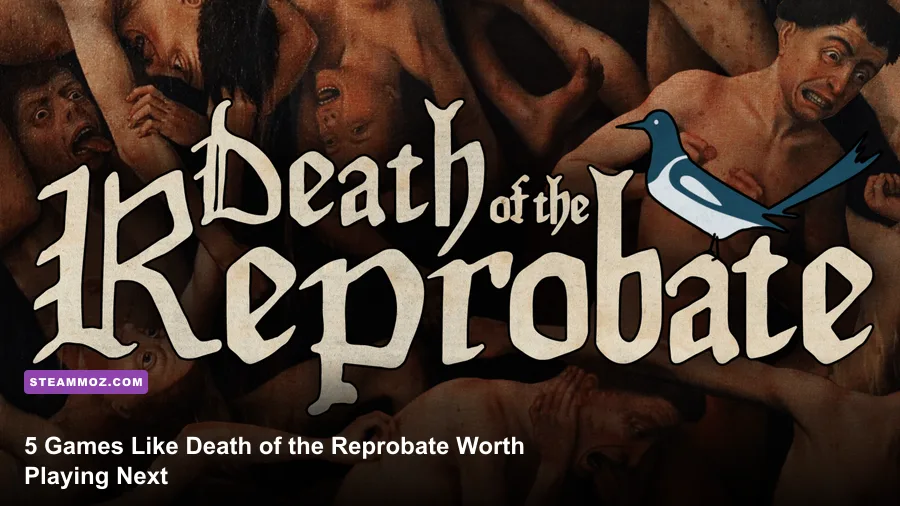
If Death of the Reprobate left you craving more bizarre point-and-click comedy, start with The Procession to Calvary and Four Last Things. They are the closest matches by far, sharing Joe Richardson's collage-like Renaissance art, filthy jokes, irreverent historical references, and wonderfully awkward puzzle logic. After those, Pentiment, The Excavation of Hob's Barrow, and Thank Goodness You're Here! broaden the formula with stronger mystery, horror, or slapstick. These are the best games like Death of the Reprobate you need to play in 2026 because each preserves at least one part of its magic without feeling like a cheap imitation.
Death of the Reprobate works because its humor is inseparable from its presentation. Characters look like figures cut from old paintings, locations feel assembled from museum walls, and every conversation can veer from religious satire to deliberately stupid wordplay. There is no combat build, loot grind, or reaction-test busywork. The challenge comes from noticing a visual detail, trying an outrageous interaction, and accepting that the correct solution may be the funniest possible one.
That makes choosing a follow-up slightly tricky. A conventional adventure may offer better voice acting but lack the visual joke. A serious historical game may capture the period detail but not the anarchic comedy. The ranking below separates those qualities rather than pretending every recommendation is identical.
The Best Matches at a Glance
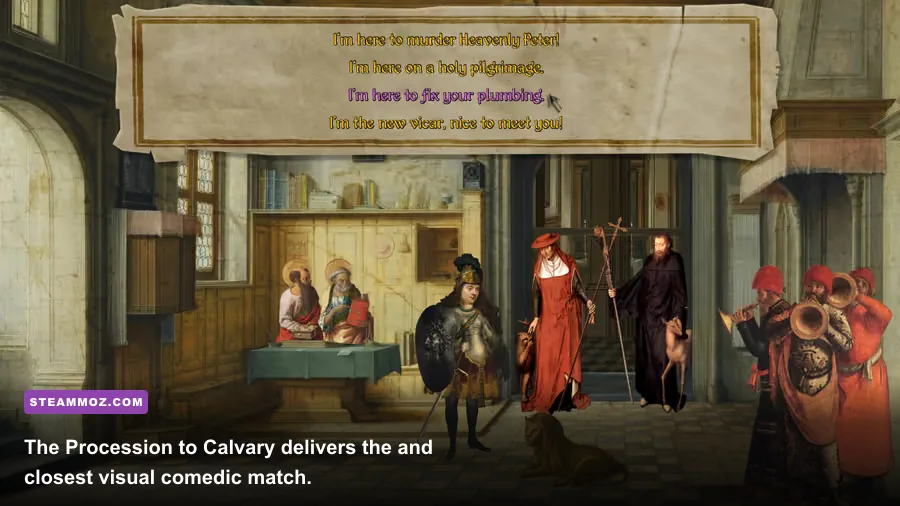
The first two games are the obvious choices. They come from the same creator and use the same basic visual trick: public-domain paintings are cut apart, recombined, animated, and placed into a point-and-click world. The other three recommendations are here for specific reasons. Pentiment is the best historical narrative game, Hob's Barrow is the best investigative horror adventure, and Thank Goodness You're Here! is the best pick if the jokes matter more than traditional puzzle design.
| Game | Why It Matches | Comedy | Estimated Length | Best For |
|---|---|---|---|---|
| The Procession to Calvary | Same collage art and absurd religious satire | Very high | 4–6 hours | The closest overall replacement |
| Four Last Things | Same creator, art style, and puzzle DNA | Very high | 3–5 hours | Seeing where the formula began |
| Pentiment | 16th-century setting, art history, investigation | Moderate | 15–25 hours | Story and historical detail |
| The Excavation of Hob's Barrow | Slow investigation and tactile item use | Low | 6–8 hours | Atmosphere and mystery |
| Thank Goodness You're Here! | Dense absurdity and short comic interactions | Very high | 3–4 hours | Fast, joke-heavy sessions |
One useful warning: none of these games recreates every part of Death of the Reprobate. The Procession to Calvary comes closest visually, while Four Last Things has the strongest direct continuity. Pentiment asks you to read far more. Hob's Barrow is genuinely unsettling. Thank Goodness You're Here! replaces inventory puzzles with compact environmental gags. Pick based on the specific itch you want to scratch.

🎮 Death of the Reprobate
Looking to experience this game? Grab your digital key directly on our store for $8.44.
View on Steammoz Store →S-Tier Picks for Death of the Reprobate Fans

1. The Procession to Calvary
This is the easy S-tier recommendation. The Procession to Calvary is another Joe Richardson adventure built from Renaissance paintings, and it feels like the immediate ancestor of Death of the Reprobate rather than merely a similar game. You play as [AB], a warrior ordered to hunt down the escaped tyrant Heavenly Peter after a violent religious conflict. The premise is intentionally ridiculous, but the world is packed with visual references to actual European art.
The central appeal is the collision between solemn imagery and shameless dialogue. A painted saint can deliver an insult. A nobleman can be persuaded through an interaction that sounds like a medieval legal argument but ends in a puerile punchline. Richardson's games understand that the funniest joke often comes from allowing a grand image to remain completely serious while the player does something idiotic in front of it.
Its puzzles are compact but occasionally mischievous. You will gather objects, interrogate strange citizens, and test combinations that initially seem too absurd to work. The game rewards clicking on everything, but it does not drown you in dozens of inventory items. That economy makes the solutions easier to parse than in larger adventure games, while the deliberately rude writing keeps the process entertaining.
The main difference is pacing. The Procession to Calvary is more linear and feels like a sequence of comic sketches linked by a road-trip plot. Death of the Reprobate gives its locations and interactions more room to breathe. If you want the same art direction and comedic rhythm right now, though, this is the first game to install. Visit the official Steam page for The Procession to Calvary before buying, since its humor is intentionally crude and its subject matter is irreverent.
2. Four Last Things
Four Last Things is shorter, rougher, and arguably even more concentrated. It is the first game in Richardson's Renaissance trilogy, and it establishes the formula that later becomes more confident in Death of the Reprobate: famous-looking paintings, impossible combinations, religious imagery, and characters who speak as if a church fresco has suddenly developed a filthy sense of humor.
The quest structure revolves around committing the seven deadly sins, which gives the adventure a clear framework. That objective is a perfect excuse to explore, provoke townspeople, and manipulate situations that would be morally appalling in any serious historical drama. The comedy comes from the contrast between the lofty framing and the ridiculous practical tasks required to make each sin happen.
Do not expect modern adventure-game conveniences. Four Last Things can be less generous with clue delivery, and some interactions only make sense after you have exhausted the available dialogue. Keep a small note of unusual requests and unexplained objects. If an NPC mentions a specific vice, profession, or location, it is probably not throwaway flavor text.
Its tiny scope is also a strength. You can finish it in an evening, and every screen has a high concentration of things worth clicking. It is the best recommendation for players who loved Death of the Reprobate's visual language but want a sharper, more puzzle-focused experience. The official Four Last Things listing also makes it easy to compare the trilogy's evolution across releases.
| Feature | Four Last Things | The Procession to Calvary | Death of the Reprobate |
|---|---|---|---|
| Visual source | Renaissance paintings and collage animation | Renaissance paintings and collage animation | Renaissance paintings and collage animation |
| Structure | Compact sin-based quest | Mostly linear travel adventure | More expansive episodic exploration |
| Puzzle difficulty | Moderate, occasionally opaque | Moderate and joke-driven | Moderate with more environmental interactions |
| Tone | Crude religious satire | Crude political and religious satire | Crude historical absurdism |
| Best starting point | Fans who want the origin | Fans who want the closest follow-up | The benchmark for the trilogy |
A-Tier Alternatives That Nail the Investigation
3. Pentiment
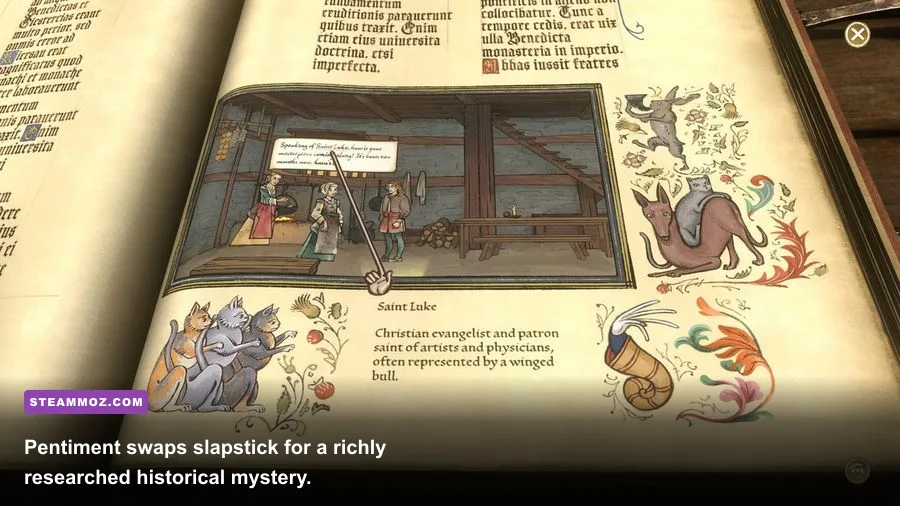
Pentiment is a very different game, but it belongs on this list because it understands the power of historical art better than almost any modern adventure. You play Andreas Maler, an artist working in the Bavarian town of Tassing during the 16th century. After a murder disrupts the local community, Andreas becomes involved in an investigation that stretches across years, social classes, and religious upheaval.
The artwork is designed around illuminated manuscripts, woodcuts, and period lettering. Characters' dialogue appears in different handwritten styles depending on their education and social position. That is not just decoration. The typography tells you who these people are before you fully understand what they believe, and the shifting art style mirrors a Europe being transformed by printing, reform, and political pressure.
Unlike Death of the Reprobate, Pentiment is not built around constant punchlines. It has dry humor and sharp character writing, but its real strength is consequence. You will make accusations without complete evidence, choose which relationships to prioritize, and live with decisions that cannot be reloaded into a perfect outcome. The game does not treat investigation as a puzzle box with one clean answer; it treats it as a social process shaped by prejudice and incomplete information.
Start Pentiment if what you loved was the historical texture, handmade visual identity, and feeling that every villager belongs to a larger culture. Give it several sessions rather than expecting a quick comedy adventure. Its first act is deliberately patient, while later chapters gain enormous emotional weight from details you may initially dismiss. The official Pentiment site explains the historical inspiration, and the Steam version remains the most convenient PC option.
4. The Excavation of Hob's Barrow
The Excavation of Hob's Barrow is the pick for players who enjoyed searching every corner of Death of the Reprobate but would prefer an oppressive mystery. You play Ellen Newland, an antiquarian who travels to the rural village of Bewlay after receiving a letter about an ancient barrow. The villagers are evasive, the landscape feels hostile, and every ordinary conversation seems to conceal a local superstition.
Its interface is classic point-and-click: inspect objects, collect items, combine clues, and question residents until their stories stop lining up. The difference is mood. A locked door is not merely a puzzle gate; it may be connected to a burial custom, a family secret, or a belief that the village has spent generations trying to avoid naming.
Hob's Barrow is especially good at making mundane objects feel important. A shovel, a piece of clothing, a letter, and a meal can all become evidence. Read every document and revisit places after major conversations. The game often advances its mystery through a new line of dialogue rather than a dramatic objective marker, so rushing from one highlighted location to the next will make you miss the texture that makes Bewlay convincing.
This is not a comedy substitute. The humor is sparse, and later scenes lean hard into folk horror. Still, the investigation has the same tactile satisfaction as Death of the Reprobate: look closely, test a theory, discover that the world is stranger than the protagonist expected. Fans of the darker side of narrative adventures can also compare it with Steamoz's Edna & Harvey: The Breakout tips for another offbeat point-and-click experience.
B-Tier, But Still Worth Your Time

5. Thank Goodness You're Here!
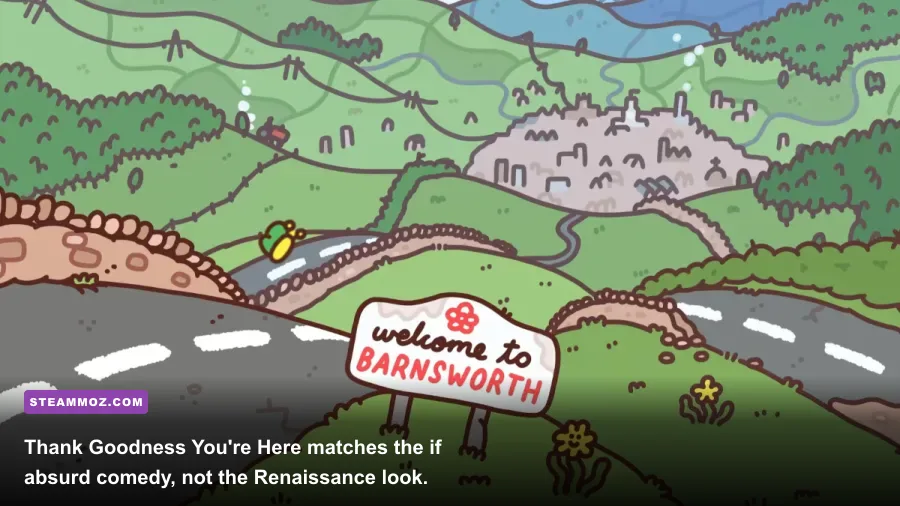
Thank Goodness You're Here! is the least similar visually, yet one of the strongest recommendations if your favorite part of Death of the Reprobate was its commitment to nonsense. You play a tiny traveling salesman visiting Barnsworth, a northern English town full of bizarre residents and increasingly impractical requests. The character cannot speak in a conventional dialogue tree, and most interactions are handled through movement, jumping, slapping, and enthusiastic participation in other people's problems.
That stripped-down design changes the puzzle rhythm. Instead of collecting a large inventory and combining objects, you complete short comic errands that unlock new parts of town. A request may begin with a missing item and end with a machine, a shop, or an entire family becoming involved in a chain of escalating stupidity. The game is closer to an interactive sketch show than a traditional adventure, but it shares Death of the Reprobate's instinct to keep pushing a joke past the point where a sensible game would stop.
Barns-worth is packed with repeatable visual gags. Revisit streets after helping someone, try interacting with props that look decorative, and watch for background characters whose animation changes after an objective. There is no traditional combat build and almost no punishment for experimentation, so the correct strategy is to prod the environment until it reacts.
The trade-off is length and depth. You will finish it in roughly three to four hours, and players seeking demanding inventory puzzles may find it too gentle. But as a palate cleanser after a long historical adventure, it is superb. Its exaggerated voices, colorful 2D animation, and tightly edited jokes make it one of 2026's safest recommendations for anyone who wants humor first.
Why it still earns a place on the list
Death of the Reprobate and Thank Goodness You're Here! both understand that a location can function as a joke engine. The point is not simply to reach the next objective. It is to see what happens when an ordinary-looking person, animal, or building is treated with total comedic seriousness. If you prefer its loudest, most immediate jokes to slower puzzle solving, this is the right detour.
Which Game Should You Play First?
Use the table below rather than choosing only by review score. The best follow-up depends on which ingredient of Death of the Reprobate mattered most to you. This is also where many recommendations go wrong: a player asking for the art style may not want a grim mystery, while a player asking for absurd writing may not need another Renaissance setting.
| If You Loved... | Play This First | Why | What to Expect |
|---|---|---|---|
| The Renaissance collage visuals | The Procession to Calvary | It uses the same creator's visual method | Short, linear, extremely irreverent |
| The trilogy's puzzle design | Four Last Things | It is the most direct mechanical predecessor | More compact and occasionally less obvious |
| Historical detail and social satire | Pentiment | Tassing feels researched down to its language and art | Longer, slower, and much more dramatic |
| Searching, reading, and clue gathering | The Excavation of Hob's Barrow | Every object and conversation can matter | Folk horror replaces broad comedy |
| Rapid-fire absurdity | Thank Goodness You're Here! | Its errands are compact comedy machines | Light puzzles and a short runtime |
For a clean 2026 play order, begin with The Procession to Calvary, then play Four Last Things while the visual references are fresh. Move to Pentiment if you want a substantial story rather than another quick adventure. Follow it with Hob's Barrow for tension, and save Thank Goodness You're Here! for the moment you want something bright, fast, and gloriously stupid.
Players who struggle with adventure-game logic should resist looking up a complete walkthrough immediately. Try a three-step method instead. First, exhaust every dialogue option. Second, inspect each new object from multiple angles and note any unusual wording. Third, revisit older locations after a major story beat. Both Richardson's games and Hob's Barrow hide progress in conversation changes, while Pentiment often rewards remembering a character's trade, faith, or family connection rather than finding a literal key.
On PC, all five games are light enough for modest hardware, but the presentation still benefits from a stable frame rate. These are 2D or stylized adventures, so lowering resolution should be your last resort. Use native resolution, keep texture quality high, and disable unnecessary motion blur if your display or capture software makes painted edges look soft. For more general point-and-click performance advice, Steamoz's Hakuoki: Kyoto Winds 60 FPS settings and Hacknet graphics settings guide cover the same low-overhead PC troubleshooting basics.
| PC Setting | Recommended Value | Performance Impact | Visual Note |
|---|---|---|---|
| Resolution | Native display resolution | Low to moderate | Preserves painted edges and small text |
| Texture quality | High | Low | Keeps collage details and manuscript textures crisp |
| V-Sync | On for 60 Hz displays | Negligible | Prevents scrolling judder during screen transitions |
| Motion blur | Off if available | Small | Improves readability of stylized animation |
| Frame cap | 60 FPS | Reduces unnecessary GPU load | More than enough for these adventure games |
The Verdict for 2026
The Procession to Calvary is the closest game like Death of the Reprobate, and Four Last Things is the essential companion piece. Those are the two you should buy first. Pentiment is the richer long-form choice, Hob's Barrow is the best atmospheric alternative, and Thank Goodness You're Here! is the funniest non-Renaissance substitute.
What links them is not a combat system or a shared engine. It is confidence. Each game trusts a strong visual identity, memorable characters, and the idea that players will happily investigate a strange world without a checklist telling them what matters. That is exactly why Death of the Reprobate stands out on Steam: it feels authored, specific, and a little dangerous to explain to someone who has not seen it.
So start with Richardson's earlier work if you want the same painted madness. Choose Pentiment for consequences and historical immersion. Pick Hob's Barrow for dread, or Thank Goodness You're Here! for concentrated comic chaos. Any of those routes will keep the point-and-click spark alive long after the Reprobate's final outrageous interaction.