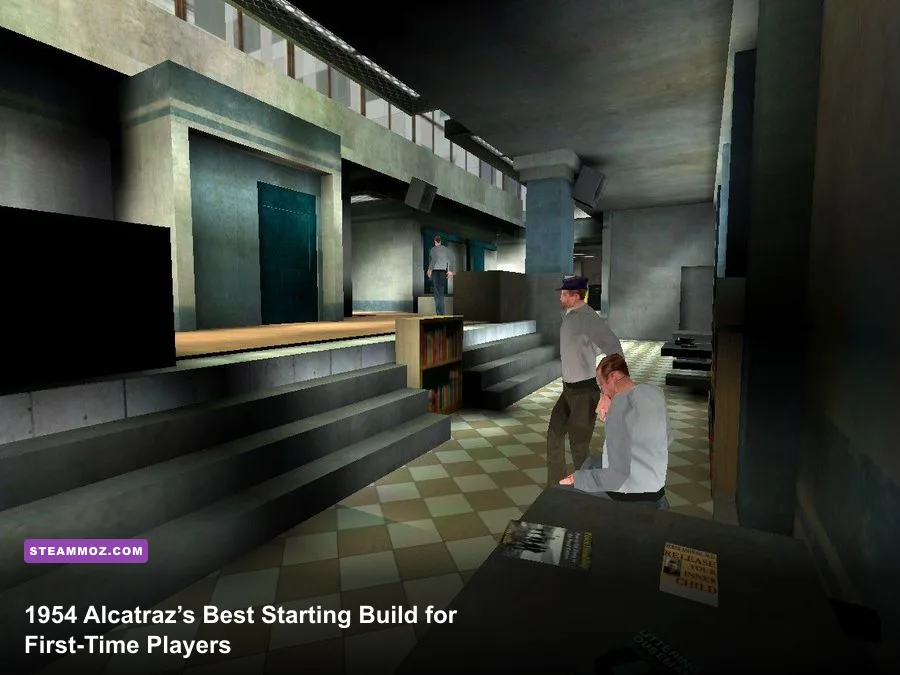
The best starting build for 1954 Alcatraz is a two-character, low-risk investigation route: play Joe as a patient observer, switch to Christine whenever the story opens her scenes, exhaust every safe dialogue option, and combine only clearly related items before testing risky actions. There are no stats, skill trees, weapons, or selectable classes here, so your “build” is really a decision-making strategy designed to preserve clues, avoid dead-end thinking, and uncover the strongest escape path on a first playthrough.
1954 Alcatraz is a narrative point-and-click adventure from Daedalic Entertainment and Irresponsible Games. It follows convict Joe Lyons inside Alcatraz and his wife Christine outside the prison as both struggle against criminals, police pressure, and an escape plan that can collapse through a single bad choice. That makes beginner advice slightly different from a normal RPG build guide. You are not stacking Strength or choosing between a stealth tree and a combat tree. You are managing information, timing, inventory logic, and the consequences of what Joe and Christine say to the people around them.
If you want the cleanest first run, use the official 1954 Alcatraz Steam page as your baseline for supported features, then treat this guide as a practical route plan. Players familiar with demanding puzzle adventures may also appreciate Steamoz’s advice on building for survival in Crawls; the same principle applies here, even though the tools are conversation and observation rather than armor and damage.
The Best Beginner Build at a Glance

The strongest opening approach is the Patient Investigator. It prioritizes complete scene examination and reversible choices instead of rushing toward the first apparent escape solution. Joe should handle prison-side exploration and anything involving his knowledge of the facility. Christine should handle outside contacts, errands, and social situations where a wrong tone can create trouble. You do not manually distribute points, but you can absolutely make decisions that function like a build.
| Build Element | Recommended Choice | Why It Works | Beginner Mistake to Avoid |
|---|---|---|---|
| Primary mindset | Investigate first, commit second | Important clues are often revealed by optional interactions | Clicking the obvious objective immediately |
| Joe’s role | Prison-side observer and planner | His scenes establish access, routines, and escape logic | Assuming every suspicious object is usable immediately |
| Christine’s role | Social infiltrator and outside fixer | Her conversations expand the plan beyond Alcatraz | Choosing aggressive dialogue before learning context |
| Inventory policy | Keep related objects together | Most combinations follow a visual or narrative clue | Combining everything randomly |
| Choice policy | Save before major conversations | Some decisions close off information or alter later scenes | Relying on one autosave |
This route is deliberately conservative. It may take a few extra minutes per chapter, but it prevents the most common beginner frustration: reaching a puzzle with no idea why an item matters because an earlier optional interaction was skipped. The game’s challenge is less about twitch skill and more about building a mental map of who knows what, who can be trusted, and which objects belong to the same problem.

🎮 1954 Alcatraz
Looking to experience this game? Grab your digital key directly on our store for $0.99.
View on Steammoz Store →How Joe and Christine Actually Work

The game’s defining mechanic is the split between Joe and Christine. Joe is incarcerated, watched, and constrained by the physical layout of Alcatraz. Christine has more freedom of movement, but she faces criminals and authorities who can punish careless decisions. These are not two classes with different damage values. They are two information channels. A detail discovered by one character often explains an obstacle faced by the other.
Joe’s prison-side priorities
With Joe, inspect the cell, nearby fixtures, fellow inmates, guards, and any object that looks too deliberately placed. Talk to people more than once when the conversation changes after an item is found or a new story beat occurs. Joe’s advantage is familiarity. He understands routines and prison geography better than Christine, so his scenes should be treated as the planning phase rather than a race toward escape.
Do not assume that an object is useful simply because the cursor highlights it. Point-and-click adventures often use environmental inspection to deliver atmosphere, foreshadowing, or a clue that becomes relevant later. Read the description, note the wording, and remember where the object is located. If the game lets you revisit the room, do so after a conversation changes the situation.
Christine’s outside priorities
Christine’s route is more socially dangerous. She can investigate leads, make arrangements, and speak with people Joe cannot reach, but her choices can expose the plan. Start conversations neutrally, gather information, and avoid treating every suspicious character as an enemy. The game’s noir tone encourages distrust, yet the safest response is often the one that keeps a contact talking.
A useful rhythm is to complete the obvious safe interactions with one character, switch when the game allows it, and then return after the next story trigger. That loop helps reveal whether Joe’s information changes Christine’s available options or vice versa. For comparison, Steamoz’s Defend the Rook run-strengthening tips cover a very different genre, but its principle of improving a run before taking a risk fits 1954 Alcatraz perfectly.
The First-Hour Progression Route

Your first hour should be about establishing context, not forcing an escape. The opening teaches the game’s language: inspect the environment, use dialogue to expose relationships, and test items only when their purpose makes sense. Follow this sequence whenever the game gives you freedom to explore.
| Stage | What to Do | What You Gain | Risk Level |
|---|---|---|---|
| 1. Establish the scene | Inspect every visible hotspot before leaving | Object descriptions and environmental clues | Very low |
| 2. Clear dialogue | Use all non-hostile conversation options | Names, motives, routines, and access information | Low |
| 3. Check inventory | Read each item description and test obvious pairings | Potential puzzle relationships | Low |
| 4. Change viewpoint | Switch between Joe and Christine when possible | Cross-character context and new objectives | Low |
| 5. Make a commitment | Save before a dangerous conversation or irreversible action | A recoverable decision point | Medium |
The key is to separate information gathering from problem solving. If Joe finds a locked or inaccessible area, do not immediately cycle through every inventory item. First ask what the obstacle represents. Is it a physical barrier, a guard routine, a missing permission, or a clue that Christine must pursue outside? Once you classify the problem, the correct interaction becomes much easier to identify.
Keep a small note of names and locations. That sounds old-school, but it is unusually effective in this game because the story connects prison conversations with outside events. Write down who mentioned a place, which character distrusts whom, and which object was described as unusual. Your notes become a second inventory, and they prevent you from repeating conversations blindly.
Inventory Puzzles Without Random Clicking

1954 Alcatraz rewards thematic logic rather than brute-force experimentation. Before combining two objects, explain the connection in one sentence. “This item repairs that damaged object” is a sensible theory. “Maybe these unrelated objects trigger a hidden solution” is not. Use the first theory, test it, and then revisit the environment if it fails.
Pay attention to descriptions that mention condition, material, ownership, or intended use. A damaged object usually needs a repair solution. A document or photograph usually supports a conversation or identification step. A key-like item may be useless until you learn which lock or routine it relates to. The game rarely expects you to solve a puzzle with an item that has no narrative relationship to the obstacle.
There is also a useful distinction between progress items and context items. Progress items open, repair, reveal, or alter something. Context items explain the world and make later choices clearer. Do not discard the latter mentally just because they do not produce an immediate animation. A conversation clue can be as valuable as a physical tool, especially when Christine needs to judge whether an outside contact is safe.
If you become stuck, use this recovery order: inspect the current area again, speak to every available character, reread inventory descriptions, revisit the last location, and only then try combinations. Avoid clicking every hotspot in a random pattern. That approach can accidentally trigger a scene before you understand the situation, and it teaches you nothing about the puzzle’s logic.
Dialogue Choices and Save Management
Dialogue is not decorative in 1954 Alcatraz. It controls how much information you receive and how dangerous a relationship becomes. The safest opening choice is usually the one that gathers facts without revealing Joe’s or Christine’s full plan. Threats, accusations, and overly confident claims may feel appropriate for a noir story, but they can close doors faster than a failed item combination.
Create manual saves before any conversation that appears to involve an escape arrangement, a criminal contact, a guard, or a major personal decision. Use separate save slots rather than overwriting one file. A practical naming scheme is “Joe-before-contact,” “Christine-before-deal,” or “island-return.” That makes experimentation painless and lets you compare outcomes without replaying the entire chapter.
| Situation | Best First Response | Why | When to Reload |
|---|---|---|---|
| New contact offers help | Ask for details before agreeing | Reveals motive, cost, and hidden conditions | The conversation ends before you understand the deal |
| Guard or authority challenges you | Stay calm and avoid unnecessary claims | Reduces the chance of escalating suspicion | You expose information without gaining anything |
| Criminal threatens Christine | Collect information before provoking them | Context can reveal a safer route | A hostile response removes future options |
| Escape plan advances | Save immediately beforehand | Creates a clean branch point | You want to test a different consequence |
Do not reload every time a response feels imperfect. Consequences are part of the game’s appeal, and some awkward outcomes reveal valuable information. Reload when a choice clearly destroys your objective, skips a clue, or leaves you without a sensible next step. That balance keeps the first playthrough exploratory instead of turning it into a spreadsheet exercise.
Common Beginner Traps and Better Alternatives
The biggest trap is treating 1954 Alcatraz like a conventional stealth game. You are not waiting for a patrol’s exact three-second gap, and there is no combat build that rescues a bad decision. The game wants you to understand the situation before acting. If an option appears dangerous, pause and look for missing context rather than assuming the solution is simply faster execution.
Another trap is ignoring revisitable rooms. New dialogue, inventory items, and story events can change what a familiar scene means. Recheck the environment after a major conversation, after switching characters, and after obtaining a new object. This habit is more reliable than wandering randomly because it ties every revisit to a clear trigger.
Finally, do not judge a choice only by whether it creates immediate progress. A conversation that gives no item may still reveal a relationship or location needed later. That is why the Patient Investigator build outperforms a speed-focused approach for beginners. It creates a strong information base before the game asks you to gamble.
For players who like troubleshooting their adventure setup before starting, Steamoz’s guides on PC crashes and stutter fixes and smooth PC settings are useful general references. They are not 1954 Alcatraz-specific, but stable performance matters in any dialogue-heavy game where a crash can erase an important decision point.
The Final First-Playthrough Checklist
Before committing to a major action, ask four questions: Have I inspected every hotspot? Have both Joe and Christine exhausted their useful conversations? Do I know why this item belongs in this puzzle? Did I create a manual save? If the answer to any question is no, keep investigating.
The best beginner build is therefore simple but powerful: Joe for observation, Christine for outside leverage, dialogue for intelligence, inventory for targeted solutions, and saves before irreversible choices. That approach respects what makes 1954 Alcatraz interesting. You are not overpowering the prison. You are assembling a fragile plan under pressure, one clue at a time.
For more background, check the publisher’s official 1954 Alcatraz game page and the developer information from Irresponsible Games. Start slowly, keep your notes close, and let the story’s consequences teach you how the prison—and the people around it—really works.