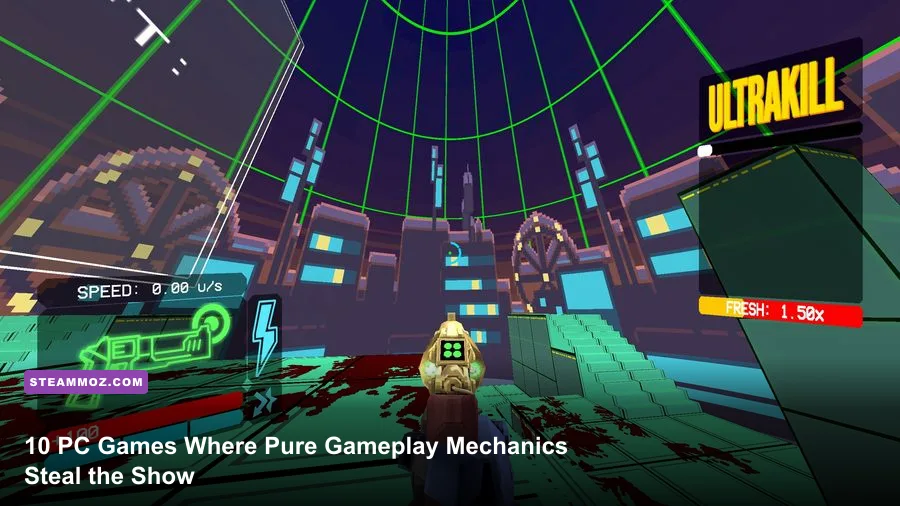
If you judge a game by how thrilling it feels the moment your fingers touch the mouse and keyboard, narrative cinematic fluff takes a backseat to raw mechanical execution. The best PC games with incredible gameplay prioritize microsecond input response, deep kinematic movement, layered physics interactions, and combat loops that reward genuine player skill over stat-padding gear grinds. Whether you are chaining coin ricochets in an adrenaline-soaked arena shooter or timing sub-second deflections against a ruthless boss, these ten titles represent the absolute pinnacle of tactile game feel on PC.
The Gold Standard: Ranking the Top 10 Gameplay-First PC Masterpieces
Gameplay purity lives and dies by feedback loops: telegraphs must be readable, hitboxes must align to the pixel, and control schemes must never fight the player. When hardware runs at 144Hz or higher with unbuffered mouse input, sloppy physics and clumsy recovery frames become painfully obvious. The titles below earned their legendary status because their core loops remain electrifying after hundreds of hours of play.
Before breaking down each genre's specific mechanical triumphs, here is how our top ten PC picks stack up in terms of core loops, mechanical identity, and mechanical skill ceilings.
| Game Title | Primary Genre | Signature Gameplay Mechanic | Skill Ceiling | Optimal Input Device |
|---|---|---|---|---|
| ULTRAKILL | Retro Movement FPS | Coin toss hitscan ricochet & blood-siphon healing | 10/10 | Mouse & Keyboard |
| Sekiro: Shadows Die Twice | Action Combat | Frame-perfect deflection & Posture break fatal strikes | 9.5/10 | Controller / Mouse |
| DOOM Eternal | Arena Combat FPS | Resource triangle (Chainsaw/Flame Belch/Glory Kill) | 9/10 | Mouse & Keyboard |
| Monster Hunter: World | Action RPG | Animation priority, hitstop weight & Guard Points | 9.5/10 | Controller |
| Devil May Cry 5 | Character Action | Style switching, Jump Canceling & Exceed revs | 10/10 | Controller |
| Hades | Isometric Action Roguelite | Dash-strike iframe exploitation & Boon synergies | 8.5/10 | Controller / Mouse |
| Dead Cells | 2D Roguelite Metroidvania | Roll-canceling, breach stun & parry shields | 8.5/10 | Controller |
| Armored Core VI: Fires of Rubicon | 3D Mech Action | ACS Stagger gauge buildup & 3D kinetic energy throttling | 9/10 | Controller / Mouse |
| Returnal | Third-Person Bullet Hell | Active reload Overload & dash projectile intangibility | 8.5/10 | Mouse & Keyboard |
| Risk of Rain 2 | Third-Person Roguelike Shooter | Uncapped exponential item proc-chains & momentum physics | 8/10 | Mouse & Keyboard |
Fast-Twitch Precision: Movement Shooters That Redefine Momentum
No games showcase the lightning reflexes of PC gaming quite like movement shooters, and ULTRAKILL stands as an untouchable masterclass. Its design eliminates regenerating shields and cover mechanics entirely; instead, your primary life-support system is showering in fresh demon blood at point-blank range. Its most iconic mechanical flourish is the Marksman Revolver: flicking an airborne gold coin with an alternate fire lets you shoot that coin with a hitscan beam, redirecting an auto-critical strike directly into the weakest point of a priority target. Advanced players take it a step further by punching their own shotgun pellets right as they leave the barrel—dubbed "Projectile Boosting"—creating miniature nuclear detonations on demand.
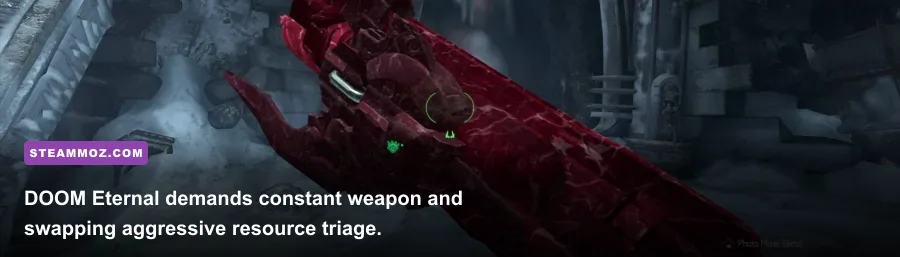
Right alongside it stands DOOM Eternal, which treats high-speed arena combat as a high-stakes resource triage puzzle. You cannot play passive. If your ammo runs dry, your 8-second Chainsaw cooldown refills it. If your armor disintegrates, the shoulder-mounted Flame Belch lights a room on fire to extract armor shards. Low health? Stagger a heavy demon into flashing blue/orange states to trigger a high-speed Glory Kill. When you master quick-swapping between the Super Shotgun, Ballista, and Heavy Cannon Precision Bolt, you bypass weapon reload animations entirely to delete high-tier Tyrants in under three seconds. Just like dialing in high-performance settings for modern military shooters in our Far Cry 6 FPS optimization guide, running DOOM Eternal at high refresh rates reduces input lag to near-zero, transforming mouse aim into a lethal scalpel.
Frame-Perfect Combat: The Rhythm and Weight of Melee Mastery

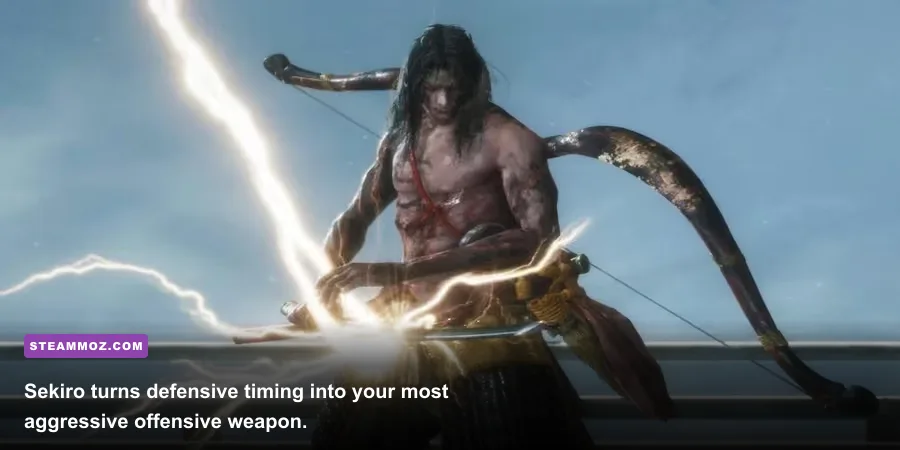
While shooters demand snappy spatial accuracy, melee action masterpieces require absolute mastery of animation frames and rhythm. Sekiro: Shadows Die Twice discards traditional stamina bars to introduce the revolutionary Posture system. In Sekiro, blocking damage is a failing strategy; your primary interaction is the Deflection, which grants an initial 30-frame window (at 60 FPS) that steadily shrinks to a punishing 7 frames if you mash the button. By meeting sword swings in rhythm, you build your enemy's Posture meter until their guard shatters, allowing a brutal Shinobi Deathblow regardless of how much health they have left. Adding the Mikiri Counter—stepping directly onto an unblockable thrust attack with precise forward-dash timing—delivers some of the most satisfying mechanical feedback in video game history.
On the opposite end of the spectrum sits Monster Hunter: World, celebrated for its relentless animation priority and hitstop tactile weight. Unlike floaty arcade slashers, every weapon in Monster Hunter features rigid wind-ups and recovery frames. Swinging a Greatsword requires you to anticipate where a wyvern will land four seconds before it arrives. If you pick the Charge Blade, you transition through a multi-phase system: storing kinetic charge into sword phials, transferring that energy into a fortified shield, executing microsecond Guard Points during weapon morphs, and releasing that stored kinetic energy into devastating Super Amped Element Discharges (SAED). If you appreciate strict frame data and defensive execution, this is the action equivalent of the tight combat mechanics dissected in our Fatal Fury City of the Wolves breakdown.
Meanwhile, Devil May Cry 5 represents the ultimate execution ceiling in character action. Piloting Dante demands real-time style switching between Trickster, Swordmaster, Gunslinger, and Royal Guard across four ranged and four melee weapons without breaking a combo. Through Jump Canceling—using the jump input against an enemy's hitbox to instantly reset animation recovery frames—high-level players suspend demons in mid-air indefinitely, weaving complex juggle patterns that resemble a choreographed martial arts symphony.
Rogue-Lite Perfection: Dynamic Synergy and Infinite Skill Expression

Action rogue-lites live and die by their micro-mechanics. If fundamental movement and weapon handling feel sluggish, repeating the same levels becomes a chore. Hades cracked this formula by marrying instant 8-way directional dash-strikes with generous invulnerability frames (i-frames). Zagreus never feels locked into place; every standard attack can be animation-canceled into an evasive repositioning move. When you layer the Olympian boon network on top—like combining Athena's deflect mechanics with Ares' delayed Doom bursts to trigger the devastating Merciful End Duo Boon—your standard combat loop mutates into screen-clearing explosions of numbers.
For side-scrolling perfection, Dead Cells dominates the 2D plane with absurdly tight roll-canceling and aggressive Breach mechanics. Striking an enemy does not just chip their health pool; every weapon inflicts hidden Breach damage. Surpassing an enemy's poise threshold violently interrupts their attack animation, rewarding relentless aggression. If you pick up a Cursed Sword—where taking a single hit results in instant death—the game shifts into a pure, heart-pounding dance of parry-shield frame windows and aerial stomp interrupts.
Taking this formula into the third dimension, Risk of Rain 2 replaces fixed skill trees with exponential, item-driven procedural chaos. Unlike games that artificially cap proc chances, Risk of Rain 2 lets item effects trigger other item effects infinitely. A single critical shot can trigger an AtG Missile Mk. 1, which detonates a Ukulele's chain lightning, which procs a Will-o'-the-wisp explosion, vaporizing an entire valley of teleporter bosses in a single physics tick. If you enjoy theorycrafting and gear acquisition like hunting the best equipment in our Everspace deluxe upgrade loadout guide, Risk of Rain 2's uncapped item synergies offer endless emergent experimentation.
High-Mobility Mastery: Verticality, Ballistics, and 3D Kinematics
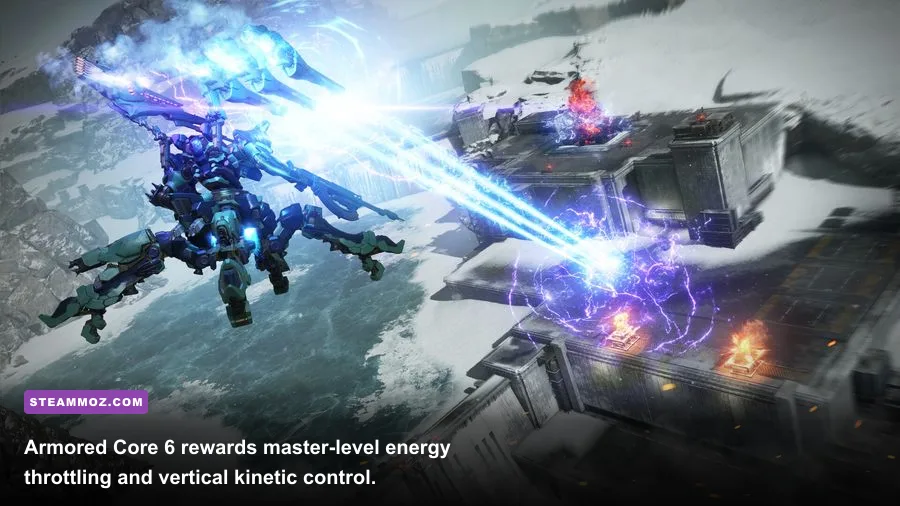
True three-dimensional gameplay shines brightest when mechanics push movement vertically and horizontally across massive scales. Armored Core VI: Fires of Rubicon turns mech customization into an intense tactile combat experience. Your performance relies entirely on managing energy (EN) recharge delays and masterfully using Assault Boost to manipulate engagement ranges. Much like Sekiro, AC6 features an Attitude Control System (ACS) Stagger gauge. By punishing enemy mechs with high-impact kinetic weapons like kinetic shotguns or shoulder-fired needle launchers, you force them into an overloaded stagger state, multiplying direct-hit damage by up to 235%. Navigating dense vertical complexes while throttling booster energy scratches a mechanical itch that fans of spatial navigation—like exploring hidden anomalies in our Everspace 2 secrets guide—will instantly appreciate.
Rounding out the elite ranks is Housemarque's Returnal. Melding bullet hell arcade design with third-person shooter precision, Returnal requires you to dash directly through walls of glowing cyan and crimson enemy fire, exploiting complete projectile invulnerability. Its defining mechanical spark is the Overload system—an active-reload timing ring that rewards hitting your reload button inside a micro-window to instantly clear your weapon's cooldown while boosting damage and projectile speed. With weapons like the Hollowseeker or the Dreadbound (whose shards must physically bounce back to your chassis before you can fire again), positioning dictates your theoretical damage-per-second output.
To experience these complex mechanical systems at their best, you must protect your baseline frame pacing. High execution thresholds mean a single stutter or framedrop can desynchronize a deflection or ruin a jump-cancel input. Applying clean hardware profiles and driver adjustments—similar to our methods for eliminating engine hitches and fixing PC crashes—ensures pure, unfiltered mechanical responsiveness across every mouse flick, parry, and evasive dash.